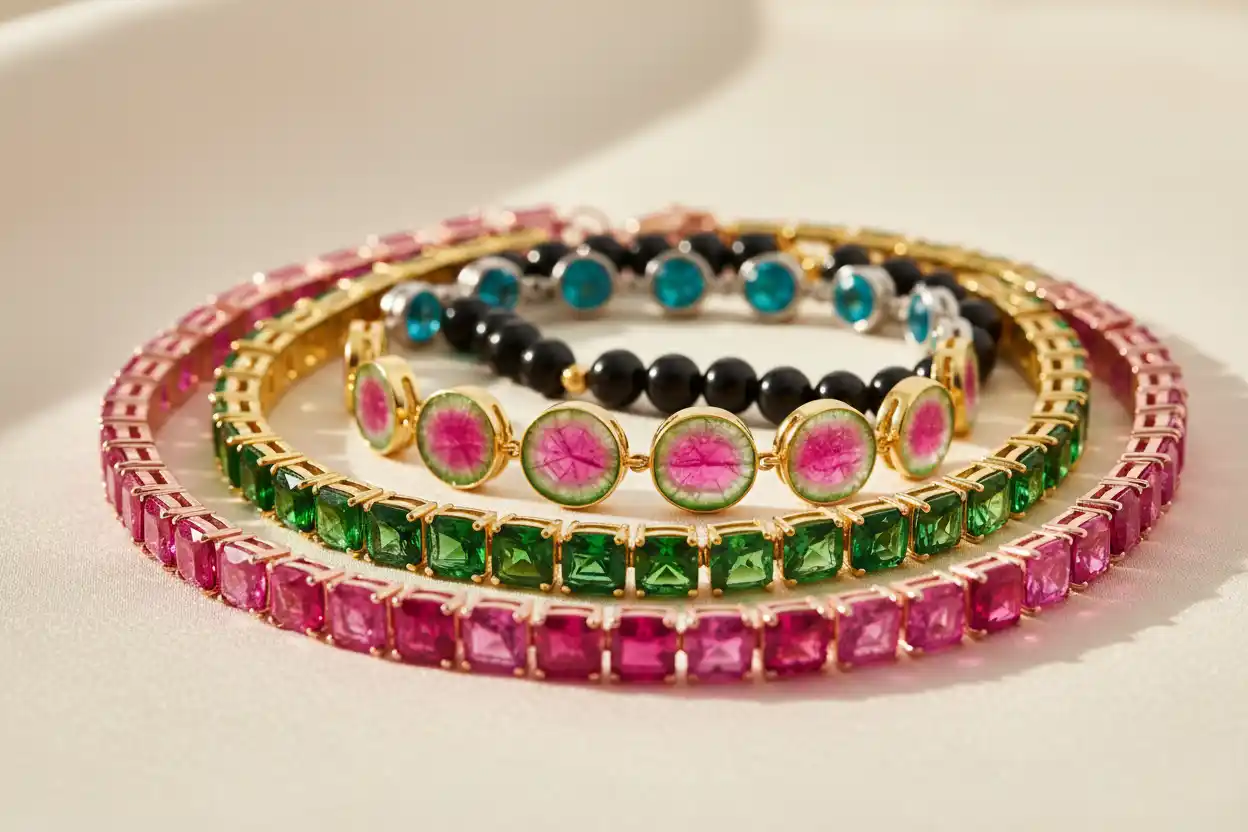
Tourmaline Bracelets: How to Choose and Wear
Tourmaline bracelets can display almost every major gemstone color, from pale pink and vivid green to deep blue, black, yellow, orange and sharply divided multicolor zones. A bracelet may contain one protected center gem, a complete row of calibrated faceted stones or a strand assembled from dozens of polished beads.
This variety makes Tourmaline highly adaptable, but it also creates purchasing challenges. Stones sold under the same family name may differ in mineral species, transparency, inclusion density, treatment, color stability and market value.
Tourmaline has useful jewelry hardness, yet its fair toughness and common internal fractures mean bracelet construction still matters. Secure settings, flexible articulation, clean drill holes, appropriate fit and a dependable clasp should be evaluated alongside color.
Tourmaline Bracelets at a Glance
| Feature | What to Consider |
|---|---|
| Gem family | Borosilicate Tourmaline group |
| Common gem species | Elbaite, Dravite, Uvite and Schorl |
| Typical colors | Pink, red, green, blue, black, yellow, orange and multicolor |
| Mohs hardness | Approximately 7–7.5 |
| Toughness | Fair |
| Pleochroism | Often strong |
| Common bracelet styles | Tennis, line, station, bead, charm, cuff and bangle |
| Best protective setting | Low bezel or substantial individual prongs |
| Common treatments | Heating, irradiation and occasional fracture filling |
| Main bracelet concern | Impact, fractures, weak drill holes and clasp failure |
| Safest cleaning | Warm water, mild soap and a soft brush |
| Birthstone connection | October |
What Is a Tourmaline Bracelet?
A Tourmaline bracelet is any wrist-worn design containing minerals from the Tourmaline group.
Many transparent pink, red, green, blue and multicolor gems are elbaite. The completed Elbaite guide explains that important species without requiring every jewelry page to repeat its detailed chemistry.
Black Tourmaline is usually Schorl, while brown or yellow material may belong to Dravite or another species. Green Tourmaline can include elbaite, Uvite and related compositions.
The broad Tourmaline meaning guide owns family-level mineralogy, formation and symbolism. This article concentrates on bracelet quality, settings, fit and wear.
Is Tourmaline Suitable for Bracelets?
Tourmaline ranks approximately 7–7.5 on the Mohs scale, giving it useful resistance to everyday scratching.
Its toughness is only fair, however. Internal liquid-filled tubes, feathers and surface-reaching fractures can make individual gems more vulnerable than the hardness number suggests.
Bracelets also encounter more hard surfaces than earrings or necklaces. Wrist jewelry regularly contacts desks, tables, doorframes and metal objects.
Small sound stones in protected settings can be worn regularly. Highly included gems, thin slices and projecting points deserve more cautious occasional use.
The completed gemstone hardness chart places Tourmaline relative to Quartz, Topaz, Sapphire and other jewelry materials.
Tourmaline Tennis Bracelets
A tennis bracelet places individually set faceted Tourmalines in one continuous flexible row.
Rounds and ovals are the easiest shapes to calibrate. Cushions create a softer outline, while emerald cuts or baguettes produce a more geometric design.
A premium bracelet should match the stones in hue, tone, saturation, visible dimensions and brilliance. Exact color uniformity is not always desirable, particularly when the design deliberately uses a rainbow progression.
Each link must articulate smoothly. The bracelet should curve around the wrist without twisting, creating hard corners or allowing adjacent girdles to strike one another.
Individual settings provide better separation than a construction in which neighboring stones share too much exposed contact. Shared prongs can look lighter, but one damaged prong may affect more than one gemstone.
A box clasp with at least one secondary safety mechanism is preferable for a valuable continuous line.
Rainbow Tourmaline Bracelets
Rainbow bracelets use several naturally occurring Tourmaline colors.
A successful progression may move through green, blue, yellow, peach, pink and red. Alternatively, colors can repeat in a controlled pattern.
The stones should remain comparable in brightness even when their hues differ. One nearly black green gem or heavily windowed pale stone can interrupt the sequence.
Natural Tourmaline color ranges are broad, but not every intense novelty color is untreated. Written treatment disclosure remains important.
The completed types of Tourmaline guide explains the major species, varieties and trade names. Symbolism by color belongs in the planned Tourmaline color meaning guide.
Tourmaline Bead Bracelets
Beaded bracelets may use translucent polished elbaite, opaque black Schorl, included multicolor material or mixtures of several varieties.
Round beads are the most common. Faceted beads add surface sparkle but expose more edges to abrasion.
Examine every drill hole. Chips, pale stress marks and fractures radiating from the opening can weaken the bead.
Color concentration around drill holes may indicate dye, particularly in unusually intense inexpensive strands.
Beads should be polished evenly, without deep pits or flat areas. Natural inclusions are expected in many varieties, but poor finishing should not be misrepresented as natural character.
Elastic Tourmaline Bracelets
Elastic construction offers convenience but makes the cord the bracelet’s most disposable component.
The elastic should remain proportionate to the bead weight. Large Tourmaline beads need stronger, properly sized material than lightweight glass beads.
Roll the bracelet over the hand rather than stretching it outward forcefully. Repeated overextension weakens the cord.
Replace the elastic when it becomes loose, flattened, discolored or visibly frayed.
Avoid wearing elastic bracelets in hot showers, swimming pools and spas. Heat, chemicals and prolonged moisture can weaken the cord even when the stones themselves appear unaffected.
Knotted Tourmaline Bracelets
Knots between beads reduce direct impact and limit loss if the string breaks.
This construction is especially useful for valuable multicolor, Rubellite or fine transparent bead strands.
The knots should sit closely against the beads and remain consistent in size. Large uneven gaps allow unnecessary movement.
Silk can create an elegant drape but may absorb moisture and cosmetics. Modern synthetic cords can offer stronger resistance, although their quality varies.
Professional restringing is appropriate when the material becomes stretched or soiled.
Wire-Strung Bracelets
Flexible jewelry wire supports a clasp and gives the strand more structure than elastic.
The wire should curve smoothly. Kinks or sharply bent sections can fail after repeated movement.
Crimps must remain secure and should be covered or finished so they do not scratch the wearer.
A heavy strand requires a clasp and connecting rings capable of supporting the complete weight.
Wire-strung construction also makes it easier to incorporate metal spacers, although the spacer edges must remain smooth.
Tourmaline Station Bracelets
Station bracelets place several individually mounted Tourmalines along a chain.
This design uses fewer gemstones than a tennis bracelet and can make each stone more visually distinct.
Bezel-set stations offer good edge protection. They also help maintain the face-up orientation of strongly pleochroic stones.
A station should not flip continually against the wrist. Poor balance can make an attractive front-facing gem appear dull or nearly black during wear.
Adjustable station bracelets are practical gifts, but the extension chain and clasp must still match the weight of the settings.
Tourmaline Charm Bracelets
A charm bracelet may contain one Tourmaline drop, a birthstone charm or several colored stones.
The charm should connect through a soldered or mechanically secure ring. Thin open jump rings can pull apart when caught on clothing.
A compact bezel-set charm is safer than a long exposed crystal point.
Do not place Tourmaline directly beside Diamond, Sapphire or rough metal charms that repeatedly contact its surface.
A charm format is useful when the buyer wants a meaningful color without purchasing a complete matched line.
Cuffs and Bangles
Tourmaline cabochons and faceted stones can be mounted in rigid cuffs and bangles.
A rigid structure controls gemstone orientation and prevents bead-to-bead impact. However, the entire bracelet may still strike hard surfaces.
Low bezels or protected galleries are preferable to high clusters.
Hinged bangles require a well-aligned hinge and secure clasp. Excessive sideways movement can signal wear.
Open cuffs should not be bent repeatedly during use. Continual reshaping weakens the metal and can transfer pressure to the gemstone.
Pink Tourmaline Bracelets
Pink Tourmaline ranges from pale blush and salmon to vivid magenta.
The completed Pink Tourmaline guide owns the variety’s symbolism and broader identity.
Pink and red Tourmalines often contain more visible inclusions than many green or blue stones. The inclusions may be acceptable when they do not create structural weakness or reduce brilliance excessively.
Very pale stones can lose color intensity at small sizes. Rose gold may strengthen their warmth, while white metal creates clearer contrast.
Irradiation may be used to create or intensify some pink colors. Treatment disclosure is therefore important even when the appearance seems natural.
Rubellite Bracelets
Rubellite is the red-to-pinkish-red Tourmaline variety expected to retain attractive red color under different lighting.
Fine Rubellite can be strongly saturated but visibly included. Buyers should distinguish acceptable internal character from open fractures that weaken the gem.
Matching a complete Rubellite bracelet is difficult, particularly when the stones must share both vivid color and similar transparency.
The completed Rubellite price guide explains value factors. The Rubellite buying guide owns the detailed loose-stone purchasing process.
Green Tourmaline Bracelets
Green Tourmaline covers yellow-green, forest green, blue-green and deep emerald-like colors.
Verdelite is a common trade name for green Tourmaline, particularly green elbaite.
Strong pleochroism can make a stone bright from one direction and extremely dark from another. Bracelet stones should be cut and set so their face-up appearance remains lively.
A dark stone should not be judged only beneath an intense spotlight.
Green Tourmaline generally has a higher clarity expectation than Rubellite, although individual material varies.
Yellow and white metals both work well. Yellow gold emphasizes warmer greens, while white metal highlights blue-green colors.
Indicolite Bracelets
Indicolite is blue, violetish blue or greenish-blue Tourmaline.
Fine blue material can be rare, while dark stones may show heavy extinction.
Strong pleochroism and a dark crystal axis make cutting orientation especially important. A bracelet may appear uneven if one stone faces bright blue while the next looks almost black.
The completed Indicolite price guide covers value, while the Indicolite buying guide explains quality and cutting.
White gold and platinum usually strengthen the cool appearance.
Paraíba Tourmaline Bracelets
Copper-bearing Tourmaline can show vivid blue, greenish blue and bluish green colors.
Because fine material is rare and costly, a Paraíba bracelet may use small calibrated stones, a few stations or one central charm rather than a complete large-gem line.
Origin and copper-bearing identity should not be inferred from neon color alone.
The dedicated Paraíba Tourmaline bracelet guide owns construction and matching for this premium variety. General authentication and quality belong in the Paraíba Tourmaline buying guide.
Watermelon Tourmaline Bracelets
Watermelon Tourmaline displays pink and green color zoning, often with a pale band between them.
Beads may show longitudinal bands, while slices display the pink center and green rim more directly.
Thin slices are more vulnerable than compact rounded beads. Drill holes should remain far enough from the edge to avoid cracking.
The dedicated Watermelon Tourmaline bracelet guide handles slice orientation, zoning and bracelet construction. The general variety page is available at Watermelon Tourmaline meaning.
Black Tourmaline Bracelets
Black Tourmaline is usually Schorl and is commonly fashioned into beads.
Opaque black beads should have a smooth polish and clean drill holes. Long internal channels, rough pits and surface-reaching fractures can weaken the strand.
Natural Schorl may show vertical striations when the original crystal surface is retained.
Glass, dyed stone and plastic can imitate a polished black appearance. The planned where-to-buy Black Tourmaline guide will own seller and authenticity checks.
Black Tourmaline is less rare than fine transparent color varieties, so price should reflect workmanship rather than exaggerated scarcity claims.
Multicolor and Bicolor Stones
Some faceted Tourmalines display two or more colors within one gem.
The zoning should be oriented deliberately. A sharp pink-green division can become the central feature, while muddy boundaries may look less intentional.
In a bracelet, every multicolor gem does not need identical zoning. However, the direction and proportions should create a coherent design.
Long emerald or rectangular cuts often follow the growth of the original crystal and preserve color sections.
The setting must protect thin corners and avoid obscuring the most attractive boundary.
Cat’s-Eye Tourmaline Bracelets
Parallel growth tubes can produce chatoyancy in Tourmaline.
Cat’s-eye material is cut as a cabochon so the reflected band appears across the curved surface.
Green, blue and pink cat’s-eye Tourmalines occur. The eye is commonly softer than that of fine cat’s-eye Chrysoberyl.
A bracelet should orient the eyes consistently. Randomly angled bands make the row appear poorly assembled.
Cabochons need secure low bezels or substantial prongs, particularly when the material is heavily included.
Evaluating Color
Color is usually the first quality factor.
Bright, attractive saturation is desirable, but excessive darkness can hide brilliance. Earthier olive, brown, gray and muted colors may still suit a particular design.
Judge a bracelet in daylight-equivalent light and ordinary indoor conditions. Strong retail lighting can make dark stones appear brighter.
Color consistency matters in uniform bracelets, while deliberate variation matters in rainbow designs.
The completed Tourmaline price guide explains why different color varieties can occupy entirely different market levels.
Evaluating Clarity
Clarity expectations depend on color variety.
Red and pink Tourmalines commonly contain visible liquid-filled tubes and fractures. Green and blue material is often expected to look cleaner.
A visible inclusion is not automatically unacceptable. Structural position matters more than presence alone.
Fractures reaching a girdle, drill hole or prong contact point deserve particular caution.
Fracture filling with oils or resins can make cracks less visible. Such treatment should be disclosed because it changes cleaning and repair requirements.
Evaluating Cut and Matching
Tourmaline crystals frequently grow as long prisms, encouraging elongated cuts.
Emerald cuts, long cushions, ovals and rectangular shapes can preserve weight effectively.
Strong pleochroism means cutters must consider crystal direction. A deep green or blue stone can look nearly black when oriented poorly.
In a bracelet, the stones should be matched face-up rather than solely by weight.
Windowing, dark extinction and mismatched cutting styles become especially obvious across a continuous row.
Treatments
Heating can lighten dark stones or alter color. Heat-induced changes are generally stable.
Irradiation can create or intensify some pink, red and yellow colors. Irradiation-related color may be less stable when exposed to heat or intense light.
Fracture filling with oil or resin can improve apparent clarity.
Treatments are not automatically unacceptable, but they should be disclosed and reflected in price.
The completed Tourmaline buying guide owns the detailed evaluation process.
Bracelet Fit
Measure the wrist where the bracelet will sit.
A tennis bracelet should allow comfortable movement without hanging excessively loose. Too much movement increases impact, while a tight bracelet strains links and settings.
Large beads reduce internal circumference. Two strands with the same outside length can therefore fit differently.
Elastic bracelets must pass over the hand without extreme stretching.
Try normal wrist movement before the return period ends. The bracelet should not pinch, rotate constantly or interfere with circulation.
Clasp Security
A box clasp with a secondary safety latch is appropriate for fine tennis and line bracelets.
Lobster clasps work well for lighter station and wire-strung designs.
Magnetic clasps may release unexpectedly and are rarely suitable for valuable Tourmaline suites.
Connecting rings should be soldered or sufficiently substantial.
Open and close the clasp repeatedly. It should engage clearly without looseness or sharp edges.
Wearing Tourmaline With Other Jewelry
Tourmaline can be stacked with gold or silver bangles when direct impact remains limited.
Avoid stacking it tightly against Diamond, Sapphire or Topaz, which can scratch its surface.
Rough metal edges can also abrade polished beads.
A Tourmaline bracelet should not be squeezed between a heavy watch and hard gemstone bangle.
The companion Tourmaline earrings guide and Tourmaline necklace guide offer lower-impact alternatives. The planned Tourmaline ring guide will address hand wear separately.
October Birthstone Bracelets
Tourmaline is one of October’s birthstones, together with Opal.
The completed October birthstone guide explains the calendar tradition and differences between the two gems.
A multicolor bracelet suits recipients who do not have one preferred color. Pink Tourmaline is a familiar gift choice, while green, blue and black offer less conventional options.
The completed October birthstone jewelry guide compares bracelets with rings, earrings and necklaces.
Cleaning Tourmaline Bracelets
Use warm water, mild soap and a soft brush.
Support the bracelet over a bowl or closed drain. Work gently beneath settings and around drill holes, where lotion accumulates.
Rinse briefly and dry thoroughly.
Do not use steam or ultrasonic cleaners. Heat, vibration, liquid inclusions and filled fractures create unnecessary risk.
Avoid soaking elastic, silk, leather, glue or uncertain bead treatments.
The completed guide to cleaning Tourmaline jewelry provides complete instructions.
Storage
Fasten clasp bracelets before storage.
Lay tennis and line bracelets in their natural curve rather than folding them sharply.
Keep Tourmaline away from Topaz, Sapphire and Diamond. It can also scratch softer gemstones.
Store bead strands without stretching the elastic or cord around a permanent display form.
Tourmaline appears in the crystals beginning with T and gemstones beginning with T directories.
Final Perspective
A Tourmaline bracelet should be evaluated as a complete engineered piece rather than a collection of attractive colors. The gems need compatible face-up brightness, sound edges and settings or drill holes that can tolerate wrist movement.
After confirming gemstone quality, inspect articulation, clasp security and fit. A smaller bracelet with well-matched stones and strong construction will usually provide more lasting value than a larger suite assembled from dark, fractured or poorly oriented material.
Frequently Asked Questions
1. Is Tourmaline durable enough for bracelets?
Yes. Tourmaline has a hardness of approximately 7–7.5, but its fair toughness and common inclusions still require sensible protection.
2. Which Tourmaline bracelet style is safest?
A low station bracelet with individually bezel-set stones offers strong protection. A well-constructed tennis bracelet can also work.
3. Can Tourmaline bracelets be worn every day?
Careful regular wear is possible. Remove them for exercise, cleaning, gardening and work involving hard surfaces.
4. Why do Tourmaline bracelet stones sometimes look different as the wrist moves?
Tourmaline is strongly pleochroic, so color and darkness can change with viewing direction.
5. Are pink Tourmalines usually included?
Pink and red varieties commonly show more visible inclusions than green and blue Tourmaline.
6. Are rainbow Tourmaline bracelets naturally colored?
Many natural colors exist, but heating, irradiation and dye can also alter appearance. Treatment disclosure remains important.
7. Is Paraíba Tourmaline appropriate for bracelets?
Yes, although its rarity and value make protected settings and laboratory documentation especially important.
8. Are Watermelon Tourmaline slices durable in bracelets?
Thin slices can crack around edges and drill holes. They require more protection than compact beads or cabochons.
9. How should an elastic Tourmaline bracelet fit?
It should roll over the hand without extreme stretching and rest without constant tension.
10. Can Tourmaline bracelets be cleaned ultrasonically?
No. Warm soapy water is recommended because inclusions, fractures and treatments may react poorly to vibration.
11. Does a Tourmaline bracelet need a laboratory report?
Routine commercial strands may not. Reports become useful for valuable Paraíba, Rubellite, Indicolite or unusual natural-color suites.
12. How should a Tourmaline bracelet be stored?
Keep it in a padded compartment, laid in its natural shape and separated from harder gemstones.