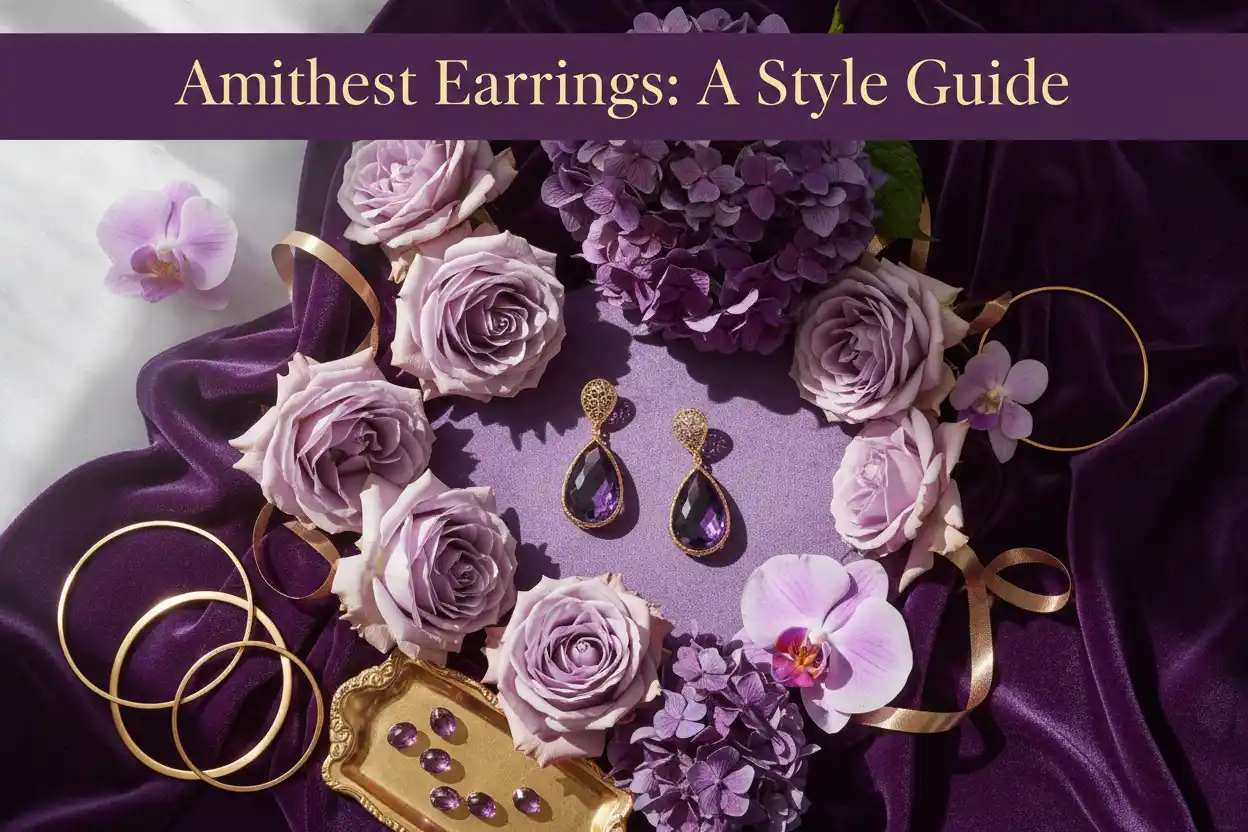
Amethyst Earrings: Styles, Settings & Buying Tips
Amethyst earrings place quartz’s violet-to-purple color close to the face, where differences in saturation, undertone, cut, movement, metal color, and pair matching become more noticeable than they might in a single pendant or ring. Amethyst is also well suited to earrings from a durability standpoint: it ranks 7 on the Mohs scale, has good toughness, and has no cleavage, while the ear position generally exposes the gemstone to fewer hard knocks than the hands or wrists receive during ordinary wear.
A successful pair of amethyst earrings still depends on much more than two attractive purple stones. Studs need posts and backs strong enough to support the complete earring without tilting forward, drops need secure hinges and connections, briolettes need sound drilled areas, leverbacks must close positively, and every matched pair should look balanced in color, dimensions, face-up size, cut, and visual weight.
Amethyst itself also deserves careful disclosure because natural amethyst, laboratory-grown amethyst, heat-modified quartz, glass imitations, coated materials, and other purple stones can enter the jewelry market. The best amethyst earrings combine attractive gemstones with dependable findings, comfortable weight, appropriate settings, honest material information, and construction suited to the way the pair will actually be worn.
Amethyst Earrings at a Glance
| Feature | What matters for amethyst earrings |
|---|---|
| Gem material | Purple quartz |
| Composition | SiO₂ |
| Mohs hardness | 7 |
| Toughness | Good |
| Cleavage | None |
| Main advantage | Earrings receive relatively little direct impact |
| Common forms | Studs, halos, drops, dangles, huggies, hoops, clusters and briolettes |
| Main quality issue | Matching color, dimensions, cut and zoning across the pair |
| Stud concern | Post strength, back size, stability and forward tilting |
| Drop concern | Total weight, movement, hinges, jump rings and closures |
| Briolette concern | Chips or fractures around drilled tops |
| Common material issue | Natural vs laboratory-grown origin and treatment disclosure |
| Color concern | Very dark stones may lose brightness indoors |
| Care concern | Excessive heat and prolonged intense light can affect color |
| Birthstone association | February |
Why Amethyst Works Especially Well in Earrings
Amethyst earrings take advantage of a jewelry position that protects the gemstone from much of the repeated surface contact experienced by rings and bracelets. A ring may strike a countertop or door handle, while a bracelet constantly moves across desks and clothing hardware; earrings usually remain beside the face, where the main risks are dropping them, snagging hair or clothing, cosmetics exposure, damaged findings, and accidental impact while dressing.
Amethyst’s Mohs hardness of 7 provides useful resistance to ordinary scratching, while good toughness and lack of cleavage make the material practical in prong, bezel, halo, and drop settings. Those properties do not make quartz unbreakable, because pointed cuts can still chip, surface-reaching fractures can expand after impact, and drilled gemstones can fail around weak holes.
The earring format has another advantage: relatively large amethysts are available without automatically creating the extreme cost associated with many rarer transparent colored gemstones. Designers can therefore use substantial ovals, pears, cushions, emerald cuts, or briolettes in amethyst earrings while keeping enough flexibility for precise pair matching.
Matching Matters More in Earrings Than in Most Jewelry
A single amethyst can be attractive even when its color zoning is uneven or its proportions are slightly unconventional, but amethyst earrings place two stones in direct visual comparison. The eye naturally notices when one gemstone looks darker, larger, warmer, cooler, brighter, or more elongated than its partner.
Matching should begin with dimensions rather than carat weight alone. Two stones can weigh exactly the same yet face up differently when one is cut deeper, so length, width, outline, table proportions, and apparent size deserve comparison.
Color requires the same care. One stone may lean red-violet while the other appears blue-violet, or one may contain a dark purple zone near its center while its partner distributes color more evenly. Slight differences can disappear once amethyst earrings are worn on opposite sides of the face, but formal solitaire studs and matched drops should still look intentionally paired rather than coincidentally similar.
For intentionally asymmetrical jewelry, exact matching is unnecessary, although the difference should look deliberate. Pairing a pale lavender pear with a deep-violet cushion can succeed when shape, metalwork, or overall scale ties the design together.
Choosing Amethyst Color for Earrings
Amethyst ranges from very pale lilac and lavender through medium violet to strongly saturated reddish or bluish purple. Deep color can look impressive in photographs, but darkness is not automatically quality; an amethyst that appears richly purple in bright display lighting may become nearly black in ordinary indoor conditions if its tone is excessively dark or its cut produces large areas of extinction.
Medium to medium-dark stones often provide a useful balance between saturation and brightness for amethyst earrings. Light still returns through the gemstone, while the purple remains obvious from normal conversational distance.
Pale lavender amethyst can work particularly well in delicate studs, minimalist bezels, or white-metal settings where the design deliberately favors softness rather than maximum saturation. Conversely, stronger reddish-purple stones can carry more visual presence in yellow-gold drops or formal halo designs.
Color zoning is common in natural amethyst, so turn the earrings under different light directions rather than judging only one static photograph. Pair quality is strongest when zoning appears reasonably coordinated face-up, even if the internal distribution is not identical.
Amethyst Stud Earrings
Studs are among the most practical forms of amethyst earrings because they keep the gemstone close to the lobe, minimize swinging, and work with both small understated stones and larger statement centers. Their apparent simplicity, however, puts pair matching under greater scrutiny because there is little movement or additional design detail to distract from differences between the stones.
Round and cushion amethysts create balanced symmetrical studs, while ovals provide more vertical spread and emerald cuts emphasize broad flashes of purple. A well-cut pair should sit at similar angles and present comparable face-up dimensions.
Setting depth matters with dark material. A deeply enclosed metal cup can make already saturated amethyst earrings appear even darker, while an appropriately open design can allow easier cleaning and a brighter face-up appearance.
Post placement also matters. If a large gemstone is mounted too high or the post sits far from the pair’s center of balance, the stud can droop forward instead of sitting flat against the lobe.
Posts, Friction Backs and Lobe Support
The post and back are structural components rather than minor accessories, particularly when amethyst earrings contain large gemstones or halos. A thin post can bend, while an undersized back may allow a broad stud to tilt even when the earring is not especially heavy.
Friction backs are convenient and effective when properly fitted, but they should grip the post firmly rather than sliding with almost no resistance. Wider support backs can help distribute the load of large studs across more of the lobe and reduce forward droop.
Screw backs add mechanical security because the back must rotate along the threaded post, although they take longer to put on and remove. Threads should turn smoothly without requiring excessive force that could bend the post.
Locking backs use a mechanical release and can combine convenience with security, but dirt, cosmetics, and wear can interfere with moving components. A valuable pair of amethyst earrings deserves periodic inspection of the entire closure rather than attention only to the gemstones.
Drop and Dangle Amethyst Earrings
Movement can make amethyst earrings more visually dynamic because the stones repeatedly change their angle to surrounding light. Ovals, pears, faceted drops, and briolettes work especially well in articulated designs where purple flashes appear as the wearer moves.
Every additional joint introduces another possible failure point. Jump rings should be properly closed, hinges should move without excessive lateral play, and decorative links should not have openings large enough for neighboring components to slip free.
Long amethyst earrings also need to be evaluated by complete weight rather than gemstone carat weight alone. Amethyst is not an exceptionally dense gem, but several large stones combined with heavy gold settings, halos, chain sections, and decorative components can create substantial lobe load.
When shopping remotely, ask for the total weight of each finished earring or the complete pair. Two visually similar designs can feel dramatically different after several hours of wear if one contains much heavier metalwork.
Leverbacks, Hooks and Hinged Findings
Leverbacks are useful for amethyst earrings because the wire passes through the piercing and closes behind the lobe, reducing the chance that a moving drop will simply slip free. A good leverback should close positively without excessive looseness at the hinge.
Open fishhook or French-wire designs are light and elegant but depend more heavily on gravity and wearer awareness. Small silicone or metal stoppers can reduce accidental loss, particularly with valuable amethyst earrings or long drops that move aggressively.
Huggies and hinged hoops should close with a clear, secure action. Check that the post aligns correctly with its receiving section rather than requiring the metal to be forced sideways, because repeated misalignment can weaken the hinge or closure.
No gemstone setting can compensate for a finding that opens unexpectedly. Losing one earring from a carefully matched pair can be especially frustrating because replacing it may require locating another amethyst with similar dimensions, color, zoning, cut, and metalwork.
Briolette Amethyst Earrings
A briolette is typically a faceted drop drilled near its narrow upper end rather than mounted in a conventional prong setting. This format suits amethyst earrings because it maximizes visible gemstone area and allows light and movement to interact with the quartz from several directions.
The drill hole is the key vulnerability. A chip, fracture, or very thin section around the opening can weaken the gemstone, while wire that is too tight or poorly finished may place concentrated pressure on the drilled area.
Inspect both briolettes closely because one damaged drill hole can make an otherwise well-matched pair unreliable. Wire wrapping should support the gemstone rather than squeezing it, and sharp wire ends should never contact the skin or repeatedly scrape the quartz.
Matching briolettes also requires more than matching length. Width, body thickness, faceting, color distribution, drill-hole position, and visual weight all affect whether the two drops hang similarly.
Halo and Cluster Amethyst Earrings
Halo amethyst earrings surround a purple center with smaller accent stones, commonly diamonds or other colorless gems, increasing contrast and apparent size. This style works particularly well with medium or strong amethyst because bright accents can emphasize the center color.
The center stones should match not only each other but also the surrounding halos. Unequal halo diameter, inconsistent accent spacing, or one basket sitting noticeably higher than the other can make a pair appear mismatched even when the amethysts themselves coordinate well.
Cluster designs create a larger visual surface from several smaller gems, but the number of prongs and recesses increases maintenance. Debris from cosmetics, hair products, and skin oils can collect beneath tightly grouped stones and reduce brilliance.
Low-profile clusters generally snag less than tall, highly exposed baskets. If amethyst earrings will be worn frequently with long hair, scarves, lace, or knitted clothing, run a fingertip carefully around the settings to check for sharp or raised areas.
How Cut Changes the Look of Amethyst Earrings
Cut quality strongly influences whether amethyst earrings appear lively or dull. A well-proportioned stone should return light across much of its face rather than showing a large transparent window through the center or extensive areas that remain black from normal viewing angles.
Rounds and cushions can emphasize brilliance, while ovals and pears provide greater visual length. Emerald cuts produce broader flashes and make clarity and zoning easier to inspect, whereas briolettes prioritize movement and surface scintillation.
Pair symmetry deserves special attention. Two pears should have similar shoulder shape, point alignment, and length-to-width proportions, while two cushions should not have obviously different corner profiles.
Because amethyst occurs in comparatively large crystals, poor cutting should not be excused simply because the gemstone is purple. Attractive amethyst earrings should combine pleasing color with proportions that make effective use of that color.
Clarity and Inclusions
Transparent faceted amethyst commonly occurs with relatively high clarity, so obvious fractures, large clouds, cavities, or surface-reaching inclusions can reduce appearance and sometimes durability. A tiny internal crystal or subtle natural feature may have little practical importance, particularly if it is invisible without magnification.
Surface-reaching fractures deserve closer inspection because setting pressure or impact can exploit them. In amethyst earrings, check the material near prongs, corners, points, and drilled areas rather than looking only through the center of each gemstone.
Opaque, included, banded, or chevron material can still make attractive earrings, especially in cabochon and carved designs. The standard should match the intended material: transparent faceted amethyst is judged differently from deliberately patterned quartz where internal banding is the central visual feature.
Settings for Amethyst Earrings
Prongs expose more gemstone surface and often preserve brightness, but each prong must contact the stone securely without sitting so high that it catches hair. Four-prong settings create an open appearance, while additional prongs can provide greater redundancy in larger studs.
Bezels surround the gemstone perimeter and offer excellent protection from snagging and accidental edge contact. They can be particularly useful for everyday amethyst earrings, although thick metal surrounding a very dark stone may make it appear visually smaller or less bright.
Pointed pears and marquises benefit from protection around vulnerable tips. A V-shaped prong or thoughtfully shaped bezel can shield the point without hiding the gemstone.
The amethyst ring guide deals with far greater impact exposure at the hand, which highlights why amethyst earrings can often use more open settings successfully. Even so, security should never be sacrificed merely to expose a little more gemstone.
Earring Weight and Comfort
Comfort is highly personal because lobe anatomy, piercing position, metal distribution, and wearer sensitivity all affect how amethyst earrings feel. A pair that one person considers lightweight may become uncomfortable for someone with stretched piercings or sensitive lobes.
Stud weight should sit close to the ear rather than pulling the front downward. Larger support backs can improve stability, but they cannot fully compensate for an excessively heavy design.
Long drops create leverage as well as static weight. An earring may feel comfortable while the wearer is still but become tiring when walking causes the gemstone and metal to swing repeatedly.
For statement amethyst earrings, complete finished weight is therefore more informative than gemstone size alone. Buyers who intend to wear the pair for weddings, events, or full workdays should prioritize comfort as seriously as color.
Metal Choice and Skin Contact
Yellow gold provides a warm contrast with purple and can emphasize reddish-violet amethyst, while white gold, platinum, and silver create a cooler visual relationship that works particularly well with lavender or blue-violet material. Rose gold can soften the combination when the amethyst shows warmer red-purple undertones.
Metal color is aesthetic, but the alloy touching the piercing is a comfort and disclosure issue. The decorative front may be made from one material while posts, backs, or connecting components use another.
If metal sensitivity is a concern, verify the post and back alloy specifically rather than assuming that a gold-colored or silver-colored surface identifies its composition. Plating can also wear over time, particularly on posts and friction areas.
Natural vs Laboratory-Grown Amethyst Earrings
Laboratory-grown amethyst is quartz produced under controlled conditions rather than formed geologically, and it can have the same basic chemical composition, crystal structure, hardness, and optical properties as natural amethyst. High-quality synthetic material can therefore be difficult to distinguish from natural amethyst using appearance alone.
Laboratory-grown amethyst earrings are not inherently poor-quality jewelry. The important point is disclosure, because buyers should know whether they are paying for natural geological material or manufactured quartz.
Natural-looking color zoning does not always establish natural origin, and very high clarity does not prove a stone is synthetic because natural amethyst can also be remarkably clean. When origin materially affects price, professional gemological examination may be necessary.
The real vs fake amethyst guide separates natural amethyst, laboratory-grown quartz, glass, and other imitations in greater detail without relying on destructive home tests.
Treatments and Color Modification
Heating can change amethyst color, sometimes lightening excessively dark material or shifting suitable purple quartz toward yellow, orange, brown, or greenish appearances. Heat exposure can therefore matter both as an intentional treatment and as an accidental care risk.
Treatment should not be confused with laboratory growth. A treated natural gemstone formed geologically and was subsequently modified, whereas laboratory-grown amethyst was created in a manufactured environment.
Coatings, dyes, assembled products, or other modifications can also occur in purple jewelry, particularly when lower-cost material is being made to resemble richer amethyst. The treated amethyst guide explains the distinctions among treatment, synthesis, and imitation more fully.
For amethyst earrings, seller disclosure should clearly state natural or laboratory-grown origin when known and identify treatments that materially affect appearance, durability, or value.
How Amethyst Earrings Compare With Other Amethyst Jewelry
Earrings are among the lower-impact ways to wear amethyst. An amethyst bracelet receives much more repeated contact with desks and nearby objects, while an amethyst necklace shares the relatively protected upper-body position but introduces chain length, pendant balance, bails, and clasps instead of matched-pair concerns.
These differences matter because jewelry-form advice should follow the object rather than the gemstone name alone. Amethyst earrings demand close pair matching, comfortable total weight, dependable posts or hooks, secure backs, and attention to hair and cosmetics, while the same priorities would be incomplete guidance for a ring or bracelet.
What to Check When Buying Amethyst Earrings Online
Photographs should show both amethyst earrings together under the same lighting conditions. Separate images can make mismatched gemstones appear more similar because exposure, background, camera angle, and editing may differ.
Check the gemstone dimensions rather than relying exclusively on carat weight, then compare cut shape, visible zoning, saturation, and apparent face-up size. For drops, obtain the complete earring length and total weight; for studs, check gemstone diameter, basket depth, post dimensions, and back style.
Construction should also be described clearly. Determine whether hooks are open or closed, whether leverbacks latch securely, whether jump rings are soldered or otherwise protected against opening, and whether large studs include backs capable of stabilizing them.
Ask whether the amethyst is natural or laboratory-grown and whether treatments are known. If price is an important part of the decision, the amethyst price page helps separate gemstone value factors from the additional cost of metal, pair matching, workmanship, and brand.
Avoiding Misleading Quality Labels
Commercial terms such as “AAA,” “AAAA,” “premium,” “royal,” or “investment grade” may be used by sellers, but they do not represent one universally enforced grading system for amethyst earrings. Two retailers can apply the same label to visibly different material.
Evaluate what can actually be observed and disclosed: hue, tone, saturation, zoning, clarity, cut, dimensions, pair matching, natural or laboratory-grown origin, treatment status, setting metal, construction quality, and condition.
A specific description is more useful than an impressive adjective. “Natural amethyst, 8 × 6 mm matched ovals, medium-dark violet, 14K yellow-gold leverbacks” communicates far more than “AAAA healing-grade amethyst earrings.”
Amethyst Earrings as February Birthstone Jewelry
Amethyst is the principal modern birthstone associated with February, making earrings a practical gift because sizing is much less complicated than it is for rings or fitted bracelets. Studs in particular can work across a broad range of personal styles without requiring the buyer to know ring size or exact wrist circumference.
Birthstone status does not determine quality, however. A February label does not tell you whether the gemstones are natural, laboratory-grown, treated, well cut, accurately matched, or securely mounted.
The February birthstone guide covers the broader history and gemstone context, while buying amethyst earrings still requires evaluation of the actual pair.
Cosmetics, Hairspray and Daily Wear
Earrings sit directly beside hair and facial products, so cosmetics exposure is one of their most characteristic care concerns. Hairspray, perfume, styling products, foundation, sunscreen, and skin oils can accumulate on gemstones and behind settings, gradually reducing brightness even when the amethyst itself has not been damaged.
Apply perfume, hairspray, and other products before putting on amethyst earrings, then allow them to dry. This reduces repeated direct coating of the gemstones, posts, backs, hinges, and decorative metal.
Long hair creates an additional mechanical issue because strands can catch around prongs, hooks, chains, and articulated drops. If an earring repeatedly pulls hair, inspect the metal for raised prongs, open jump rings, or rough finishing rather than treating snagging as unavoidable.
Sunlight, Heat and Color Stability
Amethyst should not be stored for prolonged periods in intense sunlight or high heat because some material can fade or otherwise change color. Normal outdoor wear is very different from leaving amethyst earrings continuously on a bright windowsill or inside a hot vehicle.
Excessive heat is particularly relevant during jewelry repair. A jeweler should recognize that the gemstones cannot simply be exposed to uncontrolled torch heat while adjusting nearby metal components.
The gemstone hardness chart provides useful context for scratch resistance, but hardness does not describe heat stability or every other aspect of gemstone durability.
How to Clean Amethyst Earrings
For routine cleaning, lukewarm water, mild soap, and gentle hand cleaning are appropriate for many amethyst earrings. A soft brush can help remove accumulated residue from the pavilion, basket, post, back, and spaces beneath halos, provided the stones and settings are secure.
The complete earring must be considered before choosing a cleaning method. Glued components, antique mountings, plated metals, damaged gemstones, coated material, or other vulnerable additions may require more conservative care than untreated amethyst alone.
Avoid steam when treatment or heat sensitivity is a concern, and do not assume every pair belongs in an ultrasonic cleaner simply because quartz is reasonably durable. Loose settings or heavily fractured stones can turn a routine cleaning session into a gemstone-loss problem.
The detailed guide to cleaning amethyst jewelry explains material-safe cleaning and when hand cleaning is the better choice.
Storing Amethyst Earrings Without Losing or Damaging Them
Store amethyst earrings as a pair in an individual compartment or small soft pouch so harder gemstones and exposed metal edges cannot scratch the quartz. Keep the two earrings positioned so their own posts, hooks, or settings do not scrape against each other.
Stud backs are easy to misplace, particularly when they are removed from the posts during storage. Keeping each back attached loosely to its corresponding post or using a dedicated earring organizer reduces the chance of discovering one missing when the pair is needed.
Long drop earrings should not be packed into a tight tangle because chains and articulated links can kink or become caught around hooks. Allow enough space for them to lie naturally.
For valuable amethyst earrings, inspect settings and closures before important occasions rather than discovering a loose stone, weak hinge, or missing back immediately before wear.
What If You Lose One Amethyst Earring?
Losing one earring is more complicated than damaging a single stone in many other jewelry forms because a replacement needs to coordinate with the surviving piece. Exact carat weight is not enough; dimensions, cut outline, tone, saturation, zoning, metal color, setting style, and overall drop length may all need to match.
For commercial calibrated studs, replacement may be relatively straightforward. Bespoke amethyst earrings containing unusually colored stones, handmade metalwork, vintage findings, or natural briolettes can be much harder to recreate convincingly.
If a pair is expensive or sentimental, secure closures and appropriate backs are therefore not minor conveniences. They protect the value of two coordinated objects whose usefulness as a pair can be compromised when only one is lost.
Amethyst Earrings and Symbolic Meaning
Some people choose amethyst earrings because the gemstone carries traditional associations with reflection, composure, spiritual awareness, protection, and clarity. These meanings can add personal significance to jewelry, particularly for birthstone gifts or milestone pieces, but they are symbolic traditions rather than proven medical effects.
Wearing amethyst earrings should not be presented as a treatment for anxiety, insomnia, pain, addiction, or another health condition. The jewelry can function as a personal reminder or meaningful object without requiring unsupported therapeutic claims.
FAQs About Amethyst Earrings
Are amethyst earrings durable enough for everyday wear?
Yes. Amethyst has Mohs hardness 7, good toughness, and no cleavage, while the ear position receives less impact than rings or bracelets. Secure settings and findings still matter, and amethyst earrings should be removed before situations involving substantial impact, chemicals, or excessive heat.
What is the best amethyst color for earrings?
Medium to medium-dark violet often provides a strong balance between saturation and brightness, although pale lavender and deeper reddish-purple can also be attractive. The best pair should look lively in ordinary lighting rather than becoming nearly black indoors.
How closely should amethyst earrings match?
Formal studs and symmetrical drops should coordinate closely in dimensions, face-up size, tone, saturation, cut, and zoning. Intentionally organic or asymmetrical designs can tolerate greater variation when the difference clearly looks deliberate.
Are dark amethyst earrings more valuable?
Not automatically. Excessively dark amethyst can show large areas of extinction and appear almost black in normal lighting, so a slightly lighter pair with stronger brightness and better matching may be more attractive.
What backs are best for large amethyst studs?
Large friction backs, screw backs, and locking backs can all work when properly fitted. Broad support backs are particularly useful when large studs tend to tilt forward on the lobe.
Are leverbacks good for amethyst earrings?
Yes. Leverbacks are well suited to drops because they close behind the ear and provide more security than an open hook, provided the hinge and locking mechanism remain in good condition.
Are open hooks safe for valuable amethyst earrings?
Open hooks can be worn safely, but small earring stoppers reduce the risk of the hook slipping from the piercing. For expensive or sentimental drops, a closed leverback may provide greater reassurance.
Why do some amethyst studs droop forward?
Large gemstones, heavy halos, poor post placement, small earring backs, or stretched piercings can shift the center of gravity forward. A larger stabilizing back can help when the design itself is appropriately balanced.
Are laboratory-grown amethyst earrings real amethyst?
Laboratory-grown amethyst is manufactured quartz with the composition and crystal structure associated with amethyst, but it did not form naturally underground. It should therefore be disclosed as laboratory-grown or synthetic rather than sold as natural.
Can I identify natural amethyst earrings by color alone?
No. Natural, laboratory-grown, and imitation materials can overlap visually. Strong purple color, zoning, or high clarity cannot individually prove natural origin.
Can amethyst earrings fade in sunlight?
Some amethyst can fade after prolonged intense light exposure. Normal wear is different from leaving the earrings continuously in direct sun, so store them away from strongly illuminated windows and excessive heat.
Can amethyst earrings go in water?
Brief contact with lukewarm water during appropriate hand cleaning is usually acceptable for ordinary untreated amethyst, but the finished earrings may contain adhesives, coatings, plated metals, or delicate components that make prolonged soaking undesirable.
Can I use an ultrasonic cleaner on amethyst earrings?
Some untreated, unfractured amethyst in secure settings may tolerate ultrasonic cleaning, but it is not the safest universal method. Hand cleaning is preferable when treatment, fractures, adhesives, antique construction, or setting security are uncertain.
Why are briolette amethyst earrings more vulnerable near the top?
Briolettes are drilled near a narrow end, which creates a small area that carries the suspended gemstone’s load. Chips or fractures around that hole can worsen as the earring swings, so drilling and wire support need careful inspection.
Are amethyst earrings heavy?
They can range from extremely light studs to substantial statement drops. Comfort depends on the complete finished weight, including gemstones, metal, accents, chains, and findings rather than amethyst size alone.
What should I check before buying amethyst earrings online?
Confirm that photographs show the actual pair together, then compare gemstone dimensions, color, zoning, cut, complete earring weight, total drop length, setting metal, post or hook type, back mechanism, natural or laboratory-grown origin, known treatments, and return conditions.
Choosing Amethyst Earrings as a Complete Pair
Good amethyst earrings succeed because the gemstones and hardware work together. Rich purple color has little advantage if one stone is noticeably darker than its partner, while a beautifully matched pair is still unreliable when posts bend, friction backs slip, leverbacks fail to close, or drilled briolettes contain fractures around their suspension points.
Evaluate the stones first for color, brightness, cut, dimensions, zoning, and appropriate clarity, then examine everything that keeps them on the ears: posts, backs, hooks, hinges, jump rings, baskets, prongs, bezels, and connecting links. Complete weight and lobe comfort deserve equal attention, particularly for long drops or large halo studs intended to be worn for several hours.
When those details are handled well, amethyst earrings make particularly practical use of purple quartz. The comparatively protected ear position reduces impact exposure, amethyst’s durability supports regular jewelry wear, and the stone’s broad color range allows anything from restrained lavender studs to saturated violet statement drops without sacrificing the pair-specific quality that makes well-matched earrings distinctive.