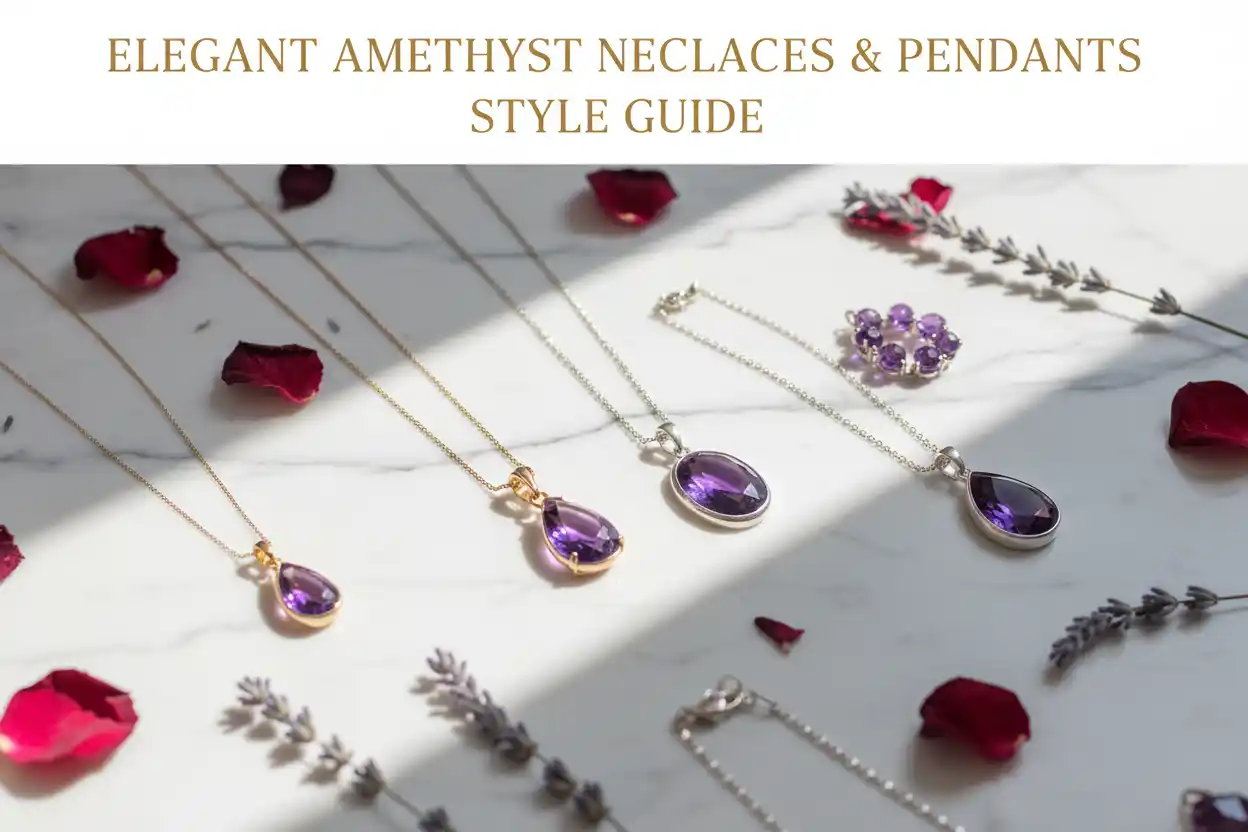
Amethyst Necklace: Styles, Settings & Buying Guide
An amethyst necklace gives purple quartz a particularly favorable place in jewelry because the gemstone normally rests against the upper chest, where it encounters fewer hard knocks than it would in a ring or bracelet, while still remaining visible enough to showcase amethyst’s lavender-to-deep-violet color. That relatively protected position also allows larger gemstones, longer drops, carved pendants, graduated beads, and multi-stone designs to remain practical, provided the setting, bail, chain, clasp, and complete pendant proportions are appropriate.
Choosing an amethyst necklace should therefore involve more than selecting the darkest purple stone or the largest carat weight. Amethyst has Mohs hardness 7, good toughness, and no cleavage, yet quartz can still chip from forceful impact, some amethyst can fade after prolonged intense light exposure, excessive heat can alter its color, and poor necklace construction can fail even when the gemstone itself remains undamaged.
The most useful buying approach is to evaluate the amethyst necklace as one complete piece of jewelry: color and cut determine how the gemstone looks, the setting controls protection and light access, the bail determines how the pendant hangs, the chain carries the load, the clasp protects against loss, and necklace length determines where the entire design sits against the body. Readers looking for the gemstone’s broader geology, history, symbolism, and mineral identity can keep those subjects separate in the amethyst meaning guide.
Amethyst Necklace at a Glance
| Feature | What matters for an amethyst necklace |
|---|---|
| Gem material | Purple quartz |
| Composition | SiO₂ |
| Mohs hardness | 7 |
| Toughness | Good |
| Cleavage | None |
| Main necklace advantage | Less repeated impact than rings and bracelets |
| Common forms | Solitaire pendant, bezel, halo, drop, station, cluster, carved pendant, bead strand |
| Popular cuts | Oval, round, cushion, pear, emerald cut, briolette and cabochon |
| Main color consideration | Strong purple should remain lively rather than becoming nearly black indoors |
| Main pendant concern | Setting security, bail position, balance and flipping |
| Main chain concern | Gauge, construction, clasp and compatibility with pendant weight |
| Main bead concern | Drill holes, cord, knots, bead-to-bead contact and fit |
| Treatment concern | Heat and other modifications should be disclosed where relevant |
| Synthetic material | Laboratory-grown amethyst exists and should be disclosed |
| Main care concerns | Impact, high heat, prolonged strong light and unsuitable cleaning |
| Birthstone association | February |
Why Amethyst Works Well in Necklaces
An amethyst necklace benefits from a combination of useful quartz durability and a relatively protected wearing position. Mohs hardness 7 gives amethyst good resistance to ordinary scratching, while the absence of cleavage removes one predictable breakage direction that complicates the use of some other gemstones in jewelry.
That does not make amethyst indestructible. A sharp pear point can chip, a surface-reaching fracture can worsen after impact, a drilled bead can break around a weak opening, and a heavily exposed pendant can still strike a table, countertop, door, zipper, or another necklace.
The necklace position nevertheless allows designers to use larger stones than many people would comfortably wear on the hand. Because sizable natural amethyst crystals are available, an amethyst necklace can provide substantial visual scale without the steep rarity premium associated with many large rubies, sapphires, alexandrites, or fine tourmalines.
Color versatility adds another advantage. Pale lavender amethyst can suit restrained silver or white-gold designs, while strongly saturated violet can support substantial yellow-gold pendants, halos, and formal pieces. Patterned material such as chevron amethyst can also be used in beads and carvings, with the broader range explained in the types of amethyst guide.
Choosing the Right Amethyst Necklace Style
Different necklace forms create different mechanical demands, so a useful style decision begins with how the jewelry is constructed rather than with a generic fashion list.
| Style | Main advantage | Main point to inspect |
|---|---|---|
| Solitaire pendant | Keeps attention on one amethyst | Bail, setting and pendant balance |
| Bezel pendant | Protects most of the gemstone edge | Excess metal can darken deep amethyst |
| Halo pendant | Adds contrast and apparent size | Accent security and overall proportion |
| Drop pendant | Adds movement and visual length | Hinges, jump rings and flipping |
| Station necklace | Spreads several stones along a chain | Rotation, spacing and chain balance |
| Cluster necklace | Creates strong presence with smaller stones | Matching, prongs and cleaning access |
| Bead strand | Offers large amounts of amethyst economically | Drill holes, cord, knots and clasp |
| Carved pendant | Highlights material and craftsmanship | Thin carved sections and attachment point |
A well-designed amethyst necklace makes the chosen construction look intentional. A solitaire should hang centrally without rotating constantly, a station necklace should not pull to one side, and a bead strand should articulate naturally around the neck rather than forming stiff angles.
Solitaire Amethyst Pendants
A solitaire amethyst necklace concentrates most of the design around one gemstone, which means cut, color, dimensions, and setting quality become immediately visible. Ovals and cushions are common because they offer a broad face-up area, rounds create symmetry, pears produce an elegant directional drop, and emerald cuts emphasize broad flashes of violet rather than rapid scintillation.
The gemstone should appear lively under ordinary indoor lighting rather than only under strong display lamps. An amethyst with very dark tone or excessive extinction may look richly purple in product photography but almost black against clothing.
Carat weight should also be interpreted carefully. A deeply cut stone can carry considerable weight beneath the setting while appearing smaller face-up than a better-proportioned gem of lower weight.
For an amethyst necklace, actual millimeter dimensions are therefore often more useful than carat weight when you are trying to understand how large the pendant will look when worn.
Prong Settings
Prongs expose much of the gemstone and can help an amethyst necklace remain visually open, particularly when the stone already has strong saturation. Four-prong settings are common, while additional prongs may provide greater security for suitable larger shapes.
Security depends on condition rather than prong count alone. A six-prong amethyst necklace with two worn or lifted prongs can be less reliable than a properly constructed four-prong piece.
Check that every prong sits against the gemstone without visible gaps, catches, or irregular alignment. Long hair, knitted clothing, lace, scarves, and fine chains can expose raised prongs quickly because they repeatedly snag on protruding metal.
Pointed pear or marquise shapes deserve additional protection around their tips. A carefully fitted V-prong or protective metal treatment can reduce exposure at the most vulnerable part of the gemstone.
Bezel-Set Amethyst Necklaces
A bezel surrounds all or most of the gemstone perimeter, making it one of the most protective choices for an amethyst necklace. The smooth outline resists snagging and reduces direct exposure of the girdle, which can make a bezel particularly attractive for regular wear.
The trade-off is optical. A heavy, dark, or fully enclosed bezel can make strongly saturated amethyst appear even darker, particularly if the stone is deep and the setting blocks light and cleaning access from behind.
An open-backed bezel can balance these concerns by protecting the perimeter while leaving access beneath the gemstone. This also makes it easier to remove lotion, skin oils, dust, and other residue from the pavilion.
If the amethyst necklace contains a pale stone, reflective yellow or rose gold can also influence apparent color around the edge, so judge the gemstone inside the finished setting rather than imagining how it looked loose.
Halo and Multi-Stone Pendants
A halo amethyst necklace uses smaller surrounding stones to increase contrast and apparent size, often placing colorless gems around a purple center. This can work particularly well with medium-sized amethyst that has attractive saturation but does not need to become physically enormous.
The halo should support the center rather than overwhelm it. Extremely bright accents around weak or grayish amethyst can make poor center color more noticeable, while a proportionate halo can intensify the impression of purple.
Multi-stone pendants introduce matching concerns similar to those found in earrings and bracelets. The stones do not need to be identical in a deliberately graduated design, but differences in tone, cut, shape, and color zoning should appear intentional.
The more gemstones an amethyst necklace contains, the more individual prongs, joints, and recesses need inspection. Elaborate construction can create visual richness, but it also increases the number of places where a loose stone or accumulated debris can become a problem.
Drop and Articulated Amethyst Necklaces
A drop amethyst necklace creates movement by suspending one gemstone or decorative section below another. Pears, briolettes, graduated arrangements, and articulated geometric designs can all use motion to change the way purple color interacts with light.
Every moving connection needs to be mechanically sound. Jump rings should close properly, hinges should articulate without excessive sideways play, and a long drop should return naturally to a forward-facing position instead of continually twisting sideways.
Flipping is especially important when the reverse looks different from the front. A backed setting, elaborate front-only design, or pendant with an unfinished rear surface becomes distracting if normal movement exposes the reverse repeatedly.
Before buying a long amethyst necklace online, check the total pendant drop rather than only the gemstone dimensions. A 15 mm amethyst can still belong to a 40 or 50 mm pendant once the bail, halo, connecting links, and decorative framework are included.
Beaded Amethyst Necklaces
A beaded amethyst necklace has a different durability profile from a faceted pendant because each bead contains drilled openings and the entire strand depends on cord, wire, knots, and clasp construction. Transparent purple beads, translucent material, chevron amethyst, heavily included quartz, faceted beads, and polished nuggets can all be appropriate when they are accurately represented.
Inspect the drill holes wherever they are visible. Chipped rims, cracks extending away from the opening, or rough internal surfaces can weaken beads and gradually abrade the stringing material.
Individual knotting can reduce direct bead-to-bead rubbing and helps limit how many beads scatter if the strand breaks. It is particularly useful for an expensive or sentimental amethyst necklace, although uneven, dirty, or loose knots indicate that restringing may eventually be necessary.
Bead size also changes fit. Large spherical beads project inward toward the neck, so an 18-inch strand made from substantial beads can fit more closely than an 18-inch fine chain.
Chain Length and Where the Pendant Sits
Amethyst necklace length influences appearance, comfort, layering, and how often the pendant interacts with clothing. Exact placement varies with neck circumference, body proportions, pendant dimensions, and neckline, but the following ranges provide useful starting points.
| Approximate length | Typical placement | Often suitable for |
|---|---|---|
| 14–16 inches | High neck to collarbone | Small pendants and close-fitting styles |
| 18 inches | Around collarbone | Versatile everyday solitaires |
| 20 inches | Upper chest | Medium pendants and layering |
| 22–24 inches | Mid-chest | Larger pendants and long drops |
| 28+ inches | Lower chest | Dramatic pendants and long strands |
An 18-inch amethyst necklace is often described as a standard everyday length, but the label is only useful if it places the pendant where you actually want it. A broad collarbone, larger neck circumference, thick bead strand, or long pendant can change the final appearance substantially.
An extender adds flexibility for gifting and changing necklines, although disproportionately heavy hardware can pull the clasp toward the front when the pendant itself is small and light.
Pendant Drop, Balance and Flipping
Pendant balance is one of the most overlooked amethyst necklace considerations. The bail should connect above the center of gravity so the pendant hangs vertically rather than rotating to one side.
Deep stones and tall baskets shift weight away from the body, which can encourage flipping. A pendant that looks perfectly centered when laid flat for photography may behave very differently once gravity and movement act on it.
Side-view photographs are therefore useful when buying an amethyst necklace online. They reveal setting depth, bail orientation, how far the gemstone projects, and whether the back is flat enough to rest naturally against the chest.
A broad, relatively flat pendant generally sits more steadily than a very deep narrow design, although good engineering can make either format wearable.
Bail Size and Construction
The bail connects the pendant to the chain and carries the repeated movement of the complete piece, making it one of the most important structural components of an amethyst necklace.
A removable pendant needs a bail opening large enough not only for the chain but also for the clasp or end ring to pass through. A seller may say that a bail accepts a 2 mm chain, yet a larger lobster clasp at the end may still prevent removal.
Fixed bails should move enough to let the pendant settle naturally without being so loose that the connecting ring wears rapidly. Soldered or securely constructed connections are preferable to thin open rings on valuable jewelry.
A bail that is visually too small can also make a large amethyst necklace appear top-heavy. Proportion matters aesthetically and mechanically.
Choosing the Chain
Cable, box, wheat, curb, rope, and other chain constructions can all support an amethyst necklace when their gauge, alloy, and workmanship suit the pendant. No single chain type is automatically correct for every piece.
A small lavender solitaire can look refined on a delicate chain, whereas a large carved pendant or heavy gold setting generally needs more substantial support. The chain should look intentional rather than barely strong enough to carry the pendant.
Thickness also affects flexibility. Very fine chains can kink or tangle, while heavy chains may dominate a pale gemstone or pull a lightweight pendant into an awkward position.
If the amethyst necklace is expensive, inspect the links closest to the clasp and pendant most carefully because repeated opening, removal, and pendant movement concentrate wear in these areas.
Clasps and Security
A necklace is only as secure as its weakest connection. Lobster clasps, spring rings, box clasps, magnetic closures, toggles, and other mechanisms can all work in appropriate designs, but each involves different trade-offs.
Lobster clasps offer a positive mechanical closure and are common on fine chains, while spring rings suit lighter designs. Box clasps can work well on substantial strands, particularly when a secondary safety mechanism is included.
Magnetic clasps are convenient for people who struggle with small hardware, but a sudden pull can separate them. That convenience may not be the best trade-off for a valuable amethyst necklace worn in crowded environments.
Check the jump rings beside the clasp as carefully as the clasp itself. A strong lobster mechanism attached through a thin open ring is still vulnerable to loss.
Choosing Amethyst Color for a Necklace
Amethyst color ranges from very pale lavender through medium violet to deep reddish or bluish purple, and an amethyst necklace can showcase any part of that range effectively when the setting and design complement the stone.
Fine saturated purple is traditionally desirable, but darkness should not be mistaken for quality. If large portions of the stone appear black in ordinary room lighting, the gemstone may be too dark, excessively deep, or affected by extinction.
Pale stones can look especially attractive in delicate designs because their transparency and soft color remain visible against skin. Darker stones often benefit from open settings and lighter backgrounds.
Color zoning is common in natural amethyst. Skilled cutting can distribute darker and lighter zones attractively, while poorly oriented material may leave one half of a pendant visibly paler than the other.
Cut Quality and Face-Up Size
The cut determines how efficiently an amethyst necklace displays its color. Windowing creates a transparent-looking central area where light passes through without returning effectively, while extensive extinction produces dark areas that remain black from normal viewing angles.
Neither problem should be confused with desirable deep color.
Because amethyst occurs in comparatively large crystals, buyers can reasonably expect balanced cutting rather than accepting poor proportions solely to preserve weight. A well-cut 10-carat gemstone may look more impressive face-up than a deeper 15-carat stone with most of its weight hidden beneath the setting.
When comparing an amethyst necklace online, use millimeter length and width together with carat weight. Finished pendant dimensions matter even more because halos, bails, frames, and decorative drops change the apparent scale substantially.
Clarity and Inclusions
Transparent faceted amethyst is widely available with good clarity, so large distracting inclusions are generally unnecessary in conventional fine jewelry. Small internal crystals or subtle natural features may have little visible effect, particularly when they are difficult to see without magnification.
Surface-reaching fractures deserve more attention because impact or setting pressure can exploit an existing weakness. Examine the girdle area and the gemstone immediately beneath prongs whenever photographs allow.
Included, translucent, chevron, or opaque amethyst can still be excellent material for beads, carvings, and artistic pendants. The correct quality standard depends on the type of amethyst necklace rather than on an assumption that every stone must look like transparent faceting material.
Natural, Laboratory-Grown and Imitation Amethyst
Natural amethyst formed geologically, whereas laboratory-grown amethyst is manufactured quartz with essentially the composition and crystal structure expected of amethyst. Synthetic material can therefore provide convincing color, clarity, hardness, and optical behavior.
That means natural origin cannot always be established from appearance alone. An extremely clean amethyst necklace is not automatically synthetic, because natural quartz can also be eye-clean, while color zoning by itself is not absolute proof of natural formation.
Purple glass and other materials can imitate amethyst as well. For valuable jewelry, non-destructive professional testing is more appropriate than destructive scratch or heat experiments, and the real vs fake amethyst guide explains those identification limits separately.
Laboratory-grown amethyst can make attractive jewelry. The important requirement is that it should not be represented as naturally mined material when origin affects what the buyer is paying for.
Treatments and Color Modification
Heat can change amethyst color, including lightening some dark material or moving suitable quartz toward yellow, orange, brown, or greenish colors under particular conditions. Other modifications can also occur in the wider purple-gem market.
Treatment does not automatically make an amethyst necklace undesirable, but disclosure matters when treatment affects appearance, rarity claims, or value. A buyer paying a premium for supposedly untreated natural color should receive accurate information.
Treatment and laboratory growth should also remain separate concepts. A natural gemstone that has been modified after mining is different from laboratory-grown quartz whose crystal itself was manufactured.
The distinctions and identification limitations are covered in the treated amethyst guide.
Comparing Amethyst Necklace With Other Jewelry Forms
An amethyst necklace normally experiences less direct impact than hand jewelry, which allows more freedom with large gemstones, open settings, and elongated drops. An amethyst bracelet has different priorities because wrist movement increases repeated contact with desks, door frames, watches, and other surfaces.
An amethyst ring receives even more concentrated impact exposure, making setting height, prong protection, shank construction, sizing, and daily-wear habits especially important.
Meanwhile, amethyst earrings require matching across a pair, comfortable total weight, dependable posts or hooks, secure backs, and attention to cosmetics and hair.
These differences are why an amethyst necklace should not simply recycle generic jewelry advice. Chain length, pendant drop, bail size, clasp security, flipping, layering, clothing contact, and chain-to-pendant proportion are central to the necklace itself.
Layering an Amethyst Necklace
Amethyst layers well with plain metal chains, but the arrangement should reduce unnecessary contact. Harder gemstones, diamond-edged pendants, rough chain textures, and sharp metal details can repeatedly strike quartz as the necklaces move.
Create enough length difference that separate pendants do not continually occupy the same position. A short amethyst necklace at the collarbone and a longer plain chain may coexist more safely than two pendants hanging directly against one another.
Pendant scale matters as well. Several substantial centerpieces competing in the same area can cause tangling and abrasion even when the visual design seems balanced.
If the amethyst necklace is particularly valuable or sentimental, wearing it alone may be the simplest way to reduce wear.
Clothing Contact and Daily Wear
The chest is relatively protected, but clothing can still affect an amethyst necklace. Metal zippers, sequins, rough embroidery, heavily textured fabric, buttons, and hard decorative elements can scrape or strike a pendant repeatedly.
Long necklaces are especially exposed because they move across a larger area as the wearer walks. A pendant that rests safely against a smooth shirt may swing directly into a belt buckle or desk edge when the wearer bends forward.
Apply perfume, body sprays, sunscreen, and lotions before putting on the necklace, then allow those products to dry. Residue can accumulate on the pavilion, chain, clasp, and settings and gradually make an otherwise attractive gemstone appear dull.
Remove an amethyst necklace before strenuous exercise, swimming, household cleaning, or work involving chemicals and significant impact.
Buying an Amethyst Necklace Online
Begin with realistic photographs. Highly saturated studio images can make purple appear stronger than it will under ordinary indoor lighting, so photographs against neutral backgrounds and more than one lighting condition are useful.
Check the actual gemstone and pendant dimensions rather than relying only on close-up photography. Product images can make a small amethyst necklace appear enormous when there is no scale reference.
Then examine construction: setting type, bail dimensions, chain length, chain gauge, clasp mechanism, complete pendant drop, and whether the pendant is fixed or removable. For bead strands, ask about bead diameter, stringing material, knotting, total length, and clasp.
Material disclosure comes next. Determine whether the amethyst is natural or laboratory-grown, whether treatment is known, what metal or alloy is used, and whether the photographs show the actual piece.
The broader amethyst buying guide covers gemstone selection in more detail, while an amethyst necklace purchase should always return to how the complete object hangs, fits, closes, and withstands normal wear.
Price and Value
Amethyst is comparatively abundant in large clean crystals, so size does not create the same dramatic rarity premium seen in many scarce colored gemstones. This makes a substantial amethyst necklace possible at relatively accessible prices, although fine color, custom cutting, high-quality metalwork, designer attribution, antique importance, and exceptional craftsmanship can increase value considerably.
Color is typically more important than sheer carat weight. Strong but lively purple, attractive zoning, effective cutting, and an appealing face-up appearance can make a smaller gemstone more desirable than a larger dark or poorly proportioned stone.
The chain and setting can also represent a major share of the finished price, particularly in high-karat gold or designer jewelry. A simple silver pendant and an elaborate gold necklace containing a similar amethyst should not be valued as though the gemstone were the only component.
Current valuation factors belong in the dedicated amethyst price guide, where loose-stone price can be separated from finished-jewelry costs.
Amethyst Necklace as February Birthstone Jewelry
Amethyst’s February birthstone association makes necklaces practical gifts because they avoid the precise sizing requirements of rings and fitted bracelets. An adjustable chain also gives the recipient flexibility to accommodate different necklines and layering preferences.
Birthstone status does not establish natural origin, treatment, or quality. A seller describing an amethyst necklace as February jewelry is identifying a traditional association, not providing a gemological grade.
For gifting, it is often more useful to learn whether the recipient prefers pale lavender, rich violet, yellow gold, white metal, minimalist settings, or substantial statement pieces than to chase an undefined “best” grade.
How to Clean an Amethyst Necklace
Routine cleaning should be gentle. Lukewarm water, mild soap, and a soft brush or cloth are suitable for many amethyst necklaces when the gemstone is untreated and the setting is structurally sound.
Focus on the pavilion and setting recesses because skin oils and lotion commonly accumulate behind the stone, reducing brightness. Clean the bail and nearby chain links as well, since these moving connections collect residue.
The complete necklace matters more than the gemstone alone. Glued components, plated metal, antique construction, fracture-filled material, damaged settings, pearls, or other accompanying materials may require a more conservative method.
Steam should be avoided because amethyst should not be exposed to excessive heat, while ultrasonic cleaning is not an appropriate default when treatment, fractures, adhesives, or setting security are uncertain. The full procedure is covered in the guide to cleaning amethyst jewelry.
Sunlight and Heat
Some amethyst can lose color after prolonged exposure to intense light, so an amethyst necklace should not be stored permanently on a sunny windowsill, dashboard, or display that receives strong direct light day after day.
Normal wear outside is different from continuous high-intensity exposure. The practical goal is not to hide amethyst from daylight but to avoid unnecessary prolonged conditions that can alter color.
High heat introduces another concern because it can change amethyst color and abrupt temperature differences can contribute to damage. Jewelers working on the setting or chain should therefore understand that the gemstone should not be casually exposed to torch heat during repair.
Storing an Amethyst Necklace
Store an amethyst necklace separately from harder gems and sharp metal objects, ideally in a soft-lined compartment or individual pouch. Sapphire, ruby, diamond, and other harder stones can scratch quartz when pieces are allowed to rub together.
Arrange the chain loosely rather than tightly coiling it around the pendant, because fine chains can kink and repeated metal-on-stone contact can mark the gemstone or setting.
Long strands should lie flat or follow a relaxed curve when possible. Bead necklaces should not be packed into a small space that forces the cord and drill holes into sharp angles.
Before returning an amethyst necklace to storage, make sure it is dry and inspect the bail, clasp, jump rings, prongs, and chain for changes that could eventually lead to loss.
Symbolism Without Medical Claims
Amethyst has long-standing associations with moderation, reflection, clarity, protection, and spiritual contemplation, which can make an amethyst necklace personally meaningful as a birthstone, heirloom, milestone gift, or intentional piece of jewelry.
Those associations belong to cultural and contemporary spiritual traditions rather than established medical treatment. Wearing an amethyst necklace has not been shown to cure anxiety, treat insomnia, prevent intoxication, regulate hormones, or replace professional healthcare.
A necklace can still serve as a visible reminder to pause, reflect, maintain a personal commitment, or return to a chosen intention. The meaning comes from how the wearer uses the symbol rather than from a guaranteed physiological effect.
FAQs About Amethyst Necklaces
Is an amethyst necklace suitable for everyday wear?
Yes. Amethyst has Mohs hardness 7, good toughness, and no cleavage, while the necklace position generally protects it from more impact than rings or bracelets. Regular wear is practical when the setting, bail, chain, and clasp are secure.
What is the best length for an amethyst necklace?
There is no universal best length, although 18 inches works for many everyday pendants. Neck circumference, pendant drop, body proportions, clothing, and whether the necklace will be layered should determine the final choice.
Is a dark purple amethyst necklace better?
Not automatically. Strong saturation is desirable, but very dark amethyst may appear almost black indoors or contain extensive extinction. A slightly lighter stone with better brightness can be more attractive.
What is the best setting for an amethyst pendant?
Prongs maximize exposure and brightness, while bezels protect more of the gemstone edge and reduce snagging. The best setting depends on stone shape, color depth, intended wear, and how much protection the gemstone needs.
Why does my amethyst pendant flip over?
Flipping can result from bail position, pendant depth, uneven weight distribution, chain interaction, or a center of gravity that sits too far forward. A side view of the pendant often reveals the cause more clearly than a front photograph.
How large should the bail be?
The bail should be proportionate to the pendant and large enough for the intended chain. If the pendant is removable, the opening must also accommodate the chain’s clasp or end fitting.
Can a chain be too thin for an amethyst necklace?
Yes. A very fine chain may be mechanically or visually unsuitable for a large pendant, particularly when the setting adds significant weight. Chain gauge should match the complete pendant rather than gemstone carat weight alone.
Are large amethyst necklaces expensive?
Not necessarily. Large amethyst crystals are relatively available, so substantial gemstones can remain affordable compared with many rarer colored gems. Fine color, precision cutting, precious metal, craftsmanship, brand, and provenance can still increase price substantially.
Is laboratory-grown amethyst suitable for a necklace?
Yes. Laboratory-grown amethyst has the composition and crystal structure of quartz and can be durable and attractive in jewelry. It should simply be disclosed as laboratory-grown rather than represented as naturally mined.
Can you identify natural amethyst from a necklace photograph?
Usually not with certainty. Natural and laboratory-grown amethyst can overlap strongly in appearance, while glass and other purple materials may also imitate the stone. High-value origin questions may require professional testing.
Can an amethyst necklace fade?
Some amethyst may fade after prolonged intense light exposure. Normal wear is different from leaving the necklace continuously in direct sunlight, so store it away from strongly lit windows and excessive heat.
Can I shower while wearing an amethyst necklace?
Removing it is preferable. Soap residue, shampoo, repeated moisture, slippery clasps, and unnecessary wear on the chain and settings provide little benefit to the jewelry.
Can I sleep with an amethyst necklace on?
Removing it before sleep is safer. Chains can tangle, stretch, snag, or place pressure around the neck, while pendants can strike nearby objects or become damaged.
Can I layer an amethyst necklace with other gemstones?
Yes, but avoid allowing harder gemstones or rough metal surfaces to repeatedly strike the amethyst. Different chain lengths help reduce direct contact between pendants.
How should a beaded amethyst necklace fit?
A bead strand should sit comfortably without excessive pressure, but large beads reduce internal space more than a thin chain of the same nominal length. Compare actual fit rather than relying only on the stated circumference.
What should I inspect before buying an amethyst necklace online?
Check gemstone color under realistic lighting, actual dimensions, cut, zoning, natural or laboratory-grown origin, known treatment, setting type, bail opening, complete pendant size, chain length and gauge, clasp construction, metal composition, and return terms.
Choosing an Amethyst Necklace as a Complete Piece of Jewelry
A strong amethyst necklace is not defined by carat weight or purple color alone. The gemstone should have attractive tone and cutting, but the setting also needs to protect it appropriately, the bail must let it hang naturally, the chain should support the complete pendant, the clasp must remain dependable, and the chosen length should place the jewelry comfortably against the body.
Those details become even more important with large stones, articulated drops, bead strands, and valuable metalwork because small construction weaknesses can compromise an otherwise impressive piece. Treatment and natural-versus-laboratory-grown origin should also be disclosed clearly when they affect the buying decision.
When gemstone quality and necklace engineering are evaluated together, an amethyst necklace can take advantage of what purple quartz does particularly well: offer strong color, substantial size, practical durability, broad design flexibility, and enough visual presence for anything from a restrained everyday pendant to a carefully constructed statement piece.