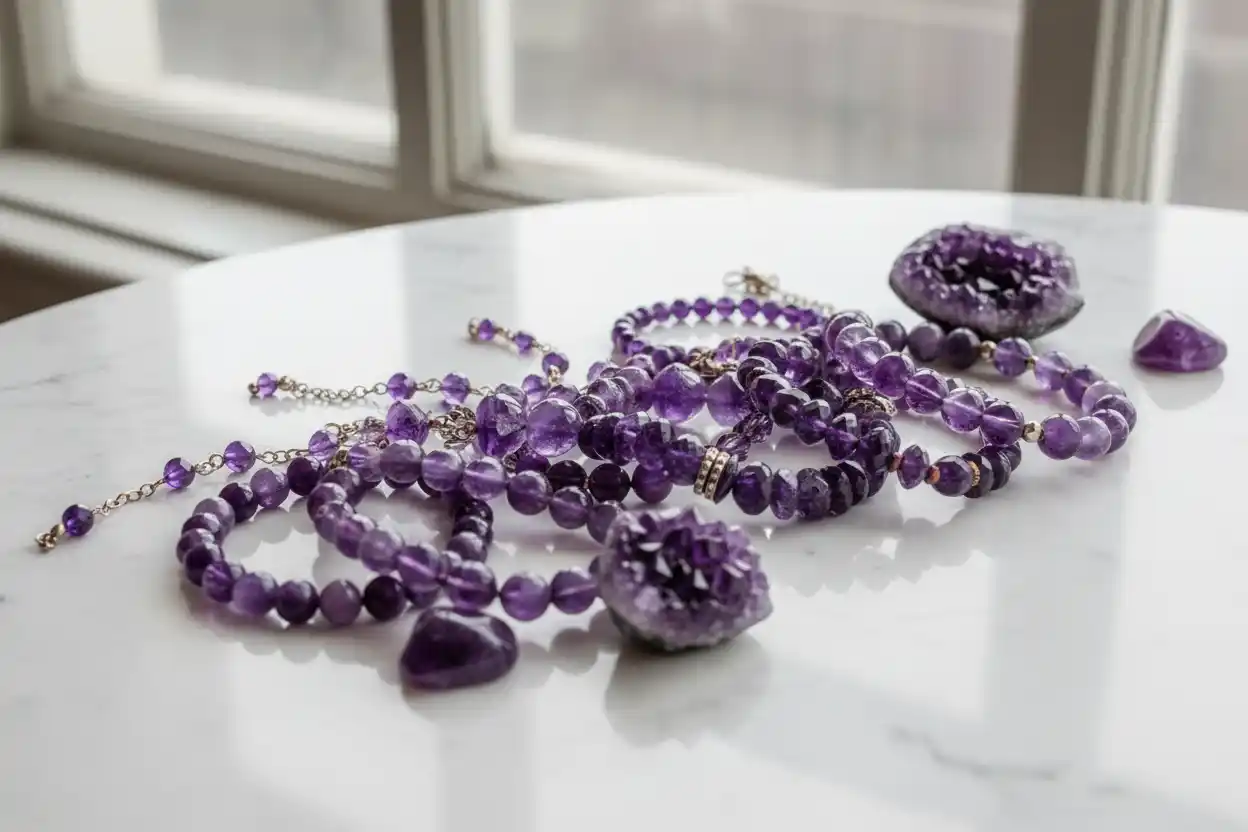
Amethyst Bracelet: Styles, Quality & Buying Tips
An amethyst bracelet puts purple quartz in one of the most demanding jewelry positions, because the wrist repeatedly meets desks, door frames, watch cases, clothing hardware, bags, countertops, and other objects throughout an ordinary day. Amethyst is durable enough for regular jewelry use—it ranks 7 on the Mohs scale, has good toughness, and lacks cleavage—but those properties do not make a bracelet immune to chipped facet edges, scratched polish, damaged drill holes, bent settings, worn elastic, or failed clasps.
Choosing a good amethyst bracelet therefore requires more than finding the deepest purple stones. Bracelet fit determines how much the piece moves and strikes nearby surfaces, bead diameter changes the true internal circumference, articulated links must flex without twisting, prongs and bezels need to protect exposed stones without unnecessarily darkening them, and multi-stone designs require thoughtful matching so one pale or poorly cut gem does not interrupt the entire bracelet.
Amethyst itself also needs proper disclosure. Natural amethyst, laboratory-grown amethyst, heat-modified quartz, dyed material, glass imitations, and other purple stones can all enter the market, and some distinctions cannot be established reliably from appearance alone. The broader amethyst meaning page covers the gemstone’s identity and symbolism, while this amethyst bracelet guide stays focused on wrist-specific construction, wearability, quality, authenticity, buying decisions, and care.
Amethyst Bracelet at a Glance
| Feature | What matters for an amethyst bracelet |
|---|---|
| Gem material | Purple quartz |
| Composition | SiO₂ |
| Mohs hardness | 7 |
| Toughness | Good |
| Cleavage | None |
| Main wrist risk | Repeated impact and abrasion against hard surfaces |
| Common forms | Stretch beads, knotted strands, tennis bracelets, stations, chains, cuffs, bangles and charms |
| Main color range | Pale lavender to strongly saturated violet and reddish purple |
| Common treatment consideration | Heat can alter amethyst color; other treatments occur less commonly |
| Laboratory-grown material | Available and should be disclosed as laboratory-grown |
| Main setting concern | Exposed corners, high settings and loose prongs |
| Main bead concern | Chipped drill holes, worn elastic/cord and abrasive spacers |
| Main fit concern | Too loose increases movement; too tight stresses cord, links and clasps |
| Routine cleaning | Warm water, mild soap and gentle hand cleaning |
| Light/heat concern | Prolonged intense light can fade some amethyst; excessive heat can alter color |
| Birthstone association | February |
Why Amethyst Works Well in Bracelets
Amethyst is considerably more practical for bracelets than many softer gems because quartz provides Mohs hardness 7 and good toughness, while the absence of cleavage means there is no single predictable cleavage direction along which the stone readily separates. GIA considers amethyst suitable for all jewelry types when reasonable care is used, although repeated wear can eventually produce abrasion and the gemstone may require repolishing.
For an amethyst bracelet, however, hardness should never be interpreted as immunity to impact. A faceted stone can still chip at a sharp corner, a bead can fracture around a badly drilled hole, and a forceful blow can damage quartz even when the surface has resisted ordinary scratching.
Bracelets face more exposure than pendants and earrings because the wrist is constantly moving through the environment. That makes the distinction between scratch resistance and impact resistance particularly important, as explained in the gemstone toughness versus hardness comparison.
Amethyst also has a practical design advantage: large clean crystals are available, so makers can create substantial beads or match multiple faceted stones without requiring the extraordinary budget associated with many rarer colored gemstones. This makes the amethyst bracelet unusually versatile, ranging from inexpensive elastic bead strands to carefully matched gold tennis bracelets.
Main Amethyst Bracelet Styles
The best amethyst bracelet style depends on how often it will be worn, how much movement is acceptable, and how much maintenance the construction requires.
| Bracelet style | Main advantage | Main concern |
|---|---|---|
| Stretch bead bracelet | Easy to put on and affordable | Elastic fatigue, drill holes and excessive stretching |
| Strung bead bracelet | Secure construction can be repaired and restrung | Cord wear and clasp quality |
| Tennis bracelet | Continuous faceted color and refined appearance | Prongs, links, articulation and clasp security |
| Station bracelet | Lightweight with less stone-to-stone contact | Stations may flip or catch |
| Chain bracelet | Flexible and easy to size | Connecting rings and gemstone settings need inspection |
| Cuff | Strong visual presence with simple construction | Repeated bending and exposed stone edges |
| Bangle | Structured silhouette | Harder to size accurately and prone to impact |
| Charm bracelet | Personalized and adaptable | Moving metal charms can strike amethyst |
These categories are not interchangeable from a construction standpoint. An amethyst bracelet made from elastic beads may contain excellent stones but fail because the elastic was repeatedly overstretched, while a fine tennis bracelet can lose a gemstone even though the quartz itself remains undamaged if a worn prong opens.
Beaded Amethyst Bracelets
A beaded amethyst bracelet is often the simplest and most accessible form, yet bead quality involves several details beyond color. Each drill hole creates an area where stress is concentrated, so inspect the openings for chips, white fracture lines, rough edges, or cracks extending into the bead.
Poorly finished drill holes can also damage the stringing material from the inside. A cord may look perfect between the beads while gradually being cut where it passes through an abrasive opening, which makes drill-hole inspection especially important on an amethyst bracelet intended for frequent wear.
Round beads should generally roll and articulate smoothly rather than locking together at awkward angles. Nugget and freeform beads naturally vary more, but sharp edges should not repeatedly press against neighboring beads or the wrist.
Color matching is partly a design preference. A deliberately graduated amethyst bracelet can transition from pale lavender to deeper violet beautifully, whereas random differences in saturation may make a strand look assembled from leftovers rather than intentionally matched.
Stretch Amethyst Bracelets and Elastic Quality
Stretch construction is convenient because it eliminates a clasp, but elastic is a consumable component rather than a permanent one. Repeated overstretching, skin oils, chemicals, age, abrasion around drill holes, and the weight of large beads can gradually weaken it.
A stretch amethyst bracelet should expand only as much as necessary to pass over the hand. Pulling the bracelet far beyond its working diameter every time it is worn accelerates fatigue and can also force adjacent beads against one another.
Large beads create another fit issue because they consume more space on the inside of the bracelet. Two bracelets with the same measured outside circumference can fit differently when one contains 6 mm beads and the other uses 12 or 14 mm beads.
If a valuable bead strand begins showing frayed elastic, excessive gaps, a flattened cord, or unusual looseness, restringing it before complete failure is far less inconvenient than recovering scattered beads after the elastic snaps.
Tennis Amethyst Bracelets
A tennis-style amethyst bracelet usually contains a continuous or nearly continuous row of faceted stones joined by articulated metal links. This construction can showcase strong purple color, but it creates dozens of small mechanical connections that should each move correctly.
Flex the bracelet gently in your hands rather than forcing it. The links should articulate smoothly without obvious stiffness, gaps, twisting, or one section repeatedly folding in the wrong direction.
Prongs deserve close inspection because every gemstone typically has multiple small contact points securing it. One badly worn or lifted prong may release a stone even when the rest of the amethyst bracelet looks immaculate.
The clasp matters just as much. A valuable tennis bracelet benefits from a positive-closing clasp and, where the design provides one, an additional safety mechanism. A secure center stone has little value if the entire bracelet can fall from the wrist unnoticed.
Station, Chain and Charm Designs
A station amethyst bracelet spaces gemstones along a chain, reducing the visual and physical density of a continuous tennis design. This can be comfortable for daily wear, although small stations should sit reasonably flat rather than flipping constantly and exposing their metal backs.
Chain styles place greater importance on jump rings, soldered connections, link thickness, and clasp integrity. Check the connection immediately beside each gemstone setting because these areas often handle repeated flexing.
Charm designs require extra caution because moving metal components can strike the amethyst. A hard charm repeatedly colliding with one gemstone may create far more wear than the same two materials would experience if they were kept apart.
If you enjoy coordinating pieces rather than building everything around the wrist, amethyst earrings provide a lower-impact format in which matched color, earring weight, posts, backs, and movement become the primary construction concerns.
Cuffs and Bangles
An amethyst bracelet built as a rigid cuff or bangle behaves differently from an articulated strand. Instead of depending on many links, the structure depends on the rigidity and shape of the metal, which makes accurate sizing particularly important.
A cuff should not need to be opened and squeezed closed aggressively every time it is worn. Repeatedly bending metal can work-harden or distort some designs, loosen mounted stones, and gradually alter the original shape.
A bangle must pass over the widest part of the hand while remaining secure once it reaches the wrist. Buying only from a generic “small, medium, large” label is therefore less reliable than checking actual inner diameter or circumference.
Tall gemstone settings on a bangle can catch on clothing or hit surfaces as the wrist turns. Lower settings usually reduce this exposure, especially when the amethyst bracelet will be worn frequently.
How an Amethyst Bracelet Should Fit
A useful fit begins with wrist circumference, but the final bracelet measurement needs to account for the style and thickness of the components. A thin chain sits closer to its nominal circumference than a strand of large spherical beads because the beads occupy space inward toward the wrist.
For most flexible styles, the amethyst bracelet should move slightly without sliding freely over the hand. Excessively loose jewelry gains momentum before striking a table or desk, while an excessively tight bracelet can place continuous tension on elastic, links, clasps, and drill holes.
Personal preference matters as well. Some wearers prefer a closer fit that stays near the wrist bone, while others want enough movement for a relaxed drape. Either can work if the bracelet remains secure and does not repeatedly strike surrounding surfaces.
When buying online, compare the seller’s stated internal circumference with a bracelet you already wear comfortably rather than relying only on generic size terminology.
Amethyst Color Quality
Color is the most important value factor in amethyst, and origin by itself does not make one stone more valuable than another. GIA notes that amethyst quality is judged primarily by the gemstone itself rather than a country-of-origin premium.
Fine transparent amethyst commonly shows attractive purple to reddish-purple color with enough saturation to appear rich without becoming so dark that the stone looks black in ordinary indoor lighting. Pale lavender material can be equally appealing in lighter, modern jewelry, but it occupies a different visual style from strongly saturated violet.
An amethyst bracelet presents another complication: several stones are viewed simultaneously. Even if each gem looks attractive alone, mismatched tone or zoning may become obvious when a dozen stones sit next to one another.
For a deliberately matched bracelet, compare the gems under neutral daylight and ordinary indoor light. One very dark stone among medium-purple neighbors can interrupt the visual rhythm, while extreme light-dark alternation should appear intentional rather than accidental.
Color Zoning in Amethyst Bracelets
Natural amethyst often shows areas of lighter and darker purple within the same crystal. Skilled cutting can distribute that zoning attractively, but poorly positioned zoning may leave one half of a gemstone noticeably pale while another appears dark.
In a multi-stone amethyst bracelet, orientation matters because similarly zoned stones may look inconsistent if each one is turned differently. A carefully matched tennis bracelet will often coordinate not only overall color but also how that color appears face-up.
Beaded material can use zoning more creatively. Chevron, banded, or intentionally variegated amethyst does not need the visual uniformity expected from transparent faceted stones because pattern variation is part of the design.
Clarity, Inclusions and Surface-Reaching Fractures
Transparent amethyst commonly occurs clean enough that obvious distracting inclusions are not necessary for natural appearance. An eye-clean amethyst bracelet is therefore entirely plausible and should not be assumed synthetic merely because the stones look clear.
Small internal inclusions can be harmless, but a fracture that reaches the surface deserves more attention on a bracelet because repeated impact and setting pressure can exploit an existing weakness.
Inspect transparent stones from several angles if possible, particularly around the girdle and underneath prongs. In a beaded amethyst bracelet, examine the material around each drill hole because fractures in that area experience tension whenever the strand bends.
Heavily included or opaque amethyst can still make attractive beads, cabochons, and artistic pieces. The appropriate standard depends on whether the internal features are part of the intended look or simply reduce durability and polish.
Cut Quality in Faceted Amethyst Bracelets
Amethyst is often available in enough size that cutters do not have to sacrifice every proportion simply to retain weight, so buyers should expect a reasonable face-up appearance. A gemstone that is excessively deep may hide carat weight beneath the setting, while a shallow poorly proportioned stone can show a transparent-looking window through its center.
Dark extinction is another concern. Strongly saturated amethyst can look impressive under jewelry-store lighting yet lose brightness when worn indoors, particularly if the setting blocks additional light from reaching the pavilion.
Round, oval, cushion, emerald, pear, and other cuts can all work in an amethyst bracelet. Pointed shapes such as pears and marquises require greater protection at the tips, while step cuts reveal zoning and clarity more readily than highly scintillating brilliant-style cuts.
Evaluate how the entire row performs rather than becoming fixated on one stone. A tennis bracelet succeeds visually when its gemstones work as a coordinated sequence.
Settings: Prongs, Bezels and Protected Edges
Prong settings allow considerable light around a faceted gemstone, but they also expose more of the girdle and rely on several small pieces of metal remaining correctly positioned. On an amethyst bracelet, inspect every prong rather than only those around the largest or central stone.
Bezels surround most or all of the gemstone edge, which provides useful protection and a smooth profile that resists snagging. The trade-off is that heavy or closed metal can visually darken an already deep purple amethyst.
Low-profile settings usually make practical sense for a frequently worn amethyst bracelet because they keep the gemstones closer to the wrist and reduce leverage during accidental impact. Very tall mountings may be visually dramatic but encounter more furniture, clothing, and neighboring jewelry.
The comparison with an amethyst ring is useful because rings experience even more concentrated impact and setting exposure. Bracelet settings still need protection, but their risks come from repeated movement across a broader section of the wrist.
Metal Choice and Hardware Quality
Silver, white gold, platinum, yellow gold, and rose gold can all complement amethyst, so metal color is primarily an aesthetic choice. Cool metals emphasize blue-violet shades, while yellow gold creates a stronger complementary contrast with purple and rose gold can work attractively with reddish-violet stones.
Metal quality also affects mechanical reliability. Thin links, worn hinge pins, open jump rings, weak clasp tongues, and poorly finished prongs can compromise an amethyst bracelet regardless of how attractive the gemstones are.
If metal sensitivity is relevant, verify the actual alloy rather than relying on appearance. White-colored metal could be silver, white gold, platinum, stainless steel, plated base metal, or another alloy with very different properties.
For a higher-value bracelet, construction quality should be visible from the reverse as well as the front. Clean joins, smooth surfaces, secure links, and accessible settings usually indicate more thoughtful workmanship than decorative front-facing details alone.
Natural, Laboratory-Grown and Treated Amethyst
Natural amethyst formed geologically, while laboratory-grown amethyst is manufactured—commonly by hydrothermal growth—but has essentially the same quartz composition and many of the same physical and optical properties. Laboratory-grown material is a legitimate jewelry product when its origin is disclosed clearly.
Separating high-quality synthetic amethyst from natural material can be difficult because both can share hardness, density, refractive index, strong purple color, and excellent clarity. Microscopic growth characteristics, twinning, spectroscopy, and other laboratory methods may be required when natural origin materially affects price.
Heat can also change amethyst color. Depending on the material and conditions, heating may lighten dark purple, remove color, or shift suitable quartz toward yellow, orange, brown, or green appearances; excessive heat can damage color and may affect durability around vulnerable edges.
The treated amethyst page separates treatment from laboratory growth in detail. For an amethyst bracelet buyer, the practical requirement is straightforward: natural versus laboratory-grown origin and any material treatment that affects appearance, durability, or value should be represented accurately.
Real vs Fake Amethyst in Bracelets
Purple glass, dyed quartz or chalcedony, coated materials, assembled products, and other purple gems can imitate amethyst, while laboratory-grown amethyst introduces a different question because it is genuine manufactured quartz rather than a glass imitation.
The real vs fake amethyst identification page covers these distinctions more fully. On a bracelet, drill holes and exposed edges can sometimes reveal suspicious dye concentration or coating wear, while round gas bubbles and curved flow structures may point toward glass.
Do not use destructive scratch, flame, acid, hot-needle, or impact tests on finished jewelry. Natural and synthetic amethyst are both quartz, so scratching cannot separate them anyway, and damaging an authentic bracelet simply to investigate it is an unnecessary loss.
Amethyst Bracelet Price and Value
Amethyst is available in relatively large clean crystals, which helps keep many pieces affordable compared with rarer colored gems. An amethyst bracelet can therefore offer substantial stone size and vivid color without requiring the price escalation associated with ruby, fine sapphire, alexandrite, or certain tourmalines.
That does not mean all amethyst bracelets should cost the same. Color saturation and brightness, consistency across multiple stones, cut quality, natural versus laboratory-grown origin, treatment, bead matching, individual stone size, precious-metal weight, clasp construction, workmanship, brand, and condition can all affect value.
For multi-stone designs, matching creates a real quality factor. Finding twelve stones that coordinate in tone, saturation, dimensions, and cut can require more selection than using one attractive gem in a pendant.
The dedicated amethyst price page addresses current value ranges separately. Be cautious with labels such as “AAA amethyst,” because there is no universal standardized AAA/AA/A grading system for amethyst; individual sellers may define those terms differently.
What to Look for When Buying an Amethyst Bracelet
Begin with the way you intend to wear the bracelet. Someone seeking occasional evening jewelry can reasonably choose a more exposed or delicate design than a person who plans to wear the same amethyst bracelet while working at a desk every day.
Next, evaluate the stones under normal lighting. Look for attractive purple color, sufficient brightness, intentional zoning, suitable clarity, and consistency appropriate to the design rather than accepting highly saturated product photography as proof of quality.
Then examine the construction. Beaded pieces need clean drill holes and reliable cord or elastic; tennis bracelets need secure settings and smooth articulation; chain styles need strong connections; cuffs need appropriate rigidity; and every valuable amethyst bracelet needs a clasp or closure that matches the risk of loss.
Finally, review disclosure. Ask whether the amethyst is natural or laboratory-grown, whether known treatment has been applied, what metal is used, whether photographs show the actual bracelet, and what return options are available if the color or fit differs from expectations.
The amethyst buying guide provides the broader gemstone-quality framework, while bracelet selection should always bring those factors back to wrist fit and construction.
Wearing an Amethyst Bracelet With a Watch
Amethyst and a watch can look attractive together, but constant contact between them may damage one or both pieces. Hard case edges, metal bracelet links, crowns, bezels, and clasps can repeatedly strike or rub the gemstones as the wrist moves.
If you wear an amethyst bracelet beside a watch, leave enough separation that they do not continually collide. A soft, close-fitting bead strand may behave differently from a loose tennis bracelet that slides several centimeters along the wrist.
Stacking also changes wear. Several bracelets may look coordinated, yet gemstones and metal hardware can abrade one another throughout the day.
For a valuable piece, reducing contact is usually preferable to assuming Mohs 7 makes amethyst unaffected by neighboring jewelry.
Coordinating Amethyst Jewelry
Matching every piece perfectly is unnecessary. An amethyst bracelet often looks more natural when its companion jewelry shares the same general metal tone or purple family without being an identical manufactured set.
An amethyst necklace can carry a larger focal stone because the upper chest is less exposed to repeated impact, making it useful when you want a statement gem without adding more weight and movement to the wrist.
Amethyst’s role as the principal modern February birthstone also makes bracelets popular gifts, especially because amethyst spans a broad range of prices and styles. Birthstone labeling, however, tells you nothing about whether the stones are natural, synthetic, treated, well cut, or securely mounted.
Everyday Wear: What to Remove the Bracelet For
An amethyst bracelet is suitable for regular jewelry wear, but the wrist position makes selective removal sensible. Take the bracelet off before weight training, gardening, mechanical work, moving furniture, contact sports, household cleaning, or other tasks that expose it to hard blows and chemicals.
Swimming also introduces unnecessary risk because chlorine can affect some jewelry metals, while the activity itself creates opportunities for impact and loss. Showering exposes the bracelet repeatedly to soap residue and makes slippery clasps easier to lose.
Cooking around strong heat is another poor environment for amethyst. Quartz tolerates ordinary daily conditions, but abrupt temperature change can cause fracture and excessive heat can alter amethyst color.
The gemstone hardness chart places amethyst’s scratch resistance in context with common jewelry gems, which helps explain why it is durable but still benefits from deliberate handling.
Sunlight and Heat
Some amethyst can fade after prolonged exposure to intense light, so an amethyst bracelet should not be left permanently on a sunny windowsill, dashboard, or other location that combines bright light with heat. Normal brief outdoor wear is very different from continuous intense exposure.
Heat deserves separate attention because it can change amethyst color and abrupt temperature shifts can contribute to fracture. This is particularly relevant during jewelry repair, where a competent jeweler should know that mounted amethyst should not simply be exposed to torch heat as though the gemstone were unaffected.
Those stability considerations are one reason color should be judged as part of the material rather than treated as permanently indestructible.
How to Clean an Amethyst Bracelet
Warm water, mild soap, and gentle cleaning are the safest routine approach for most amethyst jewelry. GIA identifies warm soapy water as safe for amethyst and advises against steam cleaning because the gemstone should not be subjected to excessive heat.
For an amethyst bracelet, however, the gemstone is only one part of the object. Elastic, silk or textile cord, adhesives, plated metal, antique settings, fracture-filled stones, and delicate clasps may require more conservative treatment than untreated quartz alone.
A soft brush can help clean beneath secure faceted settings, while beads can usually be wiped gently without prolonged soaking. Rinse away soap residue and dry the piece completely, paying attention to clasp recesses and connections.
Although ultrasonic cleaning may be suitable for some untreated amethyst in sound mountings, it is not appropriate for every finished bracelet, particularly when stones are fractured, filled, dyed, glued, loosely mounted, or combined with vulnerable stringing. Hand cleaning is the simpler default when treatment and construction are uncertain.
The step-by-step amethyst jewelry cleaning instructions separate gemstone-safe cleaning from risks created by treatments and jewelry construction.
How to Store an Amethyst Bracelet
Store an amethyst bracelet in its own compartment or soft pouch rather than tossing it into a container with harder gemstones. Diamonds, sapphires, rubies, and other harder materials can scratch quartz, while metal edges can mark polished beads and faceted surfaces.
Tennis bracelets should be stored without sharply folding or twisting the articulated links. Stretch bracelets should rest without being pulled around an oversized display object, which can keep the elastic under unnecessary tension.
Keep the piece away from prolonged intense sunlight and high heat. A drawer, jewelry box, or cabinet provides a more stable environment than an exposed sunny shelf.
Periodic inspection is worthwhile because bracelet problems frequently begin in the components rather than the gemstones. Look for raised prongs, opening jump rings, worn clasp parts, frayed cord, cracked drill holes, stretched elastic, and links that no longer move normally.
Amethyst Bracelet Meaning
An amethyst bracelet may also be selected for the gemstone’s traditional symbolism, especially themes of calm reflection, clarity, protection, sobriety, and spiritual awareness. Those associations can make the jewelry personally meaningful, but they should remain separate from claims that wearing amethyst medically treats anxiety, insomnia, pain, addiction, or another health condition.
Symbolic meaning does not change the practical requirements of the jewelry. A bracelet used as a reminder for reflection or mindfulness still needs the correct fit, secure construction, honest material disclosure, and appropriate physical care.
FAQs About Amethyst Bracelets
Is an amethyst bracelet good for everyday wear?
Yes. Amethyst has Mohs hardness 7, good toughness, and no cleavage, making it suitable for regular jewelry use. Because bracelets receive frequent impact and abrasion, remove the piece for strenuous manual work and inspect settings or stringing periodically.
Does an amethyst bracelet scratch easily?
Amethyst is reasonably scratch resistant at Mohs 7, but harder gemstones such as sapphire and diamond can scratch it, and long-term wear can gradually abrade facet edges. Store the bracelet separately from harder jewelry.
Can an amethyst bracelet break?
Yes. Hardness measures scratch resistance rather than resistance to every type of damage. Forceful impact can chip or fracture quartz, while bracelet hardware, elastic, cord, links, or clasps can fail independently of the gemstones.
How tight should an amethyst bracelet be?
It should be secure without squeezing the wrist. A small amount of movement is usually comfortable, but excessive looseness increases impact and an overly tight fit stresses elastic, links, clasps, and drill holes.
Why do large amethyst beads make a bracelet fit tighter?
Large beads project farther toward the inside of the bracelet, reducing the space available for the wrist. The nominal circumference therefore does not describe fit as accurately as it does for a thin chain.
Which amethyst color is best for a bracelet?
Strong purple to reddish-purple with attractive saturation and enough brightness to remain lively indoors is traditionally desirable, although pale lavender can be beautiful. In multi-stone bracelets, deliberate color matching is often as important as the color of an individual gem.
Is natural amethyst better than laboratory-grown amethyst for a bracelet?
Both have essentially the quartz composition and durability expected from amethyst. Natural origin may matter more to some collectors and buyers, while laboratory-grown material can provide attractive color and clarity at a lower cost. The important issue is accurate disclosure.
How can I tell if an amethyst bracelet is real?
Color and clarity alone cannot prove natural origin. Purple glass and other imitations may reveal diagnostic clues, while high-quality laboratory-grown amethyst can resemble natural quartz closely enough to require professional testing.
Is heat-treated amethyst still amethyst?
Heat can modify amethyst color, sometimes lightening dark material or shifting suitable quartz toward other commercial color varieties. Treatment should be disclosed when it materially affects what the gemstone is represented or sold as.
Is a bezel setting good for an amethyst bracelet?
Yes. A bezel can protect the gemstone perimeter and reduce snagging, which is valuable on the wrist. Very heavy or closed metal can make dark amethyst appear less bright, so protection and appearance should be balanced.
Are stretch amethyst bracelets durable?
They can be, but elastic gradually ages and can be damaged by overstretching, chemicals, rough drill holes, or heavy beads. Replace weakened elastic before it breaks completely.
Can I wear an amethyst bracelet next to a watch?
You can, but repeated contact between the bracelet and watch can create scratches and impacts. Leaving some separation is safer, especially with faceted amethyst or hard-edged metal watch cases.
Can an amethyst bracelet go in water?
Brief exposure to lukewarm water during appropriate cleaning is generally fine for amethyst, but the complete bracelet may contain elastic, adhesives, plated metal, fragile stringing, or treated stones that make prolonged soaking undesirable.
Can I shower with an amethyst bracelet?
Removing it is preferable. Repeated soap exposure leaves residue, clasps and elastic experience unnecessary wear, and a slippery bracelet is easier to lose.
Can sunlight fade an amethyst bracelet?
Some amethyst can fade after prolonged exposure to intense light. Ordinary wear is different from leaving the bracelet continuously in strong direct sunlight, so avoid long-term display on sunny windowsills or in hot vehicles.
What should I check before buying an amethyst bracelet online?
Check actual bracelet dimensions, fit, gemstone size, color under realistic lighting, natural or laboratory-grown origin, known treatment, metal composition, clasp or elastic construction, drill-hole quality where relevant, and return terms. Product photos should ideally show the actual piece rather than only a generic stock image.
Choosing an Amethyst Bracelet That Will Wear Well
A successful amethyst bracelet combines gemstone quality with mechanical design. Attractive purple color matters, but so do fit, bead diameter, smooth drill holes, reliable elastic or cord, flexible links, protected settings, strong clasps, secure jump rings, suitable metalwork, and honest disclosure about natural, laboratory-grown, or treated material.
The wrist also changes the durability equation. Amethyst is a genuinely practical jewelry gemstone, yet a bracelet receives more repeated contact than earrings or a pendant, so low settings, controlled movement, sensible stacking, and regular inspection materially improve long-term wear.
Choose the amethyst bracelet as a complete object rather than buying only a collection of purple stones. When color, construction, fit, durability, and disclosure all support one another, amethyst can provide the rich appearance of a classic colored gemstone while remaining practical enough for regular enjoyment.