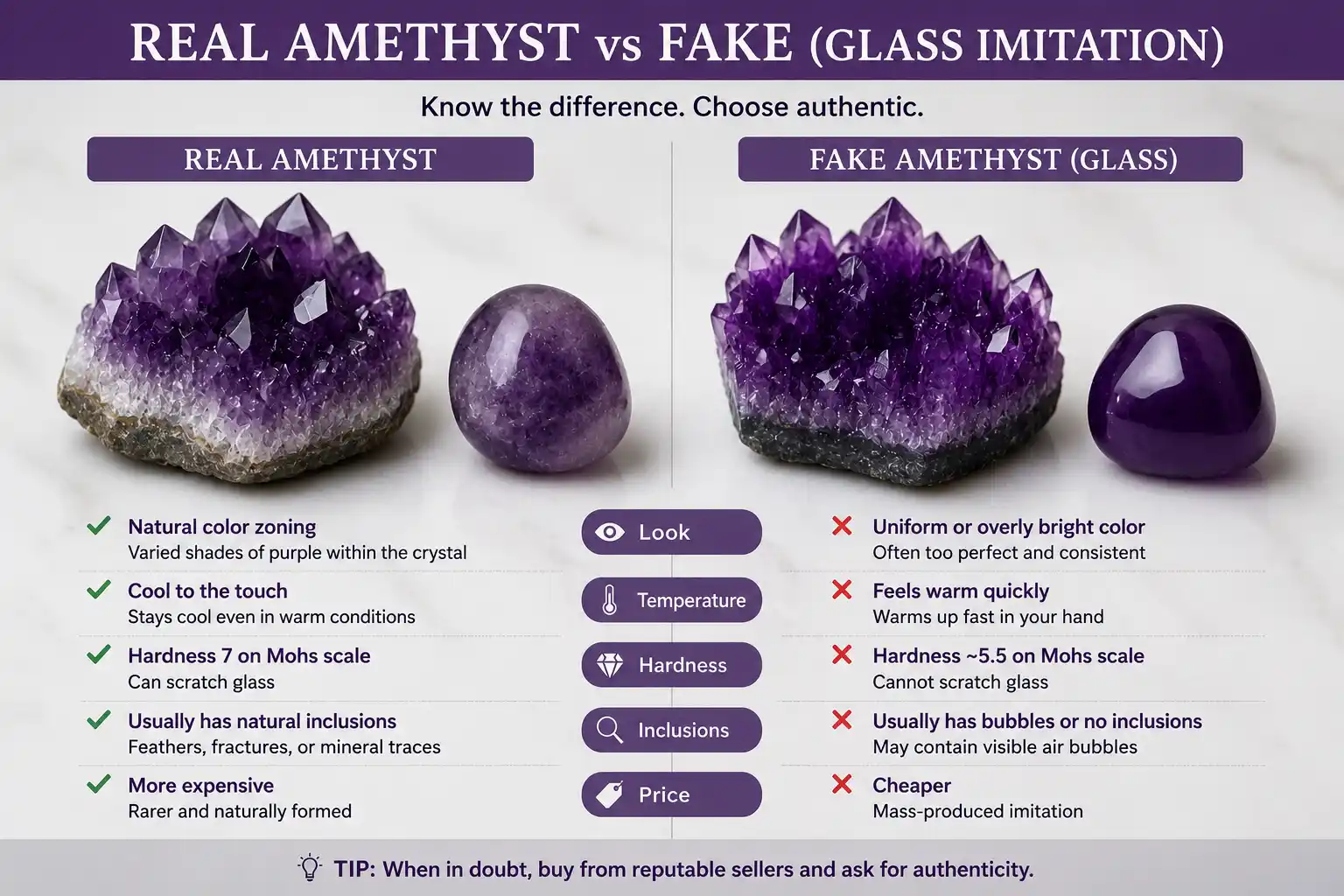
Real vs Fake Amethyst: Natural, Synthetic and Glass Tests
Real natural amethyst is purple macrocrystalline quartz. Its color develops from iron-related defects within the quartz structure combined with natural irradiation and geological history.
The market also contains hydrothermal synthetic amethyst, purple glass, dyed quartz, coated stones, assembled products and other violet gems sold under the amethyst name. Synthetic amethyst is genuine laboratory-grown quartz with essentially the same chemical and physical identity as natural amethyst, but it must not be represented as naturally mined.
Natural-versus-synthetic separation can be difficult because both materials share quartz-range hardness, density and refractive index. High-quality synthetic amethyst may be clean, strongly colored and free from obvious manufacturing clues. Visual inspection can screen for glass and poor imitations, while important stones may require twinning analysis, infrared spectroscopy or trace-element testing.
This page owns the direct authenticity workflow. The treated-amethyst guide retains the complete treatment, synthetic-growth and disclosure boundary.
Natural Amethyst vs Synthetic and Imitation Materials
| Feature | Natural amethyst | Hydrothermal synthetic amethyst | Purple glass | Dyed quartz or chalcedony |
|---|---|---|---|---|
| Material | Naturally formed quartz | Laboratory-grown quartz | Manufactured glass | Natural silica material with artificial color |
| Composition | SiO₂ | SiO₂ | Variable silicate glass | Usually SiO₂-based |
| Mohs hardness | 7 | 7 | Commonly about 5–6 | Depends on host, often near quartz if genuine quartz |
| Refractive index | About 1.544–1.553 | Same quartz range | Often different, though overlap is possible | Depends on host |
| Specific gravity | About 2.66 | About 2.66 | Variable | Depends on host |
| Color zoning | Often angular, sectoral or concentrated toward crystal tips | May be uniform or show growth-related zoning | Usually uniform or accompanied by glass flow | Dye may collect in fractures and pores |
| Twinning | Brazil-law twinning is common in natural material | Often absent or different, though some synthetics can show twinning | None as quartz twinning | Host-dependent |
| Inclusions | Mineral crystals, fluid inclusions, needles, fingerprints and growth features | Synthetic growth features, seed-related structures and occasional inclusions | Round bubbles and curved flow lines | Dye concentrations and host inclusions |
| Best confirmation | Microscopy, polariscope, FTIR and advanced testing | Same laboratory methods | Standard optical testing often separates it | Spectroscopy and treatment examination |
A visually perfect stone is not automatically synthetic. Amethyst commonly forms in large clean crystals, making eye-clean natural gems widely available.
What Is Genuine Natural Amethyst?
Amethyst is the purple variety of quartz.
Its crystal structure, hardness and optical properties match other macrocrystalline quartz varieties such as clear quartz, citrine and prasiolite. The defining feature is purple color.
The amethyst meaning guide owns formation, localities, symbolism and general properties. The types-of-amethyst guide compares deep-purple, pale, banded, chevron, locality-associated and other varieties.
Natural amethyst commonly forms in hydrothermal veins, pegmatites and cavities within volcanic rocks. Large geodes from Brazil and Uruguay may contain hundreds or thousands of well-formed crystals.
Natural Amethyst Color
Natural colors range from pale lilac to medium violet, deep purple and reddish purple.
The most commercially preferred stones combine strong saturation with enough brightness to avoid looking black in ordinary indoor light.
Natural crystals frequently show color zoning. Purple may concentrate near terminations, form triangular or angular sectors, follow growth bands or alternate with colorless quartz.
Even color can occur naturally, especially after careful cutting from a well-colored region. Uniform appearance should therefore prompt further inspection rather than an automatic synthetic conclusion.
Extremely vivid purple may also result from photography, color correction or lighting. Compare the stone under daylight and warm indoor illumination.
Natural Color Zoning
Quartz crystal growth creates different structural sectors. Iron and irradiation can affect those sectors differently, producing angular zoning.
Through a loupe or immersion, natural amethyst may show triangular, flame-like, chevron or layered patterns that relate to crystal growth.
Glass color is more likely to appear uniformly distributed or arranged in curved manufacturing flow.
Synthetic amethyst can also contain zoning. The pattern must be evaluated together with twinning and inclusions.
Cutters often orient rough to minimize visible zoning. A faceted stone can therefore be natural even when the face-up color looks even.
Brazil-Law Twinning
Brazil-law twinning is an important natural-amethyst clue.
Viewed with crossed polarizers, twinned areas may appear as intersecting, triangular, flame-like or irregular patterns. Natural twinning commonly meets at characteristic angles.
Many hydrothermal synthetic amethysts are untwinned or display different twin patterns. However, synthetic quartz capable of imitating natural twinning exists.
The presence of convincing natural Brazil-law twinning can provide strong evidence. Its absence does not prove synthetic origin because some natural amethyst is untwinned or cut from a region where the pattern is difficult to observe.
Polariscope interpretation requires training. Reflections, stress and cutting orientation can confuse inexperienced users.
Natural Inclusions
Natural amethyst may contain fluid inclusions, negative crystals, hematite, goethite, rutile, mica and other mineral particles.
Fine needle-like inclusions, irregular two-phase cavities and growth-related structures can support natural origin.
“Fingerprint” inclusions were once considered proof of natural growth, but laboratory-grown quartz can also develop liquid-filled features.
A stone may be completely eye-clean and still natural. Inclusion absence has little value without other evidence.
The how-to-identify-crystals guide provides the wider non-destructive examination framework.
Hydrothermal Synthetic Amethyst
Synthetic amethyst is grown from silica-rich solution inside a high-pressure hydrothermal vessel.
A seed plate guides crystal growth. Manufacturers control chemistry, temperature and pressure to produce purple quartz with the same fundamental structure as natural amethyst.
The material is not glass and should not be dismissed as plastic or imitation crystal. Its manufactured origin is the defining difference.
Hydrothermal amethyst may show excellent color and clarity at a low production cost. It is suitable for jewelry when disclosed accurately.
The laboratory-grown-versus-natural gemstones guide explains why synthetic and imitation are separate terms.
Visual Signs of Synthetic Amethyst
Some synthetic stones show very even color, broad growth bands, seed-related structures or unusual twinning.
Curved or chevron-like synthetic growth features may become visible through immersion or polarized light.
However, manufacturers have improved their products. High-quality material can lack inclusions, obvious zoning and easy twinning clues.
A low price for a large, saturated and exceptionally clean stone may raise suspicion, but natural amethyst is abundant enough that large clean stones are not inherently implausible.
No visual sign should be used as the sole natural-versus-synthetic conclusion.
Purple Glass Imitations
Purple glass is easier to separate than synthetic quartz in many cases.
Round gas bubbles, curved flow lines, molded seams and an unusually homogeneous interior suggest glass.
Some glass contains no obvious bubbles. Others include particles or fractures deliberately introduced to look natural.
Glass is generally softer than quartz and has different optical properties. Nevertheless, scratching a finished gem is destructive and unnecessary.
The glass-versus-crystal guide owns the complete broader comparison.
Dyed Quartz and Chalcedony
Colorless or pale quartz can be dyed purple.
Dye often collects in surface-reaching fractures, pits, drill holes and porous areas. A purple outline around a crack is more suspicious than color distributed through crystal-growth sectors.
Chalcedony, quartzite and pale aggregate materials may also be dyed and sold under amethyst-like trade names.
A dyed quartz object remains natural quartz as its base material but is not naturally colored amethyst.
The distinction matters because treatment changes value and care even when the host material is real silica.
Coated Amethyst and Coated Quartz
A thin purple, metallic or iridescent coating may be applied to quartz or another substrate.
Look for color concentrated entirely at the surface, wear along facet edges and a different appearance inside chips or drill holes.
Coating can produce colors not typical of amethyst, including metallic violet, rainbow or neon effects.
Aura-style quartz is a treated decorative product and should not be marketed as an untreated natural amethyst variety.
Abrasion, repolishing and ultrasonic cleaning can damage a coating.
Assembled and Composite Products
Two or more materials may be joined to imitate a larger or more strongly colored amethyst.
A doublet might combine a colorless crown with a purple base or colored cement layer. Beads and carvings may contain quartz fragments bonded with resin.
Inspect the profile and girdle for a straight join line, trapped bubbles or a difference in luster.
Closed-back settings can conceal assembled construction. A loose-stone examination is more reliable when permitted.
Amethyst Versus Fluorite
Purple fluorite can resemble amethyst, particularly in crystals and pale faceted stones.
Fluorite is much softer at Mohs 4 and has perfect cleavage. It commonly forms cubes or octahedrons rather than quartz prisms.
The dedicated fluorite-versus-amethyst guide owns the full comparison.
Do not perform a scratch test. Crystal habit, cleavage, refractive properties and professional testing provide safer evidence.
Amethyst Versus Charoite
Charoite is normally opaque with swirling fibrous violet, black and white patterns.
Amethyst is transparent to translucent crystalline quartz, though massive and included material can also appear opaque.
The amethyst-versus-charoite guide separates the two materials through structure, texture and jewelry use.
A polished purple cabochon should not be called amethyst solely because it lacks visible transparency.
Amethyst, Citrine and Prasiolite
Amethyst, citrine and prasiolite are quartz color varieties.
Heating responsive amethyst can produce yellow-to-orange citrine-like quartz, pale green prasiolite or colorless material. The result depends on chemistry and heating conditions.
Once a stone becomes yellow or green, it should be described by its finished color variety and treatment rather than retained under a purple-amethyst identity.
The next dedicated real-versus-fake citrine guide owns natural citrine versus heated-amethyst identification.
The prasiolite-versus-peridot guide retains the green-quartz comparison.
Chevron Amethyst
Chevron amethyst displays alternating V-shaped or zigzag bands of purple amethyst and white or colorless quartz.
Its regular banding can look manufactured, but the pattern can form naturally through repeated crystal growth.
Dye may still be used to intensify low-grade banded quartz. Inspect fractures and porous white sections for concentrated color.
The where-to-buy-chevron-amethyst guide owns variety-specific authenticity and seller checks.
Heat Treatment
Heat may lighten amethyst, remove purple or convert suitable rough into yellow, orange, brown or green quartz.
Moderate heating intended only to adjust an overly dark purple color may be difficult to detect.
A heated natural amethyst remains natural quartz, but disclosure is needed when the process affects variety name, value or buyer expectations.
The treatment page retains laboratory detection and stability details rather than duplicating them here.
Irradiation
Natural irradiation contributes to amethyst’s original purple color during geological history.
Laboratory irradiation can also create or restore color in iron-bearing quartz. Heating may follow irradiation to produce additional colors.
Artificial irradiation does not make the base quartz synthetic, but it makes the color treated.
Residual radioactivity is controlled through regulation and decay periods in legitimate trade channels. Treatment should still be disclosed.
Hardness Tests
Amethyst ranks 7 on the gemstone-hardness chart.
It can scratch ordinary glass, while common glass usually cannot scratch quartz easily.
That principle does not justify testing a finished stone. Surface coatings, uneven pressure and harder contaminating grains can produce false results or permanent scratches.
Hardness also cannot separate natural from synthetic amethyst because both are quartz.
Refractive Index and Specific Gravity
Natural and synthetic amethyst share a refractive index of approximately 1.544–1.553 and specific gravity near 2.66.
These measurements separate many glass and plastic imitations but do not resolve natural versus laboratory growth.
A refractometer may show quartz’s two readings and birefringence. Aggregate or curved material can provide only a spot result.
Hydrostatic density measurement requires a precise scale and loose stone.
Ultraviolet Response
Amethyst commonly shows weak or no fluorescence, though reactions vary with trace elements and locality.
Synthetic material can also be inert or fluorescent.
UV therefore has limited value as a standalone test. A surprising response may justify further investigation, but a normal response does not prove natural origin.
FTIR and Trace-Element Analysis
FTIR spectroscopy examines hydroxyl-related absorption features that differ among many natural and hydrothermal synthetic amethysts.
Some spectra remain difficult or inconclusive, particularly as synthetic growth methods improve.
Trace-element analysis can compare titanium, chromium, gallium and other elements. Advanced techniques may provide a stronger separation when standard gemological evidence is insufficient.
These methods are rarely economical for low-cost commercial amethyst but matter for important stones and high-value origin claims.
Buying Real Amethyst
Use the amethyst buying guide for color, clarity, cut and seller evaluation.
The amethyst price guide explains why saturation, brightness, size, cutting and provenance affect value more than unsupported natural-energy claims.
A listing should disclose natural or laboratory-grown origin and known treatment. Generic phrases such as genuine crystal or created gemstone are insufficient.
Request photos under neutral light. Avoid sellers who show one highly saturated stock image for many different stones.
Follow how to buy gemstones online and preserve the return window for independent inspection.
Amethyst Jewelry and Care
An amethyst ring can be worn regularly but may develop abraded facet edges over time.
Amethyst bracelets face more contact than amethyst earrings or an amethyst necklace.
Use warm soapy water and a soft brush. Avoid abrupt heat, aggressive chemicals and prolonged intense sunlight. The complete procedure appears in how to clean amethyst jewelry safely.
The amethyst cleansing guide owns spiritual-practice methods.
Amethyst’s February association is covered in the February birthstone guide and its separate jewelry guide.
A Safe At-Home Screening Sequence
Observe color under daylight and warm indoor light. Look for angular zoning rather than relying on saturation alone.
Use a loupe to search for bubbles, curved glass flow, dye concentration and natural-looking inclusions.
Inspect the girdle and profile for coating wear or assembled layers.
Large size and high clarity do not condemn the stone, but compare price with the market and seller disclosure.
A polariscope can reveal twinning to a trained user, but ambiguous patterns should not be overinterpreted.
Stop before scratch, heat, flame, chemical or impact tests. Seek laboratory testing when natural origin materially affects value.
Frequently Asked Questions
1. What is real amethyst?
Real natural amethyst is naturally formed purple quartz colored by iron-related defects and natural irradiation.
2. Is synthetic amethyst fake?
Synthetic amethyst is laboratory-grown quartz with essentially the same physical identity as natural amethyst. It is legitimate when disclosed but is not naturally mined.
3. Can natural amethyst be flawless?
Yes. Natural amethyst commonly occurs in large, clean crystals, so eye-clean appearance does not prove synthetic origin.
4. Do bubbles prove amethyst is glass?
Round gas bubbles strongly suggest glass, although one circular feature should be examined carefully to exclude a mineral inclusion or cavity.
5. Is perfectly even purple color fake?
Not necessarily. Cutting can produce an evenly colored natural stone, although unusually uniform material deserves closer examination.
6. Can a scratch test identify amethyst?
It may separate some soft imitations, but it damages finished stones and cannot distinguish natural from synthetic quartz.
7. Does natural amethyst always show Brazil-law twinning?
No. Twinning may be absent, difficult to observe or excluded by the cut.
8. Can synthetic amethyst show inclusions?
Yes. Hydrothermal synthetics can contain growth features, seed-related structures and liquid-filled inclusions.
9. Is heated amethyst still real?
It remains natural quartz, but heating can alter its color or commercial variety and should be disclosed appropriately.
10. Does amethyst glow under ultraviolet light?
Many stones are inert or weakly fluorescent. UV response varies and is not a reliable natural-versus-synthetic test.
11. What is the best laboratory test for synthetic amethyst?
Laboratories combine microscopy, twinning analysis, FTIR spectroscopy and, when needed, trace-element analysis.
12. When should amethyst receive a laboratory report?
Testing is most useful for important collector stones, valuable provenance claims, unusually large fine gems or disputes over natural origin.
Natural and synthetic amethyst can share color, hardness, density and refractive index almost perfectly. Glass and dyed material often reveal easier clues, but hydrothermal quartz may require far more than a loupe. The strongest conclusion comes from the agreement of color zoning, twinning, inclusions and laboratory spectra rather than from one popular home test.
Amethyst appears in Crystals That Start With A and Gemstones That Start With A.