
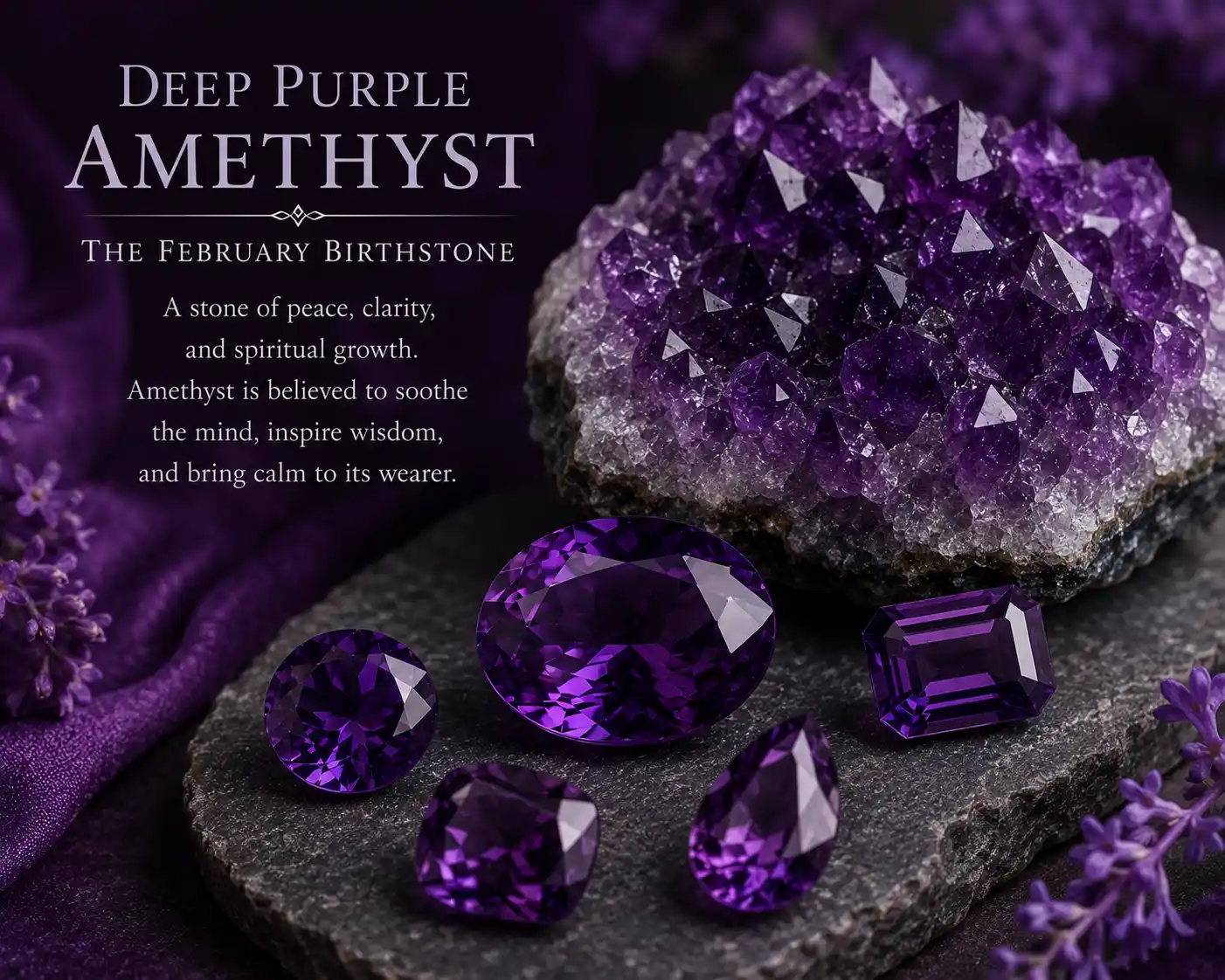
February Birthstone: Amethyst Meaning, Color and History

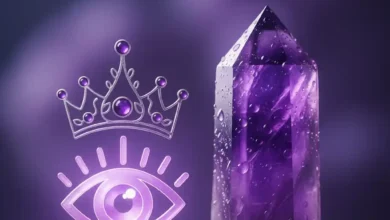
Amethyst is the principal modern birthstone for February. This purple variety of quartz ranges from pale lilac to deep violet and combines an ancient gemstone history with comparatively accessible prices and enough durability for most jewelry styles.
Its February association is only one part of its identity. Amethyst has been used in royal, religious and decorative jewelry for centuries, while its traditional symbolism includes sobriety, clarity, protection and inner strength.
February Birthstone at a Glance
| Property | Amethyst |
|---|---|
| Mineral species | Quartz |
| Composition | SiO₂ |
| Typical color | Pale lilac to deep purple |
| Crystal system | Trigonal |
| Mohs hardness | 7 |
| Luster | Vitreous |
| Transparency | Transparent to translucent |
| Cleavage | None |
| Main treatment | Heat treatment in some material |
| Birth month | February |
| Anniversary associations | Commonly 6th and 17th |
| Main care concern | Abrasion, strong heat and prolonged intense light |
What Is the February Birthstone?
Amethyst is February’s best-established modern birthstone.
It is the purple gemstone variety of quartz, the same mineral species that includes clear quartz, smoky quartz and citrine.
Unlike months with several competing modern birthstones, February is strongly identified with amethyst. Alternative historical lists may contain different gems, but amethyst remains the dominant contemporary choice.
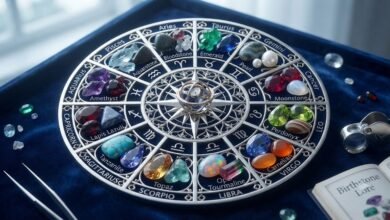
The broader birthstones-by-month guide explains how modern monthly assignments developed and why some months have more than one recognized stone.
Why Is Amethyst February’s Birthstone?
Birthstone lists developed gradually through religious, historical, commercial and jewelry traditions.
Amethyst became firmly associated with February in modern standardized lists and remains one of the most recognizable month-to-gem pairings.
Its winter-friendly purple color also gives February jewelry a distinctive identity without requiring one standard shade.
A February-born person does not need to wear amethyst, and the stone has no biological relationship with birth month. The connection is a cultural jewelry tradition.
What Color Is February’s Birthstone?
Amethyst ranges from very pale violet and lilac to medium purple, reddish purple and deep saturated violet.
Color can vary within a single crystal, creating zoning or bands. Some specimens show stronger purple near crystal tips, while cut stones may contain lighter and darker areas depending on orientation.
In the commercial market, strong saturation with an attractive balance of brightness usually receives the greatest demand.
A stone that is extremely dark can appear nearly black in ordinary lighting, so deepest color does not automatically mean highest beauty.
What Causes Amethyst’s Purple Color?
Amethyst is quartz colored through trace iron and natural irradiation-related processes within the crystal structure.
The exact color mechanism is more complex than simply containing purple pigment.
Different geological conditions, trace-element concentrations and later heating can influence the final appearance.
Because color can respond to heat and prolonged intense light, an amethyst should not be treated as permanently unchanged under every environment.
Light, Medium and Dark Amethyst
Pale amethyst can appear soft and delicate, especially in larger stones or minimalist jewelry.
Medium purple material often provides an attractive balance between visible color and brightness.
Deep violet amethyst can create a dramatic appearance, but excessive darkness may hide transparency and reduce visible sparkle.
Personal preference matters more than choosing the darkest available stone.
When comparing two gems, examine them under ordinary indoor light as well as daylight-equivalent illumination.
Red and Blue Flashes in Amethyst
Fine amethyst may show reddish or bluish secondary flashes depending on its color, orientation and lighting.
These flashes can add visual complexity, but they should not be confused with a separate gemstone variety.
Retail descriptions sometimes use dramatic trade terms for particularly saturated amethyst. Such labels can be useful descriptively, but they do not replace direct evaluation of hue, tone and saturation.
The completed guide to types of amethyst explains color varieties and trade terminology in greater depth.
Amethyst History and Name
The word amethyst is derived from the ancient Greek amethystos, commonly interpreted as meaning “not intoxicated” or “not drunk.”
Historical traditions connected the stone with protection from drunkenness and clear thinking.
Those beliefs contributed to one of amethyst’s most persistent symbolic themes: sobriety and self-control.
The association is cultural rather than pharmacological. Wearing amethyst does not prevent intoxication or change the effects of alcohol.
Amethyst in Ancient Traditions
Purple gemstones held strong status associations in several ancient societies because saturated color could be visually striking and difficult to obtain.
Amethyst appeared in beads, engraved gems, rings and decorative objects.
Over time, traditions connected the stone with protection, clarity and moderation.
Modern retellings often blend mythology, historical belief and later crystal symbolism. Therefore, ancient associations should be understood as cultural history rather than evidence that amethyst possesses measurable protective powers.
Amethyst in Royal and Religious Jewelry
Amethyst has been used in royal and ecclesiastical jewelry for centuries.
Purple has long carried associations with status, authority and spirituality in several historical contexts.
Amethyst became especially suitable for such jewelry because it could provide a rich purple appearance in transparent gemstone form.
Before large deposits expanded supply, fine amethyst was considerably more expensive relative to many other colored gems.
Its later abundance did not reduce its visual beauty, but it changed its market position.
Why Amethyst Became More Affordable
Major deposits, particularly in South America, greatly increased the supply of gem-quality amethyst.
As more material entered global trade, amethyst became accessible for larger jewelry pieces, carvings and decorative specimens.
This is an important example of why rarity and price are not fixed characteristics of a gemstone species.
A beautiful material can become more affordable when economically workable deposits increase supply.
Large size alone therefore does not make an amethyst extraordinarily valuable.
Where Is Amethyst Found?
Important amethyst-producing regions have included Brazil, Uruguay, Zambia and several other countries.
Brazil is particularly known for substantial production, including material from volcanic geodes.
Uruguayan amethyst is often associated commercially with strongly saturated purple, although individual quality varies.
Zambia has produced attractive material with strong color, while deposits also occur in the United States and many additional regions.
Origin should never be treated as a substitute for directly assessing color and cut.
Brazilian Amethyst
Brazil has supplied enormous quantities of amethyst to the world market.
Material occurs in several geological settings, including large geodes lined with purple quartz crystals.
Brazilian amethyst ranges widely in quality. Some stones are pale, while others display excellent saturation.
Therefore, “Brazilian” is an origin description rather than a grade.
The stone should be assessed for color distribution, transparency and workmanship rather than country name alone.
Uruguayan Amethyst
Uruguay is famous for deeply colored amethyst associated with basalt-hosted geodes.
Individual crystals and cut stones may show intense violet color.
However, darker does not always mean better. A stone that absorbs too much light can appear almost black when worn.
Collectors may appreciate geode specimens for crystal form and matrix as well as color.
Cut-jewelry buyers should focus on the face-up appearance rather than assuming Uruguayan origin automatically guarantees superior quality.
Zambian Amethyst
Zambian material can show rich purple coloration and attractive transparency.
Some stones may be comparatively small but strongly saturated.
As with other origins, variation within the deposit matters more than a broad geographic stereotype.
For ordinary amethyst purchases, laboratory origin determination is rarely necessary because origin often has less effect on price than color and cutting.
The completed amethyst buying guide focuses on the qualities buyers can evaluate directly.
Amethyst Hardness and Durability
Amethyst ranks 7 on the Mohs hardness scale.
That makes it suitable for earrings, pendants, bracelets and rings when normal precautions are followed.
However, quartz can still show wear over time. Dust frequently contains quartz particles, so careless rubbing may contribute to gradual surface abrasion.
Diamond, sapphire and ruby are harder and can scratch amethyst.
Store February birthstone jewelry separately rather than allowing it to rub against harder stones.
Is Amethyst Good for Everyday Jewelry?
Amethyst is durable enough for regular jewelry use, but the appropriate style depends on exposure.
Earrings and pendants receive relatively few impacts. Bracelets experience more surface contact, while rings are most exposed to knocks and abrasion.
A protected ring setting can work well for everyday wear if the owner removes it during manual work, exercise and household cleaning.
Amethyst should not be expected to remain pristine through years of rough treatment merely because it reaches 7 on the Mohs scale.
Amethyst Treatment
Heat treatment is one of the principal treatments associated with amethyst.
Heating can modify unwanted colors and, under suitable conditions, transform some amethyst material toward yellow or orange colors associated commercially with citrine.
Treatment is generally stable under normal wear once completed.
However, excessive later heat can damage color or increase risk to the stone.
The completed guide to treated and synthetic amethyst explains treatment and disclosure in greater detail.
Natural vs Lab-Created Amethyst
Amethyst can be grown in laboratories.
Laboratory-created amethyst has the same essential quartz composition and many of the same physical and optical characteristics as natural material, but its crystal growth occurred through human-controlled processes.
Visual inspection alone may not reliably distinguish high-quality synthetic and natural quartz.
Synthetic origin should therefore be disclosed clearly.
Because natural amethyst is relatively abundant, laboratory identification may not always be economically justified for inexpensive pieces.
How to Tell Real Amethyst from Imitations
Purple glass, synthetic quartz and other materials may be sold to resemble amethyst.
Useful clues can include bubbles, unnatural color concentration, surface wear and general construction, but home observations have limitations.
The completed real versus fake amethyst guide explains those warning signs.
Do not perform scratch or destructive tests on valuable jewelry.
For an important purchase, professional gemological examination provides stronger evidence.
Amethyst Meaning and Symbolism
Traditional and modern meanings of amethyst commonly include:
- Clarity
- Sobriety
- Calm
- Protection
- Spiritual reflection
- Self-control
- Inner strength
These associations come from historical, religious and metaphysical traditions.
They are not scientifically measurable effects.
A February-born wearer may value amethyst because of family tradition, color or gemstone interest without adopting any spiritual meaning.
Amethyst and February Personality Symbolism
Some modern birthstone traditions assign February amethyst qualities such as wisdom, calmness and inner strength.
These are symbolic associations rather than personality predictions.
A person born in February is not automatically calm, spiritual or disciplined because of their month.
Birthstone symbolism works best as a personal narrative or gift tradition rather than a way to classify people.
Amethyst and Valentine’s Month
February’s association with romantic celebrations has made amethyst a popular alternative to red and pink gemstones.
Purple jewelry can feel romantic without relying on conventional heart-shaped designs.
Historically, amethyst also acquired connections with love through various religious and cultural stories.
However, the stone cannot create attraction or determine relationship compatibility.
A February birthstone gift is most meaningful when it reflects the recipient’s actual taste.
Amethyst and Zodiac Connections
February spans parts of Aquarius and Pisces in Western tropical astrology.
Modern crystal lists may associate amethyst with both signs, particularly Pisces.
These correspondences differ from formal birthstone traditions and should not be treated as interchangeable.
The completed zodiac birthstones guide explains how zodiac associations differ from month-based birthstones.
Astrological meanings remain symbolic traditions rather than scientific personality assessments.
February Birthstone Jewelry
Amethyst works in nearly every jewelry format because it combines attractive color with useful hardness and broad availability.
Stud and drop earrings show purple color near the face, while pendants accommodate larger stones without much impact exposure.
Rings create greater visibility but require more care. Bracelets also benefit from low, secure settings because the wrist encounters hard surfaces frequently.
The companion February birthstone jewelry gift guide focuses on choosing formats, metals and gifts for different wearers.
Choosing Amethyst Quality
Start with color.
Look for an attractive purple that remains lively under ordinary lighting.
Next, inspect color distribution. Strong zoning may create obvious pale and dark patches, although subtle zoning can add character.
Then examine cut. A well-cut stone should return light effectively without a large transparent window through the center.
Clarity is generally expected to be high in faceted amethyst. Obvious inclusions may reduce value unless they create a distinctive collector specimen.
Amethyst Pricing
Amethyst is generally more affordable than ruby, sapphire or emerald because commercial supply is much greater.
However, price still varies with color, cutting, size, origin claims, jewelry craftsmanship and brand.
Large stones are readily available, so carat weight does not create the same exponential rarity premium seen in some other gems.
Strong color and attractive cutting often matter more than sheer size.
When shopping, compare visually similar stones rather than assuming the heaviest amethyst is the best value.
Cleaning Amethyst Jewelry
Warm water with mild soap and a soft brush is the safest general cleaning method.
Steam cleaning should be avoided because amethyst should not be exposed to high heat.
Ultrasonic cleaning may be suitable for many untreated stones, but it should not be used when fractures, filling or construction make the piece unsuitable.
The completed guide to cleaning amethyst jewelry safely provides a step-by-step approach.
Rinse carefully and dry with a soft lint-free cloth.
Amethyst and Sunlight
Some amethyst can fade after prolonged exposure to intense light.
Ordinary wear does not require keeping the gemstone in darkness, but permanent placement on a sunny windowsill is unnecessary.
The drafted guide to crystals that fade in sunlight explains why UV, heat and color-center stability vary between minerals.
Store valuable February birthstone jewelry in a shaded jewelry box when it is not being worn.
Cleansing and Charging Amethyst
Some spiritual practices symbolically cleanse or charge amethyst.
Because prolonged sunlight may alter color, low-contact methods such as sound, visualization or brief indirect light are more conservative choices.
The completed guide to cleansing and charging amethyst safely covers symbolic methods separately from physical cleaning.
No scientific evidence shows that crystals require energetic charging.
A ritual can still have personal meaning without being treated as a measurable physical process.
How to Buy a February Birthstone
Decide first whether the stone will be worn in a ring, earrings, pendant or bracelet.
Then assess color and cut under ordinary lighting.
Ask whether the material is natural or laboratory-grown and whether any treatment is known.
Inspect the metal and settings with the same care as the gemstone.
For most amethyst jewelry, a costly laboratory report is unnecessary. However, unusually expensive, historic or claimed-origin pieces may justify professional evaluation.
Conclusion
Amethyst is February’s defining birthstone: a purple variety of quartz with Mohs hardness 7, a long jewelry history and a color range extending from pale lilac to deep violet.
Its historical symbolism includes sobriety, clarity, protection and inner strength, while modern buyers value it for beauty, accessibility and versatility.
Color is the principal quality factor, but a good February birthstone purchase also considers cut, treatment disclosure, setting security and realistic care. With protection from harsh impact, excessive heat and prolonged intense sunlight, amethyst can remain an attractive piece of everyday or special-occasion jewelry.
Frequently Asked Questions
1. What is the birthstone for February?
Amethyst is the principal modern birthstone for February.
2. What color is February’s birthstone?
Amethyst ranges from pale lilac and violet to deep saturated purple and reddish purple.
3. What does the February birthstone mean?
Traditional meanings include clarity, sobriety, protection, inner strength and spiritual reflection.
4. Why is amethyst called amethyst?
Its name comes from the ancient Greek amethystos, associated with the belief that the stone protected against intoxication.
5. How hard is amethyst?
Amethyst ranks 7 on the Mohs hardness scale.
6. Is amethyst suitable for everyday jewelry?
Yes, with appropriate care. Rings and bracelets need more protection from impact and abrasion than earrings or pendants.
7. Where does February amethyst come from?
Important sources include Brazil, Uruguay, Zambia and several other countries.
8. Is dark purple amethyst always the best?
No. Strong saturation is desirable, but a stone that is too dark may lose brightness in ordinary light.
9. Is amethyst treated?
Some amethyst receives heat treatment to modify color. Treatment should be disclosed when known.
10. Can amethyst be made in a laboratory?
Yes. Laboratory-grown amethyst is synthetic quartz and should be sold with clear origin disclosure.
11. Can amethyst fade in sunlight?
Some amethyst may fade after prolonged exposure to intense light, so permanent direct-sun display should be avoided.
12. How should February birthstone jewelry be cleaned?
Warm mild soapy water and a soft brush provide the safest general method, while steam and excessive heat should be avoided.
Disclaimer: Birthstone meanings and amethyst metaphysical associations are cultural, historical and spiritual traditions rather than scientifically established effects. Amethyst cannot prevent intoxication, treat medical conditions or determine personality.