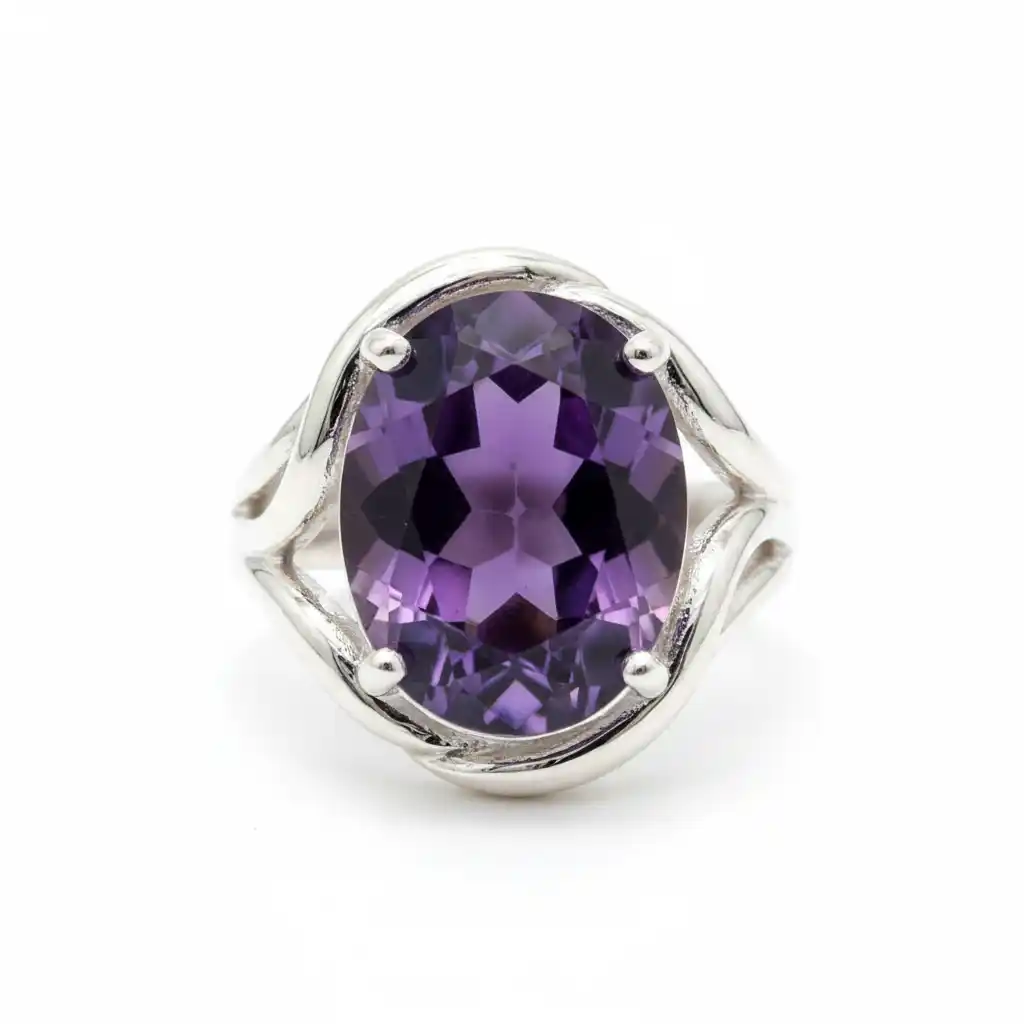
Amethyst Ring: Styles, Settings & Buying Guide
An amethyst ring can range from a restrained lavender solitaire to a substantial deep-purple statement piece, and the availability of relatively large gem-quality amethyst allows buyers to choose impressive center stones without the extreme size premiums associated with many scarcer transparent gemstones. The hand, however, is one of the most demanding places to wear any gem, so choosing an amethyst ring requires more attention to setting height, edge protection, shank construction, fit, cut, color, treatment disclosure, and expected wear than choosing the same stone for a pendant or earrings.
Amethyst is purple quartz with Mohs hardness 7, useful resistance to ordinary scratching, good toughness for jewelry, and no cleavage, which gives an amethyst ring a practical foundation for regular wear. Those properties do not make the stone indestructible: hard impacts can still chip facet edges or pointed ends, harder gemstones can scratch quartz, poorly positioned surface-reaching fractures can become weak points, and long exposure to intense light or excessive heat can affect the color of some material.
A good amethyst ring therefore balances appearance with engineering. The gemstone should remain visibly purple under ordinary lighting, the setting should protect its most exposed areas without unnecessarily darkening it, the band should stabilize the center rather than allowing constant spinning, and the design should suit how frequently the wearer uses their hands.
Amethyst Ring at a Glance
| Feature | What ring buyers should know |
|---|---|
| Gem material | Purple quartz |
| Composition | SiO₂ |
| Mohs hardness | 7 |
| Toughness | Good for jewelry |
| Cleavage | None |
| Main ring risk | Repeated impact and abrasion at hand level |
| Common cuts | Round, oval, cushion, pear, emerald cut and fantasy shapes |
| Common styles | Solitaire, bezel, halo, three-stone, cluster, cocktail and eternity designs |
| Main quality factor | Attractive purple color with enough brightness |
| Setting priority | Protect exposed girdles, corners and points |
| Fit priority | Prevent excessive spinning without creating pressure |
| Treatment consideration | Heat and other modifications should be disclosed when relevant |
| Synthetic material | Laboratory-grown amethyst exists and should be disclosed |
| Main care concerns | Impact, harder jewelry, strong heat and prolonged intense light |
Is Amethyst Suitable for Rings?
An amethyst ring can be practical for regular jewelry use because quartz provides significantly better scratch resistance than softer gems such as opal, fluorite, turquoise, pearl, or amber. Its Mohs hardness of 7 also places amethyst at an important point on the gemstone hardness chart, where it resists many common materials but remains vulnerable to harder gemstones such as topaz, sapphire, ruby, spinel, moissanite, and diamond.
Hardness is only part of the durability question. The difference between gemstone toughness and hardness matters especially in an amethyst ring because a stone may resist scratching yet still chip when a sharp edge receives a concentrated impact.
Quartz has no cleavage, which removes one specific structural weakness found in materials such as topaz or fluorite, but amethyst remains a crystalline gemstone that can fracture. A low, well-supported amethyst ring worn with sensible care can therefore perform much better than a tall, exposed design with vulnerable corners even when both contain stones of identical quality.
Ring Style Changes How Amethyst Wears
An amethyst ring should be evaluated by construction rather than by a generic style label, because each design exposes the gemstone and metal to different stresses.
| Ring style | Main advantage | Main concern |
|---|---|---|
| Solitaire | Gives one amethyst maximum visual focus | Girdle and prongs can remain exposed |
| Full bezel | Strong perimeter protection | Heavy metal can darken deep purple stones |
| Semi-bezel | Balances protection and visibility | Open sides still receive impact |
| Halo | Adds contrast and apparent size | Raised halos may snag |
| Three-stone | Creates width and visual complexity | Side stones affect comfort and matching |
| Cluster | Produces presence from smaller gems | Many small settings require inspection |
| Cocktail ring | Suits large amethyst exceptionally well | Tall construction increases impact exposure |
| Eternity band | Creates continuous purple color | Resizing and replacing stones can be difficult |
| Signet-style ring | Low profile and architectural appearance | Deep mounting can reduce brightness |
The best amethyst ring style is therefore not simply the one that looks most attractive in a close-up photograph. It is the design whose height, protection, width, setting, and fit are compatible with the wearer’s routine.
Solitaire Amethyst Rings
A solitaire amethyst ring concentrates almost every visual decision on one center stone, which makes color, cut, face-up size, setting height, and prong quality particularly easy to judge. Because amethyst commonly occurs in large crystals, even a simple solitaire can have substantial presence without requiring an elaborate halo or multiple accent stones.
Four-prong settings expose more of the gemstone and can preserve an open appearance, but they also leave wider sections of the girdle unprotected. Six-prong designs provide additional points of contact around suitable round and oval stones, although the quality and thickness of the prongs matter more than the number alone.
The center should sit firmly without movement when the ring is handled gently. A clicking sound, visible rocking, raised claw, or gap between a prong and gemstone deserves attention because an amethyst ring can lose its center stone even when the quartz itself remains completely undamaged.
An open gallery beneath the gemstone makes cleaning easier and can help a dark amethyst remain lively, but the pavilion should not project so far below the ring that it presses uncomfortably into the finger.
Bezel-Set Amethyst Rings
A bezel surrounds most or all of the gemstone’s perimeter with metal, making it one of the strongest choices for an amethyst ring intended for frequent wear. The metal protects the girdle, reduces snagging, and can shield corners or edges that would otherwise encounter hard surfaces directly.
Protection comes with an optical trade-off. Deep purple amethyst may already absorb significant light, and a heavy closed bezel can make an overly dark stone look nearly black from some angles.
A well-proportioned bezel should therefore protect the stone without swallowing it visually. Open-backed construction can improve cleaning access, while carefully shaped metal can leave enough of the crown visible to preserve the gemstone’s apparent size.
Semi-bezel designs expose more of the amethyst while protecting selected sides. They can work especially well with elongated ovals and emerald cuts, provided the unprotected areas do not contain vulnerable corners or surface-reaching fractures.
Halo Amethyst Rings
A halo amethyst ring surrounds a purple center with smaller stones, frequently colorless gems, creating contrast and increasing apparent size. The effect is strongest when the center has enough saturation to remain clearly purple beside bright accents.
Very pale amethyst can become visually overwhelmed by a brilliant white halo, while extremely dark amethyst may look heavier and less lively by comparison. Medium or strong purple with good brightness usually produces a more balanced relationship.
Setting height is particularly important in halo designs. A low integrated halo generally catches less on clothing and objects than a tall basket elevated far above the finger.
Inspect the halo from the side and underneath as well as from above. Small accent stones introduce many additional prongs and seats, so an amethyst ring can require maintenance even when the center stone remains secure.
Three-Stone Amethyst Rings
A three-stone amethyst ring can use three matching purple gems, an amethyst center with colorless side stones, or a more complex color combination. The design creates substantial width across the finger, so proportion and comfort matter as much as symbolic interpretation.
If all three stones are amethyst, compare hue and tone carefully. One reddish-purple stone between two blue-violet stones can make an otherwise symmetrical ring look mismatched, while a deliberate graduated design should show a controlled transition rather than random differences.
Large side stones can also press against neighboring fingers. A photograph from above may make the ring look perfectly proportioned while hiding how far the settings extend laterally.
For frequent wear, the three settings should behave as one structure rather than three independent projections that catch and twist against surrounding objects.
Cocktail and Statement Amethyst Rings
Amethyst is particularly well suited to cocktail rings because large crystals allow designers to use broad cushions, elongated emerald cuts, carvings, cabochons, and unusual fantasy shapes without depending on exceptionally rare rough.
A large amethyst ring, however, creates leverage. When the center sits far above the hand, even a moderate impact can transmit significant force to the prongs, basket, shoulders, and shank.
A very narrow band beneath a large center may also allow the ring to rotate continually. A wider lower shank, supportive shoulders, lower setting, or sizing adjustment can improve stability considerably.
Statement rings make sense when scale is part of the design, but their construction should acknowledge that scale. An enormous gemstone mounted on delicate metal is not automatically elegant engineering.
Choosing the Best Amethyst Color for a Ring
Color is usually the most important visual quality factor in an amethyst ring. Purple ranges from pale lilac and lavender through medium violet to strongly saturated reddish or bluish purple, and personal preference matters, but conventional fine-quality material generally combines strong color with enough brightness to remain visibly purple in normal interior light.
Darkness should not be confused with saturation. A very dark amethyst ring may appear luxurious under intense display lighting yet become almost black away from those conditions.
Pale material can be attractive when the design intentionally favors delicacy and transparency, particularly in white metal or rose-toned settings. A lighter gemstone with excellent cutting can also appear more lively than a darker stone with extensive extinction.
Natural color zoning is common in amethyst, so inspect the stone face-up rather than assuming all purple areas are evenly distributed. The different types of amethyst guide explains major color patterns and commercial varieties in more detail.
Color Zoning in an Amethyst Ring
Amethyst often develops lighter and darker purple growth zones, and those zones can remain visible after cutting. The important question for an amethyst ring is how the pattern looks from the normal viewing direction.
A skilled cutter can orient the rough so darker material contributes richness without dividing the stone into obvious pale and dark regions. Poor orientation may create one pale end, a dark triangular section, or a washed-out center.
Color zoning does not prove that an amethyst ring is low quality or fake. It is a natural characteristic of many crystals, but strong visible zoning generally becomes less desirable in conventional transparent fine jewelry when the design calls for an even face-up appearance.
Chevron, banded, or deliberately patterned amethyst belongs to a different aesthetic category and should not be judged by the same expectations as a transparent solitaire.
Cut Quality and Face-Up Size
Carat weight alone does not tell you how large or attractive an amethyst ring will look. A very deep stone can retain substantial weight below the girdle while appearing surprisingly small from above, while an overly shallow cut may spread widely but produce a transparent-looking window through the center.
Good cutting distributes brightness and color across the face of the stone. Large areas that remain black as the ring moves indicate extinction, while a broad area where the wearer can easily see through the stone suggests windowing.
Oval, cushion, and round cuts are versatile because their curves reduce sharp impact points. Pear and marquise shapes can be beautiful in an amethyst ring but deserve protection around their tips, where a concentrated impact can cause chipping.
Emerald cuts create broad flashes and expose clarity and zoning more openly. Fantasy cuts can give an amethyst ring unusual character, although thin projections and complex outlines may require custom protective settings.
Clarity and Inclusions
Transparent amethyst commonly occurs clean enough for eye-clean faceted jewelry, so large distracting inclusions are not necessary to establish natural origin. A completely clean-looking amethyst ring should therefore not be assumed laboratory-grown simply because no inclusions are visible without magnification.
Small internal crystals may have little effect on durability, while fractures reaching the surface deserve greater attention, especially when they lie beneath a prong or close to an exposed girdle edge.
Metal can hide these features. When considering an expensive amethyst ring, inspect the gemstone from several angles and pay particular attention to areas where the setting contacts the stone.
Included, translucent, or patterned amethyst can still make excellent cabochon and artistic rings when those internal features are intentionally part of the appearance.
Natural, Laboratory-Grown and Imitation Amethyst
Natural amethyst formed geologically, whereas laboratory-grown amethyst is manufactured quartz with the basic composition and crystal structure expected of the natural gemstone. Laboratory-grown material can display convincing purple color and very high clarity, so an amethyst ring cannot always be classified confidently from photographs alone.
Synthetic amethyst is not the same as purple glass. It is laboratory-grown quartz, while glass and other substitutes merely imitate the appearance.
The real vs fake amethyst guide covers natural, synthetic, glass, dyed, and other imitation materials in more depth. Avoid destructive scratch, flame, chemical, or impact tests on a finished amethyst ring because they can damage legitimate jewelry without answering the most important origin questions.
Laboratory-grown amethyst can be perfectly suitable for a ring when it is represented accurately. The problem is not manufactured origin; it is selling manufactured material as naturally formed material when that distinction affects price or buyer expectations.
Treatments and Amethyst Rings
Heat can alter amethyst color, including lightening some material or shifting suitable quartz toward yellow, orange, brown, or greenish appearances. Other modifications can also occur in the wider purple-gem market.
Treatment should be discussed separately from laboratory growth. A treated natural amethyst began as naturally formed quartz and was modified afterward, while laboratory-grown amethyst crystallized in a manufactured environment.
The dedicated treated amethyst guide explains these distinctions and the limits of visual identification. For an amethyst ring buyer, the practical requirement is clear disclosure whenever treatment or synthetic origin materially affects the purchase.
Setting Height Matters More in Rings
Setting height has much more practical significance in an amethyst ring than it does in earrings or many pendants because the hand repeatedly moves past furniture, handles, bags, clothing, tools, and other objects.
A low-profile setting keeps the gemstone closer to the finger and reduces leverage during an accidental strike. This does not guarantee protection, but it generally gives the setting less opportunity to catch or collide.
A tall cathedral or basket setting can make a center stone appear more prominent and may allow another band to sit closer beside it, although the added height increases exposure.
Before buying online, ask for the complete setting height rather than judging scale from a top-view photograph. Side photographs are particularly important for understanding how far an amethyst ring projects above the finger.
Prongs, Girdle Protection and Pointed Stones
Prongs gradually wear because they are exposed metal components. An amethyst ring worn frequently should therefore be inspected for thinning, flattening, catching, misalignment, or gaps around the gemstone.
Sharp corners require extra attention. Pear, marquise, princess-style, and other pointed cuts concentrate force into smaller areas than rounded shapes.
V-prongs, reinforced corners, or bezel protection can reduce that risk. The setting should fit the gemstone rather than forcing a slightly mismatched stone into a standardized mounting, because uneven pressure can create unnecessary stress.
If a prong begins catching fabric, do not simply bend it down with household tools. The underlying cause may be wear, distortion, or stone movement.
Shank Width and Ring Stability
The shank is not merely the part that circles the finger; it determines much of the comfort and stability of an amethyst ring. A broad heavy center on an extremely thin shank can rotate, tilt, or place disproportionate pressure on the finger.
A wider lower shank distributes weight more effectively and often helps a top-heavy ring remain upright. Tapered shoulders can also provide structural support while keeping the underside comfortable.
Very wide bands fit differently from narrow rings because they contact more skin. A wearer who knows a comfortable size in a thin ring should not assume the identical nominal size will feel the same in a broad amethyst ring.
Ring Size, Fit and Spinning
An amethyst ring should pass comfortably over the knuckle and sit securely without restricting normal finger movement. Excessive looseness allows a large center to spin toward the palm, while an overly tight fit can become uncomfortable as natural finger size fluctuates.
Top-heavy designs are especially prone to rotation. Correct sizing is the first solution, but a wider shank, lower setting, sizing beads, or other professional adjustments may improve stability when the center remains prone to turning.
A ring that spins constantly also exposes the gemstone to different impact directions. The problem is therefore both aesthetic and practical.
Resizing an Amethyst Ring
Resizing depends on the complete construction rather than on amethyst alone. A solitaire with a plain lower shank often provides more flexibility than an eternity band, intricate pavé ring, patterned shank, or design with gemstones extending far around the circumference.
Major size changes can alter stone spacing, prong alignment, ring shape, or decorative symmetry. Resizing can also introduce heat near the gemstone, so the jeweler needs to account for amethyst’s stability characteristics before working on the metal.
Before purchasing an amethyst ring that is not already the correct size, ask a qualified jeweler whether that specific construction can be adjusted safely and how much adjustment is realistic.
Amethyst Engagement Rings
An amethyst ring can serve as an engagement ring for someone who genuinely prefers purple and accepts the maintenance trade-offs of quartz. Amethyst offers substantial size, strong color, broad design flexibility, and generally accessible pricing, which makes distinctive custom designs possible without requiring a tiny center stone.
The durability comparison still matters. Amethyst is less scratch resistant than sapphire, ruby, moissanite, or diamond, so a frequently worn engagement ring may eventually develop fine scratches, facet-edge abrasion, or a need for repolishing.
A low bezel, substantial prongs, rounded center shape, protective halo, or other thoughtful setting can improve practicality. High exposed points and very thin claws demand more caution.
The decision should be based on the wearer’s actual habits rather than on a rule that one gemstone is universally suitable or unsuitable for engagement jewelry.
Wearing an Amethyst Ring Beside Another Ring
An amethyst ring worn beside a wedding band or stack creates additional contact that should be considered during design selection. A raised basket may allow a straight band to sit flush beneath the center, while a low protruding setting may force a visible gap.
Two rings can also rub against each other. Diamond-set bands are especially important because diamond is much harder than amethyst and can abrade exposed quartz if the stones repeatedly make contact.
Metal can also wear metal. Prongs, shared settings, and decorative edges that continually rub against a neighboring ring may gradually thin.
If an amethyst ring is intended for stacking, test the complete combination rather than judging each piece independently.
Metal Choices for an Amethyst Ring
Yellow gold creates warm contrast with violet and can make reddish-purple material appear especially rich, while white gold, platinum, and silver create a cooler relationship that often complements lavender or blue-violet stones. Rose-toned metal can work attractively with softer purple and red-violet amethyst.
Metal color does not improve intrinsic gemstone quality, although reflections from the setting may influence apparent color near the edges.
Durability and maintenance also differ among alloys. Platinum can provide substantial prongs and develops its characteristic surface patina, while white gold may use rhodium plating and can contain alloys that matter to people with particular metal sensitivities.
Verify the complete metal composition rather than relying on visible color alone.
Accent Stones
Diamonds are common accents around an amethyst ring because their neutral color creates strong contrast with purple. Other colorless gems can create a similar visual idea at different price points, while colored side stones can deliberately shift the palette.
Durability becomes a combined-property issue when several gem species share one ring. The complete piece should be cleaned and worn according to its most vulnerable components rather than assuming every accent tolerates the same conditions as quartz.
A strongly saturated amethyst may need only restrained accents, whereas a pale center can benefit from carefully chosen contrast. Accent size should support the amethyst rather than make the center appear weak or disproportionately small.
Price and Value
Amethyst occurs in sizeable clean crystals, so a large center does not automatically create a dramatic value premium. Color quality, cut, zoning, treatment, natural versus laboratory-grown origin, metal, craftsmanship, designer attribution, antique importance, and setting complexity can all affect the final cost of an amethyst ring.
This is why two rings containing similarly sized stones can have very different prices. One may use a commercially cut pale amethyst in silver, while another uses a precision-cut strongly saturated natural stone in substantial gold with custom metalwork.
The dedicated amethyst price guide separates gemstone value from finished-jewelry costs and helps explain why size alone is an unreliable pricing shortcut.
What to Look for When Buying an Amethyst Ring
Begin with the stone under ordinary lighting. Strong display illumination can make a dark amethyst ring look more vivid than it will in a typical room, so judge whether the purple remains attractive away from concentrated light.
Then examine cut and face-up appearance. Look for balanced brightness, minimal distracting windowing, controlled extinction, attractive zoning, and dimensions that make sense for the stated weight.
Next, inspect the setting from every available angle. Check prongs, bezel edges, gallery construction, setting height, shoulders, shank thickness, and how the center relates to neighboring fingers.
Ask whether the amethyst is natural or laboratory-grown and whether relevant treatments are known. The broader amethyst buying guide covers gemstone-quality evaluation, but ring buyers should add fit, setting height, resizing, and long-term wearability to that checklist.
Does an Amethyst Ring Need a Laboratory Report?
Most ordinary amethyst rings do not require independent laboratory documentation because the cost of testing can be disproportionate to the gemstone’s market value. A report becomes more reasonable when natural versus synthetic origin materially affects a substantial purchase, when unusual provenance is being used to justify a premium, or when an important designer or collector piece requires stronger documentation.
A gemological identification report is also different from a monetary appraisal. The gemstone certification guide explains what laboratory reports can establish and why seller-created letter grades should not be confused with standardized international quality grades.
Comparing Amethyst Rings With Other Amethyst Jewelry
A ring gives amethyst more impact exposure than most other jewelry forms. An amethyst necklace can support a large gemstone with much less hand-level contact, while amethyst earrings shift the main concerns toward matching, earring weight, posts, backs, hooks, and movement.
An amethyst bracelet still experiences substantial surface contact, but its risks center on wrist fit, articulation, clasps, drill holes, elastic or cord, and repeated movement across nearby objects.
An amethyst ring therefore requires its own wear strategy. Setting profile, shank stability, resizing, spinning, contact with adjacent rings, and direct impact to the center stone matter far more here than in the other forms.
How to Clean an Amethyst Ring
Routine cleaning can usually be handled with lukewarm water, mild soap, and a soft brush when the gemstone and setting are structurally sound. Pay particular attention beneath the center, where lotion, soap residue, skin oils, and debris can reduce brightness.
The complete ring must be considered before choosing more aggressive methods. Fractured material, glued components, unusual treatments, antique construction, damaged settings, or vulnerable accent stones may require more conservative cleaning.
Steam should be avoided because excessive heat is unnecessary and potentially harmful. Ultrasonic cleaning is not an appropriate universal default when treatment, fractures, or setting security are uncertain.
The detailed guide to cleaning amethyst jewelry covers safe hand cleaning and the situations in which a professional inspection is preferable.
Light, Heat and Storage
Some amethyst can lose color after prolonged exposure to strong light, so an amethyst ring should not be left continuously in intense illuminated locations or high-heat environments. Ordinary wear is different from long-term concentrated exposure.
Heat also matters during repair because uncontrolled temperature can affect color and abrupt thermal stress can damage vulnerable stones. A jeweler working on the shank or prongs should know the center stone is amethyst before applying any heat-based procedure.
Store an amethyst ring separately from harder gemstone jewelry so diamond, sapphire, ruby, topaz, or other harder materials cannot scrape the quartz. A soft-lined compartment or individual pouch also prevents prongs from catching on neighboring pieces.
Activities That Put an Amethyst Ring at Risk
An amethyst ring should be removed when the hands will encounter repeated impact, abrasive grit, heavy tools, strong chemicals, or substantial pressure. Weight training, gardening, mechanical tasks, household cleaning, and similar activities can damage either the gemstone or the setting even when quartz itself seems relatively durable.
Repeated impact is often more important than one dramatic accident. A ring that constantly strikes the same desk edge, metal handle, or equipment surface can gradually show wear around facet junctions and prongs.
Regular visual inspection is therefore useful. Check whether the gemstone moves, whether a prong catches, whether the shank is becoming misshapen, and whether scratches or chips are developing around exposed edges.
Amethyst Ring Meaning
An amethyst ring may also be chosen for traditional symbolism associated with clarity, reflection, composure, protection, and spiritual contemplation. Those meanings can add personal significance to an engagement ring, heirloom, gift, or self-purchased piece without changing the physical properties of quartz.
Symbolic interpretation should remain separate from medical claims. An amethyst ring has not been established as a treatment for anxiety, insomnia, addiction, pain, or another health condition, and wearing the stone should not replace appropriate professional care.
For a broader discussion of the gemstone’s mineral identity and traditional symbolism, the amethyst meaning page keeps those subjects separate from ring construction and wear.
FAQs About Amethyst Rings
Is an amethyst ring suitable for frequent wear?
Yes, when it has a protective setting and is worn with reasonable care. Amethyst has Mohs hardness 7, good jewelry toughness, and no cleavage, but prolonged wear can still produce scratches, facet abrasion, or chips after hard impacts.
What is the safest setting for an amethyst ring?
A full bezel provides strong perimeter protection, while low substantial prongs can also work well. The best choice depends on the gemstone shape, setting height, intended wear, and how much of the girdle or points remain exposed.
Is a high-set amethyst ring less durable?
A high setting is not automatically weak, but it exposes the center stone to more potential impact and creates greater leverage when the ring catches something. Low-profile designs are generally easier to protect during frequent wear.
Which amethyst color is best for a ring?
Strong violet to reddish-purple with enough brightness to remain visibly purple under normal lighting is widely preferred. Extremely dark material can look nearly black, while pale lavender offers a softer aesthetic.
Why does my amethyst ring look darker indoors?
The stone may have a dark tone, deep cut, significant extinction, or a closed setting that limits light. Concentrated showroom illumination can also make purple appear brighter than it does under ordinary interior lighting.
Can an amethyst ring be an engagement ring?
Yes. Amethyst can be used for an engagement ring when the wearer likes purple and accepts that quartz is less scratch resistant than several traditional engagement-ring gemstones. A protective setting improves practicality.
Can an amethyst ring be resized?
Many solitaires and rings with plain lower shanks can be resized, but eternity bands, pavé designs, complex patterns, and rings with stones extending around the band may have substantial limitations.
Why does my amethyst ring keep spinning?
The ring may be too loose, the center may be top-heavy, or the shank may be too narrow for the size and height of the setting. Correct sizing, a wider shank, lower profile, or professional sizing aids can improve stability.
Is laboratory-grown amethyst suitable for rings?
Yes. Laboratory-grown amethyst is quartz and can provide appropriate durability and attractive color. It should be disclosed as laboratory-grown rather than represented as naturally formed.
Can you tell natural and laboratory-grown amethyst apart visually?
Not always. High-quality laboratory-grown amethyst can closely resemble natural material, so professional testing may be necessary when origin materially affects price.
Does treatment make an amethyst ring less durable?
It depends on the treatment. Heat is primarily relevant to color, while other modifications may introduce different care considerations. Buyers should obtain clear treatment disclosure rather than assuming every amethyst has identical history.
Can an amethyst ring scratch?
Yes. Mohs hardness 7 provides useful resistance, but harder materials can scratch amethyst and long-term abrasion can soften facet junctions or polish.
Can an amethyst ring chip?
Yes. Quartz can chip or fracture after sufficient impact, especially at pointed ends, sharp corners, thin edges, or areas weakened by surface-reaching fractures.
Can I wear an amethyst ring beside a diamond band?
You can, but repeated contact should be minimized because diamond is substantially harder than amethyst and can scratch exposed quartz. Check whether the settings cause the stones or metal edges to rub directly.
How should I store an amethyst ring?
Store it separately in a soft compartment or pouch, away from harder gemstones and exposed metal edges. This protects both the amethyst surface and the setting.
How often should I inspect an amethyst ring?
Inspect it whenever you notice movement, catching, a hard impact, or visible wear. Periodic checking of prongs, the shank, and the gemstone seat is particularly useful for frequently worn rings.
Choosing an Amethyst Ring for Real Wear
The strongest amethyst ring combines an attractive purple gemstone with construction that acknowledges where the jewelry will actually be worn. Rich color and large carat weight are easy to notice, but setting height, prong thickness, girdle protection, shank width, fit, balance, resizing limits, accent placement, and compatibility with neighboring rings determine whether the design remains practical.
Amethyst provides useful jewelry durability and enough availability to make large, distinctive ring designs accessible, yet that abundance should make buyers more selective rather than less. There is little reason to accept an excessively dark stone, poor cutting, awkward proportions, weak settings, or vague disclosure simply because the center is large.
Choose an amethyst ring whose color remains appealing in ordinary light, whose setting protects the stone without overwhelming it, whose shank keeps the center stable, and whose natural or laboratory-grown origin and treatment history are represented clearly. When those elements work together, amethyst can offer substantial purple presence while remaining well suited to thoughtful, regular wear.