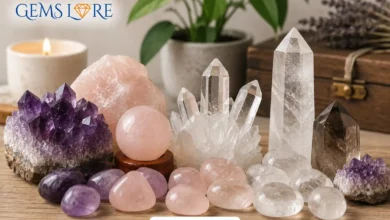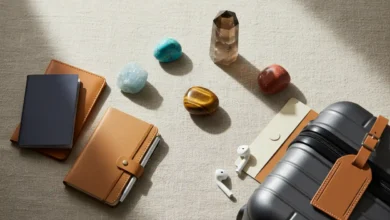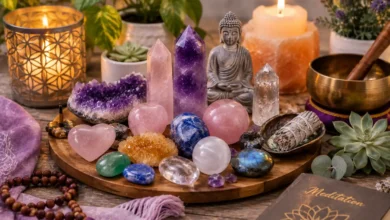

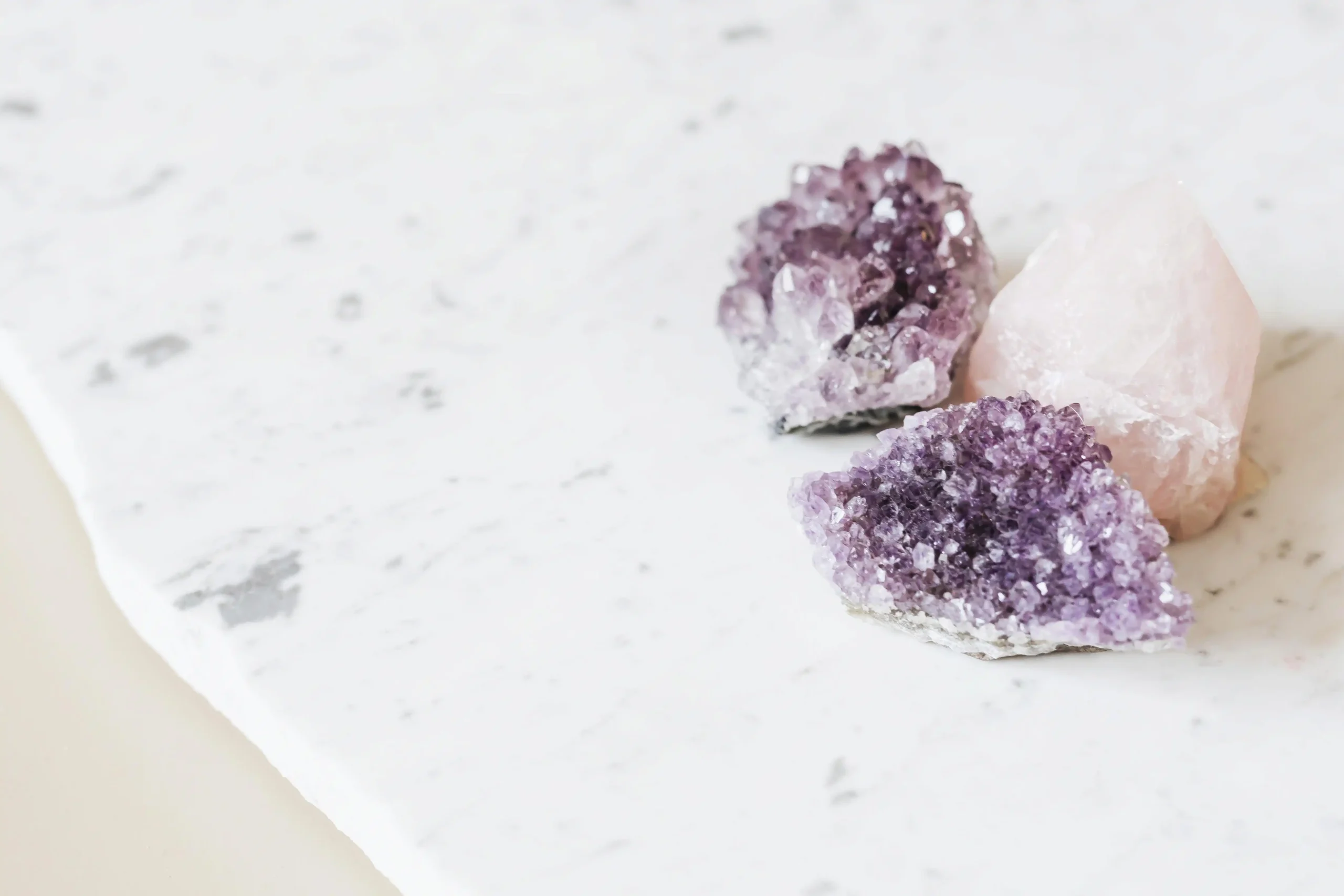

Crystals for anxiety are traditionally used as grounding objects, visual reminders, meditation aids, and symbolic prompts for calmer responses during worry, uncertainty, overstimulation, or everyday stress. Amethyst, smoky quartz, lepidolite, blue lace agate, howlite, rose quartz, and sodalite are among the most common choices because their modern meanings emphasize reflection, grounding, patience, communication, self-compassion, and clearer thinking.
Stress and anxiety overlap, so a useful guide to crystals for anxiety also needs to address workload, relationship pressure, sleep disruption, information overload, repeated reassurance-seeking, and the need to recover after demanding situations. A stone may help mark a coping routine, but it cannot remove a stressor, medically stop a panic attack, diagnose an anxiety disorder, or replace professional treatment.
At Gems Lore, crystals for anxiety are interpreted as symbolic supports rather than medical tools. Their most constructive role is to connect a familiar object with something practical: returning attention to the present, checking whether a prediction is supported by evidence, reducing unnecessary stimulation, asking clearly for help, setting a boundary, or choosing one manageable next step.
New, severe, persistent, or unexplained symptoms should not automatically be attributed to anxiety. Chest pain, fainting, significant breathing difficulty, severe confusion, sudden neurological symptoms, immediate danger, or an inability to remain safe require appropriate urgent help rather than a crystal ritual.
Crystals for Anxiety at a Glance
| Crystal | Traditional supportive theme | Practical use |
|---|---|---|
| Amethyst | Reflection and moderation | Pause before accepting a catastrophic prediction as fact |
| Smoky quartz | Grounding and perspective | Return attention to the immediate environment |
| Lepidolite | Transition and simplification | Reduce unnecessary stimulation and competing demands |
| Blue lace agate | Calm communication | Prepare a clear sentence asking for support |
| Howlite | Patience and slower reaction | Delay unnecessary checking or reassurance-seeking |
| Rose quartz | Compassion and self-respect | Replace harsh self-criticism with accurate language |
| Moonstone | Cycles and adaptation | Notice that emotional intensity can change |
| Black tourmaline | Boundaries | Reduce avoidable information or interpersonal overload |
| Fluorite | Organization | Break an overwhelming task into manageable parts |
| Sodalite | Logic and evidence | Separate possibility from probability |
| Aquamarine | Composed expression | Describe symptoms, needs, or concerns clearly |
| Clear quartz | Defined intention | Select one safe coping action |
| Red jasper | Steady effort | Manage necessary responsibilities without rushing |
| Moss agate | Gradual progress | Support long-term routines during sustained stress |
There is no scientifically established “best” crystal among these. The best crystals for anxiety are the ones whose symbolism can be connected with a safe, useful behavior without becoming something you believe you cannot function without.
Anxiety, Stress, and Anxiety Disorders Are Not the Same
Understanding the difference matters before choosing crystals for anxiety.
Stress generally develops in response to an identifiable demand, threat, pressure, or change. A deadline, financial problem, illness in the family, heavy workload, relationship conflict, move, examination, or caregiving responsibility can create stress.
Anxiety refers more broadly to fear, worry, tension, or apprehension. Sometimes the source is clear. At other times, the worry continues even when no immediate threat is obvious.
An anxiety disorder involves persistent or recurrent symptoms that may be difficult to control and can significantly affect work, education, relationships, sleep, health, or normal daily activities.
Crystals for anxiety cannot determine which category applies.
A qualified professional may need to consider duration, severity, health conditions, medications, substance use, sleep, trauma, and life circumstances before identifying the cause of persistent symptoms.
The distinction is especially important because physical symptoms associated with anxiety can also arise from other medical problems.
Can Crystals for Anxiety Really Help?
Crystals for anxiety have not been scientifically established as treatments for anxiety disorders.
That does not mean every personal crystal practice is meaningless.
A smooth stone can act as a tactile anchor.
A piece of jewelry can become a reminder of a coping statement.
A desk crystal can cue a person to stop multitasking.
A bedside stone can mark the point when work ends for the evening.
An object can also acquire meaning through repetition. If you repeatedly use smoky quartz while practicing a grounding routine, the stone may eventually remind you of the routine as soon as you see or touch it.
The useful mechanism lies in attention, association, expectation, environment, and behavior—not a demonstrated mineral-specific treatment effect.
Crystals for anxiety work best in that limited symbolic role.
Crystals for Anxiety as Cues, Not Treatments
A practical way to use crystals for anxiety is to assign one stone to one action.
| Crystal cue | Associated response |
|---|---|
| Smoky quartz | Return attention to what is physically present |
| Sodalite | Write facts separately from feared predictions |
| Howlite | Wait before checking for reassurance again |
| Blue lace agate | State one clear request |
| Rose quartz | Replace one self-attacking sentence |
| Black tourmaline | Close an unnecessary source of stimulation |
| Fluorite | Divide one overwhelming task |
| Aquamarine | Describe the concern clearly |
| Clear quartz | Choose the next safe step |
| Red jasper | Complete one essential responsibility steadily |
The crystal does not perform the response.
Its purpose is to make the response easier to remember.
If choosing, carrying, cleansing, arranging, or checking the correct crystals for anxiety begins to create more anxiety, simplify the practice or remove it completely.
1. Amethyst for Anxious Thoughts and Reflection
Amethyst is one of the most widely used crystals for anxiety because its traditional symbolism emphasizes reflection, moderation, clarity, and pausing before reacting.
Anxious thinking can make possibility feel like certainty.
A person may think:
This could happen, therefore it probably will happen.
When amethyst is used among crystals for anxiety, connect it with a simple question:
What evidence shows that this outcome is probable rather than merely possible?
You do not need to argue with every uncomfortable feeling. Instead, separate the feeling from the prediction attached to it.
Amethyst can remain on a desk, beside a journal, or in another quiet location.
The stone does not medically calm the nervous system, treat panic disorder, cure generalized anxiety disorder, or stop intrusive thoughts.
Its role among crystals for anxiety is symbolic reflection.
2. Smoky Quartz for Grounding
Smoky quartz is one of the strongest symbolic crystals for anxiety when worry pulls attention toward imagined future events.
Grounding returns attention to immediate conditions.
Hold a smooth stone and notice its weight, temperature, color, and surface.
Then identify several details in the environment.
What can you see?
What can you hear?
Where are your feet?
What actually requires action now?
What can wait?
This type of sensory orientation can be useful whether or not you believe crystals for anxiety carry metaphysical energy.
The stone supplies a consistent physical object.
It does not medically stop panic, dissociation, trauma symptoms, or another condition.
If grounding increases distress, discontinue it and follow an approach better suited to your needs.
3. Lepidolite for Overstimulation and Transition
Lepidolite is frequently ranked among crystals for anxiety because of its purple color, mica structure, and modern associations with calm, transition, and simplification.
It also naturally contains lithium.
That fact has generated misleading claims.
Holding lepidolite does not deliver a controlled medicinal lithium dose. It cannot substitute for lithium prescribed by a qualified professional, and mineral lithium should not be confused with pharmaceutical treatment.
A safer role for lepidolite among crystals for anxiety is reducing unnecessary stimulation.
Use it as a reminder to mute nonessential notifications, leave an overwhelming room, close repetitive news feeds, reduce simultaneous tasks, or create a short quiet period.
Lepidolite is relatively soft and can flake. Keep it dry and protect it from harder stones.
4. Blue Lace Agate for Asking for Support
Blue lace agate is one of the most practical communication-focused crystals for anxiety.
Worry can make it difficult to explain what is needed.
Instead of trying to produce the perfect conversation while distressed, prepare one sentence.
For example:
I am overwhelmed and need ten quiet minutes.
I need clarification about which task is most urgent.
I would like help checking whether I understood this correctly.
These symptoms have continued, and I would like professional advice.
Blue lace agate symbolizes gentle, measured communication.
It cannot guarantee that another person responds supportively.
The useful part of including it among crystals for anxiety is preparing words before stress makes communication harder.
5. Howlite for Reassurance-Seeking and Patience
Howlite is traditionally associated with patience and reduced reactivity, making it one of the more useful crystals for anxiety when worry creates repeated checking.
An anxious person may repeatedly search the same symptom, refresh a message thread, ask the same question, or look for signs that everything is safe.
Reassurance may reduce discomfort temporarily, but the uncertainty often returns.
A howlite routine can involve waiting for a short predetermined period before checking again.
Use that interval to complete another ordinary activity.
This should not be used when immediate safety or medical information is genuinely needed.
Howlite is porous, relatively soft, and frequently dyed. Avoid prolonged soaking, oils, and harsh chemical cleaning.
6. Rose Quartz for Self-Compassion
Rose quartz is traditionally associated with affection, gentleness, and self-respect. Among crystals for anxiety, its most grounded role is addressing the additional distress created by self-criticism.
Anxiety may be accompanied by thoughts such as:
I should be able to handle this.
I am failing because I feel anxious.
Everyone else manages this better.
A rose quartz practice does not require replacing those thoughts with unrealistic positivity.
Use accurate language instead:
This situation is difficult.
My body is reacting strongly.
I can choose one safe response without solving everything immediately.
Self-compassion does not mean minimizing real danger or abandoning responsibility.
It simply avoids adding unnecessary shame to an already difficult experience.
7. Moonstone for Changing Intensity
Moonstone is associated with cycles, transition, and adaptation.
That makes it one of the more useful crystals for anxiety when distress feels permanent while it is intense.
Instead of assuming the current level will remain unchanged, track what happens over time.
What occurred before the increase?
How long did the strongest period last?
What made it worse?
What helped?
Did sleep, caffeine, conflict, medication, workload, or another factor change?
Did functioning become significantly impaired?
Moonstone cannot regulate anxiety medically or change hormones simply by being worn.
Its role among crystals for anxiety is to symbolize observation across time rather than making permanent conclusions from one intense moment.
8. Black Tourmaline for Information Boundaries
Black tourmaline is widely associated with protection and boundaries.
For crystals for anxiety, boundaries can be far more practical than ideas about invisible energetic shields.
Information itself can become overwhelming.
A useful black-tourmaline boundary might involve limiting news checks, muting a hostile group chat, stopping late-night symptom searches, disabling unnecessary work alerts, or blocking abusive contact where appropriate and safe.
Black tourmaline cannot block another person’s actions, electromagnetic radiation, or physical danger through metaphysical means.
Actual boundaries require real decisions, settings, communication, and safety measures.
That makes boundary-setting one of the strongest grounded uses of crystals for anxiety.
9. Fluorite for Overwhelming Tasks
Fluorite is traditionally associated with organization, focus, and sorting information.
Anxiety can make one complex task feel like ten simultaneous emergencies.
Use fluorite among crystals for anxiety by dividing responsibilities into four categories:
| Category | Meaning |
|---|---|
| Must happen now | Immediate responsibility |
| Can be scheduled | Important but not urgent |
| Can be delegated | Another person can reasonably help |
| May not be necessary | Low-value or avoidable demand |
Then choose one item from the first category.
Fluorite does not medically improve memory, concentration, or executive function.
It is also comparatively soft and has prominent cleavage, so keep specimens protected rather than carrying fragile pieces loosely with harder stones.
10. Sodalite for Facts and Probability
Sodalite is one of the strongest evidence-oriented crystals for anxiety because its modern symbolism emphasizes logic and organized thinking.
Anxiety often focuses on possibilities.
A possibility can be real while remaining unlikely.
Write the feared prediction.
Then ask:
What evidence supports it?
What evidence does not support it?
What additional information could genuinely change the conclusion?
What response is proportionate to the realistic level of risk?
This process should never be used to dismiss genuine warning signs.
When the stakes are high or information is incomplete, seek appropriate expertise.
Sodalite cannot calculate probability independently. Its role among crystals for anxiety is to remind you to examine evidence.
11. Aquamarine for Describing What Is Happening
Aquamarine is traditionally associated with calm courage and composed communication.
It can be particularly useful among crystals for anxiety before a healthcare appointment, workplace discussion, school meeting, or conversation with someone you trust.
Prepare information while you are able to think more clearly.
Write when symptoms began, how often they occur, what physical sensations accompany them, what situations worsen them, how sleep is affected, which activities are avoided, and what support has already been tried.
The crystal cannot diagnose the problem.
Clear information can, however, make it easier to communicate with someone who may be able to help.
12. Clear Quartz for Choosing One Next Step
Clear quartz represents clarity and intention in modern crystal traditions.
Anxiety may create pressure to fix everything simultaneously.
Among crystals for anxiety, clear quartz is especially useful as a reminder to reduce the choice to one immediate action.
That action might be writing down the concern, moving to a quieter room, contacting a trusted person, preparing for an appointment, following an established care plan, or stepping away from repetitive online searching.
Choose one.
Complete it.
Then reassess.
Clear quartz does not scientifically amplify medical treatment, healing energy, or the metaphysical effects of other crystals for anxiety.
Its transparent appearance simply makes it an intuitive symbol for defining what comes next.
13. Red Jasper for Stressful Responsibilities
Red jasper adds an important stress-specific role to crystals for anxiety.
Situational stress often comes from responsibilities that genuinely cannot disappear.
Bills still need attention.
A deadline may remain.
Caregiving may continue.
A household still needs basic maintenance.
Red jasper is traditionally associated with endurance, steadiness, and practical action. Use it as a reminder to complete necessary tasks at a sustainable pace rather than responding to pressure by trying to do everything immediately.
Steady effort is different from overwork.
Crystals for anxiety should never become tools for forcing productivity when the actual problem is exhaustion, illness, or an unsustainable workload.
14. Moss Agate for Long-Term Stress
Moss agate suits long-term stress because its symbolism focuses on gradual growth, patience, and processes that develop over time.
Some problems do not have an immediate solution.
Debt repayment, caregiving, long projects, career transitions, rehabilitation, and complex family circumstances may improve gradually.
Among crystals for anxiety, moss agate can symbolize tracking progress at realistic intervals rather than demanding daily evidence that everything has been resolved.
The key question is:
Is the situation improving slowly, or merely continuing without a workable plan?
Patience is valuable when progress exists.
It should not become an excuse to tolerate danger, abuse, untreated illness, or indefinitely unsustainable conditions.
Choosing Crystals for Anxiety by Situation
Different crystals for anxiety make more sense in different situations.
| Situation | Useful symbolic choices | Practical response |
|---|---|---|
| Catastrophic thoughts | Amethyst and sodalite | Separate possibility from probability |
| Feeling physically overwhelmed | Smoky quartz | Orient toward immediate sensory information |
| Too much stimulation | Lepidolite | Reduce nonessential input |
| Difficulty asking for help | Blue lace agate or aquamarine | Prepare one clear sentence |
| Repeated reassurance-seeking | Howlite | Delay the next unnecessary check |
| Harsh self-criticism | Rose quartz | Use neutral, compassionate language |
| Emotional intensity feels permanent | Moonstone | Track how intensity changes |
| News or social-media overload | Black tourmaline | Set information boundaries |
| Too many tasks | Fluorite | Sort priorities |
| Need one immediate action | Clear quartz | Choose a single safe next step |
| Long-term responsibilities | Red jasper | Use sustainable effort |
| Slow progress | Moss agate | Review change at realistic intervals |
The wider crystal meanings chart can help compare these stones without assuming that every calming crystal has exactly the same role.
Crystals for Anxiety vs Crystals for Stress
The categories overlap heavily.
Crystals for anxiety are especially useful as symbolic prompts when the difficulty involves persistent worry, uncertainty, feared possibilities, reassurance-seeking, avoidance, or physiological arousal.
Stress-focused use is often more directly connected with an identifiable demand.
A difficult supervisor.
Too many simultaneous assignments.
Financial uncertainty.
Caregiving.
Relationship conflict.
Moving home.
A long commute.
Lack of recovery time.
The important question is not whether a stone is officially an “anxiety crystal” or “stress crystal.”
Ask what the actual problem requires.
A workload problem may need prioritization or a boundary.
A communication problem may need a conversation.
A financial problem may require figures, budgeting, or qualified guidance.
A health concern may need medical assessment.
The symbolism of crystals for anxiety is secondary to identifying the actual demand.
Crystals for Anxiety During Work Stress
Work anxiety often mixes uncertainty with identifiable pressure.
You may be worried about performance, deadlines, workload, job security, conflict, or an upcoming meeting.
Use one or two crystals for anxiety rather than covering the desk with an entire collection.
Fluorite can symbolize organizing tasks.
Sodalite can represent separating facts from assumptions.
Blue lace agate can mark a conversation about priorities.
Black tourmaline may symbolize the boundary between work and personal time.
The related crystals for mental clarity guide provides additional ways to organize information when stress makes thinking feel crowded.
A desk crystal does not improve professional performance automatically.
The calendar, task list, communication, skills, staffing, and working conditions still determine much of the outcome.
Crystals for Anxiety While Studying
Study anxiety can make a large syllabus feel impossible.
Choose one small stone for the desk.
Fluorite, sodalite, clear quartz, or amethyst can work symbolically.
Then write:
Exact task → defined work period → check understanding → planned break.
Use active recall, practice problems, or another method that reveals whether learning is happening.
Crystals for anxiety cannot guarantee grades, improve memory medically, or replace tutoring, accommodations, adequate sleep, or effective study methods.
If worry repeatedly prevents attendance, examinations, assignments, or ordinary school functioning, additional support may be appropriate.
Crystals for Anxiety Before a Job Interview
Interview anxiety often combines uncertainty, evaluation, and pressure to perform.
Citrine or carnelian may symbolize confidence, while aquamarine or blue lace agate can represent clear communication.
Amethyst can mark the pause before catastrophic predictions such as:
If I make one mistake, the interview is ruined.
Prepare examples in advance.
Review the job requirements.
Know the location or video setup.
Practice the opening answer.
Then accept that uncertainty remains.
Crystals for anxiety cannot guarantee an offer.
Their role is to reinforce preparation rather than promise a result.
Crystals for Anxiety in Relationships
Relationship anxiety may involve uncertainty about communication, attachment, conflict, trust, or another person’s feelings.
Rose quartz, blue lace agate, smoky quartz, and sodalite make a balanced symbolic combination.
Rose quartz represents self-respect and compassion.
Blue lace agate supports direct communication.
Smoky quartz brings attention back to observable behavior.
Sodalite can help distinguish evidence from feared assumptions.
Do not use crystals for anxiety to claim that someone is secretly thinking about you, spiritually obligated to return, or destined to stay.
Another person’s consent and choices remain their own.
Threats, coercion, stalking, violence, or fear require appropriate real-world safety support rather than a relationship crystal ritual.
Crystals for Anxiety When Waiting for a Reply
Waiting can intensify uncertainty.
Howlite and smoky quartz are especially useful crystals for anxiety in this situation.
Set a reasonable time before checking again.
Then place the phone out of immediate reach and move attention toward another responsibility.
The related guide to crystals for patience explores the distinction between constructive waiting and indefinite delay.
Patience does not require waiting forever for communication.
If a pattern of nonresponse itself provides information, allow that information to influence your decision.
Crystals for Anxiety and Financial Stress
Financial uncertainty can create intense worry because the stressor may be real rather than hypothetical.
Crystals for anxiety should never be used to replace actual financial information.
Start with the figures.
What money is available?
Which bills are due?
What debt exists?
Which expenses can change?
Which cannot?
Is qualified financial or legal guidance needed?
Smoky quartz can symbolize returning to the current numbers, while sodalite represents distinguishing facts from feared scenarios.
Black tourmaline can represent a boundary against impulsive spending or repetitive financial-news checking.
A prosperity stone cannot solve insufficient income or erase debt.
Crystals for Anxiety and Information Overload
Modern anxiety can be intensified by a constant stream of notifications, news, messages, videos, health searches, financial information, and social-media commentary.
Black tourmaline and lepidolite are particularly suitable crystals for anxiety when the environment itself needs simplification.
Set actual limits.
Mute alerts.
Choose defined times for news.
Avoid repeatedly searching the same health concern late at night.
Leave hostile online conversations.
Create an end time for work communication where possible.
The stone can mark the boundary.
The phone settings and behavior enforce it.
Crystals for Anxiety and Panic Symptoms
Panic symptoms can include intense fear, racing heartbeat, sweating, trembling, dizziness, chest discomfort, tingling, nausea, or shortness of breath.
A familiar smooth stone may provide a sensory anchor for someone who already has an established understanding of their symptoms and an appropriate care plan.
However, crystals for anxiety cannot determine that an episode is definitely panic.
New chest pain, fainting, severe breathing difficulty, sudden neurological symptoms, or another concerning physical change should not automatically be explained as anxiety.
A crystal should never delay urgent assessment.
When a person has a diagnosed condition and a clinician-recommended plan, a stone may accompany the plan.
It does not replace it.
Grounding With Crystals for Anxiety
Grounding can be useful when attention becomes dominated by imagined future events.
Smoky quartz is an obvious choice, while black tourmaline or another sturdy stone may also work.
Hold the crystal and describe it accurately.
Dark gray.
Translucent edge.
Cool surface.
Smooth polish.
Then describe the room.
This approach works best when the goal is orientation rather than forcing anxiety to disappear.
The useful question is:
What is true in the immediate environment?
Grounding with crystals for anxiety should stop if focusing on physical sensations increases panic, trauma symptoms, sensory overload, or dissociation.
No single technique suits everyone.
Breathing and Crystals for Anxiety
A smooth crystal can provide a simple pacing cue during comfortable breathing.
Avoid turning the exercise into a competition to inhale as deeply as possible or hold the breath for long periods.
For some people, forced deep breathing can worsen dizziness or panic sensations.
Keep breathing comfortable.
A slightly slower exhale may feel easier for some people, but anyone with relevant cardiac, respiratory, or other health concerns should follow appropriate clinical guidance.
Crystals for anxiety do not oxygenate the blood or medically regulate breathing.
The stone is only a focus object.
Crystals for Anxiety and Sleep
Nighttime anxiety often becomes stronger when daytime distractions disappear.
Amethyst, howlite, moonstone, rose quartz, and lepidolite are popular crystals for anxiety at bedtime.
Instead of expecting the stone to make you sleep, connect it with a repeatable closing routine.
Finish tomorrow’s essential planning.
Put away work materials.
Reduce unnecessary late-night searching.
Lower stimulation.
Place the crystal on a secure bedside surface.
The safety guide on wearing crystals to sleep explains why loose stones, bracelets, necklaces, and sharp crystals are generally better kept outside the bed.
Crystals for anxiety do not treat insomnia, sleep apnea, recurring nightmares, or another sleep disorder.
Persistent sleep problems deserve appropriate evaluation.
Crystals for Anxiety During Long-Term Stress
Long-term stress deserves more than an instruction to “calm down.”
The demand may be chronic.
Caregiving may continue.
A difficult legal or financial process may take months.
A long project may still need completion.
Red jasper and moss agate are useful crystals for anxiety when the central need is sustainable effort rather than immediate calm.
Define what is essential.
Remove unnecessary work where possible.
Schedule recovery.
Ask for help.
Review whether the situation remains sustainable.
A crystal practice should never turn exhaustion into a spiritual failure.
Crystals for Anxiety and Burnout
Burnout cannot be fixed simply by choosing a more powerful calming stone.
If work conditions are creating persistent exhaustion, cynicism, reduced performance, or inability to recover, the problem may require changes to workload, leave, boundaries, staffing, expectations, or professional support.
Crystals for anxiety can mark those actions.
Black tourmaline might represent the work boundary.
Lepidolite may symbolize simplification.
Rose quartz can represent treating reduced capacity without self-attack.
But if the environment remains harmful, adding another crystal to the desk does not correct the environment.
A Simple Four-Stone Set
A large collection is unnecessary.
A practical set of crystals for anxiety can contain only four stones:
Smoky quartz for present-moment grounding.
Sodalite for checking evidence.
Aquamarine for communicating what is needed.
Clear quartz for selecting the next step.
Use one at a time.
If remembering which crystal to use becomes another decision burden, choose a single durable stone and connect it with the entire sequence:
Ground → check facts → communicate → act.
Simple crystals for anxiety are often easier to use consistently than elaborate combinations.
Wearing Crystals for Anxiety
Jewelry makes crystals for anxiety easy to carry discreetly.
A pendant or bracelet can represent one short coping statement.
For example:
Facts before predictions.
One step at a time.
I can ask for clarification.
I do not need another reassurance check yet.
The crystal necklaces guide covers practical necklace construction and stone selection.
Jewelry should remain comfortable and physically safe.
Remove pieces around machinery, during sports when they may catch, and during sleep when they create an entanglement risk.
Crystals for anxiety should not become objects you believe must be worn to remain safe.
Keeping Crystals for Anxiety at Home
Place crystals where they correspond with the behavior they represent.
Smoky quartz can sit near a chair used for grounding.
Blue lace agate can remain beside a journal or phone used for important conversations.
Howlite can sit near the device you repeatedly check.
Lepidolite can mark the place where electronics are put away in the evening.
Clear quartz can remain beside a planner.
Do not scatter crystals for anxiety everywhere in the home simply to create a protective field.
A smaller number of intentional placements is easier to understand and maintain.
Combining Crystals for Anxiety
More crystals do not necessarily create stronger support.
Choose complementary symbolic roles.
Smoky quartz + sodalite works well for grounding plus evidence checking.
Blue lace agate + rose quartz combines communication with self-compassion.
Lepidolite + black tourmaline can represent simplification and boundaries.
Red jasper + moss agate suits sustained responsibilities and gradual progress.
Amethyst + clear quartz can represent reflection followed by one defined action.
Physical compatibility also matters. Fluorite, howlite, lepidolite, and other softer materials should be protected from harder quartz points and abrasive storage conditions.
Cleansing Crystals for Anxiety
Spiritual cleansing is optional.
Physical care depends on the mineral.
Do not soak every crystal simply because it was used during a stressful period.
Lepidolite can be soft and flaky.
Howlite is porous and commonly dyed.
Fluorite has prominent cleavage.
Black tourmaline may have fragile natural terminations.
Quartz-family stones generally tolerate more routine handling but can still chip.
Sound, visualization, or simply restating the intended use can provide a low-risk symbolic reset.
Crystals for anxiety do not accumulate a scientifically measurable quantity of stress that must be removed.
When Crystals for Anxiety Become Unhelpful
A crystal practice should make coping simpler.
Watch for the opposite pattern.
You may start believing that you cannot leave home without the correct stone.
Perhaps you repeatedly cleanse the crystal because you fear it has absorbed something dangerous.
You may spend hours researching which crystals for anxiety are strongest instead of addressing the actual problem.
You might interpret a lost or broken stone as proof that something bad is about to happen.
When the ritual increases fear, reduce it.
A symbolic tool should remain optional.
When Anxiety Needs Professional Support
Crystals for anxiety should remain supplementary when symptoms are persistent, severe, or disruptive.
Professional support may be appropriate when anxiety repeatedly interferes with sleep, work, school, relationships, travel, eating, healthcare, or ordinary daily activities.
Additional warning signs include frequent panic episodes, severe avoidance, substance use to cope, distress after trauma, persistent intrusive thoughts, significant depression, repeated inability to function, or concerns about personal safety.
Appropriate support may involve healthcare, psychotherapy, medication, accommodations, social support, or other interventions depending on the circumstances.
Using professional care does not mean crystals for anxiety have “failed.”
They were never a substitute for treatment.
Frequently Asked Questions
What are the best crystals for anxiety?
Common crystals for anxiety include amethyst, smoky quartz, lepidolite, blue lace agate, howlite, rose quartz, sodalite, aquamarine, moonstone, black tourmaline, fluorite, and clear quartz. None has been scientifically established as an anxiety treatment.
What is the best overall crystal for anxiety?
Amethyst and smoky quartz are two of the most versatile crystals for anxiety. Amethyst suits reflective thought, while smoky quartz is commonly used as a tactile grounding object.
What crystal is best for stress?
Smoky quartz is a strong all-purpose symbolic choice for situational stress because it represents grounding and practical perspective. Howlite, lepidolite, blue lace agate, red jasper, and moss agate may suit different stressors.
Can crystals for anxiety stop a panic attack?
No. Crystals for anxiety cannot medically stop panic or confirm that physical symptoms are caused by panic rather than another condition.
Does lepidolite treat anxiety because it contains lithium?
No. Holding lepidolite does not deliver a pharmaceutical dose of lithium and should never replace prescribed medication.
Which crystals for anxiety are best for grounding?
Smoky quartz and black tourmaline are common grounding choices. Their most practical use is as tactile or visual cues for returning attention to present conditions.
Which crystals for anxiety help with overthinking?
Amethyst and sodalite are commonly used symbolically for reflection and distinguishing evidence from assumptions. They do not medically stop repetitive thoughts.
Which crystals for anxiety support calmer communication?
Blue lace agate and aquamarine are among the most common communication-focused crystals for anxiety. Use them as reminders to prepare a clear statement or request.
Can crystals for anxiety help with sleep?
Crystals for anxiety such as amethyst, howlite, lepidolite, and moonstone may accompany a bedtime routine, but they cannot treat insomnia or another sleep disorder.
Can I keep crystals for anxiety under my pillow?
It is safer to keep stones on a stable bedside surface. Loose stones, jewelry, and crystal points can cause pressure, scratching, breakage, or entanglement.
Can I carry several crystals for anxiety together?
Yes, but you do not need many. One or two crystals for anxiety connected with clear coping actions are often easier to use than a large collection.
Can crystals for anxiety replace therapy?
No. Crystals for anxiety cannot replace psychotherapy, medication, medical assessment, or another appropriate form of professional care.
Can crystals for anxiety lower cortisol?
There is no reliable evidence that crystals for anxiety directly lower cortisol or other stress hormones.
Do crystals for anxiety work because of placebo effects?
Expectation, ritual, attention, sensory focus, and learned association can influence subjective experiences. That may help explain why some people feel calmer during a crystal routine without demonstrating a mineral-specific medical effect.
Are crystals for anxiety safe for children?
Small stones can be choking hazards, and some minerals can be sharp, fragile, or unsuitable for frequent handling. Emotional distress in children should not be explained solely through crystals or blocked energy.
Can crystals for anxiety help with work burnout?
Crystals for anxiety may symbolize boundaries or recovery routines, but they cannot treat burnout or correct harmful working conditions. Workload and organizational problems may require practical changes.
Which crystals for anxiety are good at work?
Fluorite, sodalite, smoky quartz, blue lace agate, black tourmaline, and clear quartz are useful symbolic desk choices for organization, perspective, communication, boundaries, and prioritization.
Do crystals for anxiety need cleansing?
No scientific evidence shows that crystals for anxiety absorb anxiety or negative energy. Spiritual cleansing is optional, and physical cleaning should always suit the mineral.
Can crystals for anxiety diagnose whether I have an anxiety disorder?
No. Crystals for anxiety cannot diagnose any medical or mental-health condition.
When should anxiety symptoms be checked urgently?
New chest pain, fainting, severe breathing difficulty, sudden neurological changes, severe confusion, immediate danger, or inability to remain safe should not simply be assumed to be anxiety and may require urgent professional help.
Use Crystals for Anxiety to Find the Next Safe Step
The most useful crystals for anxiety do not promise that worry will disappear.
They create reminders.
Amethyst can mark the difference between a feared possibility and an evidence-based conclusion. Smoky quartz can redirect attention toward the present environment. Lepidolite can represent reducing unnecessary stimulation. Blue lace agate can help prepare a request for support, while howlite can symbolize waiting before another reassurance check.
Rose quartz gives self-compassion a visible cue. Black tourmaline can represent information and relationship boundaries. Fluorite can organize an overwhelming workload. Sodalite keeps attention on evidence. Aquamarine supports clearer descriptions of what is happening. Clear quartz simplifies the response to one next step.
The stress side of the picture matters equally. Red jasper can symbolize sustainable effort when responsibilities remain, while moss agate suits long processes where progress needs to be measured over weeks or months rather than hours.
That makes the strongest use of crystals for anxiety remarkably practical:
Orient to the present. Identify the actual stressor. Separate facts from predictions. Reduce unnecessary demands. Communicate what you need. Choose the next safe action.
If a crystal helps you remember that sequence, it can have personal symbolic value.
If crystals for anxiety begin to create more rules, reassurance-seeking, fear, or dependency, remove the stones from the routine and simplify.
And when anxiety or stress is persistent, severe, unexplained, or disruptive, use the kind of support suited to the actual problem. A meaningful object can accompany that care, but it does not need to replace it.
Disclaimer: Meanings attached to crystals for anxiety, stress relief, grounding, calm, protection, and emotional balance come from cultural and contemporary spiritual traditions rather than established medical or psychological treatments. Crystals cannot diagnose or treat anxiety disorders, panic attacks, trauma, depression, burnout, sleep disorders, or medical emergencies. Persistent or severe symptoms deserve qualified professional support, while urgent physical symptoms, thoughts of self-harm, immediate danger, or inability to remain safe require appropriate urgent local help.