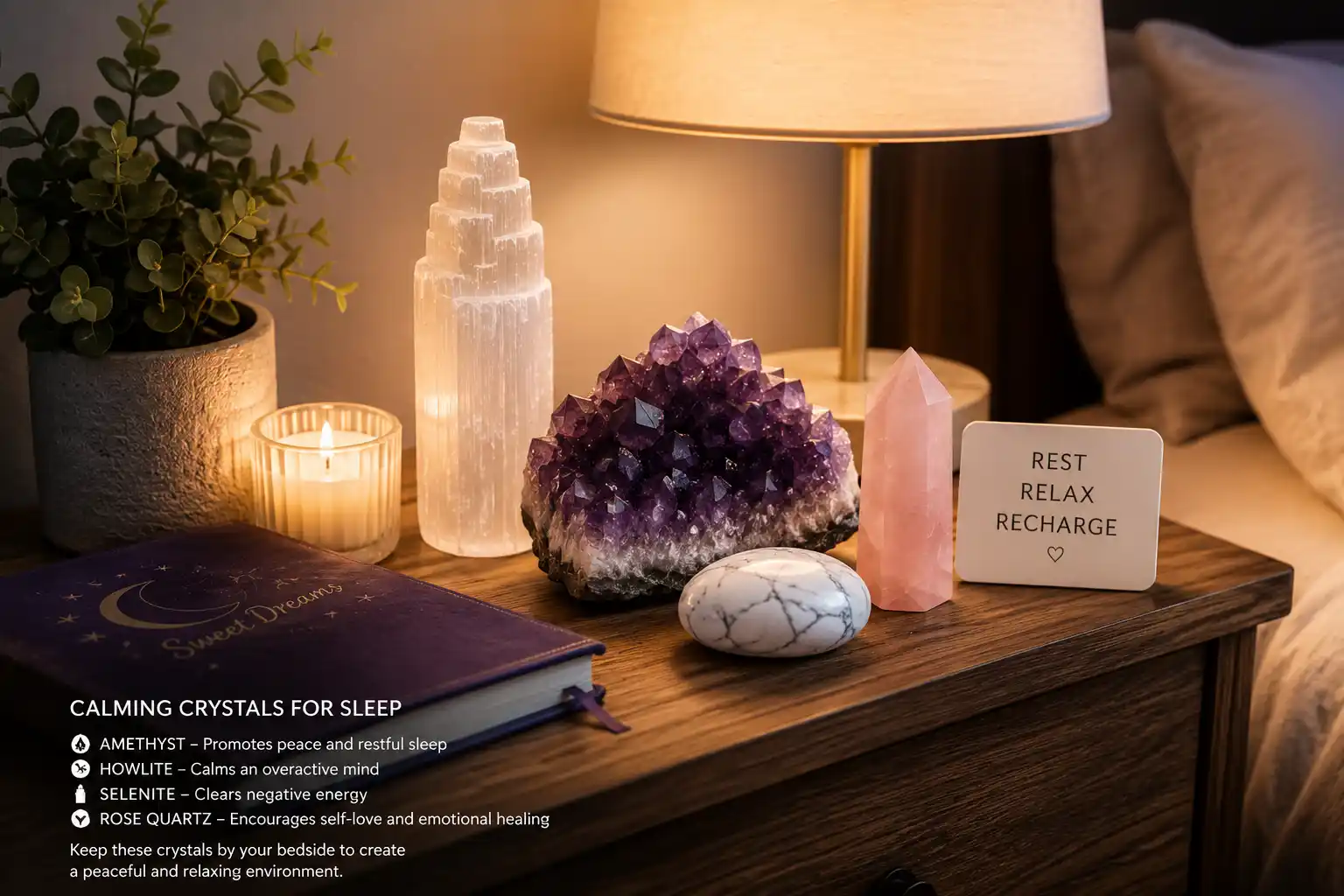
Best Crystals for Sleep and a Restful Night
Crystals for sleep are traditionally used as calming bedside symbols and reminders to maintain a consistent nighttime routine. They cannot sedate the body, cure insomnia or treat sleep apnea, but they may help establish a clear transition between daytime activity and rest.
Howlite suits a slower wind-down routine, while smoky quartz supports grounding when thoughts feel scattered. Lepidolite symbolizes simplification, rose quartz encourages a compassionate response to difficult nights and selenite can mark a quiet, uncluttered sleep environment.
Best Crystals for Sleep at a Glance
| Crystal | Traditional sleep theme | Best practical use | Main caution |
|---|---|---|---|
| Howlite | Patience and reduced reactivity | Beginning a slower bedtime routine | Porous and frequently dyed |
| Lepidolite | Transition and emotional steadiness | Ending work and digital activity | Soft and water-sensitive |
| Smoky quartz | Grounding and practical perspective | Returning attention to the present | Keep heavy pieces off the bed |
| Blue lace agate | Calm internal dialogue | Closing unfinished conversations | Protect from impacts and chemicals |
| Rose quartz | Compassion and emotional comfort | Responding gently to a difficult night | Does not treat insomnia |
| Moonstone | Cycles and emotional awareness | Tracking sleep-related patterns | May encourage dream focus for some people |
| Selenite | Peaceful-space symbolism | Marking a quiet bedside area | Soft and damaged by moisture |
| Chevron amethyst | Reflection and evening contemplation | Brief pre-sleep meditation | May increase dream attention for some users |
| Clear quartz | Intention and consistency | Defining one sleep-routine cue | Avoid assigning it many purposes |
| Sodalite | Logic and organized thought | Separating tomorrow’s tasks from bedtime | Keep away from drinks and soaking |
What Sleep Crystals Can Realistically Do
A crystal may become part of an environmental cue. When howlite appears beside a closed laptop, it can signal that work has ended. Smoky quartz may remind someone to stop problem-solving and return to present sensory details.
The stone itself does not produce sleep. Sleep depends on biological rhythms, health, environment, substances, medication and daily habits.
Therefore, a responsible practice evaluates whether the crystal supports the routine. Remove or reassign it when handling, cleansing or arranging the collection creates more stimulation than calm.
Sleep Versus Nightmares and Dream Recall
Sleep quality, nightmares and dream recall are related but distinct concerns.
The completed guide to crystals for nightmares focuses on grounding after frightening dreams and identifying when recurring nightmares need professional attention.
Meanwhile, crystals for vivid dreams and dream recall centers on remembering and reflecting on dreams. That intention may not suit someone who wants less nighttime stimulation or fewer remembered dreams.
A general sleep practice should emphasize the bedroom environment, wind-down routine and response to wakefulness rather than trying to control dream content.
1. Howlite for Beginning the Wind-Down Routine
Howlite is traditionally associated with patience, awareness and reduced reactivity. Its subdued white-and-gray appearance fits a calm bedroom setting.
Place howlite beside the location where work devices, planning materials or stimulating activities are put away.
Assign it one clear cue: the problem-solving part of the day has ended. Any unfinished task can be written down and addressed later.
Howlite does not make the brain switch off immediately. Its role is to mark a consistent behavioral transition.
Because it is porous and often dyed, keep it away from water, oils and harsh cleaning products.
2. Lepidolite for Simplifying the Evening
Lepidolite is traditionally connected with transition, calm and emotional steadiness. It suits evenings that contain too many inputs and responsibilities.
Use lepidolite near a short checklist with only essential steps: prepare for tomorrow, complete personal hygiene, reduce light and begin a quiet activity.
Avoid adding a long spiritual routine that must be completed perfectly. Pressure about sleep can make the evening feel like another performance task.
Lepidolite naturally contains lithium in its mineral structure, but holding it does not provide medication or treat insomnia, anxiety or bipolar disorder.
Its softness makes it unsuitable for soaking or loose storage beside harder stones.
3. Smoky Quartz for Nighttime Grounding
Smoky quartz is traditionally associated with grounding, release and practical perspective.
If thoughts become scattered, notice the stone’s weight, temperature, color and surface. Then identify the bed, room and present time.
Write down any task that genuinely needs attention tomorrow. Once it has been recorded, return to a quiet activity rather than continuing to plan.
Smoky quartz should remain on a secure bedside table. Heavy clusters, pointed pieces and loose stones do not belong in bedding.
4. Blue Lace Agate for Closing Mental Conversations
Blue lace agate is traditionally associated with calm and thoughtful communication.
A person may lie awake rehearsing an argument, composing messages or imagining several possible conversations. Blue lace agate can mark a brief writing period before bed.
Record the central issue and the next communication step. Then close the journal.
This approach does not resolve the conversation during the night. Instead, it confirms that the concern has a place and does not need to be rehearsed repeatedly while trying to sleep.
5. Rose Quartz for Compassion After a Difficult Night
Rose quartz represents compassion and emotional gentleness in modern crystal traditions.
Poor sleep often produces frustration and harsh predictions about the following day. Rose quartz can symbolize responding with a more proportionate plan.
Reduce nonessential demands when possible, prioritize safety and avoid describing one difficult night as proof that sleep will never improve.
Compassion does not mean ignoring persistent sleep problems. It includes seeking qualified care when the pattern continues or affects daily functioning.
6. Moonstone for Tracking Sleep Patterns
Moonstone is traditionally linked with cycles, dreams and emotional awareness.
Use moonstone beside a simple sleep diary. Record bedtime, waking time, major interruptions, daytime sleepiness and factors such as caffeine, alcohol, medication changes or unusual stress.
The record may help reveal patterns and provide useful information for a healthcare professional.
Moonstone’s dream symbolism can make some people pay greater attention to dreams. Remove it from the bedroom when that focus increases sleep anxiety or unwanted dream recall.
7. Selenite for a Calm Bedroom Cue
Selenite is traditionally associated with clarity, stillness and symbolic purification.
Place one stable piece in a dry location where it marks a low-clutter sleep environment. Keep the bedside surface free from unnecessary work materials, bright devices and unstable objects.
Selenite does not cleanse the bedroom scientifically or remove the medical causes of poor sleep. Its practical purpose is to support environmental consistency.
The stone is very soft and water-sensitive. Keep it away from humidifiers, drinks, damp windowsills and wet cleaning methods.
8. Chevron Amethyst for Brief Evening Reflection
Chevron amethyst combines bands of purple amethyst and white quartz. It is traditionally associated with contemplation and spiritual awareness.
Use it during a short evening meditation rather than an extended interpretive ritual. Notice the breath, record unfinished tasks and then allow planning to end.
Amethyst-related stones may make dream symbolism more prominent for some people. Although this is not a proven physiological effect, the personal response still matters.
Move the stone out of the bedroom when dreams feel more vivid, disturbing or mentally demanding.
9. Clear Quartz for a Consistent Sleep Intention
Clear quartz is commonly used for intention-setting. It works best when connected with one realistic sleep behavior.
Useful intentions include:
“I will begin winding down at the same time.”
“I will keep work outside the bed.”
“I will record sleep problems for my healthcare appointment.”
“I will use a quiet activity when lying awake becomes frustrating.”
Clear quartz cannot command the body to sleep. It keeps the selected routine visible.
10. Sodalite for Organizing Tomorrow’s Concerns
Sodalite is traditionally associated with logic, truth and organized thinking.
Keep it beside a small notepad used only for practical concerns. Write the task, the next action and when it will be reviewed.
This structure reduces the need to hold several unfinished responsibilities in working memory.
Sodalite is not a sedative. Its role is to give planning a defined endpoint before sleep.
Choosing a Sleep Crystal by Problem
| Sleep-related difficulty | Suggested crystals | Grounded routine |
|---|---|---|
| Difficulty ending work | Lepidolite and howlite | Create a fixed device and work cutoff |
| Racing thoughts | Smoky quartz and sodalite | Record concerns and use sensory grounding |
| Rehearsing conversations | Blue lace agate | Write one next communication step |
| Frustration about poor sleep | Rose quartz | Use a compassionate next-day plan |
| Inconsistent routine | Clear quartz and howlite | Attach the wind-down to a regular time |
| Disturbing dreams | Smoky quartz and rose quartz | Orient toward present facts after waking |
| Excessive dream focus | Smoky quartz | Remove stimulating dream-related stones |
| Cluttered bedroom | Selenite and clear quartz | Simplify the immediate sleep area |
| Emotional transition | Lepidolite and moonstone | Track patterns without demanding instant calm |
| Evening spiritual practice | Chevron amethyst and selenite | Keep reflection short and low-stimulation |
Building a Sleep-Supportive Environment
A sleep-friendly bedroom generally feels quiet, dark, cool and physically safe. The exact setup varies according to health, climate and personal comfort.
Keep work materials away from the bed when possible. Likewise, reduce light and unnecessary digital stimulation before attempting sleep.
A crystal arrangement should remain small and stable. A bedside surface crowded with towers, lamps, candles and many loose stones may create more risk and visual stimulation than comfort.
The stone should support the room rather than dominate it.
A Simple Crystal Wind-Down Routine
Choose one crystal and begin the routine at a consistent time.
Put away work and write down unfinished responsibilities. Reduce lighting and complete a quiet activity such as reading or gentle reflection.
Observe the stone for a minute, then redirect attention toward the body and environment. Avoid searching for energetic sensations or signs that sleep is beginning.
Place the stone safely aside and continue the normal bedtime routine.
What to Do When Sleep Does Not Come
Trying harder to sleep can increase frustration. When lying awake becomes prolonged and distressing, a quiet activity outside the bed may be more helpful until sleepiness returns, provided moving is safe.
Keep lighting low and avoid starting work, intense exercise or emotionally stimulating media.
A smoky quartz or howlite stone can accompany this transition, but it should not become the focus of an elaborate ritual.
Return to bed when drowsiness begins rather than according to whether the crystal feels activated.
Crystals Under the Pillow
Placing crystals beneath a pillow is unnecessary and can cause pressure, discomfort or injury.
Small stones may become lost in bedding, while raw pieces can have sharp points or loose fragments. Heavy stones may also affect head or neck positioning.
Keep the crystal on a stable bedside surface instead. The symbolic purpose does not require continuous body contact.
The completed guide explaining whether crystals can be worn to sleep covers jewelry, loose stones and nighttime physical safety more fully.
Wearing Crystal Jewelry to Bed
Necklaces, bracelets and rings can catch on bedding, press against the body or become uncomfortable as hands and tissues swell overnight.
Remove long necklaces and rigid or pointed jewelry before sleep. A smooth pendant placed on the bedside table can retain its personal meaning without creating a snagging risk.
Skin irritation may come from metal, coatings, cords or accumulated residue rather than the gemstone itself.
Comfort and safety matter more than keeping the crystal in constant contact.
Sleep Crystals and Anxiety
Anxiety can affect sleep, while repeated poor sleep can increase worry about bedtime.
The completed guide to crystals for anxiety focuses more directly on grounding and worry-oriented routines. A sleep practice should remain centered on the nighttime environment and response to wakefulness.
Crystals cannot treat an anxiety disorder. Persistent worry, panic or fear of sleeping deserves qualified support.
Sleep Crystals and Inner Peace
Inner peace is a broader intention involving acceptance, values and emotional stability. Sleep requires a biological process that cannot be forced through calm thoughts alone.
The completed guide to crystals for inner peace may support daytime reflection, while a bedtime routine should remain simple and low-pressure.
A person does not need to feel completely peaceful before sleep becomes possible.
Sleep Crystals and Meditation
A brief meditation may help transition toward rest, but longer or highly interpretive practices can become stimulating.
The completed guide to crystals for meditation explains several focal-object methods.
For sleep, use a short practice with a clear ending. Avoid demanding visions, insights or a completely empty mind.
Stop when meditation increases distress, dissociation or physical discomfort.
Children and Sleep Crystals
Loose stones should remain outside a child’s bed and beyond the reach of children who may swallow or throw them.
A large, smooth display stone may be used only as an adult-managed symbolic object. The bedtime routine itself should remain developmentally appropriate and consistent.
Persistent snoring, breathing pauses, severe sleepiness, unusual movements or major behavioral changes deserve professional assessment.
Crystals cannot treat childhood insomnia, nightmares or sleep disorders.
Cleaning Bedside Crystals
Frequently handled stones can collect oils, dust and residue. Clean each mineral according to its properties.
Howlite, lepidolite and selenite should not be soaked. Moonstone and fluorite-like materials also need protection from impact.
The completed guide to cleansing crystals safely separates symbolic cleansing from physical cleaning.
Keep stones away from drinks, medication and food on the bedside table.
When Sleep Problems Need Professional Attention
Seek qualified help when difficulty sleeping continues, significantly affects daytime function or produces fear about going to bed.
Assessment is also important for loud snoring, breathing pauses, gasping, unusual movements, severe daytime sleepiness or falling asleep during unsafe activities.
Medication and health conditions can affect sleep. Do not stop prescribed treatment without consulting an appropriate professional.
Urgent symptoms, including breathing difficulty, chest pain, severe confusion or immediate risk of harm, require prompt medical assistance.
Conclusion
The best crystals for sleep support a simple nighttime routine rather than produce sedation. Howlite marks the wind-down period, lepidolite symbolizes transition and smoky quartz provides grounding. Rose quartz encourages compassion after a difficult night, while selenite and clear quartz can help define a calm environment and consistent intention.
Crystals cannot cure insomnia or sleep disorders. A safe bedroom, stable routine and appropriate professional assessment remain the foundations of restful sleep.
Frequently Asked Questions
1. What is the best overall crystal for sleep?
Howlite is one of the most versatile choices because it symbolizes patience and a slower mental pace. Smoky quartz may be better when grounding is the main need.
2. Can crystals make someone fall asleep?
No. Crystals do not sedate the body or guarantee sleep. They may only provide cues within a bedtime routine.
3. Which crystal is suitable for racing thoughts?
Smoky quartz supports sensory grounding, while sodalite can help organize tomorrow’s practical concerns.
4. Which stone is best for nightmares?
Smoky quartz and rose quartz can support grounding and emotional comfort. Recurring nightmares may require professional assessment.
5. Can amethyst cause vivid dreams?
Some people report greater dream attention with amethyst-related stones, although this is not a proven medical effect. Remove the stone if sleep feels worse.
6. Should sleep crystals be placed under the pillow?
No. Stones under a pillow can cause pressure, break or become lost. A stable bedside surface is safer.
7. Can I wear a crystal necklace while sleeping?
Removing necklaces is generally safer because they may catch, twist or press against the body during sleep.
8. How many sleep crystals should I use?
One or two stones are enough. A large collection may make the bedtime environment more stimulating.
9. Can sleep crystals help with insomnia?
Crystals cannot treat insomnia. Persistent difficulty falling or staying asleep should be discussed with a qualified professional.
10. How should sleep crystals be cleansed?
Use a method appropriate to the mineral. Howlite, lepidolite and selenite should not be soaked indiscriminately.
11. Can children use sleep crystals?
Loose stones should remain out of a child’s bed and reach. They can create choking, throwing and injury hazards.
12. When should poor sleep receive medical attention?
Seek help when sleep problems persist, impair daytime functioning or involve loud snoring, breathing pauses, severe sleepiness or unusual nighttime behavior.
Disclaimer: Crystals cannot treat insomnia, sleep apnea, nightmares or another sleep disorder. They should not replace medical assessment, therapy or prescribed treatment. Keep heavy, sharp and loose stones out of beds and children’s reach.