Types of Amethyst: Colors and Varieties Explained
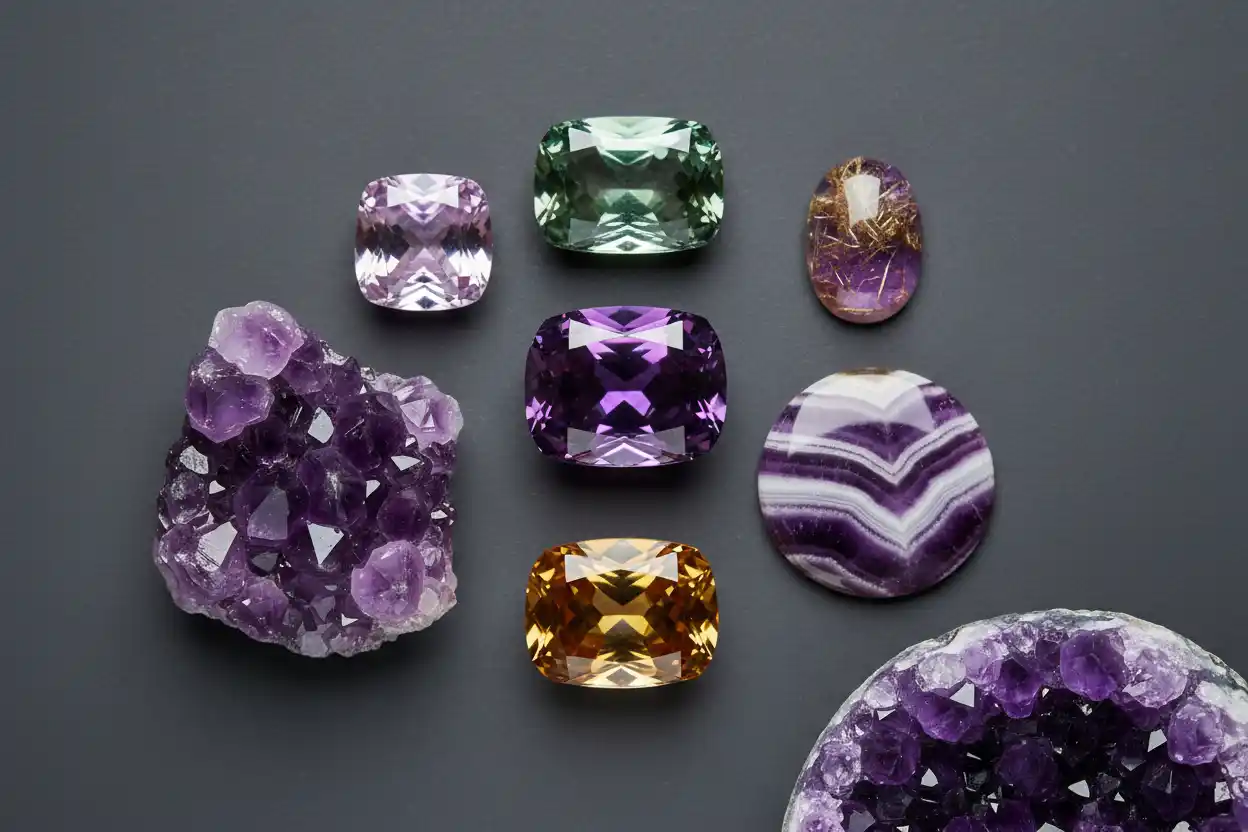
Amethyst is the purple variety of crystalline quartz. Its recognized commercial types are based on color depth, color zoning, crystal habit, inclusions, geographic source, association with other quartz colors, and whether the material is natural, treated, or laboratory-grown.
Deep reddish purple is the traditional faceted-gem ideal, while pale Rose de France, banded Chevron Amethyst, milky Cape Amethyst, smoky Brandberg crystals, Uruguayan geodes, Veracruz points, and cactus-like Spirit Quartz appeal to different collector and jewelry markets.
Many Amethyst names are trade descriptions rather than separate mineral varieties. “Siberian,” “African,” “Uruguayan,” “AAA,” and “Dream Amethyst” should therefore be treated as origin, appearance, or seller grades—not as distinct chemical species.
Amethyst at a Glance
| Property | Amethyst |
|---|---|
| Composition | Silicon dioxide, SiO₂, with iron-related color centers |
| Group or type | Purple macrocrystalline Quartz |
| Color range | Pale lilac, lavender, violet, purple, reddish purple, blue-purple, smoky purple |
| Crystal system | Trigonal |
| Crystal habit | Six-sided prisms, scepters, geode linings, clusters, massive veins, phantoms |
| Luster | Vitreous |
| Transparency | Transparent to opaque |
| Mohs hardness | 7 |
| Cleavage | None |
| Tenacity | Brittle |
| Common uses | Faceted gems, cabochons, beads, carvings, geodes, clusters, jewelry |
| Main care concern | Fractures, color fading under prolonged strong light, treatment, coatings, and silica dust |
What Is Amethyst?
Amethyst belongs to the Quartz family. Its purple color develops from iron-related structural defects combined with natural irradiation.
The Amethyst parent page owns the gem’s general history, properties, uses, and symbolism. This page separates the major color, pattern, locality, crystal-habit, and treatment categories.
All natural Amethyst has the same essential SiO₂ composition. Pale lilac, dark raspberry, banded Chevron, and smoky-purple crystals are varieties of appearance rather than separate mineral species.
Amethyst occupies a central place among types of gemstones, as well as the crystals that start with A and gemstones that start with A directories.
How Amethyst Types Are Classified
Amethyst names fall into five overlapping systems.
Color types describe lightness, saturation, hue, and modifiers. Examples include Rose de France, deep reddish purple, and smoky Amethyst.
Pattern types describe zoning or inclusions, such as Chevron, phantom, trapiche-like, or Cape Amethyst.
Crystal-habit types describe how crystals grow, including scepter Amethyst, cactus or Spirit Quartz, geode Amethyst, and druzy surfaces.
Locality names identify a source, such as Brazil, Uruguay, Zambia, Veracruz, Four Peaks, Morocco, Namibia, or the Ural Mountains.
Commercial and manufacturing names include Siberian-grade, green Amethyst, heat-treated Citrine, synthetic Amethyst, and coated material.
One crystal may fit several categories. A Namibian specimen can be Brandberg Amethyst, smoky Amethyst, phantom Quartz, and an included collector crystal at the same time.
Main Amethyst Varieties
| Amethyst type | Defining appearance | Main distinction |
|---|---|---|
| Deep purple Amethyst | Strong violet-to-reddish-purple color | Traditional faceted-gem ideal |
| Rose de France | Pale lilac or pinkish violet | Light elegant color rather than deep saturation |
| Siberian-grade Amethyst | Deep reddish or bluish purple with red flashes | Commercial color description; not proof of Russian origin |
| Zambian Amethyst | Often dark raspberry or blue-purple | Locality type known for strong saturation |
| Brazilian Amethyst | Broad range from pale to deep purple | Major global source; geodes and faceting rough |
| Uruguayan Amethyst | Commonly dark purple small crystals | Basalt geodes with concentrated color |
| Four Peaks Amethyst | Purple with red flashes or hematite inclusions | Arizona locality with restricted production |
| Veracruz Amethyst | Pale elongated prismatic crystals | Mexican collector variety |
| Moroccan Amethyst | Pale-to-medium crystals, often matrix specimens | Locality-defined collector material |
| Brandberg Amethyst | Clear, smoky, purple, phantom, and included zoning | Namibian collector crystals |
| Chevron Amethyst | V-shaped or zigzag purple-white bands | Banded Quartz, also called Dream Amethyst |
| Cape Amethyst | Purple Amethyst mixed with milky Quartz | Cloudy banded or mottled material |
| Spirit Quartz | Large Amethyst crystal coated with small points | South African cactus habit |
| Ametrine | Purple Amethyst and yellow Citrine in one crystal | Natural bicolor Quartz |
| Prasiolite | Green Quartz, often heated from Amethyst | “Green Amethyst” is only a trade synonym |
| Synthetic Amethyst | Laboratory-grown Quartz | Same general composition, manufactured origin |
Deep Purple Amethyst
The finest faceted Amethyst usually displays strong purple or reddish purple without obvious brown, bronze, grey, or uneven pale zones.
Medium-dark tone often provides the best balance. Overly dark material can appear black in ordinary lighting, while very pale material may lose visual impact.
Red flashes can appear when a well-cut stone moves beneath directional light. These flashes contribute to the traditional “Siberian” color ideal.
Deep color should remain attractive across the entire face. A dark border around a pale window does not equal fine saturation.
Large Amethyst can retain strong color because the material is abundant enough to supply substantial rough. Unlike many rare gems, carat weight alone does not create an exponential premium.
Rose de France Amethyst
Rose de France is a pale lilac, lavender, pinkish violet, or soft mauve Amethyst.
The name describes a color style rather than a French origin. Most commercial material comes from Brazil or other major Quartz-producing countries.
Fine Rose de France should look deliberately pale and evenly colored rather than washed out because of poor cutting.
Large transparent stones suit this variety because their subtle color remains visible without becoming excessively dark.
Rose cuts, checkerboards, large cushions, and briolettes are common jewelry choices.
The variety generally costs less per carat than strongly saturated fine Amethyst, though precision cutting and large clean sizes can raise the finished price.
Siberian Amethyst
Historic Russian Amethyst from the Ural Mountains included highly prized deep purple material with blue and red secondary flashes.
In modern trade, “Siberian” is often used as a color-grade description regardless of actual origin.
A Brazilian, Zambian, or Uruguayan stone may be marketed as Siberian-grade because of its appearance. That label does not establish Russian provenance.
True documented Ural Amethyst can carry mineralogical and historical value, especially as an old crystal specimen or antique gem.
For ordinary faceted stones, quality matters more than country. A seller should distinguish “Siberian color” from “mined in Russia.”
Brazilian Amethyst
Brazil is one of the world’s largest Amethyst producers. Deposits occur in basalt geodes, hydrothermal veins, pegmatites, and other geological settings.
Rio Grande do Sul is famous for large geodes and cathedral-shaped cavities lined with crystals. Minas Gerais, Bahia, Pará, and several other states also produce rough and specimens.
Brazilian material spans nearly colorless lilac through medium violet and dark purple.
Many large geodes contain pale crystal interiors or uneven zoning. Darker edges can be cut into faceted stones, while lighter sections become carvings, beads, and decorative slices.
Brazilian origin alone does not indicate low or high quality. Color, zoning, clarity, habit, and cutting remain decisive.
Uruguayan Amethyst
Uruguay is known for basalt-hosted geodes containing small, densely packed, dark purple crystals.
Artigas is the best-known producing region.
Uruguayan crystals often have richer saturation than typical large Brazilian geodes. However, individual points can be small, short, or attached to dark basalt matrix.
The material is commonly sold as clusters, geode halves, cathedrals, polished bases, and small faceting rough.
Calcite, Agate, Celadonite, and other minerals may occur with the Amethyst.
The term Uruguayan should describe documented source material rather than any dark geode with small crystals.
Zambian Amethyst
Zambian Amethyst is often associated with deep raspberry, blue-purple, and reddish-purple color.
It may contain more visible inclusions than Brazilian material, yet strong saturation can compensate for moderate inclusion levels.
Fine Zambian gems are commonly cut into ovals, cushions, pears, and emerald cuts.
Dark rough requires careful orientation. An excessively deep cut can become blackish, while a shallow design may produce a pale window.
The commercial phrase African Amethyst frequently includes Zambian material but can also refer to stones from Namibia, Tanzania, Morocco, and other countries.
African origin alone is not a standardized grade.
Four Peaks Amethyst
Four Peaks Amethyst comes from a restricted mountain deposit in Arizona.
The crystals occur in fractures and cavities within brecciated quartzite host rock.
Color ranges from pale to deep purple, sometimes with red flashes. Tiny reddish-brown hematite inclusions can provide locality clues.
Uneven color zoning and damaged crystal points reduce cutting yield.
Documented Four Peaks material has regional and collector appeal because production is limited and mining conditions are difficult.
A claim of Arizona origin should be supported by mine provenance rather than color alone.
Veracruz Amethyst
Veracruz Amethyst from Mexico is known for elegant elongated prismatic crystals.
The points commonly show pale lavender-to-medium purple color, transparent tips, and relatively slender proportions.
Matrix clusters can be highly aesthetic even when the color is lighter than faceted-gem Amethyst.
The value lies primarily in crystal habit, transparency, termination quality, and locality rather than dark saturation.
Broken points, glued crystals, and vague “Veracruz-style” labels require careful examination.
Moroccan Amethyst
Morocco produces Amethyst from several districts, including Boudi and other hydrothermal or volcanic environments.
Crystals can be pale lavender, medium purple, smoky, red-included, or associated with hematite and host rock.
Some specimens form isolated points on matrix, while others occur as geode or vein material.
Moroccan origin should not be treated as one uniform appearance because deposits differ.
Natural inclusions, crystal shape, matrix, and mine-level provenance contribute more than a generic country label.
Brandberg Amethyst
Brandberg Amethyst is associated with the Brandberg region of Namibia.
Collector crystals may combine Amethyst, Smoky Quartz, colorless Quartz, phantoms, fluid inclusions, enhydros, mineral inclusions, and complex growth zoning.
Some crystals display sharp purple phantoms inside a transparent outer layer. Others contain smoky bases, pale terminations, or scepter-like growth.
The Brandberg name belongs to a locality and collector tradition, not to a separate Quartz composition.
Fine pieces should have credible Namibian provenance. Similar included Quartz from other countries should not be relabeled solely because it resembles Brandberg material.
Chevron Amethyst
Chevron Amethyst contains repeated V-shaped, zigzag, or angular purple and white Quartz bands.
The white areas can be Milky Quartz, colorless Quartz, or zones with dense microscopic inclusions.
Dream Amethyst is an accepted trade-name synonym and should route back to Chevron Amethyst rather than receive a separate mineral identity.
The pattern is commonly visible in slabs, cabochons, towers, carvings, and spheres.
Fine material has sharp rhythmic bands and natural variation. Printed patterns, dyed fractures, and resin composites can imitate the appearance.
Cape Amethyst
Cape Amethyst is an older trade name for Amethyst mixed or intergrown with white Milky Quartz.
It commonly displays cloudy purple, white bands, irregular patches, and mottled zones rather than Chevron’s repeated V pattern.
The name was historically connected with southern African material, although it is now used more broadly.
Commercial pieces include beads, cabochons, carvings, and tumbled stones.
The white component can reduce transparency and produce an opaque decorative stone rather than a faceted gem.
Cape Amethyst should not be presented as a rare species or guaranteed locality without documentation.
Spirit Quartz and Cactus Amethyst
Spirit Quartz is a South African formation in which one larger Quartz crystal is coated along its prism faces by hundreds of smaller crystals.
Purple examples are Amethyst and may be called Spirit Amethyst or Cactus Amethyst.
The growth habit—not merely the purple color—defines the variety.
Ordinary Amethyst clusters have many crystals growing together from a matrix. Spirit Quartz has recognizable larger parent crystals beneath a later small-crystal coating.
The material usually remains a specimen. Cutting away the cactus texture destroys its defining feature.
Amethyst Geodes and Cathedrals
Amethyst geodes are cavities lined with crystals. Large sections cut upright and given a stable base are marketed as cathedrals.
Brazilian cathedrals can reach substantial sizes and commonly have basalt, Agate, and pale Quartz layers around the crystal cavity.
Uruguayan geodes are often smaller but darker.
Crystal color, coverage, point condition, cavity shape, associated Calcite, outer preparation, repairs, and shipping stability affect value.
Concrete, dye, paint, resin, and glued bases may be used during preparation. Their presence should be disclosed.
Druzy Amethyst
Druzy Amethyst consists of a surface covered with many tiny purple Quartz crystals.
The Druzy Quartz structure can form on Agate, chalcedony, matrix, or a larger Quartz surface.
Fine natural druzy sparkles evenly without obvious glue, glitter, or metallic coating.
Aura-treated druzy may display intense rainbow, blue, gold, or metallic colors created by a deposited surface film.
Druzy is a crystal-size and surface term, not a separate Amethyst chemistry.
Scepter Amethyst
Scepter Amethyst forms when a later, wider Quartz termination grows over the top of an earlier narrower crystal.
The result resembles a ceremonial scepter or mushroom-shaped cap.
Purple color may occur in the cap, stem, phantom zones, or throughout the crystal.
Reverse scepters have a wider early crystal followed by narrower later growth.
Scepter form is valued among mineral collectors, especially when the termination is complete and the zoning remains visible.
Phantom Amethyst
Phantom Amethyst contains one or more internal outlines marking earlier stages of crystal growth.
An earlier crystal surface was coated with Amethyst color, hematite, chlorite, clay, or other material before additional Quartz enclosed it.
The phantom can appear purple, smoky, red, green, white, or mixed.
A crystal may be both Brandberg Amethyst and phantom Quartz, or both Chevron Amethyst and phantom-like depending on its structure.
The term describes growth history rather than geographic origin.
Trapiche-Like Amethyst
Trapiche-like Amethyst displays six radial arms or sector boundaries around a central core.
The pattern can result from growth zoning, inclusions, and crystallographic sector development.
It is not a true biological star and does not require separate crystals glued together.
Natural trapiche-like structure is uncommon and should be distinguished from engraved, dyed, or assembled imitations.
A cut perpendicular to the crystal axis best reveals the six-part arrangement.
Ametrine
Ametrine contains both purple Amethyst and yellow-to-orange Citrine in one Quartz crystal.
The Anahí Mine in Bolivia is the principal commercial source of natural facetable Ametrine.
Sharp color boundaries and balanced purple-yellow distribution are desirable.
Heating and irradiation can produce bicolor Quartz experimentally and commercially, so a natural-origin claim deserves appropriate testing.
Ametrine should not be counted as merely a dark-and-light Amethyst grade because its yellow sectors have Citrine-type color.
Prasiolite or Green Amethyst
Prasiolite is pale green Quartz, commonly produced by heating selected Amethyst.
“Green Amethyst” is a trade synonym only. Gemologically, the material is Prasiolite rather than purple Amethyst.
Natural green Quartz of this type is rare. Most jewelry material has been heat treated or irradiated and heated.
The variety should not be confused with green glass, synthetic Quartz, Chrysoprase, Peridot, or green Beryl.
Because it has dedicated identification, price, cleaning, and buying pages, Prasiolite should remain outside the purple-variety core of this article.
Amethyst Heated into Citrine
Some Amethyst turns yellow, orange, red-brown, greenish, or nearly colorless when heated.
Much commercial Citrine is produced by heating Amethyst, particularly geode material.
Heated Amethyst often shows concentrated orange-brown color at crystal tips and a pale or white base.
Natural Citrine generally has a different geological color origin and often displays a lighter smoky-yellow or golden tone.
The distinction belongs in Citrine identification rather than treating all yellow heated Quartz as a permanent “type of Amethyst.”
Natural and Synthetic Amethyst
Hydrothermal synthetic Amethyst is widely available and can have the same general chemical composition, hardness, refractive properties, and purple color as natural material.
Laboratory-grown crystals develop around seed plates under controlled temperature and pressure.
Curved growth structures, seed remnants, synthetic twinning patterns, unusual inclusions, and infrared spectroscopy help separate origins.
Some synthetic Amethyst is exceptionally clean and evenly colored, making unaided visual identification difficult.
A synthetic stone can be attractive and durable, but it should not receive natural-origin pricing.
Treatments and Coatings
Heating can lighten overly dark Amethyst, remove brown modifiers, turn selected material yellow or green, or bleach the stone.
Irradiation can create or restore color centers in suitable Quartz.
Dye can enter fractures and pale porous material. Strong color around cracks or drill holes raises concern.
Fracture filling is uncommon but possible. Resin can improve the appearance of surface-reaching cracks.
Metallic aura coatings produce rainbow, blue, pink, green, or gold surfaces. Coated Amethyst is still natural Quartz beneath the deposited film, but the visible effect is artificial.
Detailed treatment detection belongs on treated Amethyst.
Amethyst Value and July 2026 Asking Prices
Detailed valuation belongs on the dedicated Amethyst price page.
As of July 2026, pale or commercial faceted Amethyst commonly carries asking prices around $1–$6 per carat.
Better saturated eye-clean stones often appear around $6–$20 per carat.
Fine reddish-purple, precision-cut, locality-documented, or unusually well-matched stones can ask approximately $20–$80 per carat.
Ordinary clusters and small geodes commonly range from $15–$100, while large cathedrals, exceptional specimens, rare habits, and important localities can reach hundreds or thousands of dollars.
Origin alone does not set value. Color, zoning, transparency, cutting, crystal condition, treatment, and craftsmanship remain more important.
Buying the Right Amethyst Type
The dedicated Amethyst buying guide owns detailed purchase guidance.
For a faceted stone, inspect it face-up and table-down against white paper. The second view reveals color zoning and pale areas hidden by the cut.
For a crystal or geode, request front, back, base, and close-up photographs. Repairs, concrete, glue, paint, and broken points can be hidden in one staged view.
A “Siberian,” “African,” “AAA,” or “Uruguayan” label should be explained rather than accepted as a universal grade.
The dedicated real vs fake Amethyst guide covers synthetic Quartz, glass, dye, coatings, and misidentified purple stones.
As the traditional February birthstone, Amethyst appears in a wide range of jewelry. A protected Amethyst ring can tolerate regular wear, while an Amethyst necklace, Amethyst earrings, or Amethyst bracelet creates different exposure to impact and abrasion.
Cleaning and Storage
Detailed care belongs on how to clean Amethyst jewelry.
Use lukewarm water, mild soap, and a soft brush or cloth. Rinse briefly and dry thoroughly.
Avoid sudden temperature changes, strong acids, bleach, abrasive powders, and unnecessary steam.
Hand cleaning is safest for fracture-filled, coated, dyed, repaired, or heavily included material.
Prolonged intense sunlight or heat can fade some Amethyst. Do not leave valuable specimens permanently in a bright window.
Store faceted stones away from Sapphire, Topaz, and Diamond, which can scratch Quartz.
Frequently Asked Questions
1. How many types of Amethyst are there?
There is no fixed number because names can describe color, pattern, locality, crystal habit, treatment, or commercial grade.
2. What is the finest Amethyst color?
Strong reddish purple or balanced purple without visible brown, grey, bronze, or disruptive color zoning is traditionally preferred.
3. Is Rose de France natural Amethyst?
Yes. It is a pale lilac-to-pinkish-violet Amethyst color style rather than a separate mineral.
4. Does Siberian Amethyst always come from Russia?
No. “Siberian” is often used as a color description, so genuine Russian origin requires documentation.
5. What is Dream Amethyst?
Dream Amethyst is a trade-name synonym for Chevron Amethyst.
6. Is Cape Amethyst the same as Chevron Amethyst?
Not exactly. Cape Amethyst usually has irregular milky-white and purple mixing, while Chevron Amethyst shows repeated V-shaped bands.
7. Is Brandberg Amethyst a separate mineral?
No. It is locality-defined Namibian Quartz known for purple, smoky, clear, phantom, and inclusion-rich crystals.
8. Is Spirit Quartz a type of Amethyst?
Purple Spirit Quartz is Amethyst with a distinctive cactus-like second-generation crystal coating.
9. Is Ametrine a type of Amethyst?
It is bicolor Quartz containing both Amethyst and Citrine zones.
10. Is Green Amethyst really Amethyst?
Green Amethyst is a commercial synonym for Prasiolite, usually produced by heating selected Amethyst.
11. Is synthetic Amethyst common?
Yes. Hydrothermal synthetic material is widely available and can require laboratory testing to distinguish from natural Quartz.
12. What most affects Amethyst value?
Color saturation, hue, zoning, clarity, cut, crystal habit, locality evidence, treatment, condition, and craftsmanship determine value.
Amethyst types are most useful when they describe an observable property or documented source. Deep-purple faceting rough, pale Rose de France, Chevron bands, a Brandberg phantom, a Veracruz point, and a South African Spirit Quartz cluster all belong to the same Quartz variety, yet each deserves evaluation under a different set of quality factors.
Amethyst is crystalline silica. Cutting, drilling, grinding, carving, or dry-polishing can release respirable silica dust capable of causing serious lung disease. Use wet methods, effective local exhaust ventilation, sealed eye protection, suitable respiratory protection, and controlled cleanup.