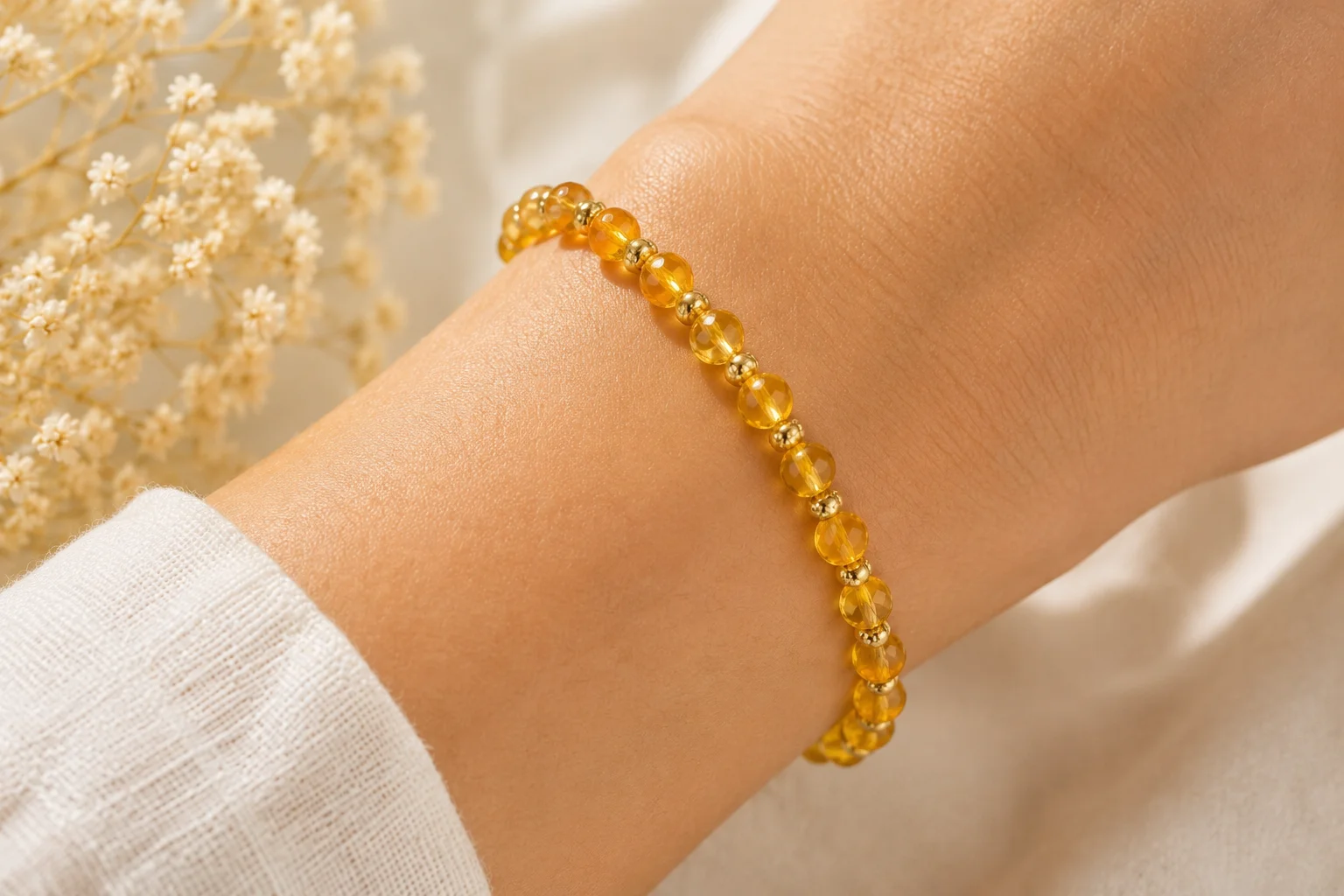
Citrine Bracelet: Styles, Fit & Buying Guide
A citrine bracelet combines the warm yellow-to-orange color of quartz with a jewelry format that receives considerably more physical contact than earrings or necklaces. That distinction matters when choosing one. Citrine has useful jewelry durability at Mohs 7 and lacks prominent cleavage, but a bracelet repeatedly touches desks, clothing, bags, door frames, watches, other jewelry, cosmetics, and household surfaces, so fit, construction, stone protection, stringing, clasp quality, and treatment disclosure deserve as much attention as color.
Most commercial citrine is natural quartz whose color has been changed by heating suitable amethyst, while natural-color citrine is less common. Heat-treated material is not automatically inferior or fake, but the treatment should be represented accurately. Buyers wanting the broader mineral and symbolism background can use the citrine meaning guide, while this page stays focused on choosing, fitting, wearing, and maintaining a citrine bracelet.
Citrine Bracelet at a Glance
| Feature | What to Look For |
|---|---|
| Gemstone | Yellow-to-orange quartz |
| Mohs hardness | 7 |
| Cleavage | None in the conventional gemological sense |
| Toughness | Generally good, but sharp impacts can still chip quartz |
| Common formats | Beaded, stretch, chain, station, tennis, charm, cuff |
| Common treatment | Heat-treated amethyst |
| Main bracelet risk | Repeated impact and surface abrasion |
| Best everyday designs | Low-profile beads, protected settings, secure flexible construction |
| Fit priority | Enough movement for comfort without excessive sliding |
| Hardware priority | Secure clasp, smooth links, strong stringing or elastic |
| Main maintenance issue | Dirt, lotion, soap and wear around drill holes or settings |
The gemstone hardness chart places citrine at 7, while gemstone toughness versus hardness explains why that number does not make a citrine bracelet immune to chips, fractures, or setting damage.
Is Citrine Durable Enough for a Bracelet?
Citrine is reasonably practical for bracelets, but the format is more demanding than many buyers realize. Quartz resists scratching better than softer jewelry stones such as fluorite, calcite, apatite, and many ornamental materials, yet bracelets receive frequent surface contact because the wrist naturally rests against desks, tables, counters, steering wheels, and other objects.
A well-made citrine bracelet can therefore handle regular careful wear, but it should not be treated like an indestructible sports accessory. Faceted stones can develop worn facet edges, exposed girdles can chip, and beads can fracture around drill holes after repeated impact.
Bracelet construction changes the risk substantially. A low beaded strand generally distributes impact better than a tall prong-set design, while a tennis-style citrine bracelet depends on dozens of small settings remaining secure. A rigid cuff with one large exposed stone can place much more impact stress on the citrine than a flexible station bracelet.
Citrine Bracelet Styles
The best style depends on how often the bracelet will be worn and how much maintenance the wearer accepts.
Beaded Citrine Bracelet
A beaded citrine bracelet is one of the simplest forms. Round, faceted, nugget, chip, or barrel-shaped stones are drilled and strung on elastic, cord, or wire.
Round polished beads are generally more practical than sharply faceted or irregular chips because smooth surfaces have fewer vulnerable edges. Larger beads create more visual impact but also add weight and strike surrounding surfaces more easily.
Inspect drill holes carefully. Chips, cracks, rough interiors, or very thin walls around the hole can shorten the life of a citrine bracelet even when the rest of each bead looks excellent.
Stretch Citrine Bracelet
Stretch bracelets prioritize convenience because no clasp is required. Their weak point is usually the elastic rather than the citrine.
Repeated stretching, body oils, cosmetics, heat, and age gradually weaken elastic. A bracelet that has become unusually loose, develops visible gaps between beads, or shows fraying near the knot should be restrung before it breaks.
Do not stretch a citrine bracelet far beyond the width of the hand. Roll it gently over the hand instead of pulling the elastic aggressively.
Citrine Chain Bracelet
A chain design may use one citrine, several stations, dangling charms, or wire-wrapped stones.
This format can feel lighter than a full bead strand and gives more control over fit. However, every jump ring, wire wrap, setting, and soldered connection becomes a possible maintenance point.
Check whether decorative stones can strike each other when the bracelet moves. Repeated gem-to-gem contact can gradually damage edges.
Citrine Tennis Bracelet
A tennis-style citrine bracelet uses a continuous or near-continuous row of faceted stones.
It can create an elegant, bright appearance, but setting quality is critical. Every stone needs sufficient metal support, and the flexible joints between links must move smoothly without allowing neighboring settings to collide.
Look for:
- Even gemstone spacing.
- Secure prongs or bezels.
- Straight alignment.
- A dependable clasp.
- A safety latch where appropriate.
- Smooth articulation between links.
One weak link can compromise the entire bracelet.
Citrine Charm Bracelet
Charm bracelets use citrine as individual drops, beads, or set accents.
They allow more movement than fixed settings, which creates visual interest but also increases impact. A citrine charm should not repeatedly strike heavy metal charms or harder gemstones.
If symbolism rather than continuous gemstone coverage is the priority, one well-protected citrine charm may be more practical than several exposed stones.
Citrine Cuff or Bangle
Rigid bracelets can showcase one large citrine or several stones in a structured design.
Because cuffs and bangles do not conform to the wrist like flexible bracelets, they can rotate and strike hard surfaces more forcefully. Low-profile bezels are generally more practical than high baskets or tall prongs.
A large center stone should sit securely without making the bracelet excessively top-heavy.
Choosing Citrine Color
Citrine ranges from pale straw and lemon-yellow through honey, gold, orange, reddish orange, and brownish orange.
The types of citrine guide explains these color categories and trade descriptions in more detail.
For a citrine bracelet, consistency matters differently depending on the design. A tennis bracelet usually looks more refined when neighboring stones match reasonably well in hue, tone, and saturation. A bead bracelet can intentionally graduate from pale yellow to deeper orange.
Very dark citrine may look attractive under strong display lighting but appear brown or nearly opaque indoors. Evaluate photographs under neutral light rather than judging color from one highly saturated image.
“Madeira citrine” is a commercial color description for rich orange-to-reddish material. It does not prove geographic origin or untreated natural color.
Natural Citrine vs Heat-Treated Amethyst
Most citrine sold commercially is produced by heating suitable amethyst. The treatment changes the quartz color while preserving its basic mineral identity and hardness.
Natural-color citrine is less common and often appears pale yellow, smoky yellow, champagne, honey, or restrained orange.
The treated citrine guide explains the treatment distinctions, while real vs fake citrine covers natural quartz, heated amethyst, synthetic quartz, and glass imitations.
For a citrine bracelet, treatment disclosure matters more than insisting that every stone must be untreated. Heat-treated quartz can make attractive and durable jewelry. The problem is paying a natural-color premium for material that has been represented inaccurately.
Ask the seller whether the stones are:
- Natural-color citrine.
- Heat-treated natural quartz.
- Laboratory-grown quartz.
- Coated quartz.
- Dyed material.
- Glass or another imitation.
A vague description such as “100% natural crystal” may refer to the quartz itself without explaining how the yellow color formed.
How to Choose Citrine Bracelet Bead Size
Bead size affects weight, comfort, appearance, and impact exposure.
Small beads create a lighter bracelet with greater flexibility. Medium beads offer more visible color without becoming cumbersome. Large beads create a statement look but can feel heavy and collide more frequently with hard surfaces.
Wrist size also matters. Very large beads shorten the bracelet’s usable inner circumference because the beads occupy more space toward the inside of the circle.
That means two citrine bracelets with the same measured outer length may fit differently if one uses small beads and the other uses substantially larger stones.
For online purchases, ask for both bead diameter and finished inner circumference rather than relying on a generic small, medium, or large label.
How Should a Citrine Bracelet Fit?
A citrine bracelet should move slightly without sliding continuously over the hand.
Measure the wrist where the bracelet will normally sit using a flexible tape or a non-stretch cord that can later be measured against a ruler. Measure close to the skin without compressing it.
Then allow additional room according to the desired fit and bracelet construction.
| Fit | Practical Result |
|---|---|
| Close | Minimal movement; useful for small smooth beads |
| Standard | Comfortable movement without excessive sliding |
| Loose | More movement and drape; greater chance of impact |
Large beads, charms, and wide rigid designs usually need more allowance than thin chains.
A bracelet that is too tight places unnecessary pressure on elastic, drill holes, links, and skin. A bracelet that is excessively loose can slide over the hand, catch objects, and strike surfaces more frequently.
Fit is therefore a durability issue as well as a comfort issue.
Elastic, Cord, Wire, or Chain?
The gemstone may receive most of the attention, but stringing material often determines how long a citrine bracelet lasts.
Elastic
Convenient and easy to wear, but it eventually stretches and degrades. Check it regularly.
Jewelry Wire
Multi-strand coated wire provides more structural support than ordinary thread for heavier beads. Crimp quality becomes important.
Cord
Suitable for knotted or casual designs. Cord should be smooth enough that rough drill holes do not cut through it rapidly.
Metal Chain
Allows adjustable fit and sophisticated settings but creates more links, solder joints, and clasp components requiring inspection.
No stringing system lasts indefinitely.
If the stones are valuable or personally important, preventive restringing is better than waiting until a weakened bracelet breaks.
Choosing the Clasp
A clasp should be easy enough to use but secure enough that accidental opening is unlikely.
Lobster clasps are common because they provide good security in a compact size. Spring-ring clasps are lighter but can be difficult for some wearers to operate. Box clasps work well in tennis-style bracelets and are stronger when combined with an additional safety mechanism.
Magnetic clasps are convenient but deserve more caution for valuable citrine bracelets because a strong pull can separate them more easily than a mechanical lock.
Toggle clasps depend heavily on correct proportions. If the bar is too short relative to the ring, the bracelet can open when slack develops.
Inspect the clasp as carefully as the gemstones.
Choosing Metal for a Citrine Bracelet
Yellow gold reinforces warm golden citrine tones, while white gold, platinum, and silver create stronger contrast. Rose gold can complement orange and reddish citrine particularly well.
Metal choice should also consider wear, allergy history, plating, and hardware quality.
Sterling silver can tarnish but is practical when well constructed. White gold may contain nickel depending on the alloy, while plated jewelry can eventually expose the underlying metal at high-friction areas.
People concerned about metal sensitivity can use the gemstones and metals for sensitive skin guide to evaluate alloys and plating rather than assuming that a visually white or yellow metal has a specific composition.
Construction quality matters more than prestige. A secure sterling-silver bracelet can protect citrine better than poorly made gold hardware.
Citrine Bracelet vs Ring, Earrings, and Necklace
Jewelry format changes the wear problem.
A citrine ring receives strong impact and abrasion because the hand contacts hard surfaces constantly. It also requires careful setting height and finger sizing.
Citrine earrings experience much less impact, making them suitable for larger or more exposed stones, but pair matching, post construction, backs, and weight become important.
A citrine necklace faces relatively little impact but introduces chain length, pendant balance, clasp position, and neckline considerations.
A citrine bracelet sits between these formats. It usually faces more abrasion than earrings or necklaces, while fit, clasp security, flexibility, drill-hole condition, and repeated desk contact become unusually important.
These distinctions are why bracelet-specific buying guidance should not simply repeat a generic citrine jewelry article.
Citrine Bracelet as November Birthstone Jewelry
Citrine shares November birthstone status with topaz.
The November birthstone guide explains the two stones, while the November birthstone jewelry guide compares practical gift formats.
A citrine bracelet works particularly well as a birthstone gift because sizing is more forgiving than a ring when the bracelet includes adjustable chain links or flexible construction.
However, birthstone status says nothing about whether the citrine is natural-color, heat-treated, synthetic, or imitation. Treatment and identity should still be evaluated independently.
Buying a Citrine Bracelet Online
Start with the stone, then evaluate the bracelet as a complete mechanical object.
The citrine buying guide covers gemstone quality, while the citrine price guide explains factors that influence value.
For the bracelet itself, request:
- Exact wrist or inner circumference.
- Bead or stone dimensions.
- Total bracelet weight.
- Metal type and purity.
- Plating disclosure.
- Clasp type.
- Stringing material.
- Treatment disclosure.
- Close photographs of drill holes or settings.
- Front and back photographs.
- Return terms.
For unfamiliar sellers, the broader guide to buying gemstones online provides useful checks for photographs, disclosure, documentation, and returns.
Do not pay a premium simply because a listing uses terms such as healing grade, manifestation quality, rare prosperity stone, or natural energy bracelet. Those phrases are not gemological grades.
Citrine Bracelet Symbolism
Citrine is traditionally associated with optimism, confidence, generosity, motivation, and prosperity symbolism.
A citrine bracelet can make those themes especially visible because it remains within the wearer’s line of sight throughout the day.
A grounded use is to connect the bracelet with a measurable action.
If the symbolism is financial responsibility, it might represent following a budget.
If the theme is confidence, it can represent preparing thoroughly before an important conversation.
If the theme is creative momentum, it can represent completing one defined task instead of waiting for perfect inspiration.
Wearing a citrine bracelet does not scientifically attract money, guarantee business success, change luck, or produce financial returns. Symbolism is most useful when it reinforces behavior rather than promising an outcome.
How to Clean a Citrine Bracelet
For uncomplicated citrine and durable metal settings, warm water, mild soap, and a soft brush or cloth are usually sufficient.
However, a bracelet contains more than quartz.
Elastic, cord, glue, plating, fracture filling, coatings, soft accent gems, and antique components can all require more conservative care.
The dedicated guide to cleaning citrine jewelry covers the full process.
For routine maintenance:
- Remove surface grit before wiping.
- Clean gently around drill holes and settings.
- Rinse away soap residue.
- Dry the bracelet completely.
- Check prongs, links, crimps, elastic, and clasps before wearing it again.
Avoid steam cleaning because unnecessary heat can create problems for quartz and jewelry construction. Ultrasonic cleaning should not be used automatically when treatment, fillings, fractures, glue, or other gemstones are unknown.
When to Remove a Citrine Bracelet
Remove a citrine bracelet before activities that combine impact, chemicals, abrasion, or unnecessary moisture.
That includes:
- Exercise.
- Gardening.
- Cleaning.
- Swimming.
- Contact sports.
- Manual work.
- Applying lotions or perfume.
- Sleeping when the design can snag or stretch.
Soap and skincare products can collect around beads, drill holes, and settings, making transparent citrine appear dull even when the gemstone itself is undamaged.
Repeated desk contact is also worth noticing. People who type or work at a computer for long periods may find that a heavy bead bracelet repeatedly strikes the work surface. Moving it to the non-dominant wrist or removing it during concentrated desk work can reduce wear.
Storing a Citrine Bracelet
Store the bracelet separately from harder gemstones such as sapphire, ruby, and diamond.
Although citrine is reasonably hard, those materials can scratch it.
Do not leave an elastic bracelet hanging from one point because the weight of the stones can stretch the cord over time. Lay it flat or place it loosely in a compartment.
Keep citrine away from prolonged intense sunlight and excessive heat because some quartz colors can fade or change under unfavorable conditions.
A soft pouch or divided jewelry box also keeps clasps and metal edges from rubbing directly against polished stones.
Frequently Asked Questions
Is a citrine bracelet suitable for everyday wear?
A citrine bracelet can handle regular careful wear because quartz ranks 7 on the Mohs scale and generally has good toughness. Bracelets still receive frequent impact and abrasion, so remove them for exercise, cleaning, gardening, swimming, and manual work.
Is most citrine bracelet jewelry heat-treated?
Much commercial citrine is heat-treated amethyst. The material remains natural quartz, but the treatment should be disclosed rather than represented as rare untreated natural-color citrine.
Is heat-treated citrine fake?
No. Heat-treated amethyst remains genuine quartz. It becomes misleading when a seller represents treated color as untreated geological color.
What is the best citrine bracelet style for frequent wear?
Low-profile smooth beads, protected station settings, and well-made bezels are generally more practical than large exposed stones or high prong settings.
How tight should a citrine bracelet be?
It should have enough room for comfortable movement without constantly sliding over the hand. Large beads and rigid designs need more fit allowance than thin chains.
Why does bead size affect bracelet fit?
Large beads occupy more space toward the inside of the bracelet, reducing usable inner circumference. Always compare bead diameter with the finished wrist measurement.
Are stretch citrine bracelets durable?
They can be practical, but elastic is a wear component and eventually needs replacement. Roll the bracelet over the hand rather than stretching it excessively.
What should I check around citrine bead holes?
Look for chips, fractures, sharp edges, thin walls, or rough drilling. Damage around the hole can weaken the bead and cut stringing material.
Can I shower with a citrine bracelet?
Solid quartz tolerates brief water exposure, but soap, elastic, cord, glue, plating, clasps, and other components may not. Removing the bracelet before showering generally preserves both appearance and construction.
Can a citrine bracelet go in sunlight?
Ordinary brief daylight is different from prolonged intense exposure. Long-term strong sunlight or heat may alter some citrine colors, so continuous windowsill storage is best avoided.
Does a citrine bracelet attract money?
There is no scientific evidence that wearing citrine produces wealth, customers, employment, investment returns, or financial luck. Prosperity symbolism can instead represent planning, discipline, generosity, or responsible financial habits.
How can I tell if a citrine bracelet is real?
Evaluate whether the stones are actually quartz, then determine whether the color is natural, heat-treated, synthetic, coated, or imitated. Visual clues can help, but treatment origin may require professional examination.
Is a citrine bracelet a good November birthstone gift?
Yes. Citrine is one of the recognized November birthstones, and adjustable or flexible bracelet designs can be easier to gift than rings because exact finger sizing is unnecessary.
What affects the price of a citrine bracelet?
Stone color, transparency, cut, size, natural versus treated color, metal quality, clasp, craftsmanship, brand, and overall construction all influence price. Large size alone does not guarantee quality.
Should citrine beads all match?
Not necessarily. Formal designs generally benefit from consistent color and bead size, while intentionally graduated or mixed-tone bracelets can use natural variation as part of the design.
Choosing a Citrine Bracelet That Will Actually Be Worn
A good citrine bracelet is not simply the one with the deepest orange stones or the largest beads. It should fit the wrist correctly, remain comfortable for the intended wear period, use construction appropriate to the gemstone’s durability, and disclose what the stones and metal actually are.
Start with citrine’s real properties: quartz hardness around 7, useful toughness, no conventional cleavage, common heat treatment, and possible sensitivity to prolonged intense heat or light. Then evaluate what makes a bracelet different from other jewelry—movement, repeated desk contact, drill holes, elastic or wire, clasp security, link articulation, bead diameter, metal edges, and wrist fit.
When those practical details are handled well, a citrine bracelet can provide warm color, durable everyday styling, November birthstone significance, and optional personal symbolism without needing exaggerated claims. Choose the stone for its appearance, choose the construction for the way it will be worn, and choose the seller for clear disclosure.