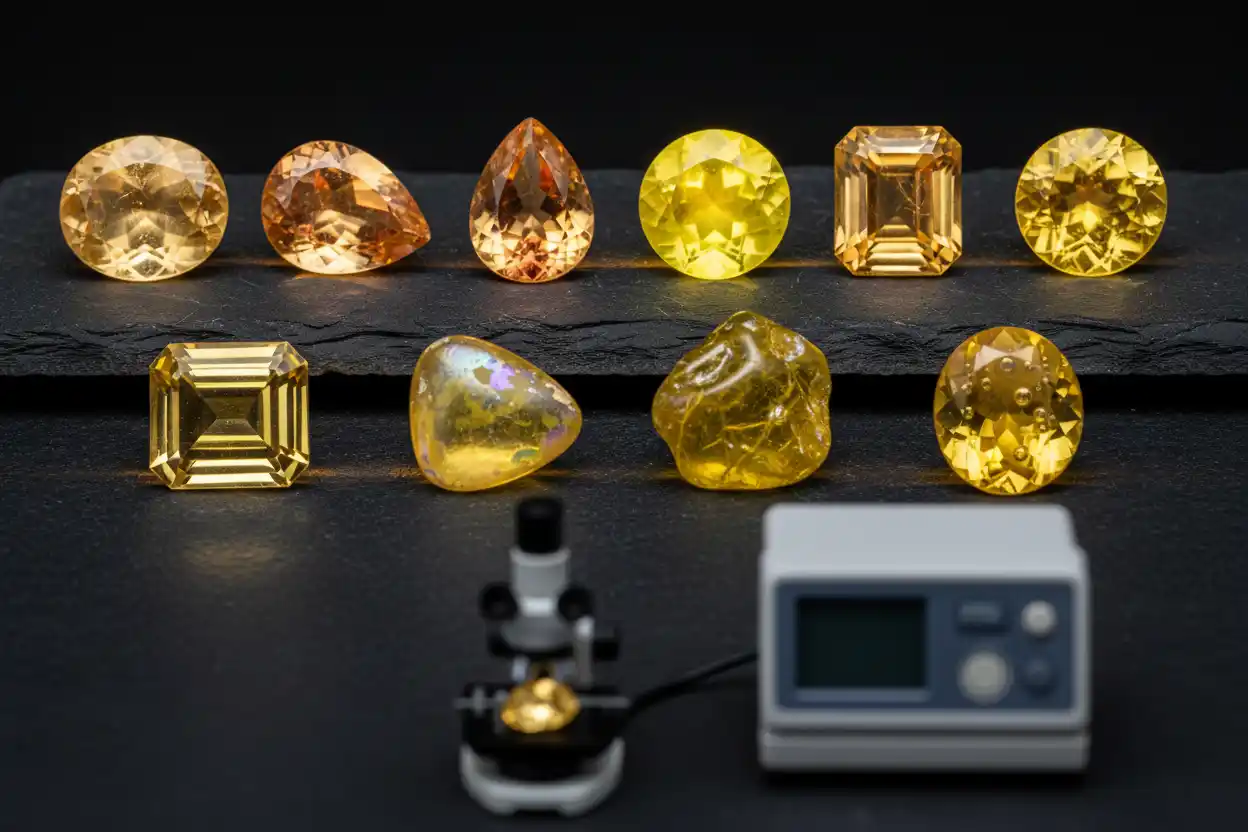
How to Spot Treated or Synthetic Citrine
Citrine is transparent yellow-to-orange quartz. Natural-color material exists, but it is comparatively uncommon. Most Citrine in the commercial market comes from heating Amethyst or other suitable iron-bearing quartz.
Heated natural quartz remains natural quartz, although its finished yellow or orange color was produced through treatment. Synthetic Citrine is a separate category: it is laboratory-grown quartz whose yellow color developed during growth or through later irradiation and heat.
Additional products can imitate or modify Citrine through coatings, dye, fracture filling, reconstruction, or glass. The greatest difficulty is that natural, treated-natural, and synthetic Citrine share quartz’s hardness, refractive index, density, and crystal structure.
The correct examination therefore confirms quartz first and then investigates how its color formed.
Citrine treatment categories at a glance
| Product category | What it is | Common evidence | Correct description |
|---|---|---|---|
| Natural-color Citrine | Naturally yellow-to-orange quartz | Natural growth and iron-related color | Natural Citrine |
| Heated Amethyst | Natural purple quartz converted to yellow or orange | Heat-altered inclusions, geode-tip pattern, treatment context | Heat-treated Citrine |
| Heated Smoky Quartz | Natural smoky material converted toward yellow or greenish yellow | Residual smoky zoning or treatment-related color | Heat-treated quartz |
| Irradiated yellow quartz | Quartz whose color centers were created through radiation | Spectroscopic color-center evidence | Irradiated quartz |
| Irradiated and heated Citrine | Quartz treated through combined processes | Color depends on defect chemistry and annealing | Treated Citrine |
| Coated Citrine | Quartz or another stone with yellow surface film | Edge wear, peeling, surface-only color | Coated gemstone |
| Dyed quartz | Fractured or porous quartz with introduced yellow dye | Dye in cracks, drill holes, pits, and grain boundaries | Dyed quartz |
| Fracture-filled Citrine | Cracks containing polymer, oil, wax, or glass | Flash effects, bubbles, filler spectrum | Filled Citrine |
| Hydrothermal synthetic Citrine | Laboratory-grown yellow quartz | Seed-related growth, synthetic inclusions, FTIR evidence | Synthetic Citrine |
| Synthetic Ametrine | Laboratory-grown or treated quartz with purple and yellow zones | Artificial growth or treatment pattern | Synthetic bicolored quartz |
| Glass imitation | Manufactured yellow or orange glass | Bubbles, flow lines, glass properties | Citrine simulant |
What natural Citrine is
Citrine belongs to the crystalline quartz family and has the composition SiO₂. Its yellow-to-orange color is associated with iron-related defects and structural processes within the crystal.
The broader species profile appears in Quartz: Types, Properties & Meaning, while Citrine’s geology and general appearance belong to Citrine: Meaning, Healing Properties & Uses.
Natural Citrine commonly appears pale yellow, smoky yellow, golden yellow, or yellow-brown. Rich orange and reddish-orange material can occur, but strong color should not automatically be interpreted as natural or treated.
The commercial color range belongs to Types of Citrine.
Most market Citrine is heated Amethyst
Amethyst and Citrine are both quartz varieties. Their colors reflect different arrangements or oxidation environments involving iron-related defects.
Heating suitable Amethyst can destroy the purple color center and create yellow, golden, orange, or reddish-orange material.
The result is commonly sold as Citrine because its finished appearance falls within the yellow-to-orange quartz category. It remains natural quartz, but the color was modified after mining.
The distinction is important because natural-color Citrine is rarer. However, heat-treated material is stable, attractive, and legitimate when described accurately.
The broad authenticity boundary appears in Real vs. Fake Citrine.
How heated Amethyst may look
Commercial geode clusters frequently show burnt-orange, reddish-orange, or brownish-orange crystal tips above a pale or white quartz base.
This pattern often reflects Amethyst geode material that was heated after mining. The color can be concentrated in the original purple growth zones, particularly near the terminations.
Some crystals develop opaque or chalky areas after strong heating. Internal iron-bearing inclusions may transform from yellow-brown goethite toward red-brown hematite, sometimes creating stress cracks.
These clues are useful but not universal. Faceting can remove the white base and obscure the original crystal form. Controlled lower-temperature treatment can also produce pale yellow material that looks less obviously heated.
A natural-color Citrine should not be authenticated merely because it lacks a burnt-orange appearance.
Heated Smoky Quartz
Suitable Smoky Quartz can also shift toward yellow, greenish yellow, or brownish-yellow after heating.
Smoky Quartz color arises primarily from radiation-induced defects associated with aluminum-bearing quartz. Heating can modify or destroy those centers, exposing other colors or producing new appearances.
Some resulting stones are sold as Citrine, Lemon Quartz, green-gold quartz, or other trade varieties.
The direct color-family comparison appears in Smoky Quartz vs Citrine.
A yellow-brown stone may occupy a genuine borderline between the two trade names. Dominant hue and transparent seller terminology are more useful than pretending every specimen has a sharp mineralogical boundary.
Irradiation
Quartz can be irradiated to create or modify smoky, purple, yellow, green, or multicolored color centers, depending on its impurities and subsequent heat treatment.
Artificial radiation may produce color directly or create a precursor that changes after controlled heating.
Natural quartz also experiences geological radiation. Consequently, natural and artificial treatment can create overlapping defects.
In some cases, laboratories cannot prove whether an equivalent color change occurred in nature or through human treatment. This limitation is especially relevant to bicolored and polychrome quartz.
The broad treatment vocabulary appears in Gemstone Treatments Explained.
Lemon Quartz
Lemon Quartz is a yellow-to-greenish-yellow trade material whose color may result from irradiation and heating of suitable quartz.
It should not automatically be treated as a natural Citrine variety. The color can lean cooler, greener, or more fluorescent-looking than ordinary golden Citrine.
The dedicated material profile appears in Lemon Quartz: Meaning, Properties & Symbolism.
A seller should state whether the product is natural-color Citrine, treated quartz, Lemon Quartz, coated quartz, or another yellow material rather than relying on interchangeable marketing names.
Yellow quartz is not always Citrine
Yellow appearance can come from several sources.
Some quartz is stained or included by iron oxides rather than colored throughout its crystal lattice. Coatings and dye can also make colorless quartz appear yellow.
The exact distinctions among Citrine, Lemon Quartz, and iron-stained material belong to Yellow Quartz Explained.
A surface-stained crystal may show yellow or orange concentrated in cracks, pits, coatings, or external iron deposits. It should not receive a transparent natural-Citrine description without confirming that the bodycolor belongs to the quartz itself.
Ouro Verde and green-gold quartz
Ouro Verde Quartz is a greenish-yellow or yellow-green treated quartz associated with irradiation and heating.
Its color sits outside the traditional warm yellow-to-orange Citrine range, although retailers may use Citrine-related terminology.
The material profile appears in Ouro Verde Quartz: Meaning, Properties & Symbolism.
The exact treatment history and stability should be disclosed because green-gold color may have different light and heat sensitivity from ordinary heated Citrine.
Artificial Ametrine
Ametrine contains adjacent purple Amethyst and yellow Citrine zones within one quartz crystal.
Natural Ametrine exists, but laboratory growth and combinations of irradiation and heating can also produce purple-yellow zoning.
A sharp boundary does not prove natural origin. The material can be natural, treated natural, synthetic, or a composite.
The broader bicolored profile appears in Ametrine: Meaning, Healing Properties & Uses.
Research has shown that equivalent natural and artificial heat-and-radiation histories may be impossible to separate conclusively in some quartz.
Hydrothermal synthetic Citrine
Synthetic quartz is grown commercially through hydrothermal methods.
Laboratory-grown yellow quartz may develop color during growth or receive later irradiation and heat. It shares natural Citrine’s composition, hardness, density, refractive index, and birefringence.
A scratch test or basic refractometer reading can confirm quartz but cannot establish geological origin.
Possible synthetic clues include a seed boundary, growth structures related to the seed orientation, breadcrumb-like particles, nail-head spicules, unusual fluid inclusions, or highly controlled zoning.
Modern synthetic material can be very clean. High-resolution FTIR and polarized-light examination may be necessary when inclusions are inconclusive.
The broader origin distinction appears in Lab-Grown vs Natural Gemstones.
Brazil-law twinning
Natural quartz commonly develops Brazil-law twinning. Polarized-light methods or immersion can reveal characteristic twinning patterns in suitable stones.
Historically, these structures have helped distinguish natural from hydrothermal synthetic quartz.
The test is not absolute. Some natural Citrine shows weak or difficult-to-observe twinning, while modern synthetic growth can produce increasingly complex structures.
A positive diagnostic pattern can support natural origin, but an inconclusive pattern should lead to spectroscopy rather than an assumption.
Coatings
Colorless quartz, pale Citrine, synthetic quartz, glass, or another gemstone can receive a yellow, orange, metallic, or iridescent coating.
Possible evidence includes stronger color on pavilion facets, peeling, scratches through the film, colorless chips, worn facet junctions, or coating protected under prongs.
A coated stone may be sold as Madeira Citrine, golden Citrine, sunset quartz, or a fantasy trade color.
The quartz core may be natural, but the surface-created color requires disclosure. Repolishing can remove the coating and radically change the appearance.
Dyeing
Quartz is not highly porous when intact, but surface-reaching fractures and induced crack networks can accept dye.
Dyed yellow crackle quartz commonly shows bright color following sharp fractures through an otherwise pale or colorless body.
In beads, color may concentrate around drill holes, pits, or damaged areas.
Stable dye does not necessarily bleed in water. Do not use acetone, bleach, alcohol, or acids as consumer tests because they can damage dye, filler, coating, adhesive, and settings.
Fracture filling
Surface-reaching fissures can be filled with polymer, oil, wax, or glass-like material.
Filled fractures may show blue, orange, purple, or yellow flash effects, bubbles, partial filling, or a smooth transparent substance across a rough crack.
Colored filler can also strengthen the apparent yellow or orange color.
Filling is less central to Citrine than heating, but it changes care requirements. High heat, solvents, ultrasonic vibration, and repair procedures can damage the filler.
Glass and other simulants
Yellow and orange glass can imitate Citrine in faceted jewelry, beads, carvings, and decorative clusters.
Glass may contain round bubbles, curved flow lines, mold seams, conchoidal chips, or worn facet junctions. Bubble-free glass remains possible.
The complete structural comparison appears in Glass vs. Crystal.
Yellow Topaz can overlap closely but has greater density, different refractive properties, and perfect cleavage. The focused distinction belongs to Citrine vs Yellow Topaz.
The completed How to Identify Crystals workflow explains why mineral identity should be established before treatment history is considered.
Natural versus synthetic testing
A gemologist first confirms quartz through refractive index near 1.544–1.553, specific gravity near 2.65, optical character, and spectrum.
Microscopy then examines growth zoning, twins, seed structures, inclusions, coating, dye, and filler.
High-resolution FTIR evaluates hydrogen-related features that can help separate natural and hydrothermal synthetic quartz.
UV-visible spectroscopy studies the yellow color center. Raman spectroscopy confirms quartz and identifies surface coatings or foreign substances.
Even with advanced testing, natural and artificial irradiation or heating may remain indistinguishable in certain stones.
Reports and market value
The Citrine Buying Guide owns color, clarity, cut, size, treatment, and seller selection. The Citrine Price Guide separates common heated material from fine faceted gems, documented natural-color crystals, and unusual collector specimens.
A laboratory report becomes worthwhile when the price depends on natural color, synthetic origin, rare zoning, prestigious provenance, or an unusually large clean gem.
The completed Gemstone Certification Labs Compared explains report options. Use How to Read a Gem Lab Report to understand cautious wording and analytical limitations.
Care for treated or synthetic Citrine
Sound natural, heated, or hydrothermal synthetic Citrine can usually be cleaned with warm water, mild soap, and a soft brush.
Avoid steam because sudden heat can fracture included quartz or alter unstable color centers.
Ultrasonic cleaning may be unsuitable when fractures, coating, dye, filler, or composite construction are present.
Prolonged intense sunlight and high heat can change certain quartz colors. Store valuable stones away from hot windows and strong display lamps.
The complete maintenance workflow appears in How to Clean Citrine Jewelry Safely.
Frequently Asked Questions
1. Is most Citrine heated?
Yes. Most commercial Citrine is produced by heating Amethyst or other suitable iron-bearing quartz.
2. Is heated Amethyst fake Citrine?
No. It is natural quartz with treatment-created yellow or orange color.
3. What does heated Amethyst Citrine look like?
Geode material commonly shows orange or brown crystal tips above white bases, although faceted and lower-temperature-treated stones can look less obvious.
4. Can Smoky Quartz become Citrine?
Yes. Heating suitable Smoky Quartz can produce yellow, greenish-yellow, or brownish-yellow material.
5. Can irradiation create Citrine?
Irradiation alone or combined with heating can create yellow, green-gold, or multicolored quartz.
6. Can laboratories always detect artificial irradiation?
No. Natural and human-induced radiation can create overlapping color centers.
7. Is synthetic Citrine real quartz?
Yes. It is laboratory-grown quartz, but it is not naturally mined and must be disclosed.
8. Can a scratch test identify synthetic Citrine?
No. Natural and synthetic Citrine both have quartz hardness 7.
9. Is Lemon Quartz the same as Citrine?
Not necessarily. Lemon Quartz commonly describes treated yellow-to-greenish-yellow quartz and should not automatically be marketed as natural Citrine.
10. Can Citrine be coated or dyed?
Yes. Surface coatings and dye-filled fracture networks can create or intensify yellow and orange color.
11. Can FTIR identify synthetic Citrine?
High-resolution FTIR can provide important natural-versus-hydrothermal evidence, especially when microscopy is inconclusive.
12. When should Citrine receive laboratory testing?
Testing is worthwhile when natural color, rare provenance, unusual zoning, synthetic origin, coating, or purchase price creates a significant difference.
Conclusion
Citrine treatment is dominated by heat. Most market material began as Amethyst or another iron-bearing quartz whose color was changed to yellow, gold, orange, or reddish orange.
Irradiation and heat can also create Lemon Quartz, green-gold material, Ametrine-like zoning, and other commercial colors. Coatings, dye, filler, glass, and hydrothermal synthetic quartz create additional categories.
The strongest identification confirms quartz first, then examines color distribution, growth origin, treatment evidence, and surface modification. Because natural and artificial heat-and-radiation histories can overlap, transparent disclosure is sometimes more scientifically honest than an unsupported natural-color claim.