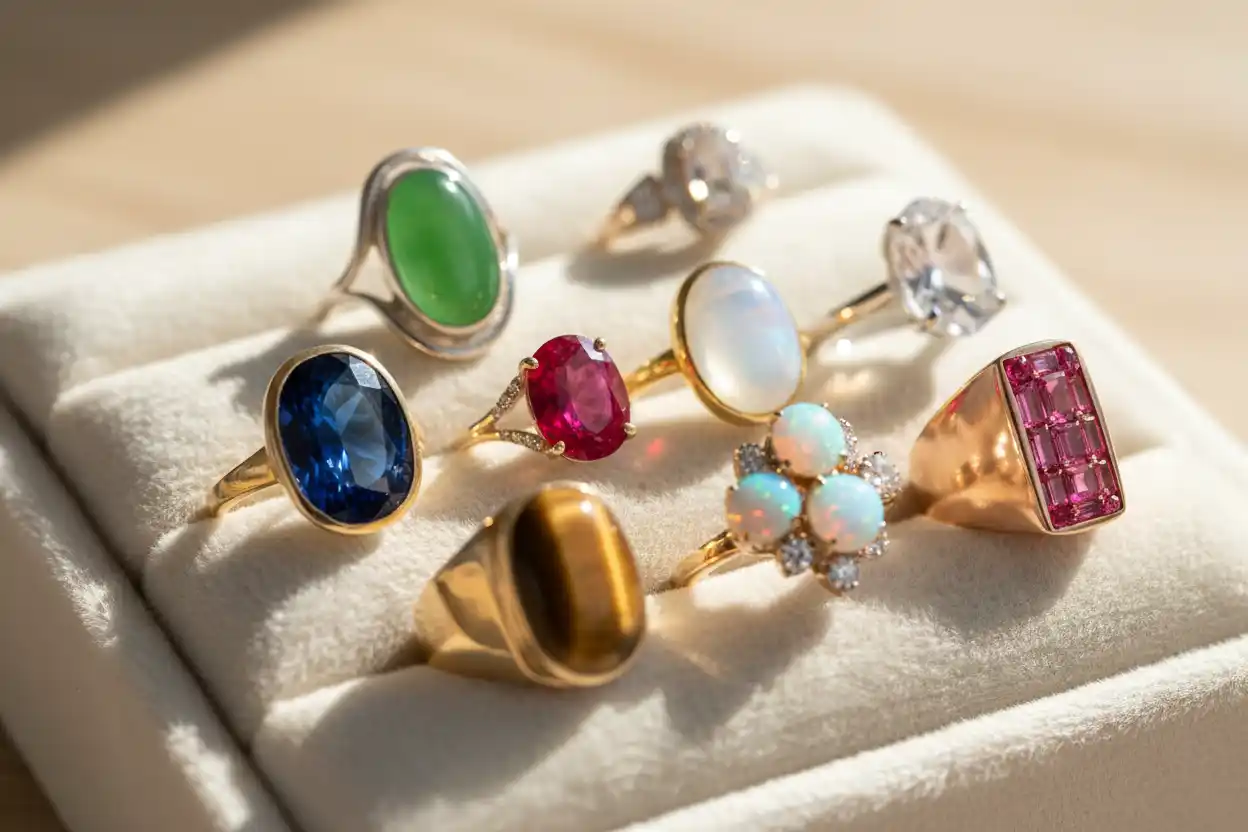
Crystal Rings: Meanings, Styles and How to Choose
Crystal rings place natural gemstones, laboratory-grown gems, organic materials, rocks or manufactured stones in one of jewelry’s most exposed positions. Rings receive more impact, abrasion, soap, hand sanitizer and temperature change than most pendants or earrings.
Their meanings can involve commitment, identity, birthstone tradition, protection symbolism or one personal intention. However, a ring’s survival depends on material durability, setting design, metal, fit and maintenance—not on the strength of its metaphysical association.
Crystal Rings at a Glance
| Ring feature | What to consider |
|---|---|
| Main styles | Solitaire, bezel, halo, cluster, signet, band, cocktail and stackable |
| Common durable stones | Sapphire, ruby, diamond, spinel, chrysoberyl and many garnets |
| Moderate-wear stones | Quartz, topaz, tourmaline, zircon and jade |
| Higher-care stones | Moonstone, opal, turquoise, lapis lazuli, fluorite and calcite |
| Main setting choices | Bezel, prong, channel, flush, tension-style and adhesive-based |
| Main fit concern | Knuckle clearance without excessive spinning |
| Main construction concern | Prongs, shank thickness, solder joints and stone support |
| Main treatment concern | Filling, coating, dyeing, impregnation and laboratory growth |
| Main care concern | Repeated impact, chemicals and residue beneath settings |
| Skin concern | Complete metal alloy, plating, solder and trapped moisture |
| Spiritual use | Personal symbolism or behavioral reminder |
| Important boundary | A ring cannot create protection, attraction or commitment |
What Is a Crystal Ring?
A crystal ring is a finger-worn piece containing a material marketed as a crystal, mineral or gemstone.
The stone may be:
- A natural mineral.
- A laboratory-grown gemstone.
- A microcrystalline aggregate.
- A multi-mineral rock.
- Natural glass.
- An organic gem.
- Manufactured glass.
- Resin.
- A reconstructed composite.
- A coated or filled material.
The word crystal therefore does not guarantee natural origin.
A rose quartz cabochon, lab-grown sapphire, lapis lazuli signet and glass imitation may all appear in crystal-ring retail categories.
The seller should identify the actual material and treatment.
Ring Styles
| Ring style | Construction | Best use |
|---|---|---|
| Solitaire | One principal center stone | Showing one faceted or cabochon gem |
| Bezel ring | Metal surrounds the stone’s edge | Protecting softer or included stones |
| Prong ring | Metal claws secure the stone | Maximizing visibility and brilliance |
| Halo ring | Center stone surrounded by smaller stones | Strong visual presence |
| Cluster ring | Several stones arranged together | Color combinations and floral designs |
| Signet ring | Broad top, often with inset or carved stone | Cabochons, engraving and durable daily designs |
| Band ring | Stones set across part or all of the circumference | Stacking, milestones and repeated color |
| Cocktail ring | Large decorative center or cluster | Occasional statement wear |
| Stackable ring | Narrow ring designed to combine with others | Flexible color and symbolism |
| Wire-wrapped ring | Stone held with shaped wire | Artisan and adjustable styles |
| Inlay ring | Thin stone sections fitted into channels | Geometric designs with protected surfaces |
| Adhesive-set ring | Stone attached partly or entirely with glue | Lower-cost fashion jewelry with limited durability |
Solitaire Rings
A solitaire centers one gemstone.
Faceted sapphires, rubies, spinels, quartz and other transparent gems often use prongs.
Cabochons may be bezel-set.
A tall solitaire receives more impact and may catch clothing.
A low-profile setting provides greater protection for everyday use.
The center stone’s dimensions matter more than carat weight alone because different minerals have different densities.
A wide stone also requires enough structural support beneath the setting.
Bezel-Set Crystal Rings
A bezel surrounds most or all of a stone’s perimeter.
It provides strong edge protection and reduces snagging.
Bezel settings suit cabochons, included gems, soft stones and active wear.
However, a bezel does not make a fragile gem indestructible.
Impact can still transfer through the metal, while trapped residue can collect around openings beneath the stone.
A well-made bezel should follow the stone evenly without gaps, sharp edges or pressure points.
Prong-Set Rings
Prongs hold the stone at several points while exposing more of its surface.
Four-prong settings show more of a stone, while six prongs add redundancy around many round gems.
A missing or lifted prong can lead to loss.
Run a soft cloth carefully over the ring. Snagging may indicate rough or raised metal.
Do not bend prongs at home.
A jeweler should inspect and tighten them with tools suited to the stone and setting.
Signet Rings
Signet rings have a broad upper surface.
They may hold a flush-set gem, carved stone, inlay or engraved metal.
Jade, onyx, tiger’s eye, lapis lazuli and bloodstone commonly appear in signet-style designs.
The broad top can protect a low-set cabochon, although its surface still strikes desks and door frames.
The completed jade-ring guide explains jadeite, nephrite and treatment.
The completed tiger’s-eye ring guide covers chatoyancy, orientation and setting.
Cluster and Halo Rings
Cluster rings arrange several small stones as one larger visual design.
Halo rings place a ring of smaller stones around a center gem.
These styles create brightness and color but add more prongs, joints and potential loss points.
Every small setting requires maintenance.
Replacement stones can be difficult to match in color and size.
A cluster’s spiritual meaning does not become stronger simply because it contains more crystals.
Choose the design for appearance and construction rather than an exaggerated count of metaphysical properties.
Crystal Rings by Traditional Meaning
| Traditional intention | Common ring stones | Grounded interpretation |
|---|---|---|
| Commitment | Sapphire, ruby, garnet and jade | Follow through consistently |
| Compassion | Rose quartz, rhodonite and pink tourmaline | Offer care while maintaining boundaries |
| Confidence | Carnelian, tiger’s eye and citrine | Prepare and act deliberately |
| Communication | Aquamarine, lapis lazuli and sodalite | State facts and needs clearly |
| Grounding | Smoky quartz, onyx and red jasper | Return attention to immediate responsibilities |
| Reflection | Amethyst, moonstone and labradorite | Pause and examine assumptions |
| Protection symbolism | Black tourmaline, obsidian and tiger’s eye | Pair symbolism with real safety measures |
| Prosperity symbolism | Citrine, jade and aventurine | Review resources and take practical action |
| Creativity | Carnelian, opal and labradorite | Begin and complete a defined project |
| Integrity | Sapphire, clear quartz and diamond | Maintain a chosen standard |
These meanings do not prove medical, relationship or financial effects.
Which Stones Are Best for Daily Rings?
Daily rings benefit from a combination of hardness, toughness, stable treatment and a protective setting.
Sapphire and ruby rank 9 on the Mohs scale and offer strong overall wearability.
The completed sapphire-ring guide and ruby-ring guide explain material-specific buying concerns.
Diamond ranks 10 but has cleavage, so it can still chip.
Spinel, chrysoberyl and many garnets also provide useful durability.
Quartz ranks 7 and can work, though facet edges and points may abrade or chip over time.
No stone is completely damage-proof.
Hardness Is Not the Same as Toughness
Hardness measures resistance to scratching.
Toughness describes resistance to breaking, chipping or cracking.
The completed gemstone-hardness chart compares Mohs values.
The guide to gemstone toughness versus hardness explains why cleavage, fractures and structure matter.
Jade offers exceptional toughness despite lower hardness than sapphire.
Topaz ranks 8 but has perfect cleavage.
Diamond is hardest yet can split along cleavage planes.
A daily-ring decision should never rely on Mohs hardness alone.
Moonstone Rings
Moonstone rings require protective design because feldspar has cleavage and moderate hardness.
A low bezel or substantial protective shoulders reduce exposed edges.
Adularescence depends on cutting orientation, so the strongest glow should remain visible when the ring sits naturally.
Moonstone symbolizes cycles and transition.
It does not regulate hormones, increase fertility or produce emotional calm medically.
Remove the ring during impact-heavy work and household cleaning.
Opal Rings
The completed opal-ring guide explains natural opal, doublets, triplets, treatments and care.
Opal can be vulnerable to impact, heat, dryness and sudden temperature change.
A bezel or protective halo may reduce edge exposure.
Doublets and triplets use assembled construction and should be disclosed.
Opal symbolizes creativity and changing perspective.
It does not scientifically amplify emotion or predict relationship outcomes.
Daily wear requires greater attention than sapphire or spinel.
Jade Rings
Jadeite and nephrite have interlocking structures that can provide excellent toughness.
However, a jade cabochon or band can still scratch and break.
A jade ring should be identified accurately because serpentine, quartz, aventurine, glass and composites may use jade-related names.
Bleaching, polymer impregnation and dyeing can affect jadeite.
Broad signet, bezel and saddle-style settings suit jade’s opaque to translucent appearance.
A jade ring may symbolize continuity and stewardship without guaranteeing prosperity.
Labradorite Rings
The completed labradorite-ring guide explains labradorescence and setting concerns.
Feldspar cleavage makes labradorite vulnerable in exposed rings.
A broad bezel protects the edges better than delicate prongs.
The strongest flash should face the wearer or viewer when the hand rests naturally.
Labradorite symbolizes perspective and complexity.
It does not provide supernatural protection or reveal hidden truths.
Tourmaline Rings
The completed tourmaline-ring guide covers color, inclusions and durability.
Tourmaline offers useful hardness but can contain fractures and internal strain.
Long crystals may be cut into elongated stones that need support at the ends.
Pink, green, blue and multicolored varieties provide broad design choice.
Treatments and origin claims require disclosure.
A ring should be selected for its actual stone quality and setting rather than a claim that one color controls a chakra.
Ring Settings for Softer Stones
Softer or cleavage-prone stones benefit from:
- Low profiles.
- Bezels.
- Partial bezels.
- Protective shoulders.
- Recessed inlay.
- Rounded cabochons.
- Limited exposed corners.
- Occasional rather than continuous wear.
Fluorite, calcite, selenite and delicate crystal points are poor choices for demanding rings.
An adhesive cap or wire alone may not provide enough protection.
A softer material can still be worn ceremonially or occasionally when the owner understands the risk.
Which Finger Should Wear a Crystal Ring?
Finger meanings vary among cultures, traditions and modern spiritual systems.
Some people associate the index finger with leadership, the middle finger with balance, the ring finger with commitment and the little finger with communication.
These interpretations are not universal.
Likewise, dominant-hand and nondominant-hand rules differ among practitioners.
Wear the ring where it fits safely and does not interfere with work.
Changing fingers does not cancel the stone’s symbolism.
Choosing the Correct Ring Size
A ring should pass over the knuckle with gentle resistance and sit without cutting into the finger.
Finger size changes with heat, cold, hydration, activity, medication and time of day.
Wide bands generally feel tighter than narrow bands at the same nominal size.
Stacked rings also reduce available space.
For a valuable or non-resizable design, professional measurement is preferable.
Do not guess size from height, body type, age or another ring worn on a different finger.
Resizing Crystal Rings
Some rings resize more easily than others.
Plain gold, platinum and silver shanks often permit adjustment within limits.
Full eternity bands, tension-style settings, extensive inlay, ceramic, tungsten and highly engraved designs may be difficult or impossible to resize.
Heat used during repair can damage treated, included, organic or heat-sensitive stones.
A jeweler may need to remove the gem before work.
Ask about resizing before purchase, particularly for customized and high-value rings.
Metals and Skin Reactions
Skin reactions often come from nickel, copper, plating, solder, moisture or trapped residue rather than the gemstone.
A natural stone does not make the complete ring hypoallergenic.
Ask for the full metal composition.
Plating can wear and expose the base alloy.
Wide rings trap more moisture beneath the band.
Remove the ring if redness, swelling, itching, numbness or broken skin develops.
Persistent symptoms deserve appropriate medical assessment.
Crystal Rings and Engagement Symbolism
A ring can carry relationship meanings beyond the stone.
Do not give a crystal ring when its commitment implications remain unclear.
Engagement and wedding stones must also withstand expected wear.
Sapphire, ruby, diamond, spinel and some garnets generally provide stronger durability than moonstone, opal, fluorite or selenite.
The ring cannot guarantee loyalty, compatibility or marriage.
Those outcomes depend on consent and continued choices.
Stacking Crystal Rings
Stacking allows several colors, metals or symbolic themes to be combined.
However, hard gemstones and exposed metal edges can abrade softer stones.
A diamond band may scratch opal, turquoise or pearl.
Raised prongs can rub against the neighboring ring’s gallery.
Leave space or use protective spacer bands where necessary.
The completed crystal-pairing guide explains why symbolic compatibility and physical compatibility are different questions.
More rings do not create stronger energy.
Authenticity and Treatment
Common ring-market concerns include:
- Laboratory-grown gems sold as natural.
- Glass or cubic zirconia sold under vague crystal names.
- Dyed howlite sold as turquoise.
- Composite jade.
- Filled ruby or sapphire.
- Coated topaz or quartz.
- Opal doublets sold as solid opal.
- Resin-backed cabochons.
- Reconstructed lapis or coral.
The completed crystal-identification guide provides non-destructive checks.
Important stones may need an appropriate laboratory report.
Avoid scratch, heat and solvent tests on finished rings.
Buying a Crystal Ring
Ask for:
- Exact stone identity.
- Natural, laboratory-grown or simulated status.
- Treatment.
- Dimensions and weight.
- Setting type.
- Metal composition.
- Ring size and band width.
- Resizing limits.
- Actual-item photographs.
- Return policy.
- Repair and warranty terms.
The completed guide to buying gemstones online explains seller and image checks.
A high price or spiritual certificate does not prove authenticity.
Cleaning Crystal Rings
Remove rings before applying lotion, perfume, household cleaner and hair products.
Soap and skin residue collect beneath settings.
Use a soft cloth for routine cleaning.
Whether brief washing is safe depends on the gemstone, treatment, adhesive and metal.
Ultrasonic and steam cleaning can damage included, filled, organic, porous and cleavage-prone stones.
A jeweler should inspect valuable settings before intensive cleaning.
Sleeping, Showering and Working in Rings
Remove crystal rings before sleeping when they have high settings, sharp points or delicate stones.
The completed guide on wearing crystals to sleep explains broader risks.
Remove rings before showering, swimming, gardening, lifting weights, cleaning and using machinery.
Water may not damage every gemstone, but soap, chemicals, impact and trapped moisture can damage the complete ring.
Place removed rings in a secure container rather than a sink edge or loose pocket.
Frequently Asked Questions
1. What does wearing a crystal ring mean?
Its meaning depends on the stone, finger, gift context, cultural tradition and wearer’s personal intention.
2. Which crystals are best for everyday rings?
Sapphire, ruby, diamond, spinel, chrysoberyl and many garnets generally offer strong durability.
3. Is quartz durable enough for a ring?
Quartz ranks 7 on the Mohs scale and can work, though exposed edges and points may chip or abrade.
4. Which crystal rings require extra care?
Moonstone, opal, turquoise, lapis lazuli, fluorite, calcite, pearl and selenite require greater protection.
5. Does the finger change a crystal ring’s energy?
Finger meanings are symbolic traditions rather than scientifically verified energy pathways.
6. Is a bezel better than prongs?
A bezel generally protects edges and reduces snagging, while prongs expose more of the stone. The better choice depends on the gem and design.
7. Can crystal rings be resized?
Some metal rings can be resized, while eternity, tension, inlay and alternative-metal designs may have strict limits.
8. Can I stack different crystal rings?
Yes, but hard stones and metal edges can scratch softer neighboring gems.
9. Can I sleep in a crystal ring?
Removing high, sharp, tight or delicate rings is safer and prevents snagging, pressure and damage.
10. Can I shower with a crystal ring?
Removal is recommended because soap, chemicals, moisture and temperature changes can harm stones, settings and skin.
11. How can I tell whether a crystal ring is genuine?
Check exact material disclosure, treatment, setting quality and seller evidence. Valuable stones may require laboratory testing.
12. Do crystal rings have scientifically proven healing effects?
No. Their healing, chakra, protection and relationship meanings reflect spiritual traditions rather than established effects.
Meaning Belongs in a Ring That Can Survive Its Use
A crystal ring is both a symbolic object and a small structure exposed to constant movement. The stone’s meaning will not protect a weak prong, poor fit or cleavage-prone gem from impact.
Choose the material for the intended wear, match it with a protective setting and learn its treatments before buying. The ring can represent a value or commitment, while craftsmanship and care preserve the object.
Disclaimer: Crystal-ring healing, attraction, protection, chakra and prosperity properties reflect cultural and spiritual traditions rather than established medical, relationship or financial effects. Rings cannot create consent, commitment or physical protection, and they should be removed whenever they cause pain, swelling, numbness, skin irritation or workplace hazards.