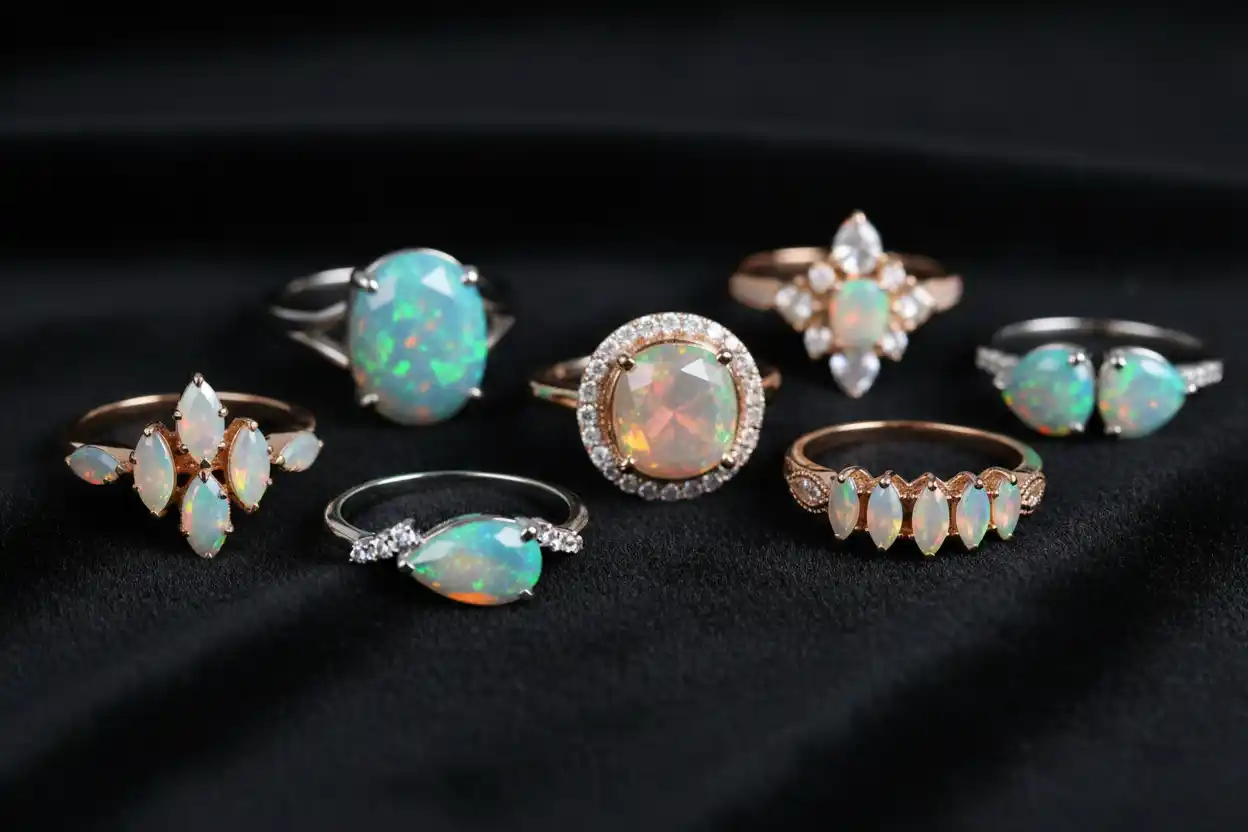
Opal Rings: Styles and Buying Tips
Opal rings place one of gemology’s most distinctive optical effects in the jewelry position that receives the greatest daily wear. Every movement of the hand can reveal new flashes of red, orange, green, blue or violet, but the same movement exposes the stone to impact, abrasion, soap, cosmetics and temperature changes.
Opal is suitable for rings when the stone is stable, the setting is protective and the wearer accepts more maintenance than a Sapphire or Diamond ring requires. A low bezel-set cabochon worn carefully can remain attractive for years. A high exposed stone worn during exercise, cleaning and manual work faces a much greater risk of damage.
Construction must also be understood. Solid Opal, Boulder Opal, doublets, triplets, synthetic Opal and treated material can all appear in rings, but they differ in value and care.
The broader Opal gemstone guide owns structure, formation, history and symbolism. This page focuses specifically on ring styles, settings, daily wear, buying and maintenance.
Opal Rings at a Glance
| Feature | What to evaluate |
|---|---|
| Material identity | Hydrated silica |
| Mohs hardness | Approximately 5–6.5 |
| Toughness | Very poor to fair |
| Main optical feature | Play-of-color in precious Opal |
| Most protective setting | Low full bezel |
| Main ring risk | Impact, scratches, crazing and liquid exposure |
| Main construction disclosure | Solid, doublet, triplet, synthetic or imitation |
| Main source-related concern | Hydrophane absorption |
| Main fit concern | Rotation and top-heavy settings |
| Main accent-stone concern | Hard girdles touching the Opal |
| Safest cleaning | Brief hand cleaning with lukewarm soapy water |
| Best wearing approach | Careful, removable jewelry rather than unrestricted wear |
Is Opal Durable Enough for Rings?
Opal can be used in rings, but it requires realistic expectations.
The Gemstone Hardness Chart places Opal below Quartz, Topaz, Sapphire and Diamond. It can be scratched by common abrasive dust and harder neighboring jewelry.
The Gemstone Toughness vs Hardness guide explains the additional risks created by brittleness, cracks, porosity and thermal stress.
A protective setting reduces edge impact but cannot stabilize an Opal that is already crazed or structurally compromised.
Someone who expects to wear one ring through every activity may find Sapphire, Spinel or Diamond more practical. Opal works best for a wearer willing to remove the ring at appropriate times.
Main Opal Ring Styles
| Ring style | Main advantage | Main concern |
|---|---|---|
| Full-bezel solitaire | Maximum general edge protection | More visible metal |
| Partial-bezel solitaire | Shows more of the outline | Exposed sides |
| Prong-set cabochon | Open visual appearance | Pressure points and exposed girdle |
| Halo ring | Adds contrast and apparent size | Hard accents and many prongs |
| Cluster ring | Broad color using smaller stones | Matching and shared settings |
| Signet-style ring | Low profile and broad support | Closed-back disclosure |
| Boulder Opal ring | Natural matrix and freeform design | Irregular thickness |
| Doublet ring | Strong color at lower cost | Adhesive and water exposure |
| Triplet ring | Surface protection and vivid display | Layered construction |
| Fire Opal ring | Transparent warm color and faceting | Pointed cuts and thermal shock |
| Cocktail ring | Large dramatic center | Height and rotation |
| Inlay ring | Smooth geometric surface | Thin Opal and adhesive |
Full-Bezel Opal Rings
A full bezel surrounds the Opal with metal.
This is generally the strongest ring setting because it protects the perimeter and reduces snagging. A low bezel also limits leverage when the ring strikes a hard surface.
The metal should meet the stone evenly. Gaps, folded edges, visible glue or movement indicate weak workmanship.
The setter must avoid excessive pressure. Opal can crack during manufacturing when a bezel is tightened over an existing weakness.
An open or partly open back allows inspection, while a closed cup may conceal backing, filling or a thin assembled layer.
Partial Bezels
A partial bezel covers selected areas while leaving other sides visible.
The setting can make a ring appear lighter and reveal an irregular outline. However, the exposed sections remain vulnerable to impact.
The design should protect points, thin edges and structurally weak areas rather than leaving them open for symmetry.
A side view helps determine whether the Opal sits low enough for practical wear.
Partial bezels suit moderate stones and careful wearers but provide less protection than a full surround.
Prong-Set Opal Rings
Prongs expose more of the Opal but concentrate pressure at a few contact points.
The stone should rest inside a supportive basket. It should not balance only between the prong tips.
Prongs must avoid cracks, pits and thin areas. Tightening metal over a weakness can cause immediate or delayed damage.
Rounded cabochons are safer than pointed stones in open prongs.
A prong-set Opal ring should be inspected regularly and removed before demanding hand activities.
Halo Opal Rings
A halo surrounds the center with Diamond, laboratory-grown Diamond, Moissanite, Sapphire, Zircon or Cubic Zirconia.
The border creates contrast and increases apparent face-up size.
Every accent material should be identified accurately. Harder stones must remain separated from the Opal by metal because direct girdle contact can scratch or chip it.
A halo can provide some perimeter protection, but a high center remains exposed above the accents.
Numerous small prongs also increase maintenance. A simple bezel may be more practical for daily wear.
Cluster Opal Rings
Cluster designs use several small Opals rather than one center.
The stones may create floral, celestial or geometric arrangements. Smaller cabochons can produce broad visible color at a lower total cost than one exceptional large Opal.
Matching should consider body tone, brightness, dominant colors and pattern scale.
Shared prongs reduce visible metal but make several stones dependent on the same setting components.
The cluster should sit low enough that the outer stones do not receive repeated side impact.
Signet-Style Opal Rings
A signet-style ring places the Opal inside a broad metal face.
The design can support an oval, cushion, rectangle or freeform stone at a low profile.
Substantial surrounding metal protects the edges and reduces rotation.
A closed back may conceal a thin Opal, a doublet or an assembled inlay. Construction should therefore be disclosed.
The signet face should contain enough metal beneath the stone to resist flexing.
Black Opal Rings
Black Opal has a dark body tone that creates strong contrast with play-of-color.
Fine natural material can make a spectacular ring but also creates significant replacement and maintenance risk.
The stone should receive a low protective setting and strong documentation. Dark body tone must be distinguished from backing, dye, smoke treatment and doublet construction.
A Black Opal ring should not be worn during exercise, gardening, cleaning or mechanical work.
The value of the stone does not make it physically tougher.
Boulder Opal Rings
Boulder Opal retains natural host rock behind or around the Opal.
The ironstone matrix can provide natural support and suit broad freeform rings.
A custom bezel usually follows the outline more securely than generic prongs.
Thin seams of precious Opal can still crack or wear even when the matrix remains intact.
Natural attached matrix should be distinguished from a separately glued backing.
Boulder Opal works particularly well in signet and low-profile artistic settings.
Ethiopian Opal Rings
Ethiopian Opal frequently shows hydrophane behavior.
The stone can absorb water, oil, perfume, lotion and other liquids. Hand jewelry creates more exposure to these substances than earrings or necklaces.
A hydrophane Opal ring must be removed before hand washing, showering, cooking, applying cosmetics and handling oils.
Absorbed water may temporarily change the appearance, but oil and contamination can create persistent effects.
A beautiful Ethiopian stone can be used successfully when the wearer accepts these restrictions.
Fire Opal Rings
Fire Opal is defined mainly by yellow, orange or red bodycolor.
Transparent material can be faceted into ovals, cushions, pears and other shapes. Some stones also show play-of-color.
Faceted Opal requires protection at corners and points. Pear and marquise tips should receive V-shaped prongs or bezel coverage.
Fire Opal can be sensitive to heat and thermal shock.
Large transparent stones may show windows or uneven color, so cut quality should be assessed carefully.
White Opal Rings
White Opal is one of the most familiar ring materials.
The pale body tone can support pinfire, broad flash and multicolored patterns.
Brightness and coverage matter more than a perfectly white background.
A low bezel or supportive halo works well for commercial white Opal. The ring should still be removed during physical activity.
White appearance alone does not establish that the stone is solid, untreated or natural.
Solid Opal, Doublets and Triplets
A solid Opal consists of Opal through its visible depth.
A doublet combines a thin Opal layer with backing. A triplet adds a transparent cap.
The Real vs Fake Opal guide owns the full diagnostic boundary.
Doublets and triplets can provide vivid ring color at a lower price. However, wrist-level water, heat and impact create more risk for adhesive layers than earrings or pendants do.
The construction should be stated on the invoice and reflected in care instructions.
A closed setting should not be used to conceal the assembled nature of the stone.
Treatments and Synthetic Opal
The Treated and Synthetic Opal guide owns smoke treatment, dye, filling, coating and laboratory-created material.
Smoke and dye can strengthen dark body tones. Resin may alter transparency or make cracks less visible.
Synthetic Opal can display genuine play-of-color through a manufactured silica structure. Resin and glass imitations use different materials.
Treatment and origin affect price and maintenance but do not automatically prevent a ring from being attractive.
Disclosure allows the buyer to choose knowingly.
Choosing Play-of-Color
The Types of Opal guide provides the broad variety context, while the Opal Buying Guide owns quality evaluation.
A ring should show bright color during normal hand movement.
A stone whose strongest flash appears only at an extreme angle may look dull from the wearer’s ordinary viewpoint.
Red and orange receive strong demand, but pattern, brightness and coverage matter more than hue alone.
Inactive or dead areas become particularly noticeable in a ring because the hand moves constantly.
Evaluating Stability
Inspect the Opal for crazing, surface-reaching cracks, pits and cloudy zones.
Crazing is a structural problem rather than an ordinary inclusion. A network of fine cracks can expand over time.
A protective setting cannot make unstable material permanent.
Ask whether the stone was observed after cutting for an appropriate period and whether the seller provides a stability warranty.
Oil or resin can make cracks less obvious temporarily.
Ring Height and Balance
A low setting reduces impact and snagging.
Large cabochons create weight above the finger and may cause rotation. A wider lower shank, sizing beads or an internal stabilizing bar can improve balance.
A very thin shank can bend and loosen the setting even when the Opal remains intact.
The center should not project farther than necessary above the metal.
Side photographs provide more useful information than a face-up view alone.
Metal Choices
Yellow gold strengthens warm flashes and creates strong contrast with dark body tones.
White gold, platinum and silver produce a cooler appearance. Rose gold can complement Fire Opal, pink common Opal and red-orange play-of-color.
Metal strength matters more than color. Bezel thickness, gallery support and shank dimensions determine durability.
Hard accent stones must remain separated from the Opal.
Alloy and plating should also be considered when the wearer has skin sensitivity.
Opal Engagement Rings
Opal can be used in an engagement ring, but the couple should understand the maintenance burden.
It is not a carefree alternative to Diamond or Sapphire. Regular inspection, careful removal and possible future replacement should be part of the decision.
A bezel-set stable Opal offers the strongest practical approach.
An exact pattern cannot be reproduced if the stone is lost or broken.
Emotional significance can make an Opal engagement ring worthwhile, but symbolism should not be confused with physical durability.
Sizing and Resizing
Many Opal rings can be resized, but heat must be kept away from the stone.
Doublets, triplets, filled Opal, inlays and complex halos may restrict resizing.
A jeweler may need to remove the Opal before soldering, adding labor and risk.
Full-eternity and continuous-inlay designs are especially difficult to alter.
Ask about resizing limits before purchase rather than assuming they can be handled later.
Price and Documentation
Current market context belongs to the Opal Price Guide.
Ring price reflects brightness, pattern, body tone, transparency, stability, treatment, construction, source claims, metal weight and workmanship.
A laboratory report can identify natural or laboratory-grown Opal and many detectable treatments. The Gemstone Certification guide explains what reports establish.
Documentation does not guarantee durability or one universal value.
The buyer should also receive a detailed invoice identifying solid or assembled construction.
Buying an Opal Ring Online
Follow How to Buy Gemstones Online Without Getting Scammed.
Request continuous video of the exact ring under neutral light and from several angles.
The listing should provide stone dimensions, ring size, shank width, setting height, treatment, source claim, solid or assembled construction, resizing limits and return terms.
Stock photographs cannot show the actual Opal’s pattern, cracks or directional color.
Opal is one of the recognized stones in the October Birthstone guide, but birthstone marketing should not replace material disclosure.
Wearing an Opal Ring
Remove the ring before washing hands, showering, swimming, exercising, gardening, cooking and cleaning.
Avoid lotion, perfume, oils and strong chemicals, especially with hydrophane material.
Do not sleep in the ring.
Avoid stacking it directly beside Diamond, Sapphire, Topaz or rough metal settings.
A smooth spacer can reduce contact but does not make an active stack risk-free.
Cleaning and Maintenance
Follow How to Clean Opal Jewelry Safely.
Use lukewarm water, mild soap and a soft cloth. Keep the process brief.
Never use steam or ultrasonic equipment.
Do not soak doublets, triplets, hydrophane stones, inlays or glued pieces.
Store the ring in a padded compartment away from harder jewelry.
Stop wearing it when a stone moves, a prong catches, a crack appears or the shank bends.
Frequently Asked Questions
1. Is Opal suitable for everyday rings?
It can be worn regularly with care, but it is not suitable for unrestricted wear through every activity.
2. What is the safest Opal ring setting?
A low full bezel generally provides the strongest edge protection and reduced snagging.
3. Can Opal be used in an engagement ring?
Yes, provided the wearer accepts careful handling, maintenance and possible future replacement.
4. Are Black Opal rings more durable?
No. Dark body tone affects appearance and value, not basic durability.
5. Are Ethiopian Opal rings safe to wear?
They can be worn carefully, but hydrophane material must be protected from water, oil, perfume and cosmetics.
6. Are doublet rings genuine Opal?
They contain a genuine Opal layer attached to backing and are legitimate when disclosed.
7. Are triplet rings stronger than solid Opal?
The cap protects the face, but layered construction remains vulnerable to heat, water and adhesive failure.
8. Can Opal rings be resized?
Many can, but complex settings, inlays, assembled stones and heat sensitivity may restrict the process.
9. Can Opal be set beside Diamonds?
Yes, provided metal prevents the harder Diamond girdles from touching the Opal.
10. Why has my Opal ring become cloudy?
Oil, water absorption, residue, crazing or treatment changes may be responsible. A professional inspection is advisable.
11. Can Opal rings be cleaned ultrasonically?
No. Ultrasonic vibration can damage the stone, glue, filling and assembled construction.
12. How often should an Opal ring be inspected?
A frequently worn ring should be checked periodically and immediately after a hard impact or any change in the setting.
An Opal ring should be designed around the stone’s limitations rather than asking the stone to behave like Diamond. Low settings, strong metal and disciplined removal habits allow play-of-color to remain the focus without treating a relatively delicate material as indestructible.