Tourmaline Rings: Styles and Buying Tips
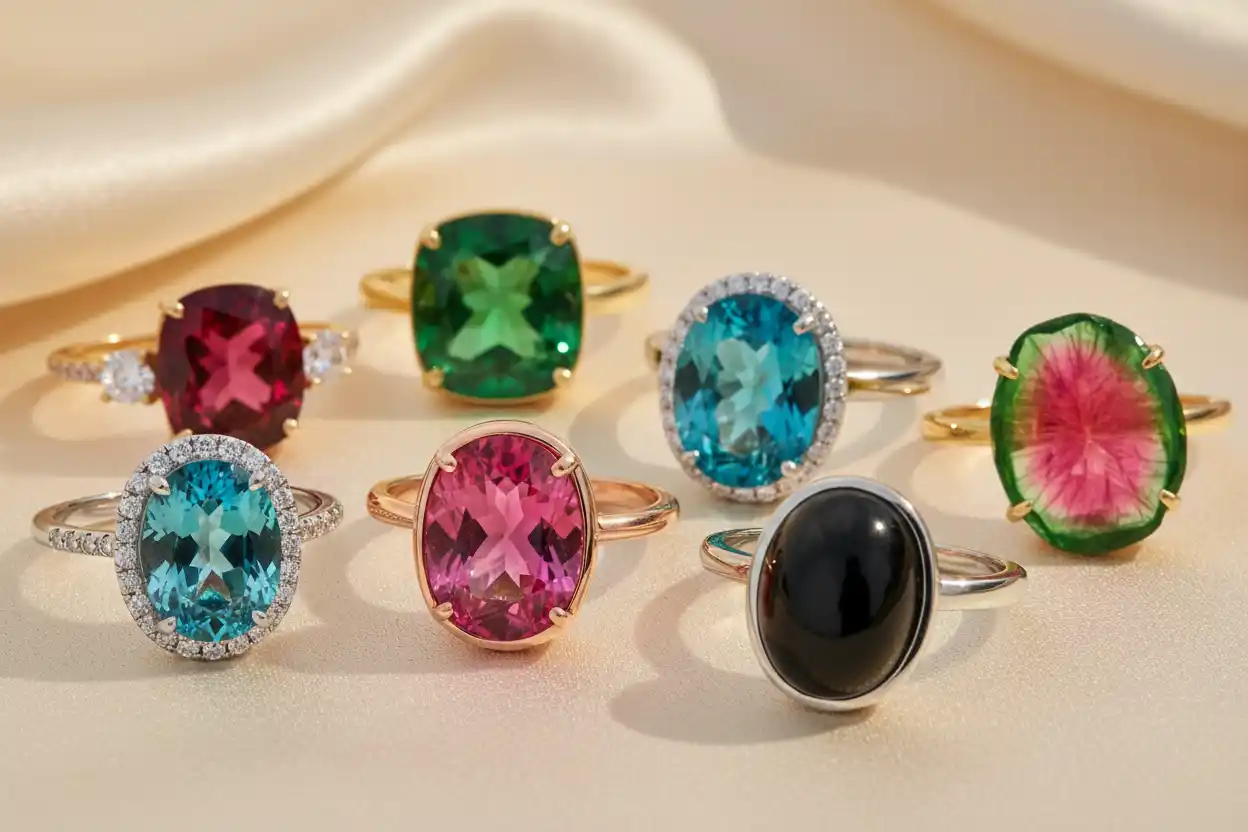
Tourmaline rings offer one of the broadest natural color ranges available in fine jewelry. A center stone may appear pale pink, vivid red, forest green, electric blue-green, yellow, orange, black or divided into two or more sharply contrasting zones.
That variety does not mean every Tourmaline ring performs in the same way. Color, mineral species, pleochroism, inclusions, cutting orientation, treatment and setting style can differ substantially from one stone to another.
Tourmaline has useful surface hardness, yet its fair toughness and frequent internal fractures require sensible protection. A low, secure setting generally offers a better long-term choice than a large gem held high above the finger by thin prongs.
Tourmaline Rings at a Glance
| Feature | What to Consider |
|---|---|
| Gem family | Borosilicate Tourmaline group |
| Common gem species | Elbaite, Dravite, Uvite and Schorl |
| Color range | Pink, red, green, blue, black, yellow, orange and multicolor |
| Mohs hardness | Approximately 7–7.5 |
| Toughness | Fair |
| Pleochroism | Often strong |
| Popular cuts | Oval, cushion, emerald, round, pear and cabochon |
| Best settings | Low bezel, protective halo and substantial prongs |
| Common treatments | Heat, irradiation and occasional fracture filling |
| Best daily-wear varieties | Sound, clean stones in protected settings |
| Main durability concern | Impact, fractures and exposed corners |
| Safe cleaning | Warm water, mild soap and a soft brush |
Is Tourmaline Suitable for Rings?
Tourmaline is suitable for rings when the gemstone is structurally sound and the setting fits the wearer’s routine.
Its hardness of approximately 7–7.5 provides useful scratch resistance. However, hardness does not measure resistance to breaking. Surface-reaching fractures, internal tubes and brittle corners can make one Tourmaline more vulnerable than another stone with the same mineral name.
Rings receive repeated contact with desks, counters, door handles, tools and neighboring jewelry. Consequently, a protected occasional ring can accommodate material that would be too risky for continuous daily wear.
The completed Tourmaline meaning guide owns the family’s geology, mineral species and general symbolism. This page focuses specifically on ring design, wear and buying decisions.
Tourmaline Solitaire Rings
A solitaire places one Tourmaline at the center of the design.
Oval and cushion cuts are widely used because they preserve valuable rough while providing an attractive face-up outline. Emerald cuts suit Tourmaline’s elongated crystal habit, while rounds require greater weight loss but offer balanced symmetry.
A tall basket may allow more light around the stone, although it also increases snagging and impact exposure.
For regular wear, a lower setting is generally more practical. The stone should sit securely without the culet or pavilion pressing against the finger.
A large center also needs a sufficiently broad shank. Otherwise, the ring may rotate constantly and expose the gemstone to repeated side impacts.
Bezel-Set Tourmaline Rings
A bezel surrounds most or all of the gemstone’s girdle with metal.
This setting offers strong edge protection and creates a smooth profile that does not catch easily on clothing.
A full bezel is especially useful for included Tourmaline, pointed color zones or cabochons. A partial bezel exposes more of the stone but leaves selected sides vulnerable.
The jeweler must close the metal gradually. Excessive pressure can extend a fracture or chip a weak edge.
A bezel may make the gemstone appear slightly smaller, but its metal border can also intensify color. Yellow gold warms pink and green stones, while white metal creates stronger contrast around blue and vivid red material.
Prong-Set Rings
Prongs expose more of the gemstone and create a lighter-looking setting.
Four-prong designs provide an open appearance but less redundancy. Six prongs offer greater security for larger rounds and ovals.
Every prong should contact the gemstone evenly. One overly tight claw can concentrate pressure on a small area.
Pear, marquise and trillion cuts need protection at their points. V-shaped prongs or partial bezels are preferable to exposed corners.
Visible fractures near prong positions deserve particular caution. A structurally weak stone should not be forced into a setting designed for a cleaner gem.
Halo Tourmaline Rings
A halo surrounds the Tourmaline with small accent stones.
Colorless Diamonds or white Sapphires can brighten pink, green, blue and red centers. They also increase the complete visible outline without requiring an unusually large Tourmaline.
The accents must not touch the center stone directly. Diamond and Sapphire are harder and can scratch Tourmaline.
A low halo can protect parts of the center’s girdle. However, a raised double halo adds height, weight and many small prongs that require maintenance.
The center should remain visually dominant. An oversized surround may distract from fine color or deliberate zoning.
Three-Stone Rings
Three-stone settings may combine Tourmaline with Diamond, Sapphire or additional Tourmalines.
Tapered baguettes create a clean frame around an oval or emerald-cut center. Pear or round side stones produce a softer composition.
Hard side stones need enough separation to prevent direct girdle contact.
Three Tourmalines can form a tonal progression, such as pale pink to Rubellite, or a contrasting sequence using green and pink.
Matching should consider brightness and orientation rather than color names alone. Strong pleochroism can cause one stone to appear much darker than its neighbors when the ring moves.
Cluster Rings
Cluster rings use several smaller Tourmalines to create floral, geometric or irregular patterns.
This format can produce substantial color coverage without requiring one large center.
Rainbow clusters may intentionally combine several hues. Single-color clusters require closer matching in tone, saturation and brilliance.
Every small stone introduces another setting point. Weak or bent prongs can allow loss before the overall ring appears damaged.
The gallery beneath the cluster should provide both structural support and enough access for gentle cleaning.
Cocktail Rings
Tourmaline’s color range and elongated crystals suit dramatic cocktail rings.
Large Rubellite, green Tourmaline, Indicolite and multicolor gems can create impressive statement pieces.
A large setting also encounters more impact. High domes, projecting points and broad exposed girdles should generally be reserved for controlled occasions.
A cocktail ring must feel balanced on the finger. An undersized shank can allow the heavy center to rotate.
Size should not compensate for windowing, excessive darkness or unstable fractures.
Tourmaline Engagement Rings
Tourmaline can be used in an engagement ring when the wearer accepts its care requirements.
Pink, green, blue and multicolor gems provide distinctive alternatives to conventional Diamond or Sapphire centers.
A low bezel or protective halo offers the best practical foundation. Thin exposed corners and very high settings increase risk.
Tourmaline is less resistant to impact than Sapphire, Ruby or Diamond. The wearer should remove the ring for exercise, gardening, cleaning, manual work and activities involving hard equipment.
A separate activity or travel ring may help preserve a valuable center stone.
Pink Tourmaline Rings
Pink Tourmaline ranges from pale blush and salmon to vivid magenta.
Pink and red Tourmalines commonly contain visible liquid-filled tubes, feathers and fractures. Attractive color may justify some inclusions, but structural weakness should not be ignored.
Pale stones can lose visual intensity at small sizes. Rose gold may strengthen their warmth, while white metal provides more contrast.
Irradiation may create or intensify some pink colors. Written treatment disclosure is therefore relevant even when the stone looks natural.
Rubellite Rings
Rubellite is the red to pinkish-red Tourmaline variety expected to retain an attractive red appearance under different lighting.
Fine Rubellite can be richly saturated yet visibly included. Color may carry more weight than perfect clarity, provided the fractures do not threaten durability.
The completed Rubellite buying guide explains quality factors, while the Rubellite price guide owns value and market intent.
A low halo or bezel is sensible for a valuable included stone.
Green Tourmaline Rings
Green Tourmaline occurs in yellow-green, olive, forest, emerald and blue-green colors.
Verdelite is a commonly used name for green Tourmaline, particularly green elbaite.
Strong pleochroism can make a gem appear bright from one direction and nearly black from another. A ring should be judged face-up in ordinary lighting rather than only beneath concentrated display lamps.
Green material generally carries a higher clarity expectation than Rubellite, although individual stones vary.
Yellow gold suits warm olive and forest shades, while white metals emphasize cooler blue-green color.
Indicolite Rings
Indicolite is blue, violetish-blue or greenish-blue Tourmaline.
Fine blue material is uncommon. Dark rough can also be difficult to orient without heavy extinction.
A well-cut stone should retain recognizable blue color indoors rather than appearing black through its center.
The completed Indicolite buying guide explains color orientation, and the Indicolite price guide covers value factors.
A protected white-metal setting usually complements its cool appearance.
Paraíba Tourmaline Rings
Copper-bearing Tourmaline can show vivid electric blue, greenish-blue and blue-green colors.
The dedicated Paraíba Tourmaline ring guide owns design and buying decisions for this premium variety.
Copper-bearing identity and geographic origin should not be inferred from vivid color alone. A significant stone merits reliable laboratory documentation.
The completed Paraíba Tourmaline buying guide covers reports, origin and quality. The Paraíba Tourmaline price guide handles market value.
Because fine material is expensive and sometimes included, protected settings are particularly important.
Watermelon Tourmaline Rings
Watermelon Tourmaline shows pink and green zoning, commonly with a pale band between the colors.
The dedicated Watermelon Tourmaline ring guide owns slice orientation, setting and wear.
A cross-section slice may display a pink center surrounded by green. Longitudinal cuts may show colors running from one end to the other.
Thin slices are more fragile than compact faceted stones. A protective frame or full bezel can reduce edge damage.
The general Watermelon Tourmaline meaning guide covers its identity, while the Watermelon Tourmaline buying guide handles broader quality concerns.
Black Tourmaline Rings
Black Tourmaline is usually Schorl.
It is commonly cut into cabochons, tablets, carved forms and polished crystal sections.
Natural Schorl may contain pits, striations and fractures. The surface should still be finished appropriately for the intended design.
A low bezel or signet-style mounting suits opaque material and protects its edges.
Black glass, dyed stone and resin can imitate the appearance. Authenticity should be evaluated through the material rather than claims about spiritual protection.
Cat’s-Eye Tourmaline Rings
Parallel internal tubes can produce chatoyancy in Tourmaline.
The gemstone must be cut as a cabochon so a reflected band appears across its curved surface.
Green, blue and pink cat’s-eye Tourmalines occur. The eye is often softer and broader than the line in fine cat’s-eye Chrysoberyl.
A ring should display the band when the hand rests naturally. Poor orientation may hide the effect.
A protective bezel is useful because cat’s-eye material is commonly included.
Pleochroism and Face-Up Color
Tourmaline often displays different colors or degrees of darkness along different crystal directions.
Cutters may orient pale rough to deepen its color. Conversely, dark green or blue rough may need an orientation that prevents the closed crystal axis from dominating.
This tradeoff affects both visible size and price. A cutter may sacrifice more rough to produce a brighter face-up gem.
Rotate the ring under several lighting conditions. The stone should remain attractive through ordinary hand movements.
Pleochroism is part of Tourmaline’s identity, but excessive darkness should not be excused automatically as a natural feature.
Color Zoning
Tourmaline crystals often contain bands or sections of different color.
Zoning can be highly desirable when it is sharp, centered and deliberately incorporated into the cut.
A poorly positioned boundary may leave one color hidden beneath the setting or cause the ring to look uneven.
Long emerald cuts can display an end-to-end transition. Slices reveal concentric or parallel patterns.
The planned Tourmaline color meaning guide owns symbolism by hue, while the completed types of Tourmaline guide explains mineral varieties and trade terminology.
Clarity and Structural Condition
Clarity standards vary by color.
Pink and red material commonly contains more visible inclusions. Green and blue Tourmalines are generally expected to appear cleaner.
An internal tube or crystal may have little effect on durability. A surface-reaching feather beside a prong is more concerning.
Inspect the gemstone from the side and beneath the setting. Metal can hide fractures that are not obvious face-up.
Fracture filling with oil or resin may reduce the visibility of cracks. Such treatment should be disclosed because it affects care and repair.
Cut Quality
Tourmaline’s elongated crystal habit encourages emerald cuts, long cushions, ovals and rectangular shapes.
A well-cut stone should return light evenly and avoid a large transparent window.
Deep stones may retain weight while looking smaller. They can also create excessive darkness.
Facet junctions should be crisp, and corners should remain intact.
Compare millimeter dimensions rather than relying only on carat weight. Two equal-weight stones can have substantially different face-up sizes.
Treatments
Heating can lighten dark material or alter some colors. Heat-induced changes are generally stable.
Irradiation can create or intensify pink, red and yellow colors. Some irradiation-related color may be sensitive to heat or intense light.
Oil or resin can reduce the appearance of fractures.
The completed Tourmaline buying guide owns the full loose-stone treatment and quality workflow.
Treatment does not automatically make a ring undesirable. The seller should disclose it accurately and price the stone accordingly.
Setting Pressure
Tourmaline can be damaged during setting when pressure is uneven.
A jeweler should inspect the stone before tightening prongs or closing a bezel.
Tension settings deserve particular caution because they rely on concentrated force against the gemstone.
Channel and flush settings can also place pressure on corners or girdles when poorly executed.
Protective does not mean excessively tight. The ideal setting holds the stone securely while distributing force evenly.
Choosing the Metal
Yellow gold suits Rubellite, pink, yellow and warm green Tourmaline.
Rose gold complements pale pink, peach and some bicolor stones.
White gold and platinum emphasize blue, blue-green and vivid cool pink gems.
Sterling silver works for commercial Tourmaline but should not use thin or weak prongs around a large center.
Alloy sensitivity, maintenance, setting strength and resizing options should guide the choice.
Ring Size and Comfort
Obtain an accurate finger measurement before purchase.
Wide bands generally fit more tightly than narrow shanks. Finger size also changes with temperature and activity.
A large center needs enough shank width to remain upright.
Sizing beads or an internal sizing bar may improve stability.
Try normal movements such as typing, gripping a cup and putting on a jacket. The setting should not press painfully against adjacent fingers.
Resizing and Repair
Simple metal shanks can often be resized.
Full eternity designs, complex halos and heavily decorated shoulders have narrower adjustment limits.
Tourmaline may need removal before torch work because heat can affect color, fillers and internal fractures.
A jeweler should also avoid ultrasonic cleaning during repair.
Discuss resizing before purchase, especially when the ring uses a rare color-zoned or custom-cut gemstone.
October Birthstone Rings
Tourmaline is an October birthstone alongside Opal.
The completed October birthstone guide explains both options.
Pink Tourmaline is a familiar birthstone choice, but green, blue, black and multicolor material offer alternatives for recipients with different tastes.
The completed October birthstone jewelry guide compares ring gifts with necklaces, earrings and bracelets.
A birthstone association does not change the stone’s physical care requirements.
Comparing Other Tourmaline Jewelry
Tourmaline earrings provide high color visibility with less impact.
A Tourmaline necklace can accommodate a large or heavily zoned gem safely.
A Tourmaline bracelet creates repeated color but experiences more surface contact.
Rings remain the most visible format to the wearer and require the strongest protection.
Cleaning Tourmaline Rings
Use warm water, mild soap and a soft brush.
Work gently beneath the setting, where lotion and soap collect. Rinse briefly and dry completely.
Do not use steam or ultrasonic cleaners. Heat, vibration, liquid inclusions and filled fractures create unnecessary risk.
Avoid sudden temperature changes.
The completed guide to cleaning Tourmaline jewelry provides the full procedure.
Storage
Store the ring in a separate padded compartment.
Topaz, Sapphire and Diamond can scratch Tourmaline. Tourmaline can also scratch softer materials such as feldspar and Calcite.
Do not drop several rings into one hard container.
Inspect prongs and girdle edges after any significant impact.
Tourmaline appears in the crystals beginning with T and gemstones beginning with T directories.
Final Perspective
A Tourmaline ring should be judged by its face-up performance and structural condition rather than color name alone. Fine color can come from a rare variety, a deliberate orientation or treatment, while poor cutting can make even valuable rough look dark and inactive.
Once the gemstone is convincing, inspect the setting. A smaller, bright Tourmaline in a low secure mounting will usually provide more lasting satisfaction than a larger fractured stone held high above the hand by weak prongs.
Frequently Asked Questions
1. Is Tourmaline durable enough for a ring?
Yes. Its hardness of approximately 7–7.5 supports ring wear, but fair toughness and internal fractures require a protective setting.
2. Can Tourmaline rings be worn every day?
Careful regular wear is possible. Remove the ring for exercise, cleaning, gardening and manual work.
3. Which setting protects Tourmaline best?
A low full or partial bezel provides strong edge protection. Low halos and substantial prongs can also work.
4. Which Tourmaline color is most valuable?
Value varies widely. Fine Paraíba colors, Rubellite and Indicolite can command high prices, but color, treatment, size and origin all matter.
5. Why does Tourmaline change color as the ring moves?
Tourmaline is strongly pleochroic and can show different colors or darkness along different crystal directions.
6. Are pink Tourmalines usually included?
Pink and red material commonly contains more visible inclusions than green and blue Tourmaline.
7. Is Paraíba Tourmaline suitable for rings?
Yes, but valuable copper-bearing stones deserve protective settings and reliable laboratory documentation.
8. Are Watermelon Tourmaline slices durable in rings?
Thin slices are vulnerable around their edges and require protective framing, careful wear and realistic expectations.
9. Is Black Tourmaline suitable for a ring?
Yes. Sound Schorl cabochons and polished pieces work well in low bezels or signet settings.
10. Are Tourmaline rings treated?
Some stones are heated, irradiated or fracture filled. Treatment depends on the color and material.
11. Can Tourmaline rings be cleaned ultrasonically?
No. Warm soapy water is preferred because inclusions, fractures and treatments can react poorly to vibration.
12. How should a Tourmaline ring be stored?
Keep it in a padded compartment away from harder gemstones and inspect the setting after impact.