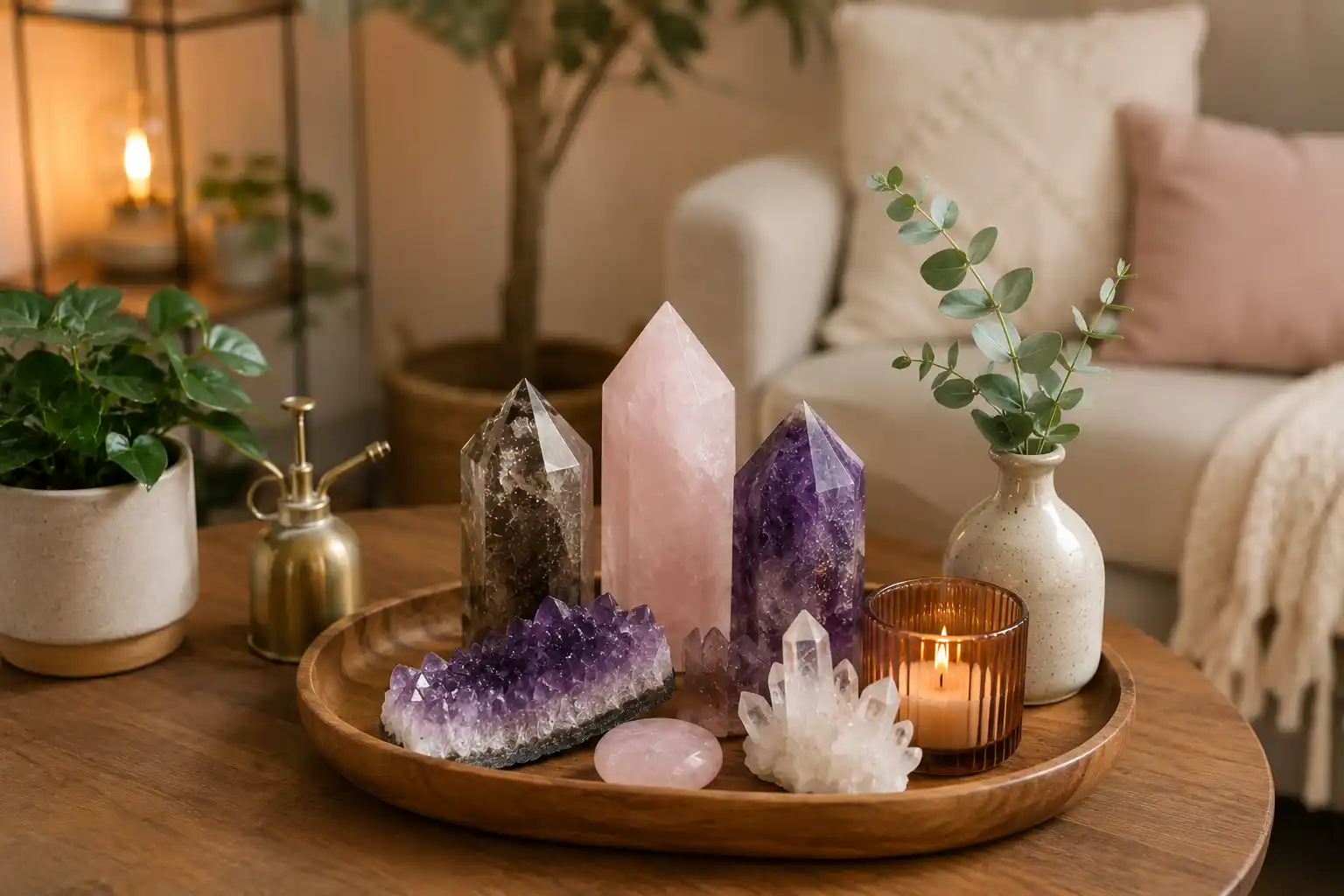
Crystals at Home: Best Stones, Rooms & Safe Placement
Crystals at home can be decorative mineral specimens, personal symbols, collection pieces, meditation objects, or simple reminders connected with household routines. The strongest placement choices start with the room itself: who uses it, what happens there, how much light and moisture it receives, and whether children or pets can reach the display.
Using crystals at home does not require assigning a different stone to every corner. Rose quartz can represent warmth in a shared room, smoky quartz can mark the transition from work to home, amethyst can suit a quiet reading area, and clear quartz can sit beside a household planner. The stone may carry traditional or contemporary symbolism, but the practical value comes from choosing an object that fits the people and the space.
At Gems Lore, crystals at home are discussed as mineral, decorative, cultural, and symbolic objects rather than scientifically established tools for changing a building’s energy, curing illness, protecting occupants, guaranteeing prosperity, or resolving relationships. A meaningful display can support reflection without turning symbolism into a promise.
Crystals at Home at a Glance
| Area | Useful starting points | Main practical concern |
|---|---|---|
| Front door or entrance | Black tourmaline, smoky quartz, jade | Clear walkways, theft, impact |
| Living room | Rose quartz, clear quartz, smoky quartz | Shared-space comfort and consent |
| Bedroom | Amethyst, rose quartz, howlite, moonstone | Stable surfaces and uncluttered sleep space |
| Home office | Clear quartz, pyrite, tiger’s eye, fluorite | Desk function, equipment vents, falling objects |
| Bathroom | Clear quartz, agate, jasper | Humidity, splashing, cleaners |
| Kitchen | Agate, jasper, quartz | Food hygiene, heat, breakage |
| Garden | Quartz, agate, jasper | Weather, soil, tools, pets |
| New home | Jade, rose quartz, smoky quartz, clear quartz | Household needs before symbolism |
| Children’s spaces | Large, stable, low-risk specimens | Choking, sharp edges, falling weight |
| Pet households | Secure inaccessible displays | Chewing, swallowing, breakage |
A useful home display is usually smaller than people expect. A few well-placed pieces are easier to clean, understand, and keep safe than a crowded collection that interferes with furniture, work surfaces, walkways, or household routines.
Start With the Purpose of the Room
Before choosing a stone placement, identify what the room needs to do well. A living room may support conversation, reading, television, children’s activities, entertaining, and rest. A bedroom prioritizes privacy, safe movement, and sleep. A home office needs concentration, organization, and a clear boundary between professional and personal time.
Once the room’s function is clear, give one stone one understandable role. Clear quartz beside a household calendar can represent the current family priority. Smoky quartz near an office doorway can mark the end of the workday. Rose quartz in a shared sitting area can symbolize appreciation expressed through actual words and actions.
This approach is easier to use without claiming that the mineral itself changes behavior. The object is the cue; communication, planning, maintenance, and decisions are what shape daily life.
People who prefer a traditional spatial framework can compare this room-first approach with Feng Shui crystals, where placement is discussed through Bagua themes and traditional context.
Best Crystals at Home for the Living Room
Living rooms are shared spaces, so stones here should fit the household rather than one person’s private practice. Stable polished pieces and substantial specimens are usually easier to manage than loose chips or tall fragile points.
Rose quartz is traditionally associated with affection, compassion, and warmth. In a living room, a rose quartz carving or polished stone can sit near family photographs, a shared journal, or a conversation area. Its grounded purpose can be as simple as reminding people to express appreciation instead of assuming it is understood.
Smoky quartz is commonly associated with grounding and perspective. It works well near the point where people transition from work or commuting into shared time. Clear quartz can sit near a planner or notice board when the household needs one visible priority.
Shared-space consent matters. One person may interpret the collection spiritually, another geologically, and another only as decoration. Nobody sharing the room should be pressured to participate in a ritual or accept metaphysical claims. A home arrangement works better when meaning remains voluntary.
Crystals at Home for the Bedroom
Bedrooms benefit from restraint. Stones should not crowd bedside tables, sit inside bedding, or create heavy objects above a bed.
Amethyst is commonly associated with reflection and moderation. A small polished piece or secure specimen can sit on a dresser or broad bedside surface. How to use amethyst covers reflective, journaling, and meditation uses while keeping those practices separate from medical claims.
Rose quartz can symbolize affection or self-respect, while moonstone is traditionally linked with cycles and change. Moonstone has cleavage, however, so it needs protection from repeated impact. Howlite is often associated with patience and quiet reflection but should not be described as a treatment for insomnia or anxiety.
Do not put crystals at home under a pillow simply because a spiritual source recommends it. Hard stones can create pressure, small pieces can move into bedding, sharp edges can scratch, brittle crystals can fracture, and jewelry can snag. A stable surface beside the bed usually provides the same symbolic reminder with less risk.
These stones cannot diagnose or treat sleep disorders. Persistent sleep problems warrant appropriate medical assessment rather than increasingly elaborate crystal placement.
Crystals at Home Near the Front Door
An entrance is both symbolic and practical. Crystals at home near the front door often include black tourmaline, smoky quartz, jade, and clear quartz because modern traditions associate them with boundaries, grounding, continuity, and intention.
Black tourmaline is widely used in protection symbolism. A grounded interpretation is to let it represent a household boundary that actually exists: keys return to one place, shoes come off at the door, private rooms remain private, or work messages stop after a set hour. The stone does not form an invisible security barrier.
Jade can represent continuity and stewardship, while smoky quartz can mark the shift from outside demands into home life. Clear quartz can represent a simple household intention. Pieces near an entrance should remain stable and unobtrusive.
Do not place spheres, towers, loose tumbled stones, or large clusters where people walk. Entrances involve bags, wet shoes, deliveries, children, pets, and hurried movement. The display should never narrow an exit route, create a trip hazard, or sit where pieces can be kicked onto a hard floor.
Crystals at Home in the Bathroom
Bathrooms expose stones to humidity, splashing water, soap, cosmetics, cleaners, aerosols, and rapid temperature changes. Material identity therefore matters more here than in many other rooms.
Clear quartz, solid agate, and many jasper pieces are generally easier to manage than highly water-sensitive minerals, but even these can contain fractures, dyes, coatings, adhesives, or metal fittings. Crystals that can and can’t go in water explains why “water safe” is not a universal property.
Selenite should not be soaked. Pyrite is better kept dry. Calcite and fluorite deserve more caution than quartz. Turquoise, lapis lazuli, malachite, porous stones, and treated composites should not simply be left beside a shower or bath because they look attractive.
Bathroom stones also need separation from household chemicals. Descalers, bleach, acids, perfume, hair products, and cleaning sprays may attack a mineral, a treatment, an adhesive, a metal stand, or a coating. A stone can carry symbolic meaning without sitting in the wettest part of the room.
Crystals at Home in the Office
A home office is one of the easiest places to connect stone symbolism with specific behavior because work already has measurable tasks.
Clear quartz can sit beside one written priority. Pyrite, traditionally associated with resources and prosperity, can remain near budgeting, invoicing, or pricing work as a reminder to use actual numbers. Tiger’s eye is commonly associated with confidence and judgment and can mark a planning area where risks and alternatives are compared.
Fluorite is often associated with organization and concentration, but it is softer and more cleavage-prone than quartz. Keep it away from desk edges. For business-oriented symbolic routines, crystals for entrepreneurs provides a more focused comparison.
Office pieces must not block computer vents, routers, chargers, printers, heaters, or lamps. Loose stones should not sit where they can drop into equipment. Heavy specimens do not belong on monitors or unstable shelves. A clear desk normally supports work better than a decorative arrangement that competes for usable space.
Crystals at Home for a New Home
Moving gives crystals at home a natural symbolic role because a new space involves new routines, responsibilities, and decisions. The best stone depends on the people moving in, not a universal housewarming formula.
Jade can symbolize continuity and stewardship. Rose quartz can represent warmth in shared areas. Smoky quartz can mark transition. Clear quartz can sit near the household planning area as a reminder of priorities. A mineral collector may instead prefer a labelled specimen chosen for geology, locality, or appearance.
A simple new-home arrangement might place clear quartz near planning, rose quartz in a shared room, and smoky quartz near the entrance. That is enough to create three distinct symbolic roles without turning the collection into another maintenance project.
If the stones are being given to someone else, crystal gifts covers recipient preference, authenticity, treatment, display format, safety, and care. A housewarming gift should fit the recipient’s home rather than impose the giver’s beliefs.
Crystals at Home in the Garden
Outdoor crystals at home face conditions that indoor displays do not: rain, irrigation, frost, strong sunlight, fertilizer, soil chemistry, lawn equipment, wildlife, pets, and large temperature changes.
Quartz, agate, and many jasper pieces may tolerate outdoor display better than softer, soluble, porous, or easily altered materials. Even durable stones can weather, lose polish, collect mineral deposits, or develop surface staining. A polished object did not necessarily evolve to remain unchanged outdoors simply because its raw material formed in nature.
Do not put unidentified crystals at home into vegetable beds, ponds, drinking-water systems, pet areas, or places where animals may chew them. Mineral specimens can contain associated phases that are unsuitable for deliberate contact with food, water, or soil.
Garden placement should also account for tools. A loose stone hidden in grass can become a hazard for a mower or trimmer. Heavy pieces can injure feet if they shift. Secure placement matters more than any symbolic association with growth.
Crystals at Home Near Plants
Crystals at home are often paired with plants because both appeal to people who enjoy natural materials. Moss agate, green aventurine, clear quartz, and jade are frequently associated with growth in contemporary crystal traditions.
The plant still depends on appropriate light, soil, water, temperature, nutrients, root space, and species-specific care. A mineral placed in the pot does not replace horticulture.
Avoid adding chips or powders to potting soil when the material is unidentified. Keep crystals at home on the surface, in a separate dish, or beside the plant when you want the visual relationship without altering the growing medium.
Windows, Sunlight and Heat
Windows can be attractive places for crystals at home, but direct light is not harmless to every material. Some colored minerals, dyes, and treatments can fade or change after prolonged intense exposure.
Amethyst is a familiar example. Crystals that fade in sunlight covers light-sensitive materials and safer display choices. A shaded interior shelf may preserve color better than a permanent sunny windowsill.
Transparent spheres and highly polished transparent shapes also deserve careful positioning because curved transparent objects can concentrate sunlight. The risk depends on geometry, light angle, and surrounding materials, but paper, fabric, dry plants, and wood should not sit where concentrated light can heat them.
Keep crystals at home away from radiators, stoves, fireplace surfaces, candle flames, and high-output lamps. Heat can worsen fractures or affect resins, dyes, adhesives, coatings, and stands. Sudden temperature changes can also stress fragile pieces.
Crystal Shapes Around the Home
Shape changes how crystals at home behave physically. Spheres roll. Towers tip. Points can scratch. Hearts have vulnerable tips and notches. Eggs need stable stands. Multi-point specimens can shed matrix or lose exposed terminations.
Crystal shapes meaning explains hearts, spheres, eggs, points, towers, pyramids, and wands while keeping symbolic interpretations separate from mineral properties.
A fluorite tower remains fluorite. A rose quartz sphere remains quartz. An obsidian heart remains volcanic glass. Crystals at home should therefore be chosen by both shape and material rather than assuming that carving removes durability concerns.
Large spheres need fitted stands. Tall towers need broad, flat bases. Sharp points should not face walkways. Heavy clusters should not sit above beds, sofas, toilets, desks, or frequently occupied chairs.
Crystals at Home With Children
Children change the safety requirements for crystals at home. Loose stones, beads, chips, miniature eggs, small carvings, and jewelry can become choking hazards. Clusters may have sharp points, and heavy specimens can cause injury if pulled from a shelf.
For infants and toddlers, crystals at home should remain adult-controlled decorative or educational objects rather than toys. Crystals for children addresses age-appropriate handling, physical risks, and careful language around emotional or educational claims.
Older children can learn from mineral color, luster, hardness, crystal habit, geology, and identification under supervision. That gives crystals at home genuine educational value without claiming that a stone improves grades, controls behavior, treats anxiety, or protects a child.
Never place loose crystals in a crib, bassinet, toddler bed, or accessible play area. Do not use crystal jewelry as infant jewelry or teething equipment.
Crystals at Home With Pets
Pets can knock over displays, chew unfamiliar objects, swallow small pieces, drink from decorative bowls, or reach shelves that appear inaccessible. Cats in particular can make high open shelving less secure than expected.
Keep crystals at home away from pet food and water dishes. Do not put loose mineral chips into aquariums, terrariums, cages, bedding, or drinking water without material-specific safety evidence.
If a specimen breaks, collect every fragment. Sharp pieces may be hard to see in carpet or under furniture. Crystals at home should remain human decorative, geological, or symbolic objects rather than items a pet is expected to wear, lick, chew, or drink from.
Enclosed cabinets are often the safest option for valuable, sharp, fragile, or small specimens in active pet households.
Moisture, Cleaning and Household Chemicals
Crystals at home collect ordinary dust, cooking film, smoke residue, fingerprints, cosmetics, and household-cleaner overspray. Physical cleaning should depend on the actual material.
Remove a specimen before cleaning the furniture beneath it. Do not spray glass cleaner, furniture polish, disinfectant, bleach, fragrance, or acidic cleaner directly onto an unknown stone. Quartz can tolerate methods that would be inappropriate for selenite, pearl, turquoise, pyrite, fluorite, calcite, or coated material.
Physical cleaning and spiritual cleansing are not the same thing. Crystals at home do not have a scientifically established need for energetic cleansing. If you use a symbolic ritual, choose a method that does not damage the stone.
Water, salt, sunlight, smoke, heat, and chemicals are not universally safe. Low-contact practices such as visualization, sound, or simply restating an intention avoid many material risks.
How to Store Crystals at Home
Not every piece needs permanent display. Rotating crystals at home can reduce clutter, limit sunlight exposure, and make fragile specimens easier to protect.
How to store crystals safely covers scratching, cleavage, padding, humidity, sunlight, sharp points, and separation. Harder stones can scratch softer ones in the same box. Towers and points need tip protection. Spheres need restraints so they cannot roll.
Keep labels with specimens when identity, locality, treatment, or care instructions matter. A collection becomes much harder to manage when the owner no longer knows what a stone is.
How Many Crystals at Home Do You Need?
There is no correct number of crystals at home. More objects do not automatically create greater calm, protection, prosperity, love, focus, or “positive energy.”
A small collection with distinct purposes is easier to keep safe and meaningful. One piece can mark household planning, another a transition zone, another a shared relationship space, and another can simply be displayed because its geology or appearance is interesting.
If crystals at home begin creating clutter, unsafe shelving, cleaning difficulty, or financial pressure, reducing the collection may improve the space more than adding another stone.
Can Different Crystals at Home Be Mixed?
Yes. The main compatibility issues are physical, not metaphysical. Crystals at home do not become dangerous because two spiritual traditions assign them different meanings.
Ask whether one stone can scratch another, whether humidity affects one specimen, whether a heavy piece can fall onto something fragile, whether sunlight changes color, and whether a mineral sheds residue.
Mixed displays work best when the pieces are physically compatible and the arrangement remains easy to dust, inspect, and move. Symbolic pairings can be personal, but material care should take priority.
A Practical Routine for Crystals at Home
Crystals at home become easier to use when each piece connects with one behavior. Rose quartz near a dining or sitting area can represent saying appreciation aloud. Clear quartz beside the weekly planner can mark the household’s main priority. Smoky quartz near the office door can signal that work has ended.
The routine should remain simple. Notice the stone, recall the intended behavior, and do the behavior. There is no need to invent elaborate rules about direction, charging schedules, moon phases, or mandatory combinations unless those practices already have personal cultural or spiritual meaning.
This approach lets crystals at home function as meaningful visual cues while keeping responsibility with the people who live there.
Frequently Asked Questions
What are the best crystals at home?
Versatile crystals at home include clear quartz, rose quartz, smoky quartz, amethyst, jade, agate, tiger’s eye, and black tourmaline. The best choice depends on the room, the material’s durability, the household, and the symbolism you want to use.
Where should I put crystals at home?
Place crystals at home near the activity or behavior they represent while checking stability, sunlight, moisture, heat, children, pets, breakage, and access. A symbol should never make the room harder to use safely.
What crystals are best for the living room?
Rose quartz, smoky quartz, clear quartz, and blue lace agate are common crystals at home for shared living spaces. Their traditional themes include affection, grounding, clarity, and measured communication.
What crystals are suitable for a bedroom?
Amethyst, rose quartz, howlite, and moonstone are common crystals at home for quieter spaces. Keep them on stable furniture rather than inside bedding or above the bed.
What crystals should go near the front door?
Black tourmaline, smoky quartz, jade, and clear quartz are popular crystals at home near an entrance. Keep the path clear and do not rely on a stone instead of locks, alarms, lighting, or other real security measures.
Can crystals go in the bathroom?
Some can, but bathroom crystals at home face humidity, splashes, cleaners, and temperature changes. Identify the mineral first and avoid soaking sensitive, treated, porous, or composite materials.
Can I put crystals in the garden?
Some durable crystals at home can be displayed outdoors, but permanent exposure to rain, frost, sunlight, irrigation, soil, and tools can change or damage them. Keep unidentified minerals out of edible beds, ponds, and pet areas.
Are crystals at home safe around children?
They can be when age-appropriate, supervised, and securely placed. Small stones, beads, sharp clusters, heavy specimens, and unknown materials should stay out of reach of young children.
Are crystals at home safe around pets?
Keep crystals at home where pets cannot chew, swallow, lick, or knock them over. Do not add mineral chips to pet food, water, bedding, aquariums, or habitats without suitable safety evidence.
Can crystals at home sit in direct sunlight?
It depends on the material. Some colors can fade, treatments may change, and transparent curved pieces can concentrate light. A shaded interior location is often safer for long-term display.
Do crystals at home protect a house?
There is no scientific evidence that crystals at home create a protective field. Protection meanings belong to cultural or spiritual traditions. Locks, fire safety, maintenance, childproofing, and appropriate security measures provide real-world protection.
Do crystals at home improve sleep or health?
Crystals at home are not medical treatments and cannot diagnose, prevent, or cure sleep disorders or other health conditions. A stone can be part of a personal reflective routine while evidence-based care remains separate.
Do I need crystals in every room?
No. A few carefully chosen crystals at home are usually easier to maintain and more meaningful than a separate collection in every room.
How should I clean crystals at home?
Use a method suitable for the actual mineral, treatment, coating, setting, or specimen. Do not assume that water, salt, sunlight, steam, ultrasonic cleaning, or household chemicals are universally safe.
Make the Home Work First
Crystals at home should fit into ordinary household life rather than forcing the household to accommodate the collection. Choose stones that mean something to the people who live there, place them securely, and respect the physical requirements of each material.
Let rose quartz represent appreciation, smoky quartz mark a transition, clear quartz identify a priority, or amethyst accompany quiet reflection if those associations are meaningful to you. Keep crystals at home away from unsafe moisture, intense heat, vulnerable sunlight, unstable shelves, young children, and pets.
The most useful crystals at home do not need exaggerated claims. A mineral can be beautiful, geologically interesting, culturally meaningful, spiritually symbolic, or personally important without being presented as a substitute for communication, healthcare, home security, maintenance, financial planning, or practical safety.
Meanings associated with crystals at home reflect cultural, spiritual, and contemporary symbolic traditions rather than scientifically established household effects. Minerals should not replace healthcare, child or pet supervision, fire protection, home security, maintenance, or other appropriate safety measures.