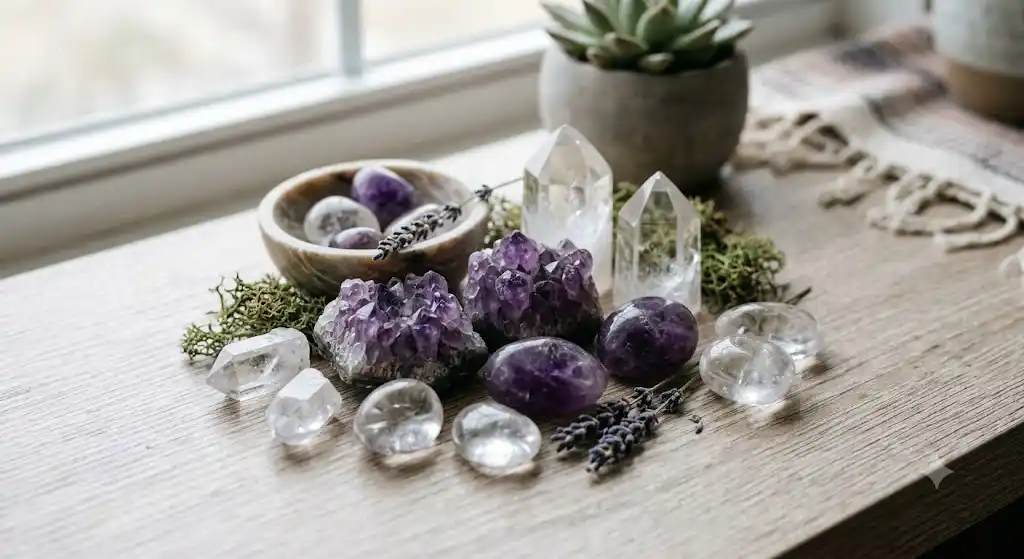
Feng Shui Crystals: Best Stones, Bagua Areas & Placement
Feng Shui crystals are commonly used as symbolic objects for color, intention, visual balance and placement within a home or workspace. Rose quartz is often associated with relationships, jade with continuity and harmony, citrine with prosperity symbolism, black tourmaline with boundaries, and clear quartz with clarity. These associations can make a room feel personally meaningful, but they are not scientifically established ways to change health, wealth, relationships or future events.
Feng Shui itself is much older and broader than modern crystal lists. Chinese Feng Shui traditions developed around landscape, orientation, buildings, directions, movement and the relationship between people and their surroundings. Modern Feng Shui crystals are therefore best understood as one contemporary layer within a much larger cultural practice.
Gems Lore approaches Feng Shui crystals as symbolic placement tools that can support reflection on how a space is used, while keeping traditional meanings separate from claims of guaranteed luck, healing, romance, protection or financial success. If your main concern is room safety, light, moisture, children or pets rather than Bagua symbolism, crystals at home covers those practical placement questions in more detail.
Feng Shui Crystals at a Glance
| Bagua theme | Common crystal choices | Grounded symbolic focus |
|---|---|---|
| Career | Black tourmaline, aquamarine, clear quartz | Direction, boundaries, deliberate progress |
| Knowledge | Amethyst, fluorite, sodalite | Study, reflection, organization |
| Family | Jade, green aventurine, rose quartz | Continuity, communication, support |
| Wealth | Citrine, jade, pyrite, green aventurine | Stewardship, opportunity, resource awareness |
| Fame | Carnelian, garnet, clear quartz | Visibility, reputation, consistent action |
| Love & relationships | Rose quartz, rhodonite, moonstone | Affection, communication, mutual respect |
| Creativity & children | Carnelian, fluorite, clear quartz | Ideas, play, structure, completion |
| Helpful people & travel | Clear quartz, lapis lazuli, sodalite | Support, communication, collaboration |
| Health / center | Jade, clear quartz, smoky quartz | Balance, routines, safe environment |
These Feng Shui crystals are modern symbolic correspondences rather than fixed ancient prescriptions. Different schools use different ways of applying the Bagua, and there is no universal rule that one exact mineral must sit in one exact corner of every home.
How Feng Shui Crystals Fit the Bagua
The Bagua is an eight-trigram framework associated with Chinese cosmological traditions. In modern interior Feng Shui, it is often represented as a map relating areas of a home or room to themes such as career, knowledge, family, wealth, fame, relationships, creativity and helpful people. The center is commonly treated as an integrating area associated with overall balance or health.
Some approaches emphasize compass directions. Others use entrance-aligned grids. Those methods should not be mixed casually. Before placing Feng Shui crystals according to a Bagua, decide which system you are actually following and apply it consistently.
The Bagua is also not a substitute for the physical reality of the room. A symbolic corner does not become useful if a heavy sphere is unstable, a fluorite tower sits in direct sun, or a multi-point specimen blocks a walkway. Feng Shui crystals should work with the space rather than make the space less safe or functional.
Career Area: Black Tourmaline, Aquamarine and Clear Quartz
Crystals used in the career area are usually chosen for themes such as direction, communication, opportunity and professional boundaries. Black tourmaline, aquamarine and clear quartz are common modern choices.
Black tourmaline is widely associated with protection and grounding in contemporary crystal practice. A practical interpretation is to use it as a reminder to protect focused work time, document agreements and maintain appropriate workplace boundaries. It cannot protect a job from layoffs, competition or unfair decisions.
Clear quartz can symbolize one defined professional priority. The clear quartz meaning profile explains the mineral and its modern clarity symbolism. Placing a small piece near a written goal can be more useful than assigning it a vague promise of “success.”
Career Feng Shui crystals work best when the object is tied to an action: preparing an application, improving a skill, organizing a portfolio, asking for feedback or reviewing a contract.
Knowledge Area: Amethyst, Fluorite and Sodalite
Common stones for the knowledge area include amethyst, fluorite, sodalite and clear quartz. Their modern symbolism centers on reflection, organization, study and distinguishing evidence from assumption.
Amethyst is traditionally associated with moderation and reflection. Near a reading chair, study desk or journal, it can mark a routine of slowing down long enough to understand material rather than simply collecting more information.
Fluorite is commonly associated with organization, but its physical care matters. It is much softer than quartz and has perfect cleavage, so a large fluorite tower should not sit where it can be knocked onto a hard floor. The symbolic location should never override the mineral’s actual durability.
For a broader comparison of stones used as study and decision-making reminders, crystals for clarity separates symbolic practice from claims about medically improving cognition.
Family Area: Jade, Aventurine and Rose Quartz
Crystals placed in the family area often emphasize continuity, communication, shared responsibility and care. Jade, green aventurine and rose quartz fit those themes in different ways.
Jade has deep cultural significance in China extending far beyond modern Feng Shui crystals. Jadeite and nephrite have been valued for craftsmanship, durability, ritual, status and symbolism across long periods of Chinese history. Using jade in a family area can therefore represent continuity and responsible care without reducing its history to a simple “luck stone.”
Green aventurine is commonly associated in contemporary practice with growth and opportunity. In a family setting, that can represent allowing relationships to change while maintaining communication.
Rose quartz can symbolize affection and compassion, but family harmony should never mean tolerating abuse, coercion or repeated boundary violations. Family Feng Shui crystals cannot force reconciliation or make another person behave respectfully.
Wealth Area: Citrine, Jade, Pyrite and Aventurine
Wealth Feng Shui crystals attract some of the strongest marketing claims. Citrine, pyrite, jade and green aventurine are frequently described as prosperity or money stones, but none has been scientifically shown to increase income, alter investment returns or change probability.
A more useful way to approach prosperity stones is to connect them with financial behavior. Citrine can sit near a budgeting or invoicing area as a reminder to review actual numbers. Jade can symbolize stewardship and long-term thinking. Pyrite’s gold-like metallic appearance can make it a natural symbol for money awareness, but it should not be treated as an investment strategy.
Green aventurine can represent taking a considered opportunity rather than assuming every opportunity is favorable. Financial decisions still require budgeting, risk assessment, appropriate professional advice and evidence.
When buying citrine, remember that much commercial orange material is heat-treated amethyst. Treatment does not make a stone unusable as one of your Feng Shui crystals, but accurate disclosure matters when price, natural origin or collecting value is important.
Fame Area: Carnelian, Garnet and Clear Quartz
Crystals in the fame area relate to reputation, visibility, recognition and how a person or organization is perceived. Carnelian, garnet and clear quartz are common symbolic choices.
Carnelian has long-standing associations with courage, creativity and action. In a fame area, it can represent doing visible work rather than waiting indefinitely for perfect conditions.
Clear quartz can symbolize clarity about what you want to be known for. Garnet can represent consistency and commitment. Reputation is built through repeated behavior, quality, communication and accountability; Feng Shui crystals cannot create admiration on their own.
A useful question for this area is simple: what action would make your actual reputation closer to the one you want? The stone can mark the question, but the answer comes from behavior.
Love and Relationships Area
Love Feng Shui crystals commonly include rose quartz, rhodonite and moonstone. Rose quartz is the best-known modern relationship stone because its pink color and symbolism are strongly associated with affection and compassion.
Use relationship stones as reminders of mutual respect, direct communication and appreciation. A rose quartz object might sit near a shared journal or a place used for calm conversation. It should never be presented as a way to attract a specific person, override consent, force reconciliation or guarantee marriage.
Rhodonite is often used symbolically for accountability and repair, while moonstone is associated with cycles and adaptation. Those themes can be more realistic for long-term relationships than expecting permanent harmony.
Relationship symbolism is only meaningful when both people retain autonomy. No placement of Feng Shui crystals can substitute for consent, boundaries, communication or safety.
Creativity and Children Area
Crystals for this area are often placed in spaces used for art, writing, design, music, play or project development. Carnelian, fluorite and clear quartz make a useful three-part symbolic combination.
Carnelian can represent starting. Fluorite can represent organizing ideas once they exist. Clear quartz can represent defining the purpose of the project. The broader crystals for creativity article explores those symbolic roles without claiming that a mineral generates talent or inspiration.
In homes with children, physical safety matters more than symbolism. Avoid loose small stones where they could be swallowed, and do not place heavy spheres, sharp points or brittle specimens on unstable shelves. Creativity Feng Shui crystals for a child’s space should be large enough, stable enough and placed high enough to avoid foreseeable hazards.
Helpful People and Travel Area
Crystals for the helpful-people area are associated with mentors, supporters, useful connections, travel and collaboration. Clear quartz, lapis lazuli and sodalite are common choices.
The strongest practical interpretation is specificity. Instead of hoping that helpful people will appear, identify what kind of help is actually needed: technical advice, an introduction, transportation, feedback, childcare, professional guidance or emotional support.
Lapis lazuli is often associated with wisdom and truthful communication. Clear quartz can symbolize a defined request. Sodalite can represent explaining the request clearly. Helpful-people Feng Shui crystals cannot compel another person to provide assistance, and support should not be treated as an entitlement.
Health and Center Feng Shui Crystals
Health-related Feng Shui crystals require especially careful language. No stone placed in the center of a house can diagnose, prevent or treat illness.
Jade, clear quartz and smoky quartz are commonly used symbolically in the center. A grounded approach is to connect this area with the condition of the living environment: clear walkways, usable lighting, safe storage, ventilation, manageable clutter and routines that support ordinary daily functioning.
The center can also be a useful place to notice whether the room itself creates unnecessary stress. Is furniture blocking movement? Are medications stored safely? Are cables creating trip hazards? Are frequently used items accessible?
Health Feng Shui crystals can accompany those improvements as decorative or symbolic objects. Medical symptoms and health concerns still require appropriate healthcare.
Choosing Feng Shui Crystals for the Front Door
Entrances are commonly emphasized in Feng Shui because they mark movement between outside and inside. Black tourmaline, jade and clear quartz are frequently used near a front door.
Front-door Feng Shui crystals should first survive the location. Avoid placing valuable stones where they can be stolen, exposed to rain, damaged by direct sun or knocked over by bags, children or pets. Narrow entryways also need clear walking space.
If a stone is being used symbolically for boundaries, its placement can accompany a practical routine: locking the door, keeping keys in one place, clearing the entrance and deciding what work or stress does not need to follow you farther into the home.
Feng Shui Crystals in the Bedroom
Bedroom Feng Shui crystals should support a room that remains calm, uncluttered and physically safe. Rose quartz, moonstone and amethyst are popular symbolic choices, but more is not better.
Avoid heavy specimens above the bed, unstable spheres on narrow tables and sharp multi-point pieces where a sleeping person could reach them. Decorative specimens with exposed points need enough space to protect both the mineral and anyone using the bedside area.
Bedroom Feng Shui crystals do not treat insomnia, anxiety, fertility problems or relationship difficulties. If a stone helps mark a bedtime routine or a shared intention, that is a symbolic use rather than a medical effect.
Feng Shui Crystals in the Office
An office is one of the easiest places to connect Feng Shui crystals with a concrete behavior. Clear quartz can mark the main priority, fluorite can accompany planning, carnelian can represent visible action, and a symbolic prosperity stone can sit near financial work.
Keep the desk functional. Feng Shui crystals should not block ventilation, interfere with electronics, crowd the keyboard or create an unstable arrangement around cables. One or two purposeful pieces usually work better than filling every available surface.
The same principle applies to home offices: the object is most useful when it points to a behavior such as reviewing finances, closing the workday, preparing a presentation or documenting decisions.
Crystal Shapes and Feng Shui Placement
Spheres, towers, points, hearts, multi-point specimens and carved forms are frequently incorporated into Feng Shui crystals. Shape affects appearance, stability, handling and symbolism, but it does not change mineral chemistry.
A fluorite sphere is still soft and cleavage-prone. A quartz point can still chip. A pyrite specimen can still react poorly to damp storage. The crystal shapes meaning overview separates modern shape symbolism from the real physical properties of the underlying material.
Choose a form that physically suits the location. A sphere needs a secure stand, a tower needs a stable base and a multi-point specimen needs enough space that fragile points are not repeatedly touched.
Buying Authentic Feng Shui Crystals
Feng Shui crystals are sold as rough pieces, tumbled stones, carvings, spheres, towers, jewelry and mineral specimens. The symbolic purpose does not remove ordinary buying questions.
Ask what the material actually is. Dyed stones, coatings, composite pieces, synthetic materials and imitations can all enter the crystal market. Treatment is not automatically a problem, but a seller should not describe dyed, coated or reconstructed material as natural and untreated.
For jade, identity and treatment can materially affect value. For quartz, glass and dyed materials can imitate some appearances. Polished stones may hide fractures under oil or wax. Large decorative objects may contain glued repairs.
The general quartz overview helps distinguish quartz-family materials, while crystals that start with R provides additional mineral context for rose quartz and related names. Buy for beauty and suitability first; do not pay a premium simply because a seller claims stronger energy, luck or manifestation power.
Caring for Feng Shui Crystals
Feng Shui crystals do not share one safe cleaning method. Quartz, jade, fluorite, pyrite, lapis lazuli, calcite and other materials differ in hardness, cleavage, porosity, treatments and sensitivity to moisture or chemicals.
Do not assume that water, salt, sunlight, smoke or heat is safe because a symbolic ritual recommends it. Physical care should be based on the mineral and any treatment, coating, adhesive or metal setting.
When several Feng Shui crystals are displayed or stored together, how to store crystals safely explains how harder stones can scratch softer ones and why sunlight, humidity, weight and fragile points matter.
Keep unknown rough material away from food preparation areas and out of reach of young children and pets. Do not ingest mineral powders or prepare drinking water by soaking unidentified stones.
How Many Feng Shui Crystals Do You Need?
There is no required number of Feng Shui crystals. Filling every room and every Bagua area with several stones does not make the practice stronger.
Start with one area where the symbolism connects with a real behavior. Select one or two materials that fit the physical space. Observe whether the arrangement helps you use the room more intentionally.
A smaller collection is also easier to clean, store and inspect for damage. Feng Shui crystals should add meaning to a room rather than becoming another source of clutter.
Feng Shui Crystals as Gifts
Feng Shui crystals can make thoughtful housewarming, wedding, business-opening or personal gifts when the recipient is interested in the practice. Jade, rose quartz, clear quartz and carefully selected carvings are common choices.
Explain the meaning without promising an outcome. “I chose jade because it has long associations with continuity and refinement” is more respectful than telling someone the stone will make them wealthy or protect their marriage.
The broader crystal gifts article covers recipient preferences, safety, authenticity, treatment, jewelry and display formats.
Frequently Asked Questions
What are the best Feng Shui crystals?
Popular Feng Shui crystals include jade, rose quartz, clear quartz, citrine, black tourmaline, amethyst, green aventurine, carnelian, fluorite and pyrite. The best choice depends on the symbolic theme, the actual room and the material’s physical suitability.
Which Feng Shui crystals are used for career?
Black tourmaline, aquamarine and clear quartz are common career choices. They are traditionally associated with boundaries, communication and clarity rather than scientifically proven professional outcomes.
Which Feng Shui crystals are used for love?
Rose quartz is the best-known relationship choice, with rhodonite and moonstone also used in modern practice. These stones can symbolize affection, accountability and adaptation but cannot control another person or override consent.
Which Feng Shui crystals are associated with wealth?
Citrine, pyrite, jade and green aventurine are commonly associated with prosperity symbolism. They do not increase income or investment returns by themselves.
What should go in the health area?
Jade, clear quartz and smoky quartz are common symbolic choices, but practical environmental factors matter more. Clear walkways, safe storage, ventilation and appropriate healthcare cannot be replaced by Feng Shui crystals.
Can I put Feng Shui crystals near the front door?
Yes, if the placement is secure. Consider theft, rain, direct sunlight, pets, children, narrow walkways and the weight or fragility of the stone.
Do Feng Shui crystals have to be natural?
No scientific evidence shows that a natural crystal is more effective for Feng Shui than a treated or manufactured object. If natural origin matters to you as a collector or buyer, ask for accurate disclosure.
Can I use Feng Shui crystals in every Bagua area?
You can, but it is not necessary. One or two carefully selected pieces tied to meaningful routines are easier to use and maintain than a crowded arrangement.
Should Feng Shui crystals be cleansed?
Spiritual cleansing is optional. Physical cleaning should follow the actual material, since water, salt, sunlight and heat can damage some stones or treatments.
Do Feng Shui crystals really attract money, love or good health?
There is no scientific evidence that Feng Shui crystals directly produce those outcomes. Their value in this context is cultural, symbolic, decorative and personal.
Use Feng Shui Crystals With Context
Feng Shui crystals are most meaningful when the symbolism matches both the Bagua theme and the way the space is actually used. Career stones can mark professional boundaries and goals. Family stones can represent continuity and respectful communication. Wealth stones can accompany budgeting and stewardship. Relationship stones can symbolize affection while preserving consent and autonomy.
The physical object still matters. Choose genuine or accurately disclosed material, place it securely, respect its care requirements and avoid turning traditional symbolism into a guarantee.
Used this way, Feng Shui crystals can add a thoughtful layer of color, history and personal intention to a home without asking a mineral to do the work of practical decisions, healthy relationships, financial planning or medical care.
Feng Shui, Bagua correspondences and crystal meanings belong to cultural, traditional or contemporary spiritual practice. Feng Shui crystals are not scientifically established methods for changing health, wealth, relationships, luck or future events, and they should not replace appropriate medical, financial, legal, safety or relationship support.
:::