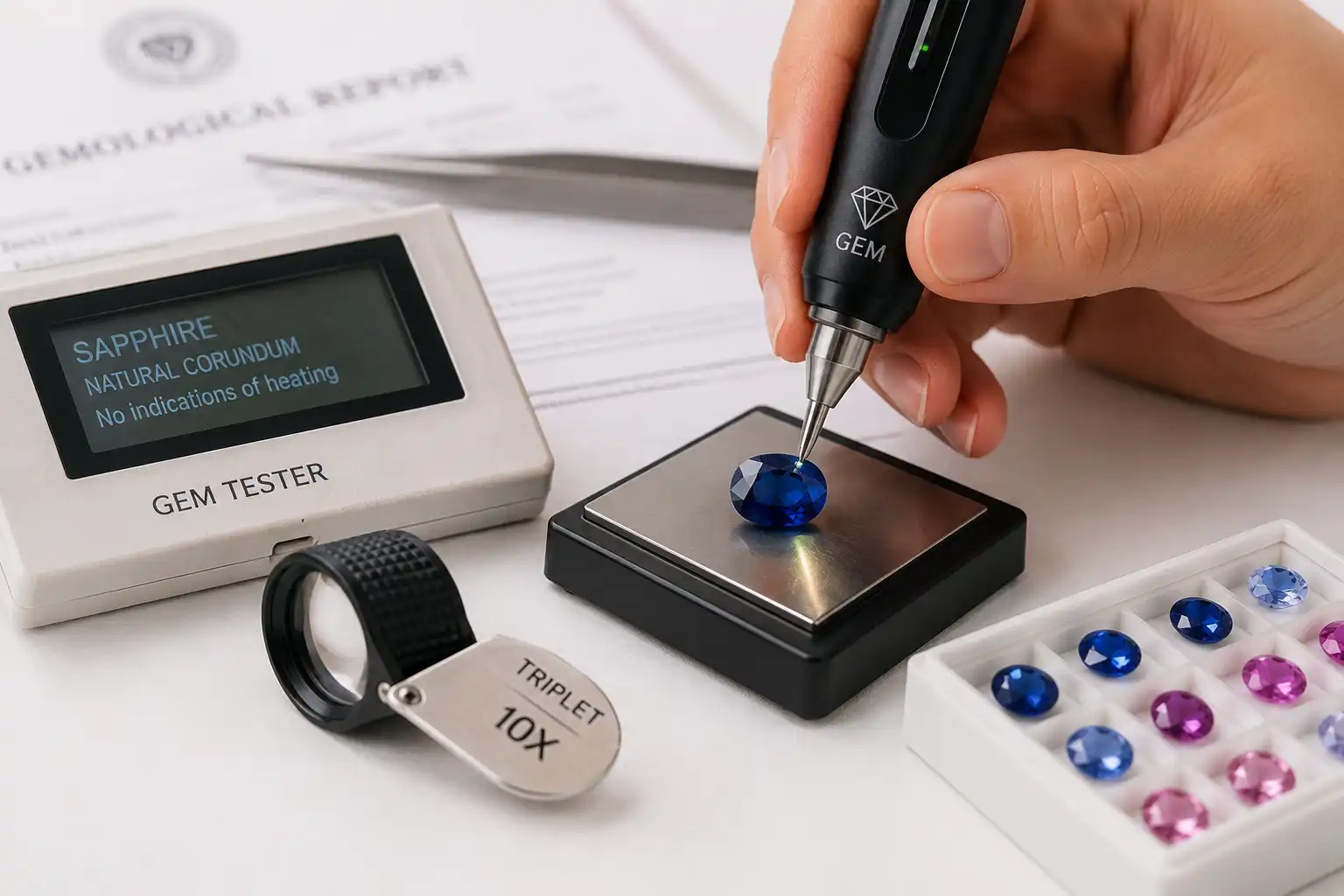
Real vs Fake Sapphire: Natural, Synthetic and Treated Tests
A real natural sapphire is corundum that formed geologically and displays any gem color except red. Blue is the most familiar sapphire color, but natural sapphires also occur in pink, yellow, orange, green, purple, white, gray, black and color-changing varieties.
Laboratory-grown sapphire is also corundum. It shares natural sapphire’s aluminum-oxide composition, hardness, density and refractive properties, although it grew through a manufactured process.
Sapphire imitations include glass, synthetic spinel, cubic zirconia, blue topaz, tanzanite, iolite, kyanite and other gems chosen to resemble one sapphire color. Natural sapphire can also be heated, diffusion-treated, fracture-filled, coated or assembled.
Therefore, a complete sapphire identification should determine:
- Whether the stone is corundum.
- Whether the corundum is natural or laboratory-grown.
- Whether its color, clarity or surface has been treated.
- Whether a variety or origin claim is supported.
This page owns the direct authenticity workflow. The completed treated and synthetic sapphire guide retains the full treatment and laboratory-growth taxonomy.
Natural Sapphire vs Synthetic Sapphire and Simulants
| Feature | Natural sapphire | Laboratory-grown sapphire | Glass or synthetic spinel | Natural lookalike |
|---|---|---|---|---|
| Material | Naturally formed corundum | Manufactured corundum | Unrelated manufactured material | Another natural mineral |
| Color range | Every corundum color except ruby red | Nearly any manufactured sapphire color | Any selected color | Mineral-dependent |
| Mohs hardness | 9 | 9 | Glass about 5–6; spinel about 8 | Mineral-dependent |
| Refractive index | Approximately 1.762–1.770 | Same corundum range | Generally different | Generally different |
| Specific gravity | Approximately 4.00 | Approximately 4.00 | Material-dependent | Material-dependent |
| Refraction | Doubly refractive | Doubly refractive | Glass and spinel usually singly refractive | Depends on mineral |
| Common natural clues | Angular zoning, mineral inclusions, rutile silk and healed fissures | Curved striae, gas bubbles, flux residues, seed structures or synthetic growth patterns | Bubbles, curved flow or synthetic features | Natural features of the substitute |
| Treatments | Heat, diffusion, filling and coating | Post-growth treatment may occur | Color is created in manufacture | Treatment varies |
| Best confirmation | Microscopy, spectroscopy, chemistry and fluorescence imaging | Same advanced methods | Standard gem testing | Standard gem identification |
Physical constants establish corundum identity but do not establish mined origin.
What Is Genuine Sapphire?
The sapphire meaning guide owns formation, symbolism, localities and general gem properties.
Sapphire and ruby belong to the same corundum mineral species. Red corundum is ruby, while other gem-quality colors are sapphire.
Pure corundum is colorless. Trace elements and structural defects produce color.
Iron and titanium contribute to blue. Chromium creates pink. Iron can produce yellow or green, while combinations of trace elements and treatments generate a wide range of other colors.
The completed types-of-sapphire guide owns blue, fancy, color-change, star and locality-associated categories.
Natural Blue Sapphire Color
Blue sapphire ranges from pale blue through cornflower, royal and violetish blue to dark inky blue.
The most desirable color depends on market preference, brightness, saturation and whether the stone remains attractive under ordinary lighting.
A deep stone can look impressive under a spotlight but nearly black indoors. A pale sapphire may appear brighter and larger face-up.
Color alone cannot prove natural origin. Synthetic sapphire, glass, synthetic spinel and diffusion-treated corundum can reproduce familiar blue shades.
Digital photographs can increase saturation, remove gray modifiers and lighten dark centers.
Fancy Sapphire Colors
Fancy sapphires include pink, yellow, orange, green, purple, white, black and color-changing corundum.
Yellow sapphire can be natural, heated, diffusion-treated or laboratory-grown.
White sapphire is colorless corundum and may imitate diamond, though it has lower brilliance and dispersion.
Padparadscha sapphire occupies a narrowly valued pink-orange to orange-pink range. Color interpretation, treatment and geographic market standards make documentation particularly important.
The completed Padparadscha sapphire buying guide owns that variety’s purchase criteria.
Natural Sapphire Inclusions
Natural sapphire may contain rutile silk, zircon crystals, apatite, mica, feldspar, spinel, hematite, fluid inclusions and partially healed fissures.
Angular or hexagonal growth zoning can follow corundum’s crystal symmetry.
Rutile silk may create a velvety appearance or a star in cabochon-cut material. Heat can dissolve or alter the needles.
Natural inclusions vary with geological source. Basalt-related sapphires often differ from metamorphic sapphires in iron content, fluorescence and inclusion scene.
No single natural-looking crystal proves origin, and a clean sapphire can still be natural.
Flame-Fusion Synthetic Sapphire
Flame-fusion synthetic sapphire grows from molten powdered ingredients that solidify into a boule.
Classic features include curved striae, curved color zoning and round gas bubbles.
Color can be extremely uniform or show curved bands matching the boule’s growth.
Some stones are cut so that curved striae become difficult to observe. Colorless synthetic sapphire can be especially challenging under ordinary visible light.
A lack of obvious bubbles or lines does not prove natural origin.
Flux-Grown Synthetic Sapphire
Flux-grown sapphire crystallizes slowly from a molten chemical solution.
It can contain wispy flux veils, fingerprints, cavities, metallic-looking particles and irregular growth features.
Some examples resemble natural sapphire under basic magnification.
Flux material is less common than inexpensive flame-fusion sapphire but can appear in high-value-looking jewelry and collector crystals.
A laboratory evaluates inclusions together with fluorescence imaging, spectra and trace chemistry.
Czochralski, Hydrothermal and Other Synthetic Sapphire
Czochralski pulling grows sapphire from a melt around a seed.
Hydrothermal and other experimental or commercial processes can also produce corundum.
Possible clues include seed boundaries, growth striations, unusual zoning and manufacturing-related inclusions.
Different methods produce different evidence. A checklist designed for Verneuil sapphire cannot identify every modern synthetic.
Laboratory reports should state laboratory-grown corundum without relying on a speculative visual label.
Heat-Treated Sapphire
Heating is the most common sapphire treatment.
It can strengthen or lighten color, improve uniformity, dissolve rutile silk and heal selected fissures.
A heated sapphire remains natural corundum when the starting stone formed geologically.
Fine unheated sapphire can command a substantial premium, particularly when color and provenance are exceptional.
Common microscopic evidence includes altered inclusions, dissolved silk, stress fractures and recrystallized fissures. Low-temperature treatment can be subtle and may require FTIR or other laboratory analysis.
Diffusion-Treated Sapphire
Diffusion introduces color-causing elements into corundum at high temperature.
Titanium diffusion can create blue color near the surface. Beryllium diffusion may produce or modify yellow, orange and pink-orange colors and can penetrate more deeply.
Shallow diffusion may concentrate color around facet junctions and girdles. Immersion can make the surface-related color easier to see.
Repolishing can remove part of a shallow color layer.
Because the stone remains corundum, hardness, refractive index and density do not expose diffusion automatically.
Fracture Filling and Flux Healing
Surface-reaching fissures may be filled with glass or another transparent substance.
Flux-assisted heat can heal fractures partially by depositing corundum-like material within them.
Filled fractures may show flash effects, bubbles or areas of different luster.
The amount of non-corundum material can range from minor filling to a composite-like construction.
Care and repair requirements depend on the filler. The completed treatment page owns the complete distinction.
Coated Sapphire
A sapphire, colorless corundum, glass or another stone can receive a colored coating.
Coatings may improve blue, pink or orange appearance or create unusual iridescent colors.
Inspect facet edges, girdles, scratches and areas beneath prongs. Abrasion can expose the underlying body.
A pavilion coating may influence the entire face-up color while remaining concealed in a mounting.
Coated natural sapphire still contains natural corundum, but its appearance depends on treatment.
Sapphire Doublets
A doublet may combine natural sapphire, synthetic sapphire, glass or another material.
Historical constructions sometimes joined a natural crown to a colored glass pavilion.
A straight girdle-level join, trapped bubbles and an abrupt change in inclusions can reveal assembly.
Closed settings make the profile difficult to inspect.
Assembled construction must be disclosed because value, durability and repair differ from one solid sapphire.
Sapphire Versus Blue Glass
Blue glass can imitate sapphire in inexpensive jewelry and rough-like specimens.
Round bubbles, curved flow lines, mold seams and homogeneous color are common clues.
Manufacturers can add cloudiness, crystals and fractures to imitate natural material.
Glass is softer, less dense and singly refractive. A refractometer and polariscope normally separate it quickly.
A scratch test is unnecessary and can damage jewelry.
Sapphire Versus Synthetic Spinel
Synthetic blue spinel is common in vintage and inexpensive jewelry.
It is usually singly refractive and has different refractive index and density from sapphire.
Flame-fusion synthetic spinel may show curved striae and gas bubbles, which can resemble synthetic sapphire clues until optical properties are measured.
A stone can be laboratory-grown yet still be a sapphire imitation rather than synthetic sapphire.
Exact chemistry determines the correct name.
Sapphire Versus Blue Topaz
Most blue topaz is irradiated and heated colorless topaz.
It is less dense than sapphire? Actually topaz specific gravity is around 3.5, while sapphire is about 4.0, and their refractive properties differ.
Topaz has perfect cleavage and commonly displays brighter sky, Swiss or London-blue commercial shades.
The completed aquamarine-versus-blue-topaz guide provides broader blue-topaz context, while direct sapphire identification should rely on instruments rather than color names.
A large vivid blue stone offered inexpensively is more likely to be treated topaz, synthetic sapphire or glass than fine natural sapphire.
Sapphire Versus Tanzanite
Tanzanite is blue-to-violet zoisite.
It shows strong pleochroism, lower hardness and different refractive properties from sapphire.
The completed tanzanite-versus-sapphire guide owns the full comparison.
Tanzanite often appears more violet and may change noticeably under warm light, although sapphire can also contain violet modifiers.
Sapphire Versus Iolite
Iolite is strongly pleochroic cordierite.
Depending on orientation, one stone can appear violet-blue, pale gray-blue and nearly colorless or yellowish.
Iolite has lower refractive index, lower density and lower hardness than sapphire.
It can offer an attractive natural blue at lower cost, but it should not be represented as sapphire.
Sapphire Versus Kyanite
Kyanite can show rich blue comparable with sapphire.
Its hardness varies by crystallographic direction, and it has prominent cleavage and lower density.
The completed kyanite-versus-sapphire guide owns the material comparison.
Kyanite’s elongated inclusions and lower durability make it a distinct gemstone rather than inexpensive sapphire.
Yellow Sapphire Versus Citrine
Yellow sapphire and citrine can overlap visually.
Sapphire is denser, harder and more refractive. Citrine is quartz with Mohs hardness 7.
The planned citrine-versus-yellow-sapphire guide retains that direct comparison.
A bright yellow stone cannot be identified by astrology, seller tradition or color alone.
White Sapphire Versus Diamond and Moissanite
White sapphire has lower refractive index and dispersion than diamond or moissanite.
Its sparkle commonly appears softer, with less white-light return than a well-cut diamond.
Surface residue can dull white sapphire quickly.
A diamond tester may help, but material identity should be established with suitable gemological tools.
The recently drafted real-versus-fake diamond guide owns the complete natural diamond, lab-diamond and simulant boundary.
Star Sapphire
Star sapphire shows asterism caused by aligned inclusions.
A natural six-rayed star should move across the cabochon with the light. Twelve-rayed stars can occur when more than one inclusion system contributes.
Synthetic star sapphire is widely available. Its star can appear excessively sharp, perfectly centered or superficial, although natural fine stars may also be attractive and well centered.
Diffusion treatment can produce or improve a star near the surface.
Authentication requires microscopic examination of the inclusion network and growth structure.
Refractive Index, Density and Birefringence
Sapphire normally has refractive index around 1.762–1.770, density near 4.00 and birefringence around 0.008–0.010.
These properties separate sapphire from glass, topaz, tanzanite, iolite, kyanite and synthetic spinel.
Natural and laboratory-grown sapphire share the corundum range.
A correct result confirms the species, not geological origin.
Composite construction and mounted stones can make measurements more difficult.
Pleochroism
Blue sapphire commonly displays blue and greenish-blue or violetish-blue directional colors.
Fancy sapphires show pleochroism according to their trace elements and orientation.
A dichroscope can support corundum identification and expose color zoning.
Ordinary glass lacks true pleochroism, while tanzanite and iolite may show much stronger directional differences.
The test remains supporting evidence rather than a natural-origin conclusion.
Ultraviolet Fluorescence
Sapphire fluorescence varies widely by color, chemistry, treatment and origin.
Some pink sapphires fluoresce red because of chromium. Iron-rich blue sapphires may be weak or inert.
Synthetic sapphires can show strong, zoned or unusual fluorescence, but no single reaction identifies every product.
Heat and diffusion may alter fluorescence patterns.
Controlled imaging can reveal growth zoning that ordinary UV lamps do not show clearly.
Spectroscopy and Trace Chemistry
Visible spectroscopy helps identify chromium, iron, titanium and color-center absorptions.
FTIR can detect selected heat-treatment features and inclusions involving hydroxyl groups.
Raman spectroscopy identifies corundum and inclusions.
Trace-element analysis can distinguish natural and synthetic growth, detect beryllium diffusion and support geographic-origin opinions.
A modern laboratory relies on a reference database rather than one threshold value.
Geographic-Origin Claims
Important sapphire sources include Kashmir, Myanmar, Sri Lanka, Madagascar, Australia, Thailand, Cambodia, Montana and several African deposits.
Color does not prove locality.
Laboratories evaluate inclusions, chemistry and spectroscopy and may issue an origin opinion when evidence is sufficient.
“Kashmir blue,” “Ceylon color” and “Montana-style teal” can function as descriptive marketing phrases without proving geographic origin.
An origin premium should be supported by an independent report.
Certificates and Reports
The completed gemstone-certification guide explains identification, treatment and origin documentation.
A sapphire report should state natural or laboratory-grown origin and disclose detectable heating, diffusion, filling or coating.
Some reports provide a geographic-origin opinion when requested.
Use how to read a gem-lab report to compare dimensions, weight and treatment wording with the exact stone.
A grading-style retailer card is not equivalent to independent laboratory analysis.
A Safe Home Inspection Sequence
Clean the stone gently.
Observe color under neutral daylight-equivalent and warm indoor light.
Use a 10× loupe to inspect zoning, silk, crystals, curved striae, bubbles, flux residues, filler flashes and assembly planes.
A polariscope and dichroscope can separate several singly refractive simulants.
A refractometer and accurate density measurement can confirm corundum.
Do not scratch, heat, acid-test or expose the stone to prolonged ultraviolet light.
When natural origin, treatment or locality affects price, seek an independent report.
Buying Genuine Sapphire
The completed sapphire buying guide owns color, clarity, cut, carat and seller assessment.
The sapphire price guide explains treatment, size, origin and variety premiums.
For laboratory-grown material, use the lab-sapphire buying guide and lab-sapphire price guide.
A seller should distinguish natural sapphire, heated sapphire, diffusion-treated sapphire, laboratory-grown sapphire and simulant clearly.
Use how to buy gemstones online and verify the report before the return period closes.
Jewelry and Care
A sapphire engagement ring can perform well because corundum is hard and generally durable.
Treatment still matters. Filled, coated and assembled stones require more cautious cleaning and repair.
Use the completed sapphire jewelry cleaning guide and disclose treatment to the jeweler before resizing or resetting.
Sapphire’s calendar role appears in the September birthstone guide.
The broader sapphire-versus-emerald-versus-ruby guide owns comparative purchase decisions rather than authentication.
Frequently Asked Questions
1. What is a genuine natural sapphire?
It is naturally formed gem-quality corundum of any color except ruby red.
2. Is laboratory-grown sapphire real sapphire?
It is genuine synthetic corundum, but it is manufactured rather than mined and must be disclosed clearly.
3. Can natural sapphire be flawless?
Yes, especially in smaller stones, although large vivid and highly clean natural sapphires are less common.
4. Do curved striae prove synthetic sapphire?
They strongly support flame-fusion growth when interpreted correctly, but their absence does not prove natural origin.
5. Is heated sapphire fake?
No. It remains natural corundum, although treatment affects rarity and value.
6. What is diffusion-treated sapphire?
It is corundum whose color or optical effect was changed by introducing elements at high temperature, sometimes mainly near the surface.
7. Can glass look like sapphire?
Yes. Colored glass can imitate blue and fancy sapphires, sometimes with manufactured inclusions.
8. How can sapphire be distinguished from blue topaz?
Sapphire is denser, more refractive and lacks topaz’s perfect cleavage. Instrument testing confirms the difference.
9. How can sapphire be distinguished from tanzanite?
Tanzanite has lower hardness, lower density, different refractive properties and much stronger pleochroism.
10. Does ultraviolet fluorescence prove sapphire is natural?
No. Natural, synthetic and treated sapphires show varied reactions.
11. Can a scratch test identify sapphire?
No. It risks damaging jewelry and cannot distinguish natural from laboratory-grown corundum.
12. When should sapphire receive laboratory testing?
Testing is advisable when natural origin, heating, diffusion, filling, star origin, geographic origin or price materially affects the purchase.
Sapphire authentication requires more than matching a stone to one shade of blue. Natural and laboratory-grown corundum share the same basic properties, while heat and diffusion can change natural color without changing species. Simulants are often separated through standard instruments; natural origin and treatment require microscopic, spectroscopic and chemical evidence matched to a credible report.
Sapphire appears in Crystals That Start With S and Gemstones That Start With S.