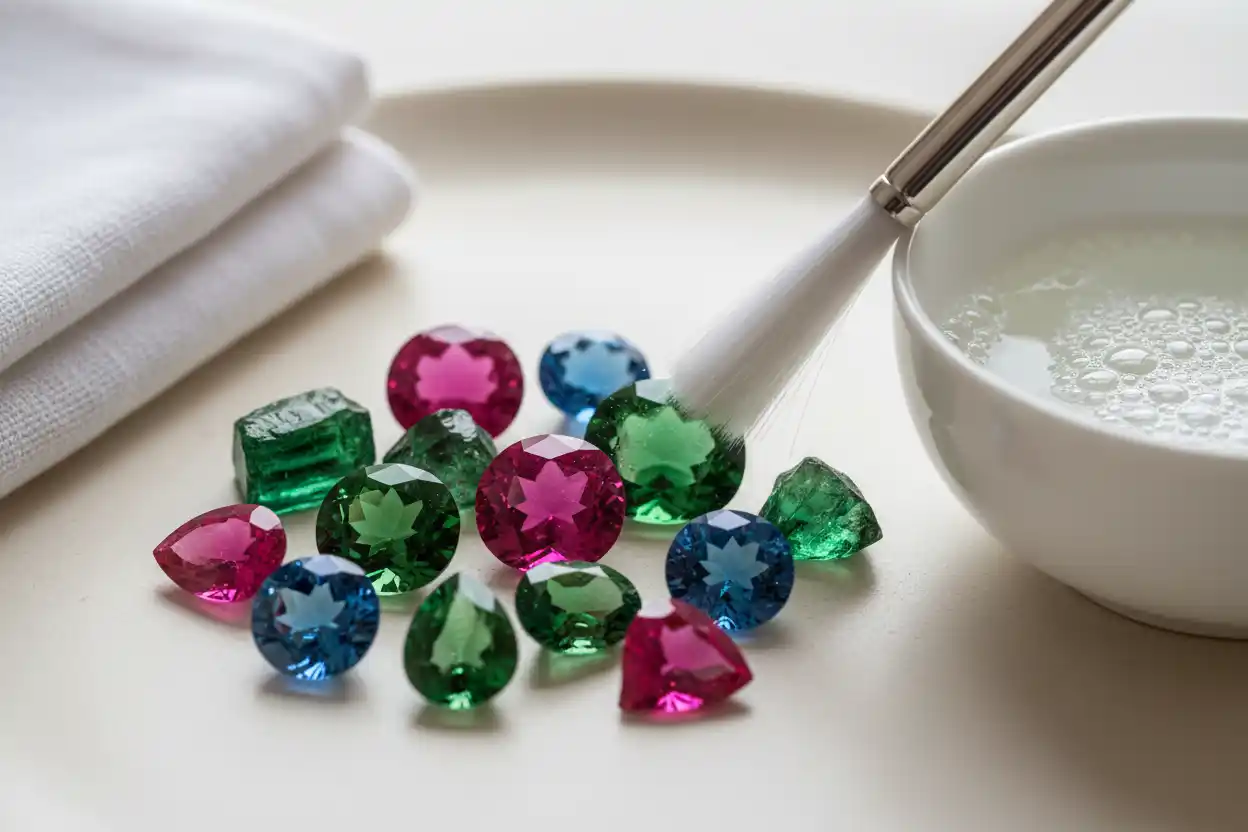
How to Clean Tourmaline Jewelry Safely: Water, Soap & Care Guide
Learning how to clean tourmaline jewelry safely starts with a simple method: inspect the piece, use lukewarm water with a small amount of mild liquid soap, clean gently with a soft brush or lint-free cloth, rinse briefly, and dry completely at room temperature. For most sound, untreated tourmaline in a secure setting, aggressive chemicals and specialized cleaning equipment are unnecessary.
Knowing how to clean tourmaline jewelry also requires recognizing how varied this gemstone family can be. Tourmaline includes green, pink, red, blue, black, copper-bearing, and naturally multicolored material. Some stones are relatively clean, while others contain liquid inclusions, growth tubes, healed fractures, or surface-reaching fissures that make conservative care especially important.
The broader tourmaline guide explains why tourmaline is a chemically complex borosilicate group rather than one uniform mineral. Its different species, colors, and commercial varieties are organized in types of tourmaline.
At Gems Lore, guidance on how to clean tourmaline jewelry is based on the stone’s physical properties, known treatments, structural condition, jewelry construction, and realistic exposure risks rather than spiritual claims about cleansing or charging.
How to Clean Tourmaline Jewelry at a Glance
| Method | General guidance |
|---|---|
| Soft lint-free cloth | Excellent for routine care |
| Lukewarm water | Usually suitable for brief cleaning of sound stones |
| Mild liquid soap | Good default for ordinary skin oil and residue |
| Very soft brush | Useful around settings and beneath stones |
| Long soaking | Usually unnecessary |
| Ultrasonic cleaner | Best avoided as a general home method |
| Steam cleaner | Avoid |
| Boiling or very hot water | Avoid |
| Sudden temperature changes | Avoid |
| Vinegar or lemon juice | Avoid |
| Toothpaste | Avoid |
| Baking-soda scrub | Avoid |
| Bleach or strong cleaners | Avoid |
| Acetone or strong solvents | Avoid for routine care |
| Salt-water soak | Unnecessary |
| Professional cleaning | Best for valuable, fractured, filled, antique, or complex pieces |
Tourmaline is commonly around 7–7.5 on the Mohs scale. That gives it useful scratch resistance for jewelry, but hardness does not make it immune to chipping or fracture. Tourmaline is brittle, and internal features can create localized weaknesses.
That distinction is central to how to clean tourmaline jewelry safely.
What You Need
You need very little equipment to learn how to clean tourmaline jewelry at home.
Prepare a shallow bowl, clean lukewarm water, a small amount of mild liquid soap, a soft lint-free cloth, a very soft jewelry brush or toothbrush, and a folded towel.
Work over the towel or bowl rather than directly over an open drain. If a stone or earring back is already loose, cleaning can reveal the problem at the worst possible moment.
Avoid concentrated degreasers, whitening toothpaste, abrasive powders, bleach, acidic household cleaners, metal polish, or products containing unknown solvents.
The safest method for how to clean tourmaline jewelry is usually the least chemically complicated one.
Step 1: Inspect the Tourmaline Before Cleaning
The first step in how to clean tourmaline jewelry is not putting it in water. It is examining it.
Check the gemstone under bright neutral light. Look for chipped facet junctions, surface-reaching fractures, cloudy filled areas, scratches, loose movement, visible adhesive, coatings, or fractures extending toward corners and edges.
Tourmaline frequently contains natural inclusions. Growth tubes, fluid inclusions, healed fissures, color-zone boundaries, and other internal features are part of the stone rather than dirt that needs to be removed.
Then inspect the jewelry. Check prongs, bezels, clasps, bails, chain links, bead holes, thread, elastic, soldered joints, enamel, and companion stones.
If a gemstone rocks inside its setting or a prong catches on fabric, stop. Knowing how to clean tourmaline jewelry means recognizing when mechanical repair needs to come before cleaning.
Step 2: Check for Treatment or Filling
Treatment status can change how to clean tourmaline jewelry.
Tourmaline may be heated, irradiated, fracture filled, coated, or subjected to other enhancements. Heat and irradiation can modify color in suitable stones, while oils or resins may be introduced into surface-reaching fractures.
Treatment does not automatically make a tourmaline unsuitable for jewelry. The important issues are disclosure, stability, value, and appropriate care.
The broader gemstone treatments overview explains why treatment and authenticity are different questions.
If you know that a tourmaline has been fracture filled, avoid long soaking, ultrasound, steam, harsh chemicals, and solvents. If treatment status is uncertain and the stone is valuable, use conservative hand cleaning.
That is safer than assuming every stone should tolerate the same procedure.
Step 3: Prepare Lukewarm Soapy Water
For ordinary how to clean tourmaline jewelry care, fill a shallow bowl with lukewarm water and add only a small amount of mild liquid soap.
The water should not be hot.
Tourmaline can contain liquid-filled cavities and internal stress. Rapid heating or cooling is unnecessary and can add risk, particularly in fractured material.
If the jewelry has just been exposed to strong sun, a heater, hot water, or a cold outdoor environment, let it return gradually to room temperature before cleaning.
Temperature moderation is one of the simplest ways to make how to clean tourmaline jewelry safer.
Step 4: Clean Gently
Dip the soft brush into the mild solution and use light pressure.
When learning how to clean tourmaline jewelry, focus on where dirt actually accumulates: beneath the gemstone, behind a setting, around prongs, inside the gallery of a ring, at pendant bails, around earring backs, and near bead holes.
Skin oil can noticeably reduce brilliance in faceted tourmaline. Lotion, sunscreen, soap residue, and cosmetics can also create a dull surface film.
Brush those deposits away gently.
Do not insert needles, pins, knives, or metal tools into narrow setting areas. Do not scrape an inclusion or fracture because it looks like dirt.
How to clean tourmaline jewelry safely is about removing surface contamination without trying to alter the natural stone.
Step 5: Rinse Briefly
For a sound, untreated tourmaline in a secure water-compatible setting, rinse briefly with clean lukewarm water.
If the piece contains glue, fracture filler, elastic, silk, sensitive companion stones, antique components, or uncertain construction, remove soap with a second damp cloth instead of immersing the jewelry.
Long rinsing and extended soaking are not necessary.
A short controlled rinse accomplishes the objective of how to clean tourmaline jewelry without introducing extra exposure.
Step 6: Dry Completely
Blot the jewelry with a lint-free cloth and let moisture around prongs, drill holes, galleries, chains, and clasps evaporate naturally.
Do not use a hair dryer, radiator, oven, heater, or other concentrated heat source.
After the jewelry is dry, inspect it once more. Cleaning sometimes makes a worn prong, chipped edge, scratch, or fracture easier to see.
The final inspection is part of how to clean tourmaline jewelry properly because clean jewelry is not necessarily structurally safe jewelry.
Can Tourmaline Go in Water?
Most sound, untreated tourmaline can tolerate brief contact with ordinary clean water.
That does not mean every tourmaline object should be submerged or soaked.
A finished piece may include fracture filler, adhesive, elastic, thread, plating, enamel, pearls, another sensitive gemstone, or antique construction. Surface-reaching fractures can also deserve additional caution.
When someone asks how to clean tourmaline jewelry because they are unsure whether water is safe, a damp cloth is a conservative starting point.
Brief water contact and prolonged immersion are different exposures.
Should You Soak Tourmaline Jewelry?
Usually not.
Extended soaking offers little advantage when you already know how to clean tourmaline jewelry with mild soap and gentle brushing.
Soaking can be particularly undesirable for filled stones, glued jewelry, heavily fractured material, bead strands, stretch bracelets, antique pieces, and designs containing other sensitive gems.
If grime remains after careful hand cleaning, the problem may be inaccessible residue, degraded polish, a repair issue, or material trapped inside a setting. More time underwater is not automatically the solution.
Can Tourmaline Go in an Ultrasonic Cleaner?
The conservative answer is to avoid ultrasonic cleaning as a general home method.
Ultrasonic machines create high-frequency vibration in a cleaning liquid. A clean, untreated, structurally sound tourmaline might survive some ultrasonic cleaning conditions, but a consumer often does not know enough about hidden fractures, fillings, liquid inclusions, or setting weaknesses to make that assumption safely.
For how to clean tourmaline jewelry containing surface-reaching fractures, filling, significant inclusions, glue, pavé, or an older setting, ultrasound adds avoidable uncertainty.
The potential benefit is also limited because mild hand cleaning usually removes ordinary dirt.
Can Tourmaline Be Steam Cleaned?
Steam is not recommended for routine home tourmaline care.
Steam introduces high heat and rapid thermal change. Those factors can be problematic for stones containing fluid inclusions, fractures, fillers, or internal stress.
It can also affect glue, coatings, delicate settings, and other gems in a multi-stone design.
There is little reason for how to clean tourmaline jewelry at home to involve steam when lukewarm soapy water is sufficient for normal residue.
How to Clean Indicolite Jewelry
Indicolite is blue to greenish-blue tourmaline. Fine material can be strongly pleochroic, meaning its apparent color changes with viewing direction.
The method for how to clean tourmaline jewelry made from indicolite remains conservative: inspect it, use mild soap and lukewarm water, clean with a soft brush, rinse briefly, and dry thoroughly.
Blue color does not require a different detergent.
What may require different care is structural condition. Dark or strongly saturated indicolite may contain fractures or tubes that become easier to see under magnification. An included stone should not automatically go into an ultrasonic machine.
Fine blue tourmaline can also be valuable. If the jewelry is expensive, antique, fracture filled, or visibly damaged, professional care is preferable to experimenting with stronger cleaners.
How to clean tourmaline jewelry containing indicolite therefore depends more on inclusions and construction than on the blue color itself.
How to Clean Paraiba Tourmaline Jewelry
Paraiba Tourmaline requires especially careful handling because fine copper-bearing material can be exceptionally valuable.
The basic method for how to clean tourmaline jewelry containing Paraiba remains mild soap, lukewarm water, and a soft brush when the gemstone is structurally sound.
Avoid steam.
Avoid abrupt temperature changes.
Ultrasonic cleaning is particularly inappropriate when the stone contains significant inclusions, surface-reaching fractures, oil, resin, or other filling.
Paraiba material can contain visible inclusions and fissures while retaining considerable market value because exceptional color may outweigh perfect clarity. Those natural or treated structural features should be respected during cleaning.
Do not assume that an expensive gemstone requires a more aggressive professional-looking cleaning method. For valuable Paraiba, restraint is usually the more sophisticated approach.
When identity itself is uncertain, real vs fake tourmaline explains why vivid blue-green color alone cannot establish that a gemstone is copper-bearing tourmaline.
How to clean tourmaline jewelry safely should always come after identifying what the stone actually is.
How to Clean Watermelon Tourmaline Jewelry
Watermelon tourmaline normally displays pink or red and green color zoning within one crystal. Its distinctive appearance developed as the chemistry of the crystal-forming environment changed during growth.
Knowing how to clean tourmaline jewelry made from watermelon material requires particular attention to the cut.
Thin cross-sectional slices are popular because they preserve the recognizable pink center and green outer zone. These slices may contain natural fractures, thin edges, drill holes, or structurally delicate areas near color boundaries.
Use lukewarm soapy water and a very soft cloth or brush. Support a thin slice rather than gripping it by one edge.
Do not bend pendant slices or force a brush into fractures.
A faceted watermelon gemstone can be cleaned like other stable faceted tourmaline, but check the setting and visible fissures first.
The watermelon tourmaline buying guide explains why thin edges, drilling, zoning, fractures, and assembled imitations matter when evaluating these stones.
For how to clean tourmaline jewelry containing a watermelon slice, physical thickness often matters more than color symbolism.
Pink and Rubellite Tourmaline
Pink tourmaline and deeper red-to-pinkish-red rubellite can contain noticeable inclusions and healed fissures.
That does not make the gemstones inferior or dirty.
When considering how to clean tourmaline jewelry in these colors, inspect surface-reaching features before immersion or machine cleaning.
Mild hand cleaning is suitable for structurally sound stones. A fracture-filled or heavily fissured rubellite deserves more conservative care.
The strong color does not justify stronger chemicals, and internal inclusions should never be treated as deposits that need to be removed.
Green Tourmaline
Green tourmaline often occurs with good transparency, although individual stones vary.
Use the same how to clean tourmaline jewelry method: mild soap, lukewarm water, gentle brushing, brief rinsing, and natural drying.
Pleochroism can make green tourmaline look darker from certain directions. A stone that remains dark after cleaning is therefore not necessarily still dirty.
The tourmaline color meaning guide separates the real causes of tourmaline color from the symbolic associations attached to different hues.
Cleaning changes surface contamination. It does not change the stone’s intrinsic pleochroism or cutting orientation.
Black Tourmaline Jewelry
Black tourmaline jewelry is commonly made from schorl, the abundant iron-rich member of the tourmaline group.
Polished beads, cabochons, pendants, and rough crystal jewelry can all collect oils and dirt. A soft damp cloth is often sufficient.
If a rough black tourmaline pendant contains natural grooves or strong longitudinal striations, a soft brush can remove dust from those recesses.
Avoid aggressive scraping because natural crystal surfaces can chip.
When how to clean tourmaline jewelry involves an opaque black stone of uncertain identity, do not assume color proves it is schorl. Glass, plastic, and other black materials can be marketed incorrectly.
How to Clean a Tourmaline Ring
Rings receive more contamination and mechanical wear than most jewelry.
How to clean tourmaline jewelry in ring form begins with checking every prong, bezel edge, and exposed corner. Tourmaline is reasonably scratch resistant but brittle, so vulnerable edges matter.
For a stable stone, clean beneath the setting with lukewarm soapy water and a soft brush. Oil and soap frequently collect on the pavilion and can make a gemstone look much darker.
Rinse briefly and dry completely.
Remove tourmaline rings before gardening, weight training, household cleaning, mechanical work, swimming, or activities involving repeated impact.
Better wearing habits reduce how often you need deep cleaning.
How to Clean Tourmaline Earrings
Earrings collect cosmetics, skin oil, hair products, perfume, and residue around backs and posts.
For how to clean tourmaline jewelry worn as earrings, remove detachable backs and clean them separately when the materials allow it.
Use mild soapy water on stable stones and settings, then dry posts, hooks, and backs fully.
Apply hairspray and perfume before putting tourmaline earrings on. This reduces repeated chemical contact and surface buildup.
If a piercing is irritated or infected, gemstone cleaning is not medical treatment. Address the skin or piercing issue appropriately.
How to Clean a Tourmaline Necklace
Tourmaline pendants generally experience less impact than rings, but they can collect perfume, lotion, sunscreen, and skin oils.
Inspect the bail, prongs, bezel, chain, and stone before cleaning.
How to clean tourmaline jewelry in necklace form depends partly on whether the design is a pendant or bead strand. A securely set pendant may tolerate a brief mild wash, while a strand also requires attention to thread, wire, knots, spacers, and clasps.
Do not soak an entire strand merely because the individual beads tolerate water.
If the necklace contains a thin multicolored slice, support it carefully while cleaning and drying.
How to Clean a Tourmaline Bracelet
Bracelets receive frequent contact with desks, sleeves, door frames, equipment, and hard surfaces.
When learning how to clean tourmaline jewelry in bracelet form, inspect both the stones and the stringing or setting system.
Stretch bracelets deserve special caution because repeated soaking can affect elastic and trapped moisture can remain around bead holes. Use a damp cloth or brief controlled wash, then dry the bracelet flat.
Tennis-style or metal-set bracelets need inspection for loose links, prongs, and clasps.
How to clean tourmaline jewelry safely always means protecting the weakest component of the piece.
Can You Use Vinegar on Tourmaline?
Vinegar is unnecessary.
Acidic household cleaners can interact with jewelry metals, solder, coatings, fillers, and other stones in the same piece.
Even when the tourmaline itself appears unaffected, there is no meaningful advantage over mild soap.
How to clean tourmaline jewelry should not become a household chemistry experiment.
Can You Use Toothpaste?
No.
Toothpaste formulations may contain abrasive particles designed to polish teeth. These particles can scratch metal, damage plating, and produce unnecessary abrasion on jewelry surfaces.
Baking soda and scouring powders present similar problems.
If mild soap does not improve the appearance, determine whether you are looking at scratches, polish wear, inclusions, or structural damage rather than simply choosing a stronger abrasive.
Can You Use Alcohol or Acetone?
Strong solvents are poor routine choices for how to clean tourmaline jewelry.
They may affect fracture filler, glue, coatings, enamel, stringing materials, or other components. Their use is also unnecessary for normal skin oil and soap residue.
A professional gemologist or jeweler may use specialized solvents in controlled circumstances after identifying the materials involved. That is different from treating solvent as a general home-cleaning method.
Hand Sanitizer and Tourmaline Rings
Frequent sanitizer use can leave residue on jewelry and repeatedly expose metal, fillers, coatings, and other components to alcohol and additives.
When practical, remove tourmaline rings before repeated sanitizer use and replace them after the hands are dry.
If a film develops, return to the standard how to clean tourmaline jewelry method rather than using stronger solvent.
Heat and Temperature Changes
Heat deserves attention with tourmaline because some stones contain liquid inclusions and healed fractures.
Sudden temperature changes can stress the gemstone. High heat during jewelry repair may also affect inclusions, fillings, or color in certain treated stones.
At home, avoid boiling water, steam jets, hair dryers, radiators, ovens, open flames, and deliberately heating the stone for cleansing rituals.
How to clean tourmaline jewelry does not require heat.
If jewelry repair involves soldering near a valuable tourmaline, make sure the jeweler knows exactly what gemstone is present.
Does Sunlight Clean Tourmaline?
Sunlight does not physically remove oil, makeup, dust, or soap.
Some spiritual practices use sunlight symbolically, but that is different from how to clean tourmaline jewelry.
Normal daylight is generally not an issue for many natural tourmaline colors, although prolonged strong exposure is unnecessary, particularly when treatment history is uncertain.
Cleaning should remove actual contamination. Symbolic practices can be considered separately without confusing them with gemstone maintenance.
How to Tell Dirt From Damage
A gemstone that still looks dull after cleaning is not necessarily dirty.
Scratches, worn facet junctions, chips, internal fractures, poor cutting orientation, strong pleochroism, inclusions, or damaged polish can all reduce apparent brilliance.
If careful how to clean tourmaline jewelry procedures do not restore the appearance, inspect the stone under neutral lighting from several angles.
A jeweler or gemologist can help determine whether the issue is surface contamination, setting obstruction, polish wear, damage, or simply the gemstone’s natural optical character.
More scrubbing cannot repair a chip.
Authenticity Matters Before Aggressive Cleaning
Cleaning is not an authenticity test.
Glass, synthetic spinel, synthetic corundum, cubic zirconia, and other materials can imitate tourmaline colors. True synthetic gem tourmaline is not a routine commercial jewelry product, making loosely described “lab-created tourmaline” listings worth checking carefully.
The real vs fake tourmaline guide explains why pleochroism, refractive behavior, inclusions, color zoning, and laboratory testing are more useful than destructive home tests.
Do not use scratch tests, flame tests, hot needles, or aggressive chemicals to identify a stone before deciding how to clean tourmaline jewelry.
Those tests can permanently damage genuine material without proving what it is.
How Often Should Tourmaline Jewelry Be Cleaned?
There is no universal schedule.
A ring worn daily may need light cleaning every few weeks when lotion and soap accumulate beneath it. Earrings and pendants may need less frequent washing.
A soft cloth after wear can extend the interval between deeper cleaning.
The point of how to clean tourmaline jewelry is not to wash it constantly. It is to remove residue when necessary while minimizing mechanical and chemical stress.
Keep Tourmaline Jewelry Cleaner Between Washes
Prevention makes how to clean tourmaline jewelry easier.
Apply perfume, cosmetics, sunscreen, lotion, and hairspray before putting jewelry on. Allow products to dry first.
Remove tourmaline before showering, swimming, gardening, exercise, house cleaning, cooking that involves messy ingredients, or working with tools.
Swimming creates several unnecessary risks at once: chlorine or salt exposure, hard pool surfaces, sand, sudden temperature changes, and the possibility of losing the jewelry.
A stone that stays cleaner needs less cleaning.
How to Store Tourmaline Jewelry
Allow tourmaline to become completely dry before storage.
Store each piece in a padded compartment or soft pouch where it cannot rub against harder gemstones. Diamond, ruby, sapphire, and topaz can scratch tourmaline.
Tourmaline itself can scratch softer gemstones.
Thin watermelon slices need support around their edges. Long natural crystals should not be stored where pressure is concentrated on a termination. Rings and faceted gems should not be thrown together loose in one box.
Proper storage is a continuation of how to clean tourmaline jewelry because preventing scratches and fractures preserves the surface you just cleaned.
When Professional Cleaning Is Better
Home care is appropriate for many ordinary pieces, but knowing how to clean tourmaline jewelry also means knowing when not to proceed.
Professional inspection is sensible when the gemstone is an expensive Paraiba, fine indicolite, significant rubellite, valuable multicolored tourmaline, or an antique stone.
It is also appropriate when the gem is loose, heavily fractured, fracture filled, repaired, coated, glued, mounted with delicate companion stones, or contained in an unusually complex setting.
If cleaning exposes a loose prong or chip, stop wearing the piece until it is repaired.
Professional help is especially useful when the problem appears to be damage rather than contamination.
Physical Cleaning and Symbolic Cleansing Are Different
How to clean tourmaline jewelry refers to removing real material such as oil, makeup, dust, soap residue, and dirt.
Spiritual cleansing belongs to cultural or contemporary metaphysical practice. Tourmaline is often associated symbolically with protection, grounding, communication, affection, growth, or balance depending on color, but it has no scientifically established need to be energetically cleansed.
If a symbolic practice matters to you, choose one that respects the physical stone.
Sound, visualization, intention, or another dry practice avoids the unnecessary risks of salt water, heat, prolonged sun, smoke residue, or long soaking.
Frequently Asked Questions
What is the safest way to clean tourmaline jewelry?
The safest general method for how to clean tourmaline jewelry is lukewarm water, mild liquid soap, gentle brushing with a soft brush, a brief rinse, and complete drying, provided the stone and setting are structurally sound.
Can tourmaline get wet?
Most sound untreated tourmaline can tolerate brief contact with clean water. Avoid prolonged soaking when the stone is fracture filled, heavily fractured, glued, or mounted with moisture-sensitive materials.
Can tourmaline jewelry be soaked overnight?
No. Long soaking provides little cleaning benefit and can create unnecessary risks for fillings, glue, stringing, settings, and companion materials.
Can tourmaline go in an ultrasonic cleaner?
Ultrasonic cleaning is best avoided as a general home method because tourmaline may contain fractures, fluid inclusions, filler, or other structural features that can respond poorly to vibration.
Can tourmaline be steam cleaned?
Steam cleaning is not recommended. Heat and rapid temperature change add avoidable risk.
How do I clean Indicolite jewelry?
Use mild soap, lukewarm water, and a very soft brush or cloth. Avoid aggressive cleaning when the blue tourmaline contains significant fractures or inclusions.
How do I clean Paraiba Tourmaline jewelry?
Clean a structurally sound Paraiba gently with lukewarm soapy water and a soft brush. Avoid steam, abrupt heating, and ultrasonic cleaning when inclusions, surface-reaching fractures, filling, or treatment are present.
How do I clean Watermelon Tourmaline jewelry?
Use lukewarm soapy water and minimal pressure. Support thin slices carefully and inspect drill holes, edges, and natural fractures before cleaning.
Can I clean tourmaline with vinegar?
Vinegar is unnecessary and may create problems for metal, filler, coatings, or other materials in the jewelry.
Can I clean tourmaline with toothpaste?
No. Toothpaste can contain abrasive ingredients that may damage jewelry surfaces and metal finishes.
Can alcohol damage tourmaline jewelry?
The tourmaline itself may tolerate brief alcohol exposure in some circumstances, but alcohol can affect filler, glue, coatings, and other construction materials. It is unnecessary for routine cleaning.
Why is my tourmaline still dull after cleaning?
Natural inclusions, scratches, worn polish, chips, pleochroism, dark cutting orientation, or setting obstruction may be responsible. Additional scrubbing will not correct those issues.
How often should tourmaline jewelry be cleaned?
Clean it when visible oils and residue accumulate. Wiping the jewelry after wear and minimizing contact with cosmetics can reduce the need for deeper cleaning.
Is Paraiba Tourmaline more difficult to clean?
The basic method is similar, but valuable Paraiba may contain inclusions or surface-reaching fractures and can justify more conservative handling or professional care.
Can treated tourmaline be cleaned with water?
It depends on the treatment. Brief gentle cleaning may be suitable for many treated stones, but fracture-filled, coated, glued, or uncertain material should receive more cautious care.
Keep Tourmaline Care Conservative
Knowing how to clean tourmaline jewelry does not require powerful chemicals or expensive machines. For most sound pieces, careful inspection, lukewarm water, mild soap, gentle brushing, brief rinsing, and complete drying are enough.
The important differences appear in the details. Indicolite can be valuable and strongly pleochroic. Paraiba Tourmaline may combine exceptional value with inclusions or filling. Watermelon Tourmaline can occur as thin zoned slices with vulnerable edges and drill holes. Pink and rubellite material may contain significant fissures. A treated or fracture-filled stone deserves additional caution.
A reliable approach to how to clean tourmaline jewelry protects both the gemstone and everything surrounding it. The setting, treatment, inclusions, stringing, glue, and companion stones can impose stricter limits than the tourmaline itself.
Avoid steam, abrupt temperature changes, abrasive household products, prolonged soaking, and unnecessary ultrasonic cleaning. Store the jewelry separately from harder gemstones and remove it before activities that expose it to impact, chemicals, or heavy grime.
Ultimately, how to clean tourmaline jewelry safely comes down to restraint. Remove ordinary contamination with the gentlest effective method, preserve the stone’s structure and treatment, and use professional help when the jewelry is valuable, damaged, filled, antique, or difficult to evaluate.