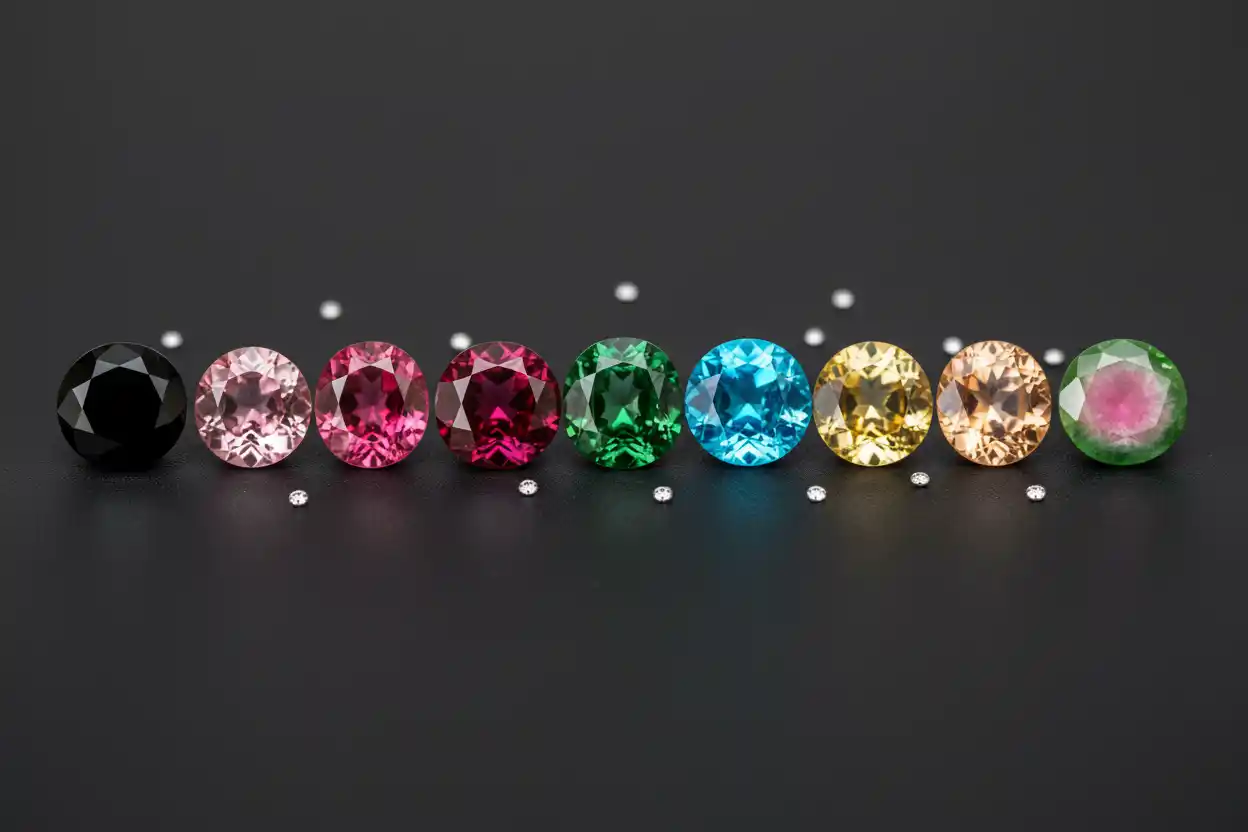
Tourmaline Color Meaning: Black, Pink, Green, Blue & More
Few gemstone groups display color as dramatically as tourmaline. Natural tourmaline occurs across virtually every hue, including black, brown, yellow, green, blue, pink, red and striking combinations of several colors within a single crystal.
Gemologically, those colors arise through changing chemistry, trace elements and color centers during crystal growth. Symbolically, modern traditions assign different themes to different colors: black tourmaline with boundaries and protection, pink with affection, red with vitality, green with growth, blue with communication and multicolored tourmaline with integration and change. These meanings are cultural or personal rather than scientifically established properties.
Tourmaline Colors at a Glance
| Tourmaline Color | Common Gem / Trade Term | Common Modern Symbolism |
|---|---|---|
| Black | Schorl | Boundaries, protection, grounding |
| Pink | Pink tourmaline | Compassion, affection, emotional openness |
| Red / deep pink-red | Rubellite | Passion, commitment, vitality |
| Green | Verdelite / green tourmaline | Growth, balance, renewal |
| Intense green | Chrome tourmaline | Vitality, confidence |
| Blue | Indicolite | Communication, reflection, composure |
| Neon blue-green | Paraíba-type copper-bearing tourmaline | Expression, individuality, transformation |
| Yellow | Yellow tourmaline | Optimism, clarity, creativity |
| Brown | Dravite commonly contributes to brown material | Stability, practicality |
| Colorless | Achroite trade usage | Clarity, openness |
| Pink + green | Watermelon tourmaline | Balance, integration, relationships |
| Multicolored | Parti-colored tourmaline | Adaptability, complexity and transition |
This page focuses specifically on color symbolism. The completed Types of Tourmaline guide owns mineral varieties and trade classifications, while Tourmaline: Meaning, Properties & Symbolism remains the general parent profile.
Why Does Tourmaline Come in So Many Colors?
Tourmaline is a chemically complex mineral group.
Its crystal structure can accommodate numerous elements, allowing color to change as chemistry changes during growth.
GIA attributes many blue and green colors primarily to iron and possibly titanium.
Manganese commonly contributes to red and pink and may contribute to certain yellows.
Some pink and yellow tourmalines can also involve radiation-related color centers.
Copper produces the extraordinary saturated blue and green colors of Paraíba-type tourmaline.
Chrome tourmaline’s intense green name is slightly misleading because GIA notes that vanadium frequently contributes more of the color than chromium.
The result is one of the broadest natural color palettes in gemology.
Why Can One Tourmaline Crystal Have Several Colors?
Conditions can change while a crystal is growing.
The concentration of trace elements in the surrounding fluid may shift.
Later growth can therefore have a different color from the earlier core.
This produces dramatic zoning.
A crystal may begin pink and finish green.
Another can develop a pink center surrounded by green.
Tourmaline can also show colors arranged along the crystal length or concentrically.
Rather than being a defect, strong well-defined zoning is sometimes the reason a specimen is valuable.
Black Tourmaline Meaning
Black tourmaline is usually schorl, an iron-rich tourmaline species.
It is generally opaque and is much more abundant than fine transparent gem tourmaline.
Modern crystal traditions strongly associate black tourmaline with:
protection, grounding, boundaries and stability.
There is no scientific evidence that it blocks negative energy, electromagnetic radiation or harmful intentions.
A more grounded symbolic interpretation is to use it as a reminder of practical boundaries.
For example:
What am I willing to participate in, and what will I step away from?
The completed Black Tourmaline: Meaning, Healing Properties & Uses owns the complete black-tourmaline profile.
Pink Tourmaline Meaning
Pink tourmaline spans very pale blush colors through strong saturated pink.
Manganese is one of the important contributors to pink and red colors in tourmaline.
Modern symbolism commonly associates pink tourmaline with:
affection, compassion, emotional openness and gentleness.
A grounded interpretation focuses on expression.
Instead of expecting the stone to attract love, ask:
Have I actually communicated appreciation?
The completed Pink Tourmaline: Meaning, Healing Properties & Uses handles the variety’s broader healing and symbolism context.
Rubellite Meaning
Rubellite is the trade name used for strongly colored pink-to-red tourmaline, although exact usage varies somewhat within the trade.
GIA describes rubellite as encompassing pink, red, purplish red, orangy red or brownish red, while noting that some dealers reserve the name for stronger red material rather than ordinary pink.
Symbolically, rubellite is commonly associated with:
passion, vitality, emotional courage and commitment.
Its meaning is therefore usually more intense than the gentler symbolism attached to pale pink tourmaline.
The completed Rubellite: Meaning, Properties & Symbolism preserves that distinct intent.
Red Tourmaline Meaning
Red tourmaline falls visually close to ruby and red spinel in fine examples.
The color naturally attracts symbolism involving:
courage, action, vitality and passion.
These are interpretations derived partly from red color symbolism rather than measurable tourmaline properties.
A useful personal interpretation could connect red tourmaline with acting on an important commitment instead of waiting for ideal motivation.
That keeps “vitality” connected to behavior rather than an unsupported health claim.
Green Tourmaline Meaning
Green tourmaline covers a remarkable range.
Some stones are yellowish or olive green.
Others are clean medium green, deep forest green or bluish green.
Fine transparent green tourmaline can be highly attractive in faceted jewelry.
Modern symbolism commonly associates green with:
growth, balance, renewal and connection with nature.
A green-tourmaline intention might therefore focus on gradual development:
What action can I repeat consistently enough for growth to occur?
The color does not cause growth; it represents it.
Verdelite
“Verdelite” is a traditional trade name used for green tourmaline.
The term is less necessary in modern gemological communication because simply saying “green tourmaline” often provides clearer information.
When used, verdelite should not be treated as a completely separate mineral species.
The symbolism remains the same broad green-tourmaline framework of:
renewal, growth and balance.
Gemstone quality depends on actual color, clarity and cutting rather than whether a seller chooses the verdelite label.
Chrome Tourmaline Meaning
Chrome tourmaline is an intense green gem variety associated mainly with East African sources.
Despite the name, GIA notes that much chrome-tourmaline color is produced primarily by vanadium, sometimes with chromium.
Fine material can rival tsavorite and emerald visually.
Modern symbolism typically emphasizes:
vitality, confidence and vigorous growth.
Its intense saturation creates a stronger visual personality than pale green tourmaline.
However, symbolic “strength” should not be confused with physical durability or medical effect.
Blue Tourmaline Meaning
Blue tourmaline ranges from violetish blue through blue to greenish blue.
The trade name indicolite is commonly applied to blue tourmaline.
Modern blue symbolism often centers on:
communication, reflection, composure and truthfulness.
A practical blue-tourmaline intention might be:
I will explain what I mean directly rather than hoping the other person infers it.
This creates a behavioral interpretation of communication symbolism.
The completed Indicolite: Meaning, Properties & Symbolism owns the dedicated blue-tourmaline profile.
Indicolite vs Paraíba Color
Not every blue tourmaline is Paraíba.
Traditional indicolite commonly owes blue or green-blue colors largely to iron-related chemistry.
Paraíba-type material is distinctive because copper contributes to its highly saturated electric or neon appearance.
The two can overlap in hue, but their chemistry and market rarity differ.
This is why a seller should not label every bright blue tourmaline “Paraíba.”
Color alone does not prove copper-bearing composition or geographic claims.
Paraíba Tourmaline Meaning
Paraíba tourmaline became famous after spectacular copper-bearing blue-green material was discovered in Brazil in the late 1980s.
Related copper-bearing tourmalines were later found in Nigeria and Mozambique.
The colors can include:
electric blue, violetish blue, greenish blue, blue-green and vivid green.
Modern symbolism often links Paraíba’s striking appearance with:
individuality, expression, transformation and creative confidence.
These meanings are modern because the gem entered the market only recently.
The completed Paraiba Tourmaline: Meaning, Properties & Symbolism owns its full mineral and history profile.
Watermelon Tourmaline Meaning
Watermelon tourmaline typically displays a pink interior surrounded by green, recreating the color arrangement of watermelon flesh and rind.
Its symbolism often combines the themes assigned separately to pink and green.
Pink represents affection and emotional openness.
Green represents growth and balance.
Together, modern traditions commonly interpret watermelon tourmaline as a symbol of:
integration, relationship balance and emotional growth.
Its strongest appeal, however, is also gemological: a single crystal recorded changing chemistry while it grew.
The completed Watermelon Tourmaline: Meaning, Properties & Symbolism owns the full variety profile.
Bicolor Tourmaline Meaning
Bicolor tourmaline contains two clearly visible color zones.
The combination does not have to be pink and green.
A crystal may combine:
green and blue, pink and colorless, yellow and green or several other pairings.
Symbolically, bicolor tourmaline is often associated with:
balance, adaptability and holding two perspectives simultaneously.
That interpretation is visually intuitive because one mineral crystal can contain distinct appearances without losing its underlying identity.
Parti-Colored Tourmaline Meaning
Parti-colored tourmaline contains multiple color zones.
GIA notes that complex zoning can result when trace-element concentration changes during growth.
Modern symbolism frequently treats multicolored tourmaline as representing:
adaptability, complexity, transition and integration.
Someone might use it as a reminder that a situation does not need to fit one simple category.
Again, the symbolism comes from the visual structure rather than a measured energetic property.
Yellow Tourmaline Meaning
Yellow tourmaline can range from pale straw-like tones through stronger golden or brownish yellow.
Iron and manganese-related chemistry can contribute depending on the tourmaline type, while radiation-related color centers may influence some yellow elbaite.
Modern symbolism commonly associates yellow with:
optimism, learning, confidence and creativity.
A grounded use could connect yellow tourmaline with curiosity:
What do I need to learn before making this decision?
That converts color symbolism into a useful question.
Brown Tourmaline Meaning
Brown tourmaline occurs in several tourmaline-group compositions.
Dravite is particularly well known for brown, yellowish-brown and dark colors.
Modern brown symbolism usually emphasizes:
stability, practicality and connection with ordinary responsibilities.
A brown-tourmaline intention could therefore focus on maintaining simple routines rather than seeking dramatic transformation.
This can provide an effective contrast with brightly colored gem tourmalines that attract more energetic metaphysical descriptions.
Colorless Tourmaline Meaning
Very pale or colorless tourmaline is sometimes called achroite, a trade term meaning essentially “without color.”
Colorless material is much less familiar than black, green, blue or pink tourmaline.
Symbolically, clear gemstones are commonly associated with:
clarity, openness and neutrality.
A practical meaning might be the willingness to examine information without deciding the answer in advance.
Achroite remains tourmaline rather than a separate spiritual category.
Tourmaline Color and Pleochroism
Color is more complicated than bodycolor alone because many tourmalines are strongly pleochroic.
A gem may show different colors or different depths of color when viewed along different crystal directions.
Green tourmaline provides a particularly important example.
One direction may look attractive green while another is much darker.
Cutters must orient rough carefully to display the best combination.
This means two apparently similar pieces of rough can produce very different finished gemstones.
The completed Tourmaline Buying Guide owns the full purchasing implications.
Does Tourmaline Color Affect Value?
Very strongly.
Tourmaline’s value cannot be summarized with one price per carat because different colors occupy completely different market categories.
Fine copper-bearing Paraíba material can command exceptional premiums.
Rubellite and fine chrome-green stones can also be valuable.
Ordinary dark green, brown or black tourmaline occupies a different market.
Color saturation, tone, clarity, cutting, rarity and size all interact.
The completed Tourmaline Price Guide handles those valuation differences rather than duplicating price ranges in this symbolism page.
Tourmaline Color Treatments
Some tourmaline is heated or irradiated to modify color.
Treatment practices differ according to variety.
Copper-bearing material can be heated to improve color, while irradiation can affect certain pink or other tourmalines.
Treatment is not automatically unacceptable.
Disclosure matters because the buyer may value natural color or untreated status.
A color name should never be used to conceal enhancement.
Choosing Tourmaline by Color
Begin with the appearance you actually like.
Choose black for an opaque architectural look.
Pink and rubellite provide warm red-family colors.
Green spans subtle pastel to intense chrome-like saturation.
Blue and indicolite create cooler colors, while Paraíba-type material occupies the electric-blue and green extreme.
Watermelon and parti-colored stones turn color zoning itself into the design.
Then evaluate the variety’s quality and market separately.
Symbolism can be added afterward.
The strongest choice is a gemstone whose color you genuinely enjoy rather than one selected solely because a metaphysical list claims it is necessary.
Tourmaline as an October Birthstone
Tourmaline shares October birthstone status with opal.
Its enormous color range makes it unusually flexible for birthstone jewelry.
Someone born in October does not have to select one “correct” tourmaline color.
Pink, green, blue, multicolored and other varieties all belong within the tourmaline family.
Color choice can therefore reflect personal taste while still preserving the birthstone association.
The completed October Birthstone: Opal & Tourmaline owns the full birthstone history.
Frequently Asked Questions
1. What do different tourmaline colors mean?
Modern symbolism commonly associates black with protection and boundaries, pink with affection, red with passion, green with growth, blue with communication and multicolored stones with integration and adaptability.
2. What causes tourmaline’s different colors?
Tourmaline’s complex chemistry allows elements including iron, manganese, copper, vanadium and chromium, along with radiation-related color centers, to produce a wide color range.
3. What does black tourmaline symbolize?
Black tourmaline is commonly associated with grounding, protection and boundaries in modern crystal traditions.
4. What does pink tourmaline symbolize?
Pink tourmaline commonly represents affection, compassion and emotional openness.
5. What does rubellite symbolize?
Rubellite’s deeper pink-to-red appearance is commonly linked with passion, commitment, vitality and emotional courage.
6. What does green tourmaline mean?
Modern traditions commonly connect green tourmaline with growth, balance, renewal and nature.
7. What does blue tourmaline symbolize?
Blue tourmaline or indicolite is commonly associated with communication, reflection and composure.
8. What does Paraíba tourmaline symbolize?
Because Paraíba-type tourmaline is a relatively modern discovery, its symbolism is contemporary and often emphasizes individuality, expression, creativity and transformation.
9. What does watermelon tourmaline mean?
Modern symbolism commonly combines pink themes of affection with green themes of growth, creating associations with emotional integration and balanced relationships.
10. Is chrome tourmaline actually colored by chromium?
Chromium can contribute, but GIA notes that many chrome tourmalines receive much of their intense green color from vanadium.
11. Are tourmaline colors always natural?
No. Heat and irradiation can modify some tourmaline colors, so treatment disclosure matters for significant purchases.
12. Which tourmaline color is most valuable?
There is no universal answer, but fine copper-bearing Paraíba tourmaline occupies the highest-value category in much of the modern market. Exceptional rubellite and chrome-green material can also be valuable.
Conclusion
Tourmaline’s extraordinary color range reflects its equally complex chemistry.
Iron-related mechanisms contribute to many blues and greens. Manganese helps create pink and red. Copper produces the extraordinary saturation of Paraíba-type material, while changing chemistry during crystal growth can create bicolor, watermelon and multicolored zoning within a single crystal.
Modern symbolism follows that visual diversity.
Black tourmaline represents boundaries, pink affection, green growth, blue communication and multicolored stones integration or adaptability.
These meanings can make a gemstone personally significant, but the most remarkable story remains geological: one mineral group can record changing chemistry through virtually every major gemstone color.
Understanding both aspects creates the clearest picture. Color tells you something real about chemistry, growth and market rarity; symbolism tells you what people choose to make that color represent.
Disclaimer: Tourmaline color meanings, chakra associations and metaphysical symbolism are cultural, spiritual or personal interpretations rather than scientifically established medical, psychological or energetic effects.