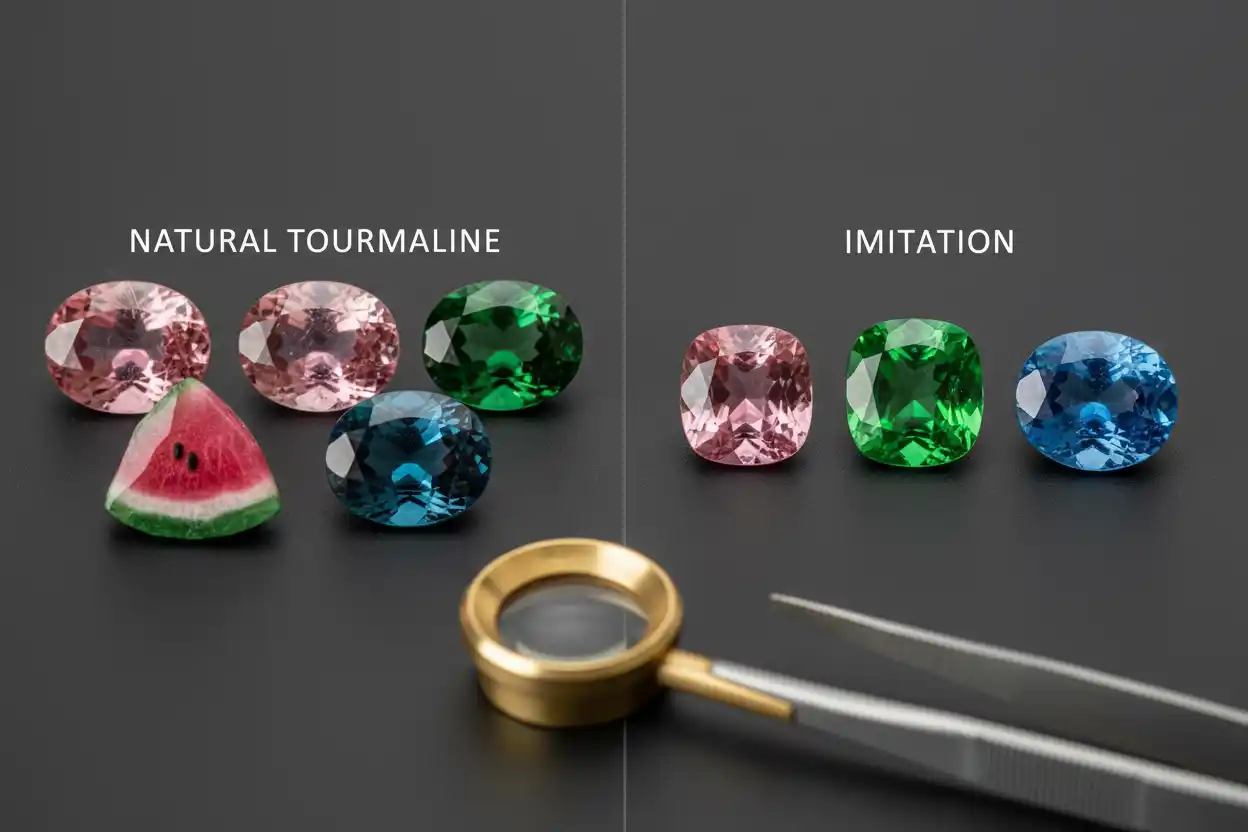
Real vs Fake Tourmaline: How to Tell the Difference
Real tourmaline is a natural borosilicate mineral from a chemically diverse group that occurs in almost every major gemstone color. Fake tourmaline, by contrast, is not one specific substance. Glass, synthetic spinel, synthetic corundum, cubic zirconia, plastic, and even other natural gemstones can all be represented incorrectly as tourmaline.
Fortunately, genuine tourmaline has a useful combination of properties: refractive index around 1.624–1.644, noticeable birefringence, strong pleochroism in many colors, Mohs hardness of about 7–7.5, and a specific gravity generally near 3.06. Natural stones can also contain characteristic growth tubes, fluid inclusions, color zoning, and mineral inclusions.
No single home test proves authenticity, though. For valuable rubellite, indicolite, Paraiba, chrome tourmaline, or large multicolored stones, professional gemological testing remains the most reliable approach.
Real vs Fake Tourmaline at a Glance
| Feature | Natural Tourmaline | Glass Imitation | Synthetic Spinel | Cubic Zirconia |
|---|---|---|---|---|
| Origin | Natural mineral | Manufactured | Laboratory-grown spinel | Manufactured |
| Crystal structure | Trigonal | Amorphous | Cubic | Cubic |
| RI | About 1.624–1.644 | Commonly lower; varies by glass | About 1.718 | About 2.15–2.18 |
| Birefringence | About 0.018–0.040 | None | None | None |
| Pleochroism | Often noticeable to strong | None as a crystalline optical effect | None | None |
| Specific gravity | About 3.06, with variation | Variable, often lower | About 3.60 | Roughly 5.6–6.0 |
| Mohs hardness | About 7–7.5 | Often lower | About 8 | About 8–8.5 |
| Common internal clues | Growth tubes, fluid inclusions, zoning, mineral inclusions | Bubbles, flow structures, fused areas | Synthetic growth features, possible gas bubbles | Usually very clean |
| Color zoning | Common in many tourmalines | Can be artificially reproduced | Can be manufactured in many colors | Can be manufactured in many colors |
| Strong dichroism | Common in many colored stones | No | No | No |
| Commercial synthetic counterpart | No routine synthetic gem tourmaline | Not applicable | Different material | Different material |
| Best confirmation | Gemological testing | RI/microscopy | RI/optical character | RI/density |
The Tourmaline guide covers the mineral family’s composition, colors, varieties, and symbolism. This page focuses specifically on whether a stone represented as tourmaline is actually tourmaline.
What Is Real Tourmaline?
Tourmaline is not a single mineral species but a supergroup of closely related borosilicate minerals.
Gem-quality material commonly belongs to species such as elbaite, while dravite, uvite, fluor-liddicoatite, and other tourmalines occupy different parts of the group.
Their chemistry can incorporate sodium, calcium, lithium, magnesium, iron, manganese, chromium, vanadium, copper, fluorine, and other elements.
That chemical flexibility helps explain tourmaline’s remarkable color range.
Natural material occurs in black, brown, yellow, green, blue, pink, red, purple, colorless, and multicolored combinations.
Therefore, color alone is one of the weakest ways to decide whether a specimen is genuine.
What Does “Fake Tourmaline” Mean?
The term can describe several different situations.
A piece of colored glass might be sold as tourmaline.
Synthetic spinel could be cut in a tourmaline-like pink, green, or blue color and misrepresented as natural tourmaline.
A seller might incorrectly advertise another natural gemstone as tourmaline.
Alternatively, genuine natural tourmaline could receive treatment but still be described inaccurately as untreated.
These are different problems.
A treated natural tourmaline is still real tourmaline. An imitation is a different material altogether.
The distinction between enhancement and material identity is explained more broadly in Gemstone Treatments Explained.
Is Treated Tourmaline Fake?
No.
Heating, irradiation, or fracture filling does not automatically make a natural tourmaline fake.
If the original stone crystallized naturally as tourmaline, it remains natural tourmaline after treatment.
However, the treatment should be disclosed when it is relevant to value, stability, care, or the terms under which the gemstone is sold.
This distinction is particularly important for Paraiba-type, pink, red, and clarity-enhanced stones.
Authenticity asks:
Is the material actually tourmaline?
Treatment analysis asks:
What happened to the tourmaline after it formed?
Those questions should not be merged.
Is There Synthetic Tourmaline?
For the ordinary jewelry market, true synthetic gem tourmaline is not commercially established.
Tourmaline’s chemistry is unusually complex, which makes producing transparent gem-quality synthetic counterparts considerably more difficult than growing synthetic sapphire, ruby, spinel, or diamond.
Tourmaline has been produced and studied experimentally, but modern gemological references do not recognize a normal commercial supply of synthetic gem tourmaline.
This creates an important buying warning.
A cheap product advertised as “lab-grown tourmaline,” “synthetic tourmaline,” or “lab-created Paraiba tourmaline” should not automatically be assumed to be genuine laboratory-grown tourmaline.
It may instead be glass, synthetic spinel, synthetic corundum, cubic zirconia, or another manufactured simulant.
Synthetic Does Not Mean Imitation
The terminology is worth understanding.
A synthetic gemstone has essentially the same fundamental chemical composition and crystal structure as its natural counterpart but was created artificially.
A simulant is a different material chosen because it resembles the gemstone.
For example, synthetic sapphire is genuinely corundum made in a laboratory.
If blue synthetic sapphire is represented as blue tourmaline, however, it is functioning as a tourmaline imitation.
Likewise, synthetic spinel can imitate many colored gemstones without becoming a synthetic version of those gems.
Tourmaline’s Refractive Index
Refractive index is one of the most useful identification properties.
Gem-quality tourmaline generally falls around 1.624–1.644, although exact values vary with chemical composition.
This range separates it from many likely substitutes.
Synthetic spinel, for example, is around 1.718.
Cubic zirconia is dramatically higher.
Many ordinary glasses are lower.
A professional refractometer can therefore eliminate numerous possibilities quickly.
More importantly, tourmaline normally gives two refractive-index readings because it is doubly refractive.
That combination of RI range and birefringence is considerably more diagnostic than color.
Tourmaline Is Doubly Refractive
Tourmaline belongs to the trigonal crystal system and is optically uniaxial.
Most gem tourmaline consequently displays double refraction, with birefringence generally around 0.018–0.040.
Glass is not crystalline and does not produce normal mineral birefringence.
Synthetic spinel and CZ belong to the cubic system and are normally singly refractive.
This gives a gemologist another effective separation method.
However, birefringence should be measured rather than guessed simply by looking at the gemstone.
Unlike zircon, tourmaline does not necessarily show obvious doubled facet edges to the casual observer.
Pleochroism Is an Important Clue
Tourmaline is famous for strong pleochroism, particularly in green, blue, brown, and some other strongly colored stones.
Pleochroism means the gemstone can show different color intensities or colors when viewed in different crystallographic directions.
Tourmaline is uniaxial, so this effect takes the form of dichroism.
A green stone might appear dark green along one direction and noticeably lighter or differently toned from another.
Blue tourmaline can also show strong directional color differences.
This property is important enough that cutters orient tourmaline rough carefully to control the darker and lighter directions.
Glass, CZ, and synthetic spinel do not show true tourmaline-style dichroism.
A dichroscope can therefore provide useful supporting evidence.
Pleochroism Does Not Prove Authenticity by Itself
Some other natural gemstones are also pleochroic.
Sapphire, iolite, tanzanite, beryl varieties, and numerous other minerals can display directional color changes.
Therefore, seeing two colors does not prove that a stone is tourmaline.
Instead, pleochroism should agree with refractive index, birefringence, density, inclusions, and other properties.
Good gem identification works by assembling multiple independent observations.
Natural Tourmaline Inclusions
Tourmaline frequently contains useful internal evidence of natural growth.
Long narrow growth tubes are particularly characteristic.
Some are hollow, while others contain liquid or gas.
Tourmaline can also contain irregular fluid inclusions, healed fractures, trichite-like features, mineral crystals, growth blockages, and internal color zoning.
In elbaite from pegmatites, associated mineral inclusions can include feldspar, mica, zircon, and related minerals.
These features can provide strong evidence of natural geological formation.
The general How to Identify Crystals guide explains why inclusions are most useful when interpreted alongside physical properties rather than used independently.
Growth Tubes in Real Tourmaline
Growth tubes can be particularly useful under magnification.
They typically follow the long direction of the crystal because they developed during tourmaline’s elongate prismatic growth.
In cabochons, dense parallel tubes can even create a cat’s-eye effect.
A loupe or microscope may reveal them as fine straight or irregular channels.
However, their absence does not mean a gem is fake.
Fine transparent tourmalines can be extremely clean.
Moreover, a clever imitation may contain artificial structures designed to resemble natural inclusions.
The feature needs context.
Natural Color Zoning
Color zoning is another classic tourmaline characteristic.
Changes in the chemistry of the mineral-forming fluid during crystal growth can produce distinct colored zones within one crystal.
The famous Watermelon Tourmaline shows one of the most recognizable examples, typically combining a pink interior and green outer zone.
Other tourmalines may show green-to-colorless, pink-to-colorless, blue-to-green, or complex multicolor zoning.
Natural zoning can provide useful evidence of growth history, but it does not prove authenticity on its own.
Colored glass can be manufactured in multiple layers or colors.
Consequently, a perfect watermelon pattern should be examined rather than accepted automatically.
Real Tourmaline Crystal Shape
Natural tourmaline commonly forms elongated prismatic crystals.
Cross-sections can appear triangular or rounded triangular, while vertical striations often run along the length of crystal faces.
Terminations can display complex trigonal forms.
These habits make natural rough tourmaline visually distinctive.
However, shape is not proof.
Manufacturers can mold, grind, or polish glass into convincing crystal-like prisms.
GIA has documented man-made glass objects with well-formed prism shapes specifically designed to resemble valuable copper-bearing tourmaline crystals.
Therefore, “it looks exactly like a tourmaline crystal” is only the beginning of identification.
Real vs Fake Tourmaline: Glass
Glass is one of the easiest materials to color and therefore one of the most versatile gemstone imitations.
A glass imitation may appear pink, green, blue, red, or even multicolored.
Possible microscopic clues include:
gas bubbles,
flow structures,
swirled color,
mold marks,
fused boundaries,
and unusually uniform clarity.
However, none of these features appears in every piece of glass.
Some glass can be remarkably clean.
Conversely, natural tourmaline can contain rounded fluid or gas-bearing inclusions that an inexperienced observer might mistake for glass bubbles.
Refractive index and optical character provide much stronger separation.
The site’s Glass vs Crystal guide covers glass identification in broader detail.
Can Glass Have Fake Inclusions?
Yes.
This is particularly important for high-value Paraiba-type material.
Manufactured glass can contain metallic particles, bubbles, internal swirls, or deliberately introduced structures that create a superficially natural appearance.
GIA has examined bluish-green man-made glass prisms containing copper-colored metallic inclusions that resembled copper-bearing tourmaline at first glance.
Standard testing exposed the difference immediately: the glass had a much lower refractive index and density than genuine tourmaline.
Microscopy also revealed gas bubbles and glass flow structures.
Therefore, impressive-looking inclusions should be identified, not merely noticed.
Real Tourmaline vs Synthetic Spinel
Synthetic spinel is another potential imitation because manufacturers can create it in many colors.
It is a different material from tourmaline.
Spinel is cubic and therefore singly refractive.
Tourmaline is trigonal and usually doubly refractive.
Synthetic spinel’s refractive index is also around 1.718, above the normal tourmaline range.
Its specific gravity is approximately 3.60, again differing from most gem tourmalines.
Certain synthetic spinels can contain characteristic growth features or gas bubbles resulting from their manufacturing process.
Routine gemological testing should separate the materials readily.
Real Tourmaline vs Synthetic Sapphire
Synthetic sapphire can also imitate certain tourmaline colors.
Blue synthetic sapphire might resemble indicolite, while pink or red synthetic corundum could be mistaken for pink tourmaline or rubellite in a misleading listing.
Corundum is much harder at Mohs 9 and has an RI around 1.762–1.770.
Its specific gravity is also close to 4.00.
Tourmaline normally measures Mohs 7–7.5, has a lower RI, and is less dense.
Both materials can be pleochroic, which is why a single dichroscope observation does not settle the question.
RI and other standard tests make the distinction much clearer.
Real Tourmaline vs Cubic Zirconia
Cubic zirconia can be manufactured in almost any color.
Consequently, green, pink, yellow, or blue CZ can be used as a visual substitute for tourmaline.
CZ is considerably denser.
It also has a refractive index above 2.1, much higher than tourmaline.
Because CZ is cubic, it is singly refractive and does not show tourmaline’s normal birefringence or dichroism.
Its strong brilliance can sometimes be another visual clue, although cut quality and color can make appearance deceptive.
The Cubic Zirconia guide explains the manufactured material separately.
Fake Pink Tourmaline
Pink tourmaline is particularly easy to imitate visually because many materials can be manufactured or selected in pink.
Glass, synthetic spinel, and synthetic sapphire are all possibilities.
A real pink tourmaline may contain growth tubes, fluid inclusions, fractures, zoning, or other natural features, but some high-quality stones are extremely clean.
Pink color itself proves nothing.
Furthermore, some natural pink tourmaline may have been irradiated to strengthen color.
That is a treatment question rather than an authenticity question.
The safest identification uses RI, birefringence, pleochroism where visible, and microscopy.
Fake Rubellite
Rubellite is the red-to-pinkish-red tourmaline variety valued for maintaining an attractive red appearance under different lighting.
Because vivid red material can be valuable, accurate identification becomes especially important.
Synthetic corundum and synthetic spinel can both be produced in strong red or pink-red colors.
Glass can imitate them as well.
Natural Rubellite is often included, and commercial acceptance of inclusions is greater when the color is exceptional.
Still, an included red stone should never be declared rubellite solely because its inclusions “look natural.”
Material identity comes first.
Fake Green Tourmaline
Green is one of tourmaline’s broadest color categories.
Natural green stones may belong to elbaite, dravite, uvite, or other tourmaline species depending on chemistry.
Chrome tourmaline and ordinary green tourmaline can also overlap visually with emerald, tsavorite, diopside, peridot, and manufactured materials.
Many green tourmalines show strong dichroism.
However, natural green gemstones that resemble tourmaline are not “fake” unless they are falsely represented as tourmaline.
A correct identification should distinguish lookalike from fraud.
Fake Blue Tourmaline
Blue tourmaline, commonly called Indicolite in appropriate material, can range from greenish blue to strong blue.
Glass and synthetic spinel can imitate this color.
Blue synthetic sapphire is another potential visual substitute.
Tourmaline’s RI, birefringence, density, and strong pleochroism separate it from these materials.
Because natural blue tourmaline can become quite dark in one crystallographic direction, well-cut stones are oriented carefully.
An imitation may reproduce the face-up color while failing to reproduce that directional optical behavior.
Fake Paraiba Tourmaline
Paraiba Tourmaline deserves the greatest caution because fine copper-bearing stones can command very high prices.
Color alone cannot prove Paraiba identity.
Bright neon blue, turquoise, green-blue, and green materials can be produced in glass and other manufactured substances.
Furthermore, natural non-copper-bearing gemstones can sometimes approach similar colors.
Professional identification first establishes that the gem is tourmaline.
Advanced chemical analysis can then determine whether copper is present at levels consistent with copper-bearing tourmaline.
For high-value stones, laboratories may also assess geographic origin using trace-element chemistry and other evidence.
A seller’s statement that a stone “looks Brazilian” is not meaningful origin proof.
Paraiba Color Is Not a Home Test
A common online mistake is assuming that vivid electric blue means genuine Paraiba.
It does not.
Copper-bearing tourmalines are famous for spectacular blue-to-green colors, but appearance varies with copper, manganese, iron, treatment, cutting, and lighting.
Meanwhile, glass and other substitutes can be manufactured in extremely vivid shades.
Therefore, the brighter the color and the higher the asking price, the stronger the argument for independent testing.
Fake Watermelon Tourmaline
Watermelon tourmaline’s obvious color zoning makes it seem easy to authenticate, but the pattern itself can be imitated.
Glass and other manufactured materials can display contrasting pink and green areas.
Dyed or assembled materials may also be marketed using tourmaline terminology.
Real watermelon tourmaline often preserves structural relationships between its color zones and the original crystal growth.
Natural inclusions and crystal morphology can add evidence.
Still, refractive testing remains more reliable than simply checking whether pink and green occur together.
Fake Black Tourmaline
Black tourmaline presents a different identification challenge because most material is opaque.
The common black species in the gem and crystal trade is usually schorl.
Opaque black glass, plastic, dyed materials, and other dark minerals can be sold incorrectly as black tourmaline.
Natural black tourmaline commonly forms strongly striated prismatic crystals, sometimes with recognizable triangular cross-sections.
Broken pieces can lack these obvious external forms, though.
The dedicated Black Tourmaline guide covers the variety itself.
For uncertain polished black material, professional mineral identification is preferable to relying on color, weight in the hand, or scratch tests.
Does Real Tourmaline Have Bubbles?
A genuine natural tourmaline can contain fluid inclusions with gas bubbles.
Therefore, the common internet rule that “bubbles always mean glass” is too simplistic.
The important question is what the inclusion looks like and how it occurs.
A perfectly rounded isolated gas bubble within homogeneous glass can support an imitation diagnosis.
A multiphase fluid inclusion trapped within a healed fracture or growth structure may instead be entirely natural.
This distinction often requires magnification and experience.
Are Cracks a Sign of Real Tourmaline?
Not necessarily.
Natural tourmaline can certainly contain fractures.
In fact, pink and red material frequently shows significant internal features.
However, glass can also crack, while intentionally manufactured products may include internal-looking features.
Moreover, a fracture-filled tourmaline can still be natural even though a foreign substance has been introduced into its fissures.
Therefore, “cracks equal real” is not a reliable test.
Is a Perfectly Clear Tourmaline Fake?
No.
High-quality tourmaline can be eye-clean and occasionally exceptionally clean under magnification.
Clarity varies strongly by color and geological source.
Green tourmaline is often expected to be relatively clean, whereas red and pink stones receive more market tolerance for inclusions.
The absence of visible inclusions therefore does not establish synthetic or imitation origin.
Optical and physical testing remains necessary.
Do Real Tourmalines Have Striations?
Natural rough crystals commonly show strong longitudinal striations.
These parallel grooves reflect tourmaline’s crystal growth.
They can be a useful supporting feature on natural crystal specimens.
However, polished faceted gemstones normally lose the original crystal surface.
Furthermore, manufacturers can mold or carve lines into imitations.
Striations should therefore support an identification rather than serve as proof.
Does Real Tourmaline Feel Heavy?
Tourmaline is moderately dense, with specific gravity generally near 3.06 but varying with species and composition.
That means it feels heavier than many plastics but does not have the extreme heft of cubic zirconia.
Human hands are poor measuring instruments, though.
Stone size, cut, mounting, and personal expectation make “heaviness” highly subjective.
Hydrostatic specific-gravity measurement provides meaningful data.
Holding two stones and guessing does not.
Can You Use a Scratch Test?
Avoid it.
Tourmaline ranks around 7–7.5 on the Mohs scale, but deliberately scratching an unknown gemstone risks permanent damage.
Furthermore, many substitutes overlap sufficiently in hardness that a crude test does not produce a useful diagnosis.
Glass may be softer, while synthetic spinel, synthetic sapphire, and CZ can be harder than tourmaline.
A scratch result therefore narrows little while potentially ruining a genuine gem.
The site’s Gemstone Hardness Chart should be used to understand durability, not as encouragement for destructive testing.
Does Real Tourmaline Scratch Glass?
Many tourmalines can scratch ordinary glass because they are harder.
That does not make the test useful.
Synthetic spinel, synthetic sapphire, quartz, CZ, and numerous other materials can also scratch glass.
Therefore, passing the glass-scratch test does not establish tourmaline identity.
Likewise, failure can result from technique, weathered surfaces, or attempting to scratch with an unfavorable edge.
Use non-destructive optical tests instead.
Can You Use a Magnet?
Magnetic response is not a universal authenticity test for tourmaline.
Tourmaline chemistry varies dramatically, particularly in its iron and manganese content.
As a result, different specimens can respond differently to magnetic fields.
Meanwhile, other minerals can also show magnetic responses.
Therefore, a social-media test claiming that “real tourmaline must stick to a magnet” or “real tourmaline is never magnetic” is unreliable.
Laboratory gemology offers much stronger diagnostic evidence.
Can UV Light Identify Tourmaline?
Not by itself.
Tourmalines show variable fluorescence behavior depending on composition, color, and trace elements.
Some specimens may be inert, while others can display weak responses.
Imitations also vary.
Therefore, UV reaction should be treated as supplementary evidence.
A specific fluorescence color or absence of fluorescence does not prove that the stone is genuine.
Can a Diamond Tester Identify Tourmaline?
A basic diamond tester is not a tourmaline identifier.
Traditional diamond testers primarily measure thermal conductivity.
They may show that a stone does not behave like diamond, but that result leaves an enormous number of possibilities.
Tourmaline, sapphire, glass, CZ, spinel, quartz, and numerous other gemstones can all produce non-diamond results.
Consequently, a diamond tester cannot replace RI, optical character, microscopy, and related gemological methods.
Use a Dichroscope for Colored Tourmaline
A dichroscope can be particularly useful because tourmaline is often strongly pleochroic.
Rotate the gemstone while observing it through the instrument.
Many genuine colored tourmalines will reveal two different color components or noticeably different intensities.
Green tourmaline can show especially strong differences.
However, the result still needs interpretation.
Other doubly refractive gemstones are also pleochroic, so the dichroscope can support tourmaline identification without establishing it independently.
Use a Polariscope
A polariscope can help establish optical character.
Tourmaline is normally doubly refractive, whereas glass is generally singly refractive or anomalously doubly refractive because of internal strain.
Spinel and CZ are cubic and normally singly refractive.
Correct interpretation can therefore narrow the possibilities substantially.
Because strain patterns and orientation can complicate observations, the test works best as part of a standard gemological sequence rather than as a one-step consumer trick.
A Refractometer Is Much More Useful
For faceted stones with an appropriate polished surface, refractive-index testing is one of the strongest routine methods.
Tourmaline’s approximate 1.624–1.644 range immediately excludes many potential substitutes.
Combined with its birefringence, the readings can provide a strong identification.
This is why professional gemology relies on measured properties rather than subjective claims such as “the color looks natural.”
Check for Strong Pleochroism
After RI, directional color behavior can provide another clue.
Turn a loose colored stone through different orientations under consistent lighting.
Some tourmalines visibly darken or change hue.
A dichroscope makes the effect easier to evaluate.
Still, do not reject a pale stone simply because you cannot see dramatic pleochroism with the naked eye.
Color intensity, cutting orientation, species, and observation direction all influence what is visible.
Check the Listing Language
Incorrect terminology can expose a suspicious seller before gemological testing begins.
Be cautious with phrases such as:
“natural synthetic tourmaline”
“lab-grown Paraiba tourmaline” without laboratory identification
“tourmaline CZ”
“tourmaline glass”
“created tourmaline crystal” without stating the actual material
“natural cubic tourmaline”
These descriptions confuse material identity, origin, or trade terminology.
A legitimate listing should state clearly what the stone is.
For example:
Natural tourmaline
Natural pink tourmaline, irradiated if known
Natural copper-bearing tourmaline
or
Synthetic spinel, tourmaline-color imitation
Clear disclosure is more meaningful than marketing language.
Check Whether the Price Makes Sense
Price cannot authenticate a stone, but implausible pricing can indicate that additional scrutiny is warranted.
Ordinary small tourmalines can be affordable.
However, large clean rubellite, fine indicolite, chrome tourmaline, exceptional bicolor stones, and especially fine Paraiba material can be considerably more valuable.
A large flawless “Brazilian Paraiba tourmaline” offered for the price of costume jewelry deserves verification.
Conversely, a high price does not prove authenticity.
Imitations can also be overpriced.
The Tourmaline Buying Guide covers quality and buying decisions separately from this authenticity workflow.
Check Whether the Color Looks Too Perfect
Uniform color is not evidence of fakery.
Some real tourmalines are beautifully even.
Similarly, dramatic zoning is not proof of natural origin.
The more useful question is whether the color distribution is consistent with the stone’s crystal growth, inclusions, optical behavior, and measured gemological properties.
A manufactured imitation can have perfect color.
A natural stone can also have perfect color.
Appearance only becomes diagnostic when supported by additional evidence.
How to Check Tourmaline at Home
Start with non-destructive observation.
Clean the gemstone gently so fingerprints and residue do not obscure the surface or internal features.
Next, examine it under neutral lighting and compare color from several directions.
Use a 10× loupe to look for growth tubes, fluid inclusions, zoning, mineral crystals, fractures, bubbles, or flow-like structures.
If the stone is an intact natural crystal, examine its overall shape and longitudinal striations.
Then review any certificate, invoice, weight, dimensions, and seller description.
These observations can reveal obvious problems, but they should be viewed as a screening process rather than a final identification.
What Not to Do at Home
Do not heat a tourmaline to test its color.
Do not deliberately expose it to intense radiation or prolonged UV.
Do not scratch it with quartz, steel, glass, or another gemstone.
Do not perform destructive acid tests.
Do not rely on flame tests.
Do not hit it to see how it breaks.
These methods can damage genuine gemstones, destroy treatments, weaken fractures, or create misleading results.
The cost of professional identification is usually far less than the cost of damaging a valuable stone.
How Gemologists Authenticate Tourmaline
Professional testing begins with standard gemological properties.
Refractive index helps establish the material’s optical range.
Birefringence and optical character confirm whether its behavior matches trigonal tourmaline.
Specific gravity provides an independent density measurement.
A dichroscope evaluates pleochroism.
Magnification reveals growth features, natural inclusions, fracture filling, and evidence of imitation materials.
Spectroscopy can provide additional chemical and color information.
For complicated or high-value stones, advanced methods such as Raman spectroscopy and chemical analysis can identify the material more decisively.
When Raman Spectroscopy Helps
Raman spectroscopy identifies materials through characteristic vibrational spectra.
That makes it useful when conventional examination leaves uncertainty.
A Raman spectrum can separate tourmaline from glass, spinel, corundum, quartz, and other substitutes without destructive testing.
It can also help identify certain inclusions within a gemstone.
For unusual specimens or valuable stones, this level of confirmation can be far stronger than any collection of home tests.
Paraiba Requires More Than Basic Identification
A laboratory can first establish that a stone belongs to the tourmaline group.
However, the valuable Paraiba designation requires additional chemical information.
Copper-bearing tourmaline is identified through trace-element analysis, often using sophisticated analytical instruments.
Geographic origin—Brazil, Mozambique, Nigeria, or another locality—requires another level of interpretation.
Therefore:
tourmaline identity, copper-bearing status, treatment status, and geographic origin are four separate questions.
A report should be read carefully to determine which questions it actually answers.
Check the Gem Lab Report
A serious purchase should come with documentation proportionate to its value.
For ordinary inexpensive stones, verification by a qualified gemologist may be enough.
For valuable Paraiba, rubellite, indicolite, unusual large stones, or major origin claims, an independent laboratory report can be worthwhile.
Confirm that the laboratory is reputable and that the report corresponds to the exact stone by matching dimensions, carat weight, and other identifying information.
The Gemstone Certification guide explains the differences among reports and laboratories.
A Seller Certificate Is Not Always a Lab Report
Some jewelry listings include colorful laminated “certificates” produced by the seller or wholesaler.
These documents may contain little more than a product name and estimated weight.
They should not automatically be treated as independent gemological evidence.
A meaningful report identifies the testing laboratory, report number, gemstone measurements, weight, material identification, and relevant conclusions.
When high-value treatment or origin claims are involved, the laboratory’s reputation becomes especially important.
Real Tourmaline Can Be Inexpensive
Price alone should never cause a buyer to label a stone fake.
Tourmaline has an enormous quality range.
Small pale stones, dark green material, included pink tourmaline, ordinary black schorl, and commercial beads may be inexpensive while remaining completely natural.
Likewise, rough mineral specimens can vary dramatically in price.
The word “tourmaline” therefore does not automatically imply a luxury gemstone.
Variety and quality matter.
Fake Tourmaline Can Be Expensive
The reverse is also true.
A seller can attach a high price to glass or another imitation.
Branding, precious-metal settings, inaccurate rarity claims, or outright fraud can inflate the asking price.
Consequently, paying a premium does not prove authenticity.
The more expensive the stone, the more useful independent evidence becomes.
Real vs Fake Tourmaline Jewelry
Identification becomes slightly more difficult once a gemstone is mounted.
Settings can block access to the pavilion, interfere with refractometer measurements, conceal chips or fillers, and make accurate specific-gravity testing impossible.
Nevertheless, a gemologist can often obtain enough information from optical examination, microscopy, spectroscopy, and other techniques to identify a mounted tourmaline.
If the stone is especially valuable, temporary removal from the setting may occasionally provide better testing access, but that should be performed only by a qualified jeweler when genuinely necessary.
Does Natural Tourmaline Have Value?
Yes, but value depends strongly on variety and quality.
Tourmaline’s market ranges from inexpensive black crystals to some of the world’s most valuable colored gemstones.
Color, saturation, tone, clarity, cut, size, variety, treatment, provenance, and—in certain cases—geographic origin influence value.
Copper-bearing Paraiba occupies a very different market from ordinary green or black tourmaline.
Therefore, authenticity is only the first step.
Once the material has been confirmed, quality and market evaluation follow separately.
How to Buy Real Tourmaline Safely
First, identify exactly what variety you intend to buy.
A seller offering ordinary green tourmaline does not need to provide the same level of documentation expected for a major Paraiba stone.
Next, examine the description for clear material terminology.
Ask about treatments without assuming that “natural” means untreated.
For important stones, request an independent laboratory report.
Compare carat weight with dimensions and inspect photographs under realistic lighting.
Finally, buy from a seller with a clear return policy that allows independent verification.
How to Care for Confirmed Natural Tourmaline
Tourmaline ranks approximately 7–7.5 on the Mohs scale, making it durable enough for many jewelry applications.
However, it can fracture under hard impact.
Warm water, mild soap, and a soft brush are the safest general cleaning approach.
Avoid sudden temperature changes and excessive heat.
Ultrasonic or steam cleaning is less appropriate when fractures, inclusions, or filling are present.
The complete routine appears in How to Clean Tourmaline Jewelry Safely.
Frequently Asked Questions
How can I tell if tourmaline is real?
Combine refractive index, birefringence, pleochroism, specific gravity, magnification, and inclusion evidence. Tourmaline typically has RI around 1.624–1.644, birefringence around 0.018–0.040, and SG near 3.06.
What is the easiest fake tourmaline to spot?
Poor-quality glass can be relatively obvious when it contains rounded bubbles, flow lines, molded surfaces, or an RI far below tourmaline. High-quality imitations can require professional testing.
Does real tourmaline have bubbles?
It can contain fluid inclusions with gas bubbles, so bubbles alone do not prove glass. Their structure and geological context must be examined.
Does real tourmaline have inclusions?
Often, yes. Growth tubes, fluid inclusions, mineral crystals, zoning, and fractures occur naturally. However, high-quality tourmaline can also be exceptionally clean.
Is synthetic tourmaline common?
No. True synthetic gem tourmaline is not a routine commercial gemstone. Materials advertised loosely as synthetic tourmaline should be independently identified.
Is lab-grown tourmaline real tourmaline?
A true laboratory-grown counterpart would need essentially the same fundamental chemistry and structure as tourmaline. However, commercial synthetic gem tourmaline is not normally available, so ordinary “lab-grown tourmaline” listings deserve scrutiny.
Is treated tourmaline fake?
No. A naturally formed tourmaline remains natural tourmaline after heat, irradiation, or clarity enhancement. Treatment status should simply be disclosed appropriately.
Can glass look like real tourmaline?
Yes. Glass can reproduce virtually any tourmaline color and can even be manufactured with internal-looking features or crystal-like shapes.
Can fake tourmaline have inclusions?
Yes. Glass can contain bubbles and metallic particles, while synthetic materials can contain growth-related inclusions from manufacturing. The type of inclusion matters more than simply whether something is visible inside.
Does real tourmaline change color when rotated?
Many colored tourmalines show strong pleochroism and can appear darker, lighter, or differently colored when viewed from different directions. However, this is not universal enough to use as the only authenticity test.
Is watermelon tourmaline easy to fake?
Its pink-and-green zoning can be imitated visually with manufactured or assembled materials. Natural-looking color zoning should therefore be supported by gemological testing.
How can you tell fake black tourmaline?
External striations and natural crystal habit can support black tourmaline identification, but opaque glass, plastic, and other minerals can resemble it. Professional mineral testing is the safest approach for uncertain material.
Can a scratch test prove tourmaline is genuine?
No. Tourmaline is about Mohs 7–7.5, but many possible substitutes overlap or exceed that hardness. Scratch testing is destructive and inconclusive.
Can a diamond tester identify tourmaline?
No. A basic diamond tester may show that a stone is not diamond, but it does not specifically identify tourmaline.
Is Paraiba tourmaline easy to fake?
Its vivid color can be imitated by glass and other materials. Genuine Paraiba identification requires confirming tourmaline first and then confirming copper-bearing chemistry with appropriate laboratory analysis.
Is a certificate enough to prove tourmaline is genuine?
Only when the report comes from a credible laboratory, corresponds to the exact stone, and actually addresses the relevant identification question.
Final Takeaway
Real tourmaline is a natural trigonal borosilicate mineral with a distinctive combination of properties: refractive index around 1.624–1.644, birefringence around 0.018–0.040, specific gravity near 3.06, Mohs hardness around 7–7.5, and frequently strong pleochroism.
Natural stones may also contain growth tubes, liquid and gas inclusions, mineral crystals, fractures, and complex color zoning.
Fake tourmaline can be glass, synthetic spinel, synthetic sapphire, cubic zirconia, plastic, or another natural gemstone represented incorrectly. Because manufacturers can reproduce attractive colors and even apparently natural internal features, color and inclusions alone cannot establish authenticity.
True synthetic gem tourmaline is not an established commercial counterpart, which means inexpensive listings described as “lab-created tourmaline” deserve particular scrutiny.
For a basic screening, examine the stone with magnification, look for plausible growth structures and directional color behavior, and review the seller’s terminology. Avoid scratch, heat, flame, and other destructive tests.
For valuable stones—especially Paraiba, fine rubellite, indicolite, unusual multicolored gems, or pieces carrying important origin claims—refractive-index testing, optical examination, microscopy, spectroscopy, and independent laboratory analysis provide far stronger evidence.