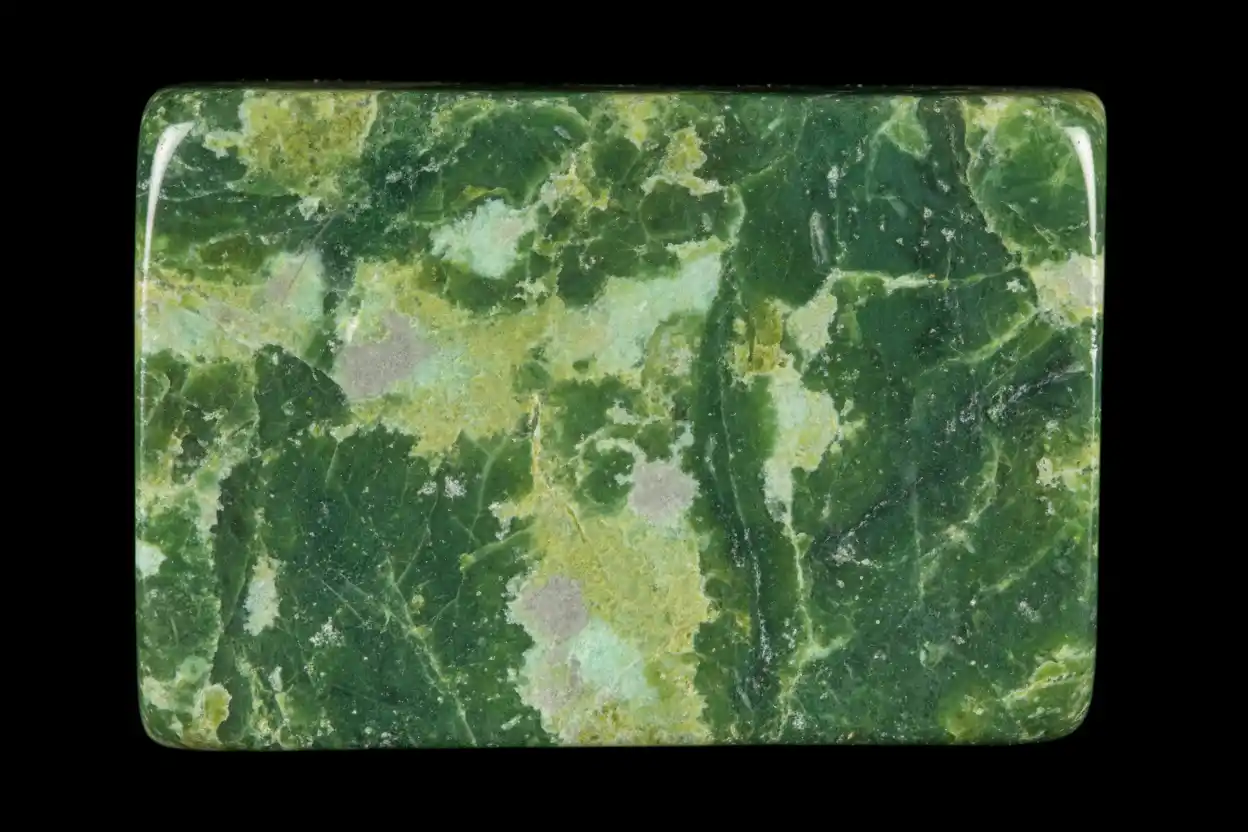
Lizardite: Meaning, Properties & Symbolism
Lizardite is a soft, commonly pale-green magnesium silicate mineral within the serpentine group. It usually forms as extremely fine scales or massive waxy aggregates during the hydration and alteration of magnesium-rich rocks, while distinct crystals are rare and generally microscopic or only a few millimeters across.
Lizardite at a Glance
| Property | Lizardite Characteristics |
|---|---|
| Material type | Serpentine-group sheet silicate mineral |
| Composition | Mg₃Si₂O₅(OH)₄, with possible iron, aluminum and nickel substitution |
| Colors | Pale green, yellow green, cream, white, gray green and occasionally darker green |
| Crystal system | Trigonal or hexagonal polytypes, commonly described as pseudo-orthorhombic in habit |
| Habit or texture | Fine scales, platy aggregates, massive material, coatings and rare tiny crystals |
| Luster | Waxy, greasy, pearly or dull |
| Transparency | Translucent in thin material; usually opaque in massive rock |
| Mohs hardness | Approximately 2.5 |
| Cleavage | Perfect basal cleavage |
| Tenacity | Thin crystals may bend; massive material is soft and variably brittle |
| Common uses | Mineral specimens, research material, carvings, cabochons and serpentine ornamental stone |
| Main care concern | Softness, cleavage, scratches and possible association with fibrous asbestos minerals in mixed serpentinite |
What Is Lizardite?
Lizardite is one of the principal minerals within the serpentine group. Its ideal composition is magnesium silicate hydroxide, written Mg₃Si₂O₅(OH)₄.
The name comes from the Lizard Peninsula in Cornwall, England, where the mineral was studied in altered ultramafic rock. Although the name may sound zoological, it refers to the locality rather than the appearance of a reptile.
Lizardite commonly occurs as microscopic plates stacked into compact aggregates. Those sheets give the material its low hardness, perfect basal cleavage and smooth waxy appearance.
Because individual crystals are so small, most buyers encounter lizardite as a green mass within serpentinite rather than as a clearly defined crystal. Accordingly, a polished specimen may contain lizardite together with magnetite, brucite, chrysotile, antigorite, carbonate minerals and remnants of the original ultramafic rock.
Lizardite and Serpentine
The word serpentine can refer either to a mineral group or to a rock composed mainly of serpentine minerals.
Lizardite is one specific mineral within that group. Serpentine may instead contain lizardite, antigorite, chrysotile or mixtures of all three.
This distinction matters because commercial green carvings are often sold simply as serpentine. Visual inspection may not reveal which serpentine-group mineral dominates the object.
Lizardite tends to form fine platy sheets. Antigorite commonly develops wavy, modulated layers and can produce tougher compact material. Chrysotile forms rolled microscopic tubes that can create flexible fibers.
Consequently, a polished serpentine carving should not be renamed lizardite unless its mineralogy has been tested.
How Lizardite Forms
Lizardite develops mainly through serpentinization, a water-rock reaction that alters magnesium- and iron-rich igneous minerals.
Olivine and pyroxene are abundant in mantle-derived rocks such as peridotite and dunite. When water enters fractures, these minerals become unstable under the new temperature and pressure conditions.
The reaction produces serpentine minerals, magnetite, brucite and sometimes hydrogen gas. Lizardite commonly forms at relatively low metamorphic temperatures or during retrograde alteration as previously hotter rocks cool in the presence of water.
Instead of simply filling an empty cavity, lizardite may replace olivine grain by grain. The resulting rock can preserve outlines of the original minerals even though its chemistry and crystal structure have changed.
Repeated fluid movement creates green veins, mesh textures and pale alteration zones. Meanwhile, magnetite may accumulate along boundaries as black grains or thin lines.
Crystal Structure and Physical Behavior
Lizardite is a sheet silicate. Each structural layer combines a silica-rich tetrahedral sheet with a magnesium-rich octahedral sheet.
The two sheets do not fit perfectly because their preferred dimensions differ. Lizardite accommodates that mismatch mainly through small structural adjustments while retaining a comparatively flat layer.
Chrysotile resolves the same mismatch by curling the layers into tubes. Antigorite produces a wave-like structure.
Lizardite sheets separate readily along their broad basal plane, which accounts for its perfect cleavage. Thin crystals can bend, but they do not have the elastic strength associated with mica.
A Mohs hardness near 2.5 means metal, quartz dust and most gemstones scratch it easily. Therefore, a polished lizardite surface can lose gloss through ordinary rubbing.
Lizardite Colors
Pure lizardite is colorless or pale. Iron, nickel, included magnetite and other impurities create green, yellow-green, gray and darker tones.
Pale apple green is common in relatively clean magnesium-rich material. Iron tends to darken or dull the color, while finely distributed magnetite creates black specks and veins.
Nickel-bearing members approach népouite in composition and can show brighter green. However, green color alone cannot establish nickel content.
Cream or white areas may contain low-iron lizardite, carbonate minerals or other pale alteration products. Brown surfaces commonly reflect iron oxidation and weathering rather than a stable lizardite color variety.
The green gemstones market contains many tougher and more standardized alternatives. Lizardite’s appeal instead comes from its soft waxy texture and geological relationship with altered mantle rock.
Lizardite vs Antigorite
Lizardite and antigorite have similar ideal chemistry but different structures.
Lizardite commonly forms in lower-temperature alteration environments and occurs as fine scales or massive material. Antigorite is generally associated with higher-temperature serpentine metamorphism and often produces more coherent, wavy-textured aggregates.
Compact antigorite-rich serpentine can be tougher than lizardite-rich material and may accept a stronger polish.
The distinction cannot be established reliably by green color, hardness or trade name. X-ray diffraction or Raman spectroscopy is often required because both minerals occur together.
A seller describing every attractive serpentine carving as lizardite may therefore be using the name too broadly.
Lizardite vs Chrysotile
Lizardite and chrysotile share the ideal formula Mg₃Si₂O₅(OH)₄, but their layer geometry differs.
Lizardite forms mainly flat or slightly distorted sheets. Chrysotile forms rolled tubular fibers and is the principal asbestiform serpentine mineral.
Lizardite itself is not the serpentine mineral traditionally regulated and mined as asbestos. Nevertheless, lizardite-bearing serpentinite can contain chrysotile veins or fibrous amphibole minerals.
For that reason, intact polished material should not be treated as an automatic health emergency, yet dusty, fibrous or unidentified rough requires conservative handling.
Dry sawing, grinding and aggressive brushing can release fine particles from every mineral present in the rock. The broader toxic crystals safety list explains why mixed-mineral rough deserves more caution than a smooth finished surface.
Lizardite vs Jade
Green serpentine has long been used as a jade substitute.
However, true jade consists of jadeite or nephrite. Lizardite belongs to a different mineral group and is much softer.
The jadeite versus nephrite comparison explains the two accepted jade materials, while the real versus fake jade guide covers serpentine imitations in greater detail.
A steel point can scratch lizardite-rich serpentine much more readily than either jadeite or nephrite. Furthermore, jade has far greater toughness and can support thin carving details that would chip or abrade in soft lizardite.
Trade labels such as new jade, Korean jade, olive jade and serpentine jade do not make the material mineralogically jade.
Important Lizardite Localities
The Lizard complex in Cornwall remains the type locality and source of the mineral’s name. Hydrated ultramafic rocks there contain lizardite and related serpentine minerals.
Other well-studied occurrences include Unst in the Shetland Islands, several Italian ultramafic districts and Japanese serpentinite bodies.
Canadian deposits include the former Jeffrey mine in Quebec and the Cassiar district in British Columbia. These localities are also associated with chrysotile, making accurate specimen labeling and safe preparation important.
Lizardite occurs in the Stillwater complex of Montana and in numerous ultramafic belts worldwide.
Its broad distribution does not mean that fine crystals are common. Most occurrences contain microscopic or massive material rather than isolated display crystals.
How to Identify Lizardite
Visual inspection can suggest lizardite but rarely proves it.
The material commonly has a waxy pale-green surface, low hardness and a fine scaly texture. Thin fragments may show pearly cleavage, while massive material can resemble soapstone, serpentine, talc-rich rock or pale nephrite.
Specific gravity near 2.55 helps separate it from denser jadeite and many metal-rich minerals. However, mixtures with magnetite and carbonate change the apparent density.
Raman spectroscopy and X-ray diffraction provide the most reliable distinction among lizardite, antigorite and chrysotile.
The framework in how to identify crystals should therefore end with analytical testing before a seller assigns a species-level name to massive serpentine.
Is Lizardite Suitable for Jewelry?
Lizardite can be polished, but its softness sharply limits wear.
Cabochons, pendants and large beads can display its green color and waxy luster. Nevertheless, the surface scratches readily and may develop dull patches where it rubs against clothing or metal.
Rings and exposed bracelets are poor choices. The gemstone hardness chart places lizardite below calcite and far below quartz.
Perfect basal cleavage creates another weakness. As the gemstone cleavage guide explains, pressure can separate layered minerals even without a hard impact.
The distinction in gemstone toughness versus hardness is particularly important because compact serpentine may feel solid while remaining vulnerable to scratches and edge damage.
Treatments and Imitations
Commercial lizardite and serpentine may receive wax, oil, dye, resin impregnation or surface coating.
Wax and oil deepen green color and improve the apparent polish. Resin can stabilize fractures or porous material, while dye may imitate richer jade-like green.
Reconstituted products combine crushed serpentine with resin and pigment. Mold seams, bubbles and repetitive patterns can expose the artificial construction.
The warning signs in how to spot fake crystals help identify composites, although they do not determine which natural serpentine mineral is present.
The broader gemstone treatments guide provides the correct disclosure language for wax, dye, filling and reconstruction.
Lizardite Price and Value
Most lizardite is inexpensive because massive serpentine occurs widely and species-level identification is uncommon in ordinary jewelry.
| Lizardite Material | Broad Current Asking Range |
|---|---|
| Small rough or educational specimen | $5–$25 |
| Polished cabochon | Approximately $10–$40 |
| Palm stone or small carving | Approximately $15–$60 |
| Large decorative carving | Approximately $50–$200+ |
| Well-documented mineral specimen | Approximately $30–$150 |
| Fine research-grade or rare crystallized association | Individually priced and potentially higher |
Aesthetic color, polish, pattern, locality and analytical confirmation influence value.
However, a commercial cabochon does not become rare simply because a seller changes the label from serpentine to lizardite.
Collector premiums are more defensible when the specimen has documented crystal form, locality and supporting mineralogical analysis.
Cleaning and Storage
Use a dry soft cloth for routine cleaning. When necessary, wipe a stable polished object briefly with a damp cloth and dry it immediately.
Prolonged soaking can enter fractures, affect wax or resin and loosen soft surface material. The general crystal water-safety guide should therefore be applied to the complete object rather than the formula alone.
Avoid ultrasonic and steam cleaning. Vibration can expand cleavage and grain-boundary fractures, while heat may affect treatments.
The guidance in gemstones and ultrasonic cleaners supports hand cleaning for soft layered minerals.
Store lizardite separately from harder stones. Even ordinary quartz can scratch it.
Lizardite Meaning and Symbolism
Lizardite has little separate historical symbolism because people usually encountered it as serpentine rather than as a species identified through modern mineralogy.
Contemporary interpretations connect its green color with adaptation, gradual renewal and learning to change without losing structural continuity.
Its geological formation offers a material-specific theme. An original olivine-rich rock reacts with water and becomes a new assemblage while preserving parts of its earlier texture.
Some people interpret that process as a symbol of adjusting to changed conditions rather than trying to return to an earlier state.
These meanings remain personal or cultural interpretations. Scientific evidence does not show that lizardite heals illness, detoxifies the body or creates measurable emotional effects.
Frequently Asked Questions About Lizardite
Is lizardite a real mineral?
Yes. Lizardite is a recognized magnesium silicate hydroxide within the serpentine mineral group.
Is lizardite the same as serpentine?
Lizardite is one serpentine-group mineral. A rock sold as serpentine may contain lizardite, antigorite, chrysotile or a mixture.
Is lizardite asbestos?
Lizardite is not the principal asbestiform serpentine mineral. Chrysotile is, although lizardite-bearing rock can occur beside chrysotile or fibrous amphiboles.
What color is lizardite?
It is commonly pale green, yellow green, cream, white or gray green.
Where does lizardite form?
It forms mainly when water alters olivine, pyroxene and other minerals in ultramafic rocks.
How hard is lizardite?
Its Mohs hardness is approximately 2.5.
Is lizardite a type of jade?
No. Serpentine may be marketed as jade, but true jade consists of jadeite or nephrite.
Can lizardite be used in jewelry?
It can be cut into pendants, beads and cabochons, although it scratches too easily for unrestricted daily wear.
Is lizardite treated?
Commercial material may be waxed, oiled, dyed, resin filled or reconstructed.
Can lizardite go in water?
Brief wiping is safer than soaking, especially when the material is fractured, treated or mineralogically mixed.
Can lizardite go in an ultrasonic cleaner?
No. Its softness, cleavage and possible treatments make hand cleaning preferable.
What makes lizardite valuable?
Good color, attractive pattern, stable polish, documented locality and confirmed mineralogy create value.
Lizardite belongs in the Crystals That Start With L directory as a specimen mineral rather than a durable jewelry gem.
Safety disclaimer: Lizardite itself should not automatically be labeled asbestos, but serpentinite can contain chrysotile or fibrous amphibole minerals. Avoid dry cutting, grinding or brushing fibrous and unidentified rough. Use wet methods, local extraction, eye protection and suitable respiratory protection during preparation.