Lodestone: Meaning, Properties & Symbolism
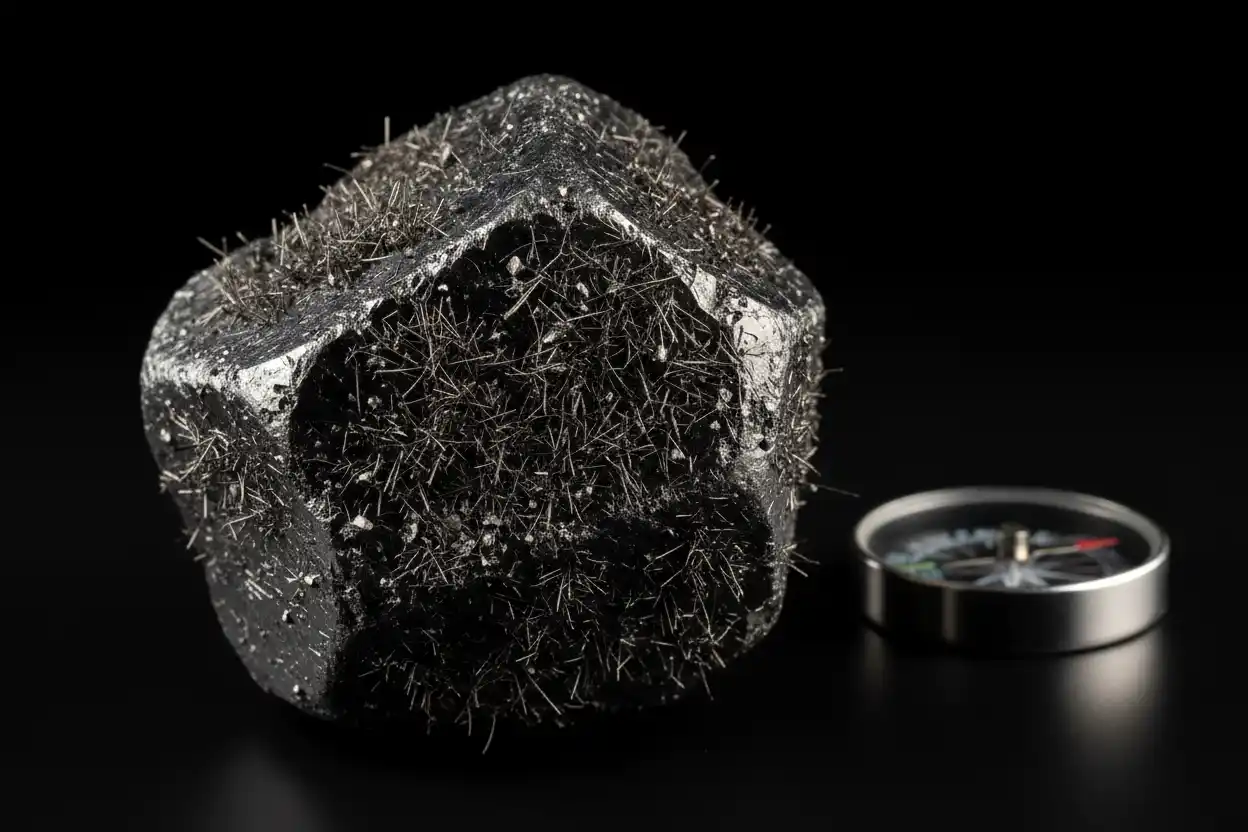
Lodestone is naturally magnetized magnetite that retains distinct magnetic polarity without first being magnetized by a person. It can attract iron and deflect a compass needle, yet only a small proportion of natural magnetite possesses enough stable remanent magnetism to qualify as true lodestone.
Lodestone at a Glance
| Property | Lodestone Characteristics |
|---|---|
| Material type | Naturally magnetized magnetite |
| Composition | Iron oxide, Fe₃O₄, commonly with minor titanium, aluminum, manganese and oxidation products |
| Colors | Black, brownish black and iron gray |
| Crystal system | Cubic |
| Habit or texture | Massive, granular, octahedral, dodecahedral and irregular naturally magnetized fragments |
| Luster | Metallic to submetallic; sometimes dull |
| Transparency | Opaque |
| Mohs hardness | Approximately 5.5–6.5 |
| Streak | Black |
| Cleavage | No true cleavage; very good octahedral parting may occur |
| Tenacity | Brittle |
| Common uses | Magnetic demonstrations, compass history, mineral collections, educational tools and symbolic objects |
| Main care concern | Mislabeling ordinary magnetite as lodestone, rusting of associated iron minerals and interference with magnet-sensitive objects |
What Is Lodestone?
Lodestone is a special form of magnetite with persistent natural magnetization.
Magnetite is an iron oxide with the formula Fe₃O₄. Its crystal structure contains both ferrous and ferric iron, creating strong ferrimagnetic behavior.
All magnetite responds to a magnetic field. However, most specimens do not retain a sufficiently strong north-south polarity in their natural state.
True lodestone has remanent magnetization. In other words, its internal magnetic domains remain aligned strongly enough for the specimen to act as a natural permanent magnet.
The distinction means that every lodestone is magnetite, but not every piece of magnetite-like iron ore is lodestone.
Magnetite Chemistry and Structure
Magnetite belongs to the spinel mineral group and crystallizes in the cubic system.
Its formula contains one ferrous iron ion and two ferric iron ions for every four oxygen atoms. Electron exchange between iron positions contributes to its magnetic and electrical properties.
Well-formed crystals commonly develop as octahedra or dodecahedra. However, lodestone often occurs as irregular massive or granular pieces rather than perfect crystals.
Fresh surfaces appear black with metallic-to-submetallic luster. Weathered surfaces may become brown because magnetite oxidizes partly to maghemite, hematite or hydrated iron oxides.
The mineral leaves a black streak, which helps distinguish it from hematite. Hematite may look metallic black but normally produces a red-brown streak.
Why Is Lodestone Naturally Magnetic?
Magnetite contains magnetic domains, which are regions where many atomic magnetic moments point in a shared direction.
In ordinary material, domains can point in different directions and largely cancel one another. A magnetite specimen may still be strongly attracted to an external magnet without behaving like a permanent bar magnet.
Lodestone has sufficient coercivity to preserve aligned domains.
Research indicates that structural irregularities, partial oxidation to maghemite and minor elemental substitutions can help pin domain boundaries and stabilize the magnetization.
A strong external field must then align those domains. Lightning is a leading natural mechanism because the electrical discharge creates an intense temporary magnetic field.
A nearby lightning strike can magnetize suitable magnetite-bearing rock. Nevertheless, not every lodestone has a documented lightning history, and the exact magnetization pathway of an individual specimen may remain unknown.
Lodestone vs Ordinary Magnetite
Ordinary magnetite is magnetic in the sense that a magnet attracts it.
Lodestone acts as a magnet itself. It can attract small iron particles and has stable poles that influence a compass needle in a repeatable direction.
This distinction is easy to overlook because sellers frequently use lodestone and magnetite as synonyms.
An ordinary magnetite crystal may cling strongly to a neodymium magnet but show little independent attraction after the external magnet is removed.
A genuine lodestone should display persistent behavior without repeated artificial magnetization.
However, strength varies greatly. Natural lodestone is often much weaker than a manufactured rare-earth magnet, so a small specimen may move only fine iron particles or a freely suspended compass needle.
Can Magnetite Be Artificially Magnetized?
Yes. A strong magnet, electrical coil or other magnetic field can magnetize suitable magnetite.
An artificially magnetized specimen may behave much like lodestone afterward.
That does not make the rock synthetic. It remains natural magnetite, but its persistent magnetization no longer proves a natural magnetizing event.
Retailers may magnetize magnetite intentionally so that it lifts pins or iron filings during demonstrations.
Unless provenance and testing establish otherwise, the most accurate description may be magnetized magnetite rather than natural lodestone.
This distinction matters more to scientific collectors than to someone purchasing a classroom magnetic specimen.
How Lodestone Forms Geologically
Magnetite forms in many geological environments.
It crystallizes as an accessory mineral in igneous rocks, concentrates in magmatic ore deposits and develops during contact or regional metamorphism.
Banded iron formations contain extensive magnetite layers that formed through ancient sedimentary and chemical processes. Skarns and hydrothermal veins can also produce magnetite crystals and massive ore.
Weathering, oxidation and structural defects can modify the magnetic properties after formation.
For lodestone to develop, suitable magnetite must then acquire and preserve a coherent magnetic direction.
Because lightning acts mainly near the surface, naturally magnetized pieces may be associated with exposed or shallow magnetite-bearing rocks.
Historical Importance of Lodestone
Lodestone provided the earliest direct human experience of natural magnetism.
Ancient observers recognized that it attracted iron. Later, people discovered that a freely suspended or carefully supported magnetized piece tended to align with Earth’s magnetic field.
Early Chinese directional devices used lodestone before magnetized iron needles became the standard compass element.
As compass technology developed, magnetism transformed navigation, surveying and geographic exploration.
The term lodestone derives from an older use of “lode” meaning way, course or journey. Thus, the name reflects the mineral’s ability to guide direction rather than merely its attraction to metal.
This history belongs specifically to naturally magnetic material and should not be expanded into unsupported claims that every magnetite object served as an ancient compass.
How to Identify Lodestone
Begin by confirming magnetite.
A fresh surface should be black, opaque and metallic to submetallic. The streak is black, while hardness generally falls between 5.5 and 6.5.
Specific gravity near 5.2 makes magnetite feel heavy for its size.
Next, test persistent polarity rather than simple attraction to a separate magnet.
A freely moving compass should deflect consistently near opposite sides of the specimen. Fine iron particles may collect more strongly at magnetic poles than across the center.
The test should be repeated after removing external magnets and metal objects from the area.
X-ray diffraction or Raman spectroscopy confirms magnetite. A magnetometer can quantify remanent magnetization and distinguish a genuinely polarized specimen from weak ordinary ore.
The crystal identification guide provides the broader sequence for combining physical and instrumental observations.
Lodestone vs Hematite
Hematite is Fe₂O₃, while magnetite is Fe₃O₄.
Magnetite normally leaves a black streak and responds strongly to magnets. Hematite leaves a red-brown streak and is usually weakly magnetic unless altered, mixed or specially heated.
Magnetic hematite sold in bead shops is frequently a manufactured ceramic or synthetic magnetic material rather than natural hematite.
Lodestone instead represents naturally magnetized magnetite.
The color and metallic luster of the two can overlap, so streak, density, magnetic polarity and laboratory testing provide better separation than appearance.
Lodestone vs Pyrite
Pyrite is iron sulfide rather than iron oxide.
It commonly shows brass-yellow metallic color, cubic or pyritohedral crystals and a greenish-black-to-brownish-black streak.
Pyrite is not strongly attracted to an ordinary hand magnet and does not function as lodestone.
Weathered pyrite may acquire dark iron-oxide coatings, creating visual confusion. A broken surface usually reveals the brass-colored sulfide interior.
Because pyrite can oxidize and create acidic residues, it also requires different storage conditions from stable compact magnetite.
Lodestone and Meteorites
Some meteorites contain iron-nickel metal and respond strongly to magnets.
However, magnetic attraction does not prove extraterrestrial origin. Magnetite is abundant in terrestrial rocks, industrial slag and black sand.
Lodestone normally leaves a black mineral streak and lacks the metal alloy structures expected in iron meteorites.
The meteorite guide explains why density, nickel content, internal texture and fusion crust matter more than a simple magnet test.
A seller should never market lodestone as a meteorite merely because it is magnetic.
Uses Beyond Collecting
Lodestone serves as an educational example of ferrimagnetism, magnetic domains and compass behavior.
Teachers can use it to show that a natural rock can attract iron without electricity or a manufactured magnet.
Geophysicists study remanent magnetism in rocks to reconstruct former magnetic-field directions, tectonic movement and geological history.
However, a small retail lodestone does not function as a precise scientific compass. Its uneven shape and multiple magnetic domains make directional readings less predictable than those from a calibrated needle.
Historically, lodestone also became a metaphor for anything that exerts a powerful attraction.
Is Lodestone Suitable for Jewelry?
Lodestone can be drilled, wire wrapped or incorporated into pendants.
Its dark metallic appearance suits rustic and geological designs. Nevertheless, it is brittle, relatively heavy and may have rough surfaces that stain skin or fabric.
The gemstone hardness chart places magnetite in a moderate range, but hardness does not prevent fractures or grain loss.
Very good octahedral parting can create weakness along structural planes. The principles in gemstone cleavage and gemstone toughness versus hardness therefore remain relevant.
Magnetic jewelry also requires practical caution around medical implants, magnetic cards, watch mechanisms and sensitive electronic equipment.
Can Lodestone Lose Its Magnetism?
Yes. Heat, repeated impact, strong opposing magnetic fields and structural alteration can reduce remanent magnetization.
Heating disrupts magnetic-domain alignment. Above magnetite’s Curie temperature, stable ferrimagnetism disappears until the material cools, and the previous domain arrangement may not return.
Ordinary household conditions are far below that temperature, but torch heating, lapidary treatment and fire damage can still alter a specimen.
Oxidation to other iron phases may also change magnetic strength over long periods.
A display lodestone should therefore be stored away from strong magnets that could reorient its poles and confuse its original natural magnetic direction.
Treatments and Imitations
Artificial magnetization is the most important commercial alteration.
Sellers may also apply oil, wax or lacquer to deepen the black color and prevent powder shedding. Resin can stabilize porous material.
Imitations include magnetic ceramic, ferrite, painted metal, slag and resin containing iron powder.
Manufactured ferrite commonly has a uniform molded shape and much stronger predictable poles than irregular natural lodestone.
The how to spot fake crystals guide helps identify molded and coated products, while gemstone treatments explained provides terminology for resin, coating and reconstruction.
Lodestone Price and Value
Most lodestone is inexpensive, although strong natural polarity, crystal form and documented locality can create premiums.
| Lodestone Material | Broad Current Asking Range |
|---|---|
| Small educational fragment | $3–$15 |
| Hand specimen with noticeable attraction | Approximately $10–$40 |
| Better natural-polarity specimen | Approximately $25–$100 |
| Well-formed magnetite crystal with remanence | Approximately $50–$250 |
| Large or historically documented collector specimen | Approximately $150–$500+ |
| Classroom magnetic demonstration set | Approximately $10–$50 |
A magnetite fragment should not receive a lodestone premium solely because an external magnet sticks to it.
Value rises when the specimen has stable measurable polarity, recognizable crystal form, strong aesthetics and documented natural provenance.
Historic collection labels and classic localities may matter more than maximum magnetic lifting strength.
Buying Lodestone
Ask whether the specimen is naturally magnetized or artificially magnetized magnetite.
A seller should be able to describe its independent magnetic behavior rather than demonstrating only that it clings to a stronger magnet.
Request a video showing the specimen deflecting a compass or attracting fine iron material without outside assistance.
Examine the surface for paint, resin, attached metal and artificial ferrite construction.
Locality information adds scientific value, although natural remanence may not be traceable to a specific lightning event.
An ordinary magnetite specimen can still be worthwhile, provided the description does not overstate its magnetic history.
Cleaning and Storage
Dry brushing or wiping is safest.
Brief rinsing may suit a compact stable specimen, but water can enter porous matrix and encourage rust-colored alteration in associated iron minerals.
The crystal water-safety guide should therefore be applied conservatively.
Avoid ultrasonic cleaning because vibration can loosen grains and change fragile assemblies. Hand cleaning is preferable under the principles in gemstones and ultrasonic cleaners.
Store lodestone away from credit cards, magnetic strips, mechanical watches, magnetic compasses and sensitive storage media.
Lodestone Meaning and Symbolism
Lodestone has a stronger historical symbolic foundation than many modern crystal-shop materials because people directly observed its attraction and directional behavior.
It commonly symbolizes guidance, orientation, attraction and commitment to a chosen course.
Natural polarity creates a useful material-specific theme. A lodestone can exert influence without visible motion or contact, yet its direction depends on an organized internal structure.
Some people interpret it as a reminder to identify what genuinely guides their decisions rather than following the strongest immediate attraction.
These meanings remain cultural or personal interpretations. Scientific evidence does not show that lodestone attracts money, controls relationships or changes biological energy.
Frequently Asked Questions About Lodestone
Is lodestone a mineral?
Lodestone is naturally magnetized magnetite rather than a separate mineral species.
Is lodestone the same as magnetite?
Every lodestone is magnetite, but most magnetite lacks strong persistent natural polarity.
Why is lodestone naturally magnetic?
Its magnetic domains became aligned and remained stabilized by suitable structure, composition and defects.
Does lightning create lodestone?
Lightning is a leading natural magnetization mechanism, although the history of an individual specimen may be impossible to prove.
Is all magnetic magnetite lodestone?
No. Magnetite can be attracted to a magnet without functioning as an independent permanent magnet.
Can lodestone work as a compass?
A freely moving lodestone can align approximately with Earth’s magnetic field, although it is less precise than a calibrated compass needle.
Does lodestone stay magnetic forever?
Its magnetism can weaken through heat, strong opposing fields, impact or mineral alteration.
Can lodestone be worn as jewelry?
Yes, but it is heavy, brittle and should be kept away from magnet-sensitive objects.
Is lodestone safe near a pacemaker?
People with pacemakers or implanted defibrillators should keep magnets away from the implant and follow their clinician’s device-specific advice.
Can lodestone go in water?
Brief rinsing may suit compact material, but dry cleaning avoids oxidation and matrix damage.
How can I recognize fake lodestone?
Check for molded ferrite, painted metal, resin, attached magnets and specimens that show no independent polarity.
What makes lodestone valuable?
Stable natural magnetization, crystal quality, locality, condition, historical provenance and aesthetic form determine value.
Lodestone belongs in the Crystals That Start With L directory as a naturally magnetic collector material.
Safety disclaimer: Magnets can interfere with pacemakers, implantable cardioverter-defibrillators and other magnet-sensitive medical devices. Keep lodestone away from implanted-device sites and follow medical guidance. Also avoid placing it beside magnetic cards, watches, compasses and sensitive electronics.