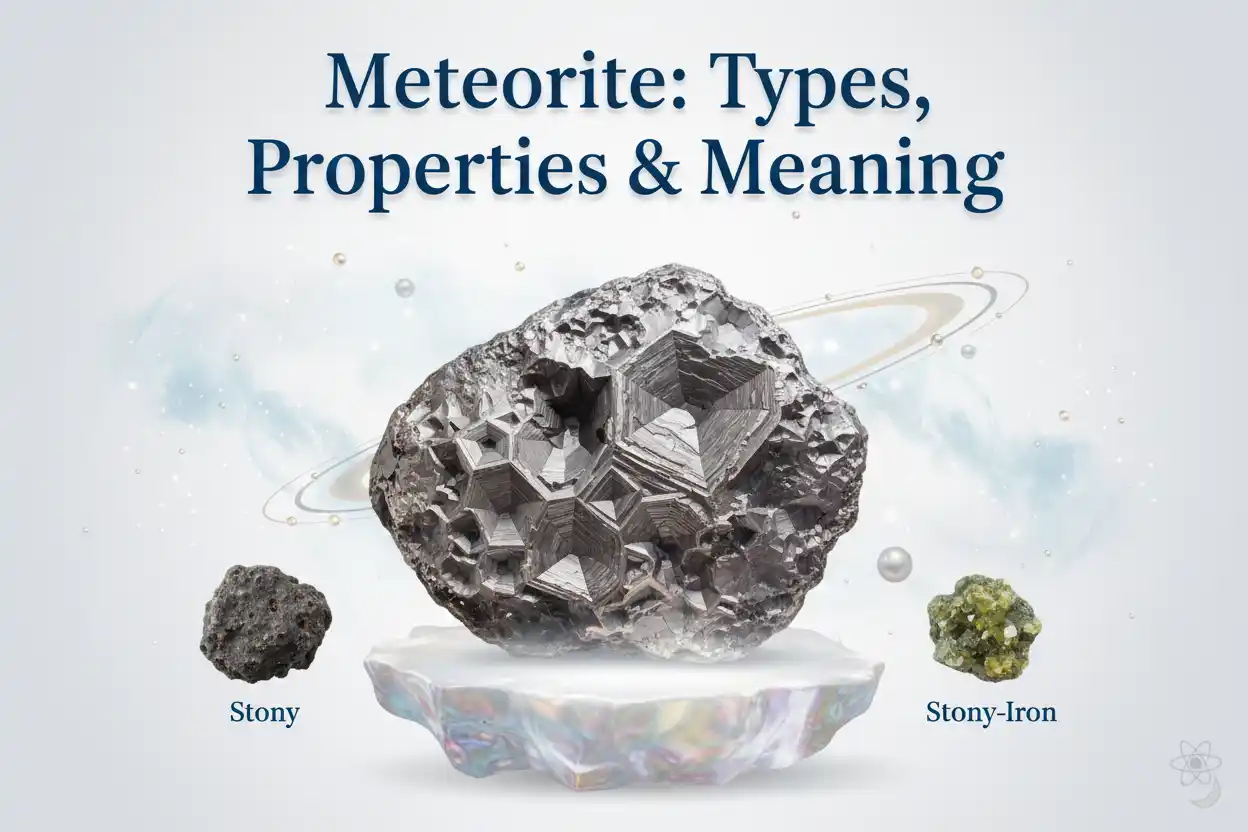
Meteorite: Types, Properties & Meaning
A meteorite is a natural fragment of extraterrestrial material that survives passage through an atmosphere and reaches the surface of a planet or moon. Most meteorites recovered on Earth came from asteroids, although a small number originated on the Moon or Mars.
Meteorite is not the name of one mineral. Instead, it is a broad classification covering rocks and metal-rich materials with widely different compositions, textures, hardness levels, densities, and preservation requirements.
Meteorite at a Glance
| Property | Meteorites |
|---|---|
| Material type | Extraterrestrial rock, metal, or rock-metal mixture |
| Main categories | Stony, iron, and stony-iron meteorites |
| Typical composition | Silicate minerals, iron-nickel metal, sulfides, or mixtures of these |
| Common colors | Black, dark brown, gray, rusty brown, metallic silver, bronze, or green-and-metallic in some pallasites |
| Crystal system | No single system applies to a whole meteorite |
| Texture | Chondritic, crystalline, brecciated, metallic, mixed silicate-metal, or fine-grained |
| Luster | Dull, earthy, submetallic, metallic, or glassy on fresh fusion crust |
| Transparency | Usually opaque; olivine in thin pallasite slices may be translucent |
| Mohs hardness | Variable according to constituent minerals |
| Cleavage | No universal cleavage |
| Tenacity | Variable; many specimens are brittle, while iron meteorites are comparatively tough |
| Common uses | Scientific specimens, collections, jewelry, etched slices, watch dials, inlay, and display objects |
| Main care concern | Rust, chloride-driven corrosion, impact damage, unstable weathering products, and misidentification |
Meteoroid, Meteor, and Meteorite
The terminology describes where the object is and what is happening to it. A meteoroid is a natural rocky or metallic object traveling through space. When it enters an atmosphere and creates a visible streak of light, that phenomenon is a meteor.
If some material survives and reaches the ground, the recovered object is a meteorite. Therefore, a shooting star is not a star, and the visible meteor is not necessarily the solid fragment later collected.
A meteorite fall is recovered after people observe or document its descent. A meteorite find is discovered without a witnessed fall, sometimes after lying on Earth for hundreds or thousands of years.
Falls often retain fresher fusion crust and less terrestrial weathering. However, a documented find can still be scientifically and commercially important when its location, classification, and chain of custody are reliable.
The Three Main Meteorite Categories
Meteorites are commonly introduced through three broad groups: stony, iron, and stony-iron. Modern scientific classification divides them much further according to mineralogy, texture, chemistry, isotopes, and parent-body history.
Stony Meteorites
Stony meteorites consist mainly of silicate minerals. They form the majority of observed falls, although dark iron meteorites may be easier to recognize during ground searches.
Chondrites contain small rounded structures called chondrules, which formed as molten or partly molten droplets in the early solar system. Their matrix may also contain olivine, pyroxene, feldspathic material, sulfides, and iron-nickel metal.
Achondrites lack the typical chondrules of primitive chondrites. Many formed through melting, differentiation, volcanic activity, impact processing, or recrystallization on parent bodies.
Some achondrites originated on differentiated asteroids. Others have been matched to the Moon or Mars through mineralogy, chemistry, trapped gases, and isotopic evidence.
Iron Meteorites
Iron meteorites consist predominantly of iron-nickel metal, especially the alloys kamacite and taenite. Minor sulfides, phosphides, carbides, graphite, and silicate inclusions may also occur.
Many represent metal-rich portions of asteroid parent bodies that experienced melting and separation into core-like and silicate-rich regions. Other iron meteorite groups have more complex origins.
When suitable iron meteorites are cut, polished, and etched, intergrowths of metal phases may reveal Widmanstätten patterns. These geometric bands record slow cooling within the parent body and cannot be reproduced simply by scratching lines onto ordinary steel.
Not every iron meteorite displays a visible pattern. Fine octahedrites, hexahedrites, ataxites, weathered pieces, and unsuitable cutting orientations can look different.
Stony-Iron Meteorites
Stony-iron meteorites contain substantial metal and silicate material. Pallasites and mesosiderites are the two best-known subdivisions.
Pallasites commonly contain gem-like olivine crystals within an iron-nickel metal framework. Thin polished slices may transmit yellow-green, olive, amber, or brown light through the silicate areas.
Mesosiderites are breccias containing silicate rock fragments mixed with iron-nickel metal. Their textures reflect violent disruption, mixing, and reassembly on asteroid parent bodies.
Pallasites are visually dramatic, but their exposed metal can corrode while their olivine crystals may crack or loosen. They therefore need more careful environmental control than an ordinary polished gemstone.
How Meteorites Form
Meteorites preserve several stages of solar-system history rather than one formation process. Primitive chondrites contain material that assembled early in the solar nebula, while differentiated meteorites record heating, melting, separation, and geological activity inside parent bodies.
Collisions later broke asteroids, moons, and planetary crusts into fragments. Some fragments entered Earth-crossing orbits and eventually encountered the atmosphere.
Atmospheric entry heats and removes material from the exterior through ablation. The resulting fusion crust is usually a thin melt layer rather than evidence that the entire meteorite became molten.
The interior often remains comparatively cool during the brief descent. Consequently, a meteorite can preserve ancient minerals, chondrules, impact veins, metals, and volatile-bearing components beneath a newly formed crust.
Most meteorites come from asteroids. Nevertheless, laboratory work has also identified lunar and Martian meteorites whose chemistry and mineralogy correspond with samples, remote observations, or planetary atmospheric data.
Famous Falls and Finds
The Murchison meteorite fell in Victoria, Australia, in 1969. This carbonaceous chondrite became scientifically important because it contains primitive solar-system material and a complex inventory of organic compounds.
Sikhote-Alin fell in Russia in 1947. Its iron masses include sculptural individuals with regmaglypts as well as sharp fragmentation pieces produced during atmospheric breakup.
Campo del Cielo is an extensive iron meteorite strewn field in Argentina. The recovered material has supplied scientific collections, educational specimens, decorative objects, and commercial jewelry.
Seymchan, found in Russia in 1967, includes both metal-rich and pallasitic material. Polished slices may reveal iron-nickel structure alongside translucent olivine.
Northwest Africa has yielded many meteorite finds, including ordinary chondrites, achondrites, lunar meteorites, Martian meteorites, and rare carbonaceous materials. However, an “NWA” designation should correspond to an approved or provisional classification rather than function as a vague marketing phrase.
How to Identify a Possible Meteorite
No single household test proves that a rock is a meteorite. Magnetic attraction, dark color, weight, surface pits, and metallic grains occur in many terrestrial rocks and industrial wastes.
A recently fallen meteorite may have a thin dark fusion crust with subtle flow lines. Older finds often weather to dark brown or rusty surfaces, especially where iron metal has oxidized.
Many ordinary chondrites contain small metal flakes visible on a cut or broken surface. Chondrules may appear as rounded grains, although metamorphism, weathering, and fine texture can make them difficult to see.
Iron meteorites feel unusually dense and may display regmaglypts, which are rounded thumbprint-like depressions shaped during atmospheric ablation. Slag can also contain cavities, but slag commonly has abundant bubbles and a glassy industrial texture.
A red or brown streak can indicate terrestrial iron oxides such as hematite. Most meteorites do not leave the strong red streak typical of hematite.
An ordinary magnet can support an initial examination, yet many Earth rocks contain magnetite or other magnetic minerals. Conversely, not every stony meteorite produces a dramatic attraction.
The systematic tests in how to identify crystals help organize observations, but meteorite confirmation generally requires a qualified laboratory, university, museum, or recognized classifier.
Common Meteorite Lookalikes
Industrial slag is one of the most frequent meteorite impostors. It may look dark, heavy, magnetic, metallic, or melted, but abundant rounded bubbles and an artificial glassy texture usually indicate industrial origin.
Magnetite-rich rocks can be strongly magnetic and dense. Iron oxides may also weather into brown or black surfaces resembling an old meteorite crust.
Smelting waste, furnace clinker, mill scale, railroad material, iron concretions, and corroded machine parts account for many suspected finds. The guide to spotting fake crystals and mineral products explains why one dramatic clue should never replace a complete identification.
Artificial “meteorite” jewelry may use etched steel, nickel-bearing alloy, resin, or terrestrial stone. Repeated etched patterns, no documented meteorite name, and descriptions such as “space metal style” deserve closer examination.
Documentation matters because meteorite classification relies on a named fall or find, type specimen, analytical work, and recognized nomenclature. A seller’s informal claim cannot replace those records.
Meteorites, Tektites, and Impact Glass
A tektite is natural glass formed when a major impact melts terrestrial material and ejects it through the atmosphere. It originates mainly from Earth rock affected by an extraterrestrial impact rather than from the incoming meteorite itself.
Moldavite is a green tektite associated with the Ries impact event in Europe. Although its formation required a meteorite impact, moldavite is not a fragment of the meteorite.
Libyan Desert Glass is silica-rich natural glass from the Great Sand Sea region. Its exact impact-related formation process has been extensively studied, but the glass itself is terrestrial material transformed by extreme heat.
These distinctions prevent the meteorite family guide from absorbing the search intent of dedicated impact-glass pages.
Meteorite Jewelry Suitability
Iron meteorites and pallasites are commonly cut into rings, pendants, cufflinks, watch dials, beads, and inlays. Their appeal often comes from documented extraterrestrial origin and visible metal structure.
Nevertheless, iron meteorite is not maintenance-free. Moisture, perspiration, salt, chlorine, and humid storage can encourage rust, especially when chloride contamination or open pores remain in the metal.
A ring receives more exposure than a pendant. Handwashing, sweat, lotions, coastal air, and repeated abrasion may eventually damage an etched pattern or protective coating.
Pallasite jewelry adds another concern because olivine and metal respond differently to cutting, impact, heat, and corrosion. Thin olivine windows can crack, while corrosion around their edges may loosen them.
Stony meteorites are generally brittle and may contain fractures or friable matrix. Protective bezels, substantial backing, and occasional wear are safer than exposed prongs or sharp corners.
The difference between scratch resistance and resistance to fracture is outlined in gemstone toughness versus hardness. Since meteorites contain several phases, one Mohs number cannot describe the entire object.
Treatments, Etching, and Alteration
Cutting and polishing expose a meteorite’s interior. Iron meteorites may then be etched with acid to reveal structural patterns produced by different metal phases.
Etching is an accepted preparation method when accurately disclosed. However, polishing away a weathered exterior or applying artificial patina can remove evidence about the specimen’s terrestrial history.
Oil, wax, lacquer, polymer coatings, and corrosion inhibitors may be applied to iron-rich specimens. These materials can slow contact with moisture, but they may wear, yellow, trap corrosion products, or complicate future conservation.
Some pallasite slices receive resin filling to support cracked olivine or seal pores. Stabilization can be practical, although sellers should identify it.
Stony meteorites may be impregnated with resin if they are fragile. Dyed resin, artificial matrix, assembled slices, and pieces mounted on steel backing also occur.
Current Meteorite Asking Prices
Meteorite prices vary more by classification, provenance, rarity, preparation, and total available mass than by size alone.
| Meteorite product | Broad retail asking range |
|---|---|
| Small common chondrite fragment | About $15–$60 |
| Common chondrite slice | About $25–$150 |
| Small Campo del Cielo or similar iron specimen | About $20–$100 |
| Larger sculptural iron meteorite | About $100–$1,500 or more |
| Etched iron slice | About $40–$300 |
| Small pallasite slice | About $80–$500 |
| Large, translucent, well-prepared pallasite slice | Several hundred to several thousand dollars |
| Carbonaceous or unusual achondrite fragment | About $50–$1,000 or more |
| Lunar or Martian meteorite | Commonly hundreds to thousands of dollars per gram, depending on classification and availability |
| Jewelry containing documented meteorite | About $50–$1,500 or more, depending heavily on metalwork |
These figures represent broad retail asking prices, not appraisals or guaranteed resale values. Classification papers, an approved meteorite name, specimen weight, preparation, and chain of custody can matter more than a dramatic sales story.
What Makes a Meteorite Valuable?
Classification is the starting point. Common ordinary chondrites usually cost less than carbonaceous chondrites, pallasites, rare achondrites, lunar material, or Martian meteorites.
Provenance affects confidence and value. A specimen linked to a recognized fall or find, reputable collection, classification record, and documented transfer history carries less uncertainty than an anonymous “space rock.”
Preparation can add value when the work reveals useful features without creating instability. A well-etched iron slice or correctly oriented pallasite section may show structure unavailable on a rough exterior.
Condition also matters. Active rust, flaking crust, poorly repaired cracks, unstable resin, and missing labels reduce desirability.
Aesthetic qualities influence display pieces. Regmaglypts, complete fusion crust, orientation, visible chondrules, contrasting metal, translucent olivine, and balanced slice geometry can all raise demand.
Rarity should be supported by classification rather than by a seller’s use of words such as ancient, cosmic, museum-grade, or one of a kind. Broader rarity claims can be compared with the materials covered in the world’s rarest gemstones, while remembering that scientific meteorite rarity follows a separate market.
Buying a Meteorite
Ask for the official meteorite name, classification, weight, and source. A recognized name such as Campo del Cielo, Sikhote-Alin, Murchison, or Seymchan is more useful than “meteorite from space.”
Check whether the piece belongs to a documented fall, find, or Northwest Africa classification. When an NWA number is provided, it should correspond to a real database entry.
Request photographs of the front, back, edges, and any label. For slices, inspect polish, saw marks, cracks, resin, rust, and the relationship between matrix and metal.
Do not treat a magnetic response as proof. Likewise, a certificate created solely by the retailer has less evidentiary value than classification through a recognized meteoritical institution.
The crystals beginning with M directory and gemstones beginning with M directory place meteorite within the site’s alphabetical navigation, although meteorite remains a family of extraterrestrial materials rather than one crystal species.
Cleaning and Storage
Handle clean, stable stony meteorites with dry hands or nitrile gloves. Repeated skin contact can transfer oils, salts, and moisture into porous surfaces.
Do not wash an unknown meteorite. Water can enter fractures, activate chloride-related corrosion, alter soluble minerals, or damage labels and coatings.
Iron and pallasite specimens should remain in a dry, stable environment. A sealed display case or storage box with monitored desiccant can reduce moisture exposure.
Avoid storing meteorites in bathrooms, kitchens, damp basements, or unconditioned outdoor spaces. Sudden temperature changes can also create condensation.
A soft dry brush can remove loose dust from a stable specimen. Active rust, sweating surfaces, orange powder, flaking metal, or expanding cracks require professional conservation rather than household rust remover.
The general water-safety guide for crystals provides useful caution, but meteorites deserve stricter care because their mineral and metal mixtures vary.
Meteorite Meaning and Symbolism
Meteorites have inspired cultural interpretations involving the sky, divine messages, transformation, ancestry, power, and contact with a world beyond ordinary human experience.
Modern symbolic use often connects them with perspective, endurance, change, exploration, and the immense scale of time. Their scientific age and extraterrestrial origin make those themes understandable without assigning supernatural properties.
Iron meteorites may symbolize resilience or structure, while pallasites can inspire ideas about balance between metal and stone. Chondrites often evoke beginnings because they preserve primitive solar-system material.
These meanings remain historical, cultural, spiritual, or personal interpretations. Scientific evidence does not show that carrying a meteorite produces guaranteed physical, emotional, or energetic effects.
Frequently Asked Questions
What is the difference between a meteor and a meteorite?
A meteor is the visible light produced during atmospheric entry. A meteorite is material that survives the passage and reaches the ground.
What are the three main types of meteorites?
The broad categories are stony, iron, and stony-iron meteorites. Scientific classification divides each category into many additional groups.
Does a magnet prove that a rock is a meteorite?
No. Many terrestrial rocks, industrial slags, and metal wastes attract magnets. Magnetic response is only one preliminary clue.
What does genuine fusion crust look like?
Fresh fusion crust is usually thin, dark, and closely attached to the exterior. Thick bubbly glass, deep foam-like cavities, or a painted-looking coating often indicates slag or another material.
Do all stony meteorites contain chondrules?
No. Chondrites contain chondrules, but achondrites generally do not. Some chondrules are also difficult to see without cutting or magnification.
Are meteorites dangerously radioactive?
Ordinary meteorites are not normally hazardous radioactive objects. Recently fallen specimens may contain measurable cosmogenic isotopes for scientific study, but this does not make typical collector pieces dangerous to handle.
Can meteorite be worn every day?
It can be used in jewelry, but iron-rich pieces may rust and stony material may chip. Rings require more maintenance than pendants or earrings.
Why does iron meteorite rust?
Iron-nickel metal reacts with moisture and oxygen. Salts, perspiration, chloride contamination, pores, and damaged coatings can accelerate corrosion.
What is a pallasite meteorite?
A pallasite is a stony-iron meteorite containing olivine crystals within iron-nickel metal. Polished slices are prized for their translucent green-to-amber silicate areas.
Is moldavite a meteorite?
No. Moldavite is terrestrial impact glass formed during a meteorite impact. It is not a fragment of the incoming space rock.
Why are lunar and Martian meteorites expensive?
They are scarce, scientifically important, difficult to authenticate, and represented by limited classified material. Provenance and laboratory confirmation strongly influence their price.
What is the safest way to clean a meteorite?
Use dry, conservative methods and avoid water unless a specialist has identified the material and its stability. Active rust or crumbling requires professional advice.
A genuine meteorite should be purchased as a documented scientific material rather than merely a magnetic curiosity. When the main appeal is glass created by an impact instead of material that arrived from space, the dedicated tektite guide provides the correct geological comparison.
Meteorites may contain nickel-bearing metal, sharp cut edges, unstable corrosion products, or friable mineral dust. Do not ingest them, place them in drinking water, dry-grind them, or handle actively corroding material without appropriate protection. People with nickel sensitivity should also use caution with iron-meteorite jewelry.