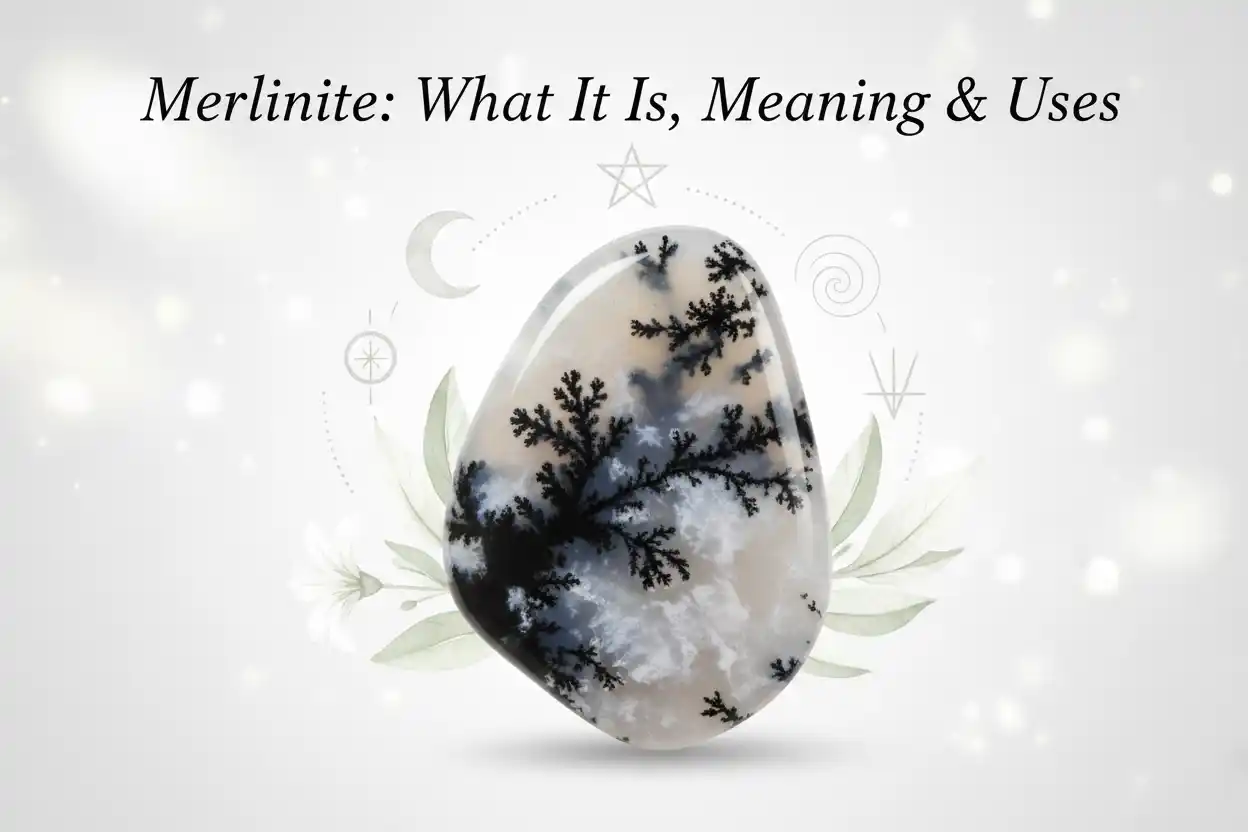
Merlinite: What It Is, Meaning & Uses
Merlinite is a commercial and metaphysical trade name rather than a recognized mineral species. Mineral references most specifically apply the name to white chalcedony containing dark dendritic patterns, although retailers also use it for dendritic opal, dendritic agate, and occasionally unrelated rocks.
That inconsistent naming changes every practical property. A seller must identify the underlying material before hardness, composition, treatment, locality, value, or care can be described accurately.
Merlinite at a Glance
| Property | Merlinite |
|---|---|
| Material type | Ambiguous trade name |
| Most specific documented usage | White dendritic chalcedony |
| Other retail usage | Dendritic opal, dendritic agate, manganese-rich material, and occasionally misnamed indigo gabbro |
| Composition | Variable; commonly silica-rich, but no universal formula applies |
| Common colors | White, cream, pale gray, smoky gray, black, brown, and occasionally blue-gray |
| Pattern | Branching, fern-like, plume-like, mossy, landscape, or ink-like dendrites |
| Crystal system | No single system applies to every product sold as merlinite |
| Texture | Usually microcrystalline chalcedony or amorphous-to-microstructured opal with mineral dendrites |
| Luster | Waxy to vitreous after polishing |
| Transparency | Translucent to opaque |
| Mohs hardness | Commonly about 6.5–7 for chalcedony; approximately 5.5–6.5 for many opal-based pieces |
| Cleavage | Usually none in chalcedony or opal; natural fractures may be present |
| Common uses | Cabochons, beads, pendants, palm stones, spheres, carvings, and display pieces |
| Main care concern | Misidentification, hidden fractures, unknown treatments, heat, scratching, and prolonged soaking |
Merlinite Is a Trade Name
Mindat records merlinite as a marketing name for white chalcedony containing dendrites. Under that usage, the base material belongs to the microcrystalline quartz family and consists predominantly of silica.
However, commercial listings do not follow one universal definition. Some sellers apply merlinite to dendritic opal, while others use it for dendritic agate or any white-and-black dendritic stone.
The name therefore functions more like a visual category than a precise geological identity. Two objects sold as merlinite may differ in water content, hardness, toughness, refractive index, porosity, and response to heat.
For this reason, a responsible product description should state “merlinite trade name—dendritic chalcedony,” “merlinite trade name—dendritic opal,” or another confirmed base material.
What Are the Black Dendrites?
Dendrites are branching mineral deposits that resemble trees, ferns, roots, moss, or winter landscapes. Despite their organic appearance, they are not fossil plants.
Manganese oxides commonly create black dendrites. Iron oxides and hydroxides can contribute brown, yellow, red, or orange branches.
Mineral-bearing fluids move through microscopic fractures, pores, or interfaces within the host stone. As conditions change, the dissolved material precipitates in branching patterns.
The process can resemble frost spreading across glass, although the resulting pattern consists of minerals rather than frozen water. Growth direction follows available pathways, chemical gradients, and nucleation points.
Some dendrites lie inside the host. Others occupy thin fractures close to the surface, where careless cutting or repolishing can remove part of the design.
Because pattern formation varies from piece to piece, natural dendrites rarely repeat exactly.
Chalcedony-Based Merlinite
Chalcedony is a compact, microcrystalline form of silica related to quartz. Its microscopic structure gives it a waxy luster and greater practical toughness than many visibly crystalline stones.
White dendritic chalcedony usually measures about 6.5–7 on the Mohs scale. It has no prominent cleavage, although it can fracture conchoidally or break along existing seams.
A chalcedony base often supports a bright polish and crisp black dendrites. Thin zones may transmit pale gray or milky light when viewed from behind.
Material with true agate banding belongs more specifically within the agate family. However, some sellers use agate and chalcedony interchangeably when describing unbanded dendritic pieces.
Chalcedony-based merlinite generally performs better in jewelry than opal-based material because it is harder, tougher, and less sensitive to moisture changes.
Opal-Based Merlinite
Dendritic opal consists of hydrated amorphous silica containing branching mineral inclusions. It normally lacks the play-of-color associated with precious opal.
The base may appear white, cream, gray, blue-gray, or translucent. Black and brown dendrites can create high-contrast landscape patterns.
Opal-based pieces tend to be softer and more variable than chalcedony. Some contain substantial porosity, fractures, matrix, or uneven water content.
Heat, rapid drying, impact, and prolonged soaking may increase the risk of crazing or surface change in susceptible material. Therefore, opal identification changes both jewelry suitability and cleaning advice.
Detailed opal classification belongs on the opal guide and the dedicated explanation of types of opal, rather than being repeated under a trade name.
Merlinite Is Not Mystic Merlinite
Merlinite and Mystic Merlinite are frequently confused, yet the commercial names usually describe different materials.
Mystic Merlinite commonly refers to indigo gabbro, a dark, coarse-grained igneous rock marketed from Madagascar. It contains visible mineral grains rather than delicate black dendrites in a white silica host.
Indigo gabbro often appears black, gray, purple-gray, or indigo-toned with mottled, patchy, or granular patterns. By contrast, the most specific use of merlinite refers to white dendritic chalcedony.
“Dendritic merlinite,” “Mystic Merlinite,” and “Indigo Merlinite” should not be treated as interchangeable geological terms. The seller should provide the underlying rock or mineral identification.
The workbook’s trade-name mapping correctly keeps Mystic Merlinite on the indigo gabbro page rather than creating a second competing mineral identity.
How Merlinite Forms
No single formation process applies to everything sold as merlinite. The geological story depends on whether the host is chalcedony, agate, opal, or another substance.
Chalcedony forms when silica-rich fluids fill fractures, cavities, or pore spaces and deposit microscopic silica. Later or overlapping fluids can introduce manganese and iron that crystallize as dendrites.
Agate-based material may develop in volcanic cavities or sedimentary environments where repeated silica deposition forms bands and internal structures. Dendrites may enter along fractures after some of that silica has formed.
Opal develops when hydrated silica precipitates from low-temperature fluids. Branching oxides can form within pores, seams, or fractures during later fluid movement.
Consequently, the black pattern and white host may not have formed at precisely the same time. The dendrites can record a later episode of fluid movement through an older silica body.
Locality Claims
The merlinite name is often associated in retail descriptions with New Mexico. Nevertheless, a trade name does not prove that a piece came from a particular mine, district, or state.
Similar dendritic chalcedony, agate, and opal occur in many geological environments worldwide. Commercial pieces are also marketed with origins including Turkey, Madagascar, India, and other countries.
Without a mine label or reliable supplier record, pattern alone cannot establish locality. A white stone with black dendrites could come from several unrelated sources.
For collectors, a precise mine or district supported by an old label carries more value than a broad “New Mexico merlinite” claim copied between sellers.
Identifying the Underlying Material
Begin with the host rather than the trade name. Chalcedony-based material should approach quartz hardness and normally resists scratching by ordinary steel.
Opal-based material is generally softer. It may also show lower density, a more resinous luster, greater porosity, or subtle differences under magnification.
Agate should display some form of banding, structural layering, or organized chalcedony growth. However, marketing descriptions often call unbanded dendritic chalcedony “agate.”
Backlighting can reveal translucency, fracture-filled dye, cloudy opal zones, and the depth of dendrites. Natural branches should occupy internal pathways rather than appearing as a flat printed design.
Magnification may reveal resin-filled cracks, paint concentrated in pits, polishing undercut, or a coating across the surface.
Refractive-index testing, specific-gravity measurement, Raman spectroscopy, infrared spectroscopy, and X-ray diffraction can distinguish chalcedony from opal and manufactured substitutes. The process outlined in how to identify crystals provides a useful testing framework.
Merlinite and Similar Dendritic Stones
Dendritic agate contains branching mineral inclusions within chalcedony that has agate structure or banding. Merlinite may overlap with this material when sellers use the trade name loosely.
Dendritic opal has a hydrated amorphous silica base. It often appears softer, more porous, and less structurally uniform than chalcedony.
Moss agate contains moss-like or plume-like inclusions, often in green, red, brown, or black. Its inclusions may look more cloud-like and three-dimensional than flat branching dendrites.
Tree agate usually has a white opaque chalcedony base with green dendritic or mossy inclusions. Its green-and-white appearance differs from the black, gray, and white palette commonly marketed as merlinite.
Indigo gabbro has a coarse igneous texture and visible interlocking mineral grains. It should not show the delicate fern-like oxide branches expected in dendritic chalcedony.
Psilomelane is an outdated collective name historically applied to hard black manganese-oxide mixtures. Some commercial descriptions incorrectly treat it as a precise component or synonym for merlinite.
Jewelry Suitability
Chalcedony-based merlinite works well for pendants, earrings, brooches, bracelets, beads, and protected rings. Its microcrystalline texture provides relatively good toughness.
However, dendrites often follow fractures. A visually dramatic line can therefore mark either a stable mineral-filled seam or a structural weakness.
Opal-based material needs more conservative use. Pendants and earrings generally expose it to less impact than rings or bracelets.
A bezel protects cabochon edges better than widely spaced prongs. Nevertheless, excessive setting pressure can break a thin stone along a natural seam.
Check drill holes for chips and branching cracks. Large beads should not press tightly against hard metal spacers or harder gemstones.
When the base remains unidentified, apply the care standard of the more delicate possibility rather than assuming quartz-level durability. The practical difference between surface hardness and breakage resistance appears in gemstone toughness versus hardness.
Treatments and Imitations
Dye can strengthen black dendrites, whiten or darken the background, or introduce blue, green, and other colors. Color often accumulates around fractures and pores.
Resin impregnation may stabilize porous or cracked material and improve polish. Fillers can also conceal pits or weak seams.
Clear coatings add shine but may scratch, yellow, peel, or collect around drill holes. Wax and oil can temporarily deepen gray or black patterns.
Glass, resin, ceramic, and printed composite material can imitate dendritic stone. Perfectly repeated branch patterns, surface-only designs, mold seams, abundant round bubbles, and plastic-like weight deserve closer examination.
Natural dendrites can look astonishingly picture-like, so complexity alone does not indicate artificial manufacture. Conversely, a seller’s claim that every pattern is natural does not replace testing.
The broader fake-crystal guide covers imitation clues, while treated agate identification owns detailed discussion of dyeing and enhancement within chalcedony materials.
Current Merlinite Asking Prices
These ranges apply to products sold as dendritic-chalcedony, dendritic-agate, or dendritic-opal merlinite. Prices for indigo gabbro should be evaluated separately.
| Product type | Broad retail asking range |
|---|---|
| Small tumbled stone | About $5–$15 |
| Small cabochon | About $8–$30 |
| Large or strongly patterned cabochon | About $25–$75 |
| Bead strand | About $15–$50 |
| Palm stone or pocket piece | About $15–$50 |
| Simple pendant | About $25–$100 |
| Sphere, flame, or polished freeform | About $40–$200 |
| Large landscape-pattern display piece | About $100–$500 or more |
| Designer jewelry | Highly variable according to metal and craftsmanship |
These figures are broad asking prices rather than appraisals. Ambiguous naming makes direct comparison difficult because sellers may be pricing chalcedony, opal, agate, or indigo gabbro under the same word.
Value Factors
Pattern quality drives much of merlinite’s appeal. Fine branches, convincing landscape scenes, balanced white-and-black contrast, and patterns that fit the cut often command more.
The base material also affects value. A seller who accurately identifies chalcedony or opal provides more useful information than one relying entirely on a metaphysical trade name.
Cabochon orientation matters because a skilled cutter can position a dendrite as the focal point. Poor orientation may cut off the strongest part of the pattern or expose an unstable seam at the edge.
Polish should be even and free of pits, cloudy resin, flat spots, and deep scratches. Matching pairs cost more because natural dendritic patterns rarely align closely.
Treatment disclosure influences collector confidence. Dyed or stabilized material can still be attractive, but it should not carry the same natural-history claim as untreated stone.
Locality adds value only when documented. A vague New Mexico story does not justify a premium by itself.
Buying Merlinite
Ask the seller to identify the host material before discussing spiritual meaning or rarity. A useful answer names chalcedony, agate, opal, or another substance.
Request photographs in ordinary white light, from the front and back, and with some transmitted light when the stone is translucent. Heavily edited images can exaggerate contrast.
Check whether dendrites remain visible at edges and beneath the polished surface. Surface paint often looks unnaturally flat or gathers in scratches.
Ask about dye, resin, filling, coating, repair, and assembly. The general gemstone treatment guide explains why disclosure matters even when a treatment improves durability.
Compare the asking price with the identified material, cut, size, and workmanship rather than relying on claims that merlinite is universally rare.
The name appears in the crystals beginning with M directory and the gemstones beginning with M directory, but neither directory changes its status as a trade name.
Cleaning and Storage
A dry microfiber cloth is sufficient for routine cleaning. For a confirmed chalcedony piece, brief washing with lukewarm water and mild soap is generally manageable.
When the base could be opal, use a barely damp cloth and avoid soaking. Unknown resin, dye, glue, and fracture filling also justify conservative care.
Do not use steam, ultrasonic cleaners, bleach, acids, strong solvents, or abrasive powders. Heat and vibration may damage an opal base or extend dendrite-bearing fractures.
Dry the piece immediately and store it away from direct heat and rapid temperature changes. A padded compartment prevents scratches and impacts.
Keep it separate from diamond, corundum, topaz, and other hard jewelry. Even chalcedony can acquire surface scratches from harder stones.
The guide to which crystals can and cannot go in water provides broader context, although the underlying material remains the deciding factor.
Merlinite Meaning and Symbolism
The name Merlinite deliberately evokes Merlin, the legendary figure associated with wisdom, mystery, transformation, and magic in later Arthurian traditions.
Modern crystal practices often connect the stone’s black-and-white contrast with duality, conscious and unconscious experience, discernment, shadow work, and integration of opposing perspectives.
Its branching dendrites also inspire associations with memory, learning, ancestry, growth, and finding direction through complex circumstances.
These meanings belong to modern spiritual culture rather than mineralogical tradition. Because merlinite is a recent commercial name applied inconsistently, claims of one continuous ancient use should be treated cautiously.
Scientific evidence does not show that merlinite produces psychic experiences, alters energy fields, recalls past lives, or treats physical and mental health conditions.
Frequently Asked Questions
Is merlinite a recognized mineral species?
No. Merlinite is a marketing and metaphysical trade name, most specifically documented for white chalcedony containing dendrites.
What is merlinite made from?
Many examples consist mainly of silica-rich chalcedony with manganese- or iron-bearing dendrites. However, some sellers use the name for dendritic opal, agate, or unrelated rock.
Is merlinite always dendritic opal?
No. Dendritic opal is one material sold under the name, but mineral references also apply merlinite to white dendritic chalcedony.
Is merlinite the same as dendritic agate?
The names sometimes overlap commercially. Dendritic agate should have an agate or chalcedony base, while merlinite remains an imprecise trade label.
Is Mystic Merlinite another name for merlinite?
Usually not. Mystic Merlinite generally refers to indigo gabbro, a coarse-grained igneous rock that differs from white dendritic chalcedony.
Are the black branches fossil plants?
No. They are mineral dendrites, commonly formed by manganese and iron oxides precipitating through fractures or pores.
How hard is merlinite?
Chalcedony-based material usually measures about 6.5–7. Opal-based material commonly falls closer to 5.5–6.5, so the underlying identity matters.
Can merlinite be worn in a ring?
A sound chalcedony cabochon can work in a protective setting. Opal-based or strongly fractured material is better reserved for lower-impact jewelry.
Can merlinite be soaked in water?
Soaking is not recommended unless the material and treatment are known. Opal, dye, resin, glue, and fracture-filled pieces may respond poorly.
Is merlinite commonly dyed?
Untreated material exists, but dye may strengthen the black pattern or alter the background. Resin filling and coatings can also occur.
Does the merlinite name prove a New Mexico origin?
No. A trade name does not establish locality. Reliable provenance requires a mine, district, or supplier record.
What makes a merlinite cabochon valuable?
Natural pattern, contrast, base-material identification, cutting orientation, polish, structural condition, treatment disclosure, matching potential, and documented locality all affect value.
Merlinite becomes easier to evaluate once the trade name is set aside and the host material is identified. When the seller confirms a chalcedony or agate base, the broader types of agate guide provides the most useful next comparison.
Cutting chalcedony-, agate-, or opal-based merlinite can release respirable silica dust, while unidentified dark inclusions may add further exposure uncertainty. Use wet lapidary methods, effective dust extraction, eye protection, and suitable respiratory protection.