Gemstones That Start With M: A–Z Guide
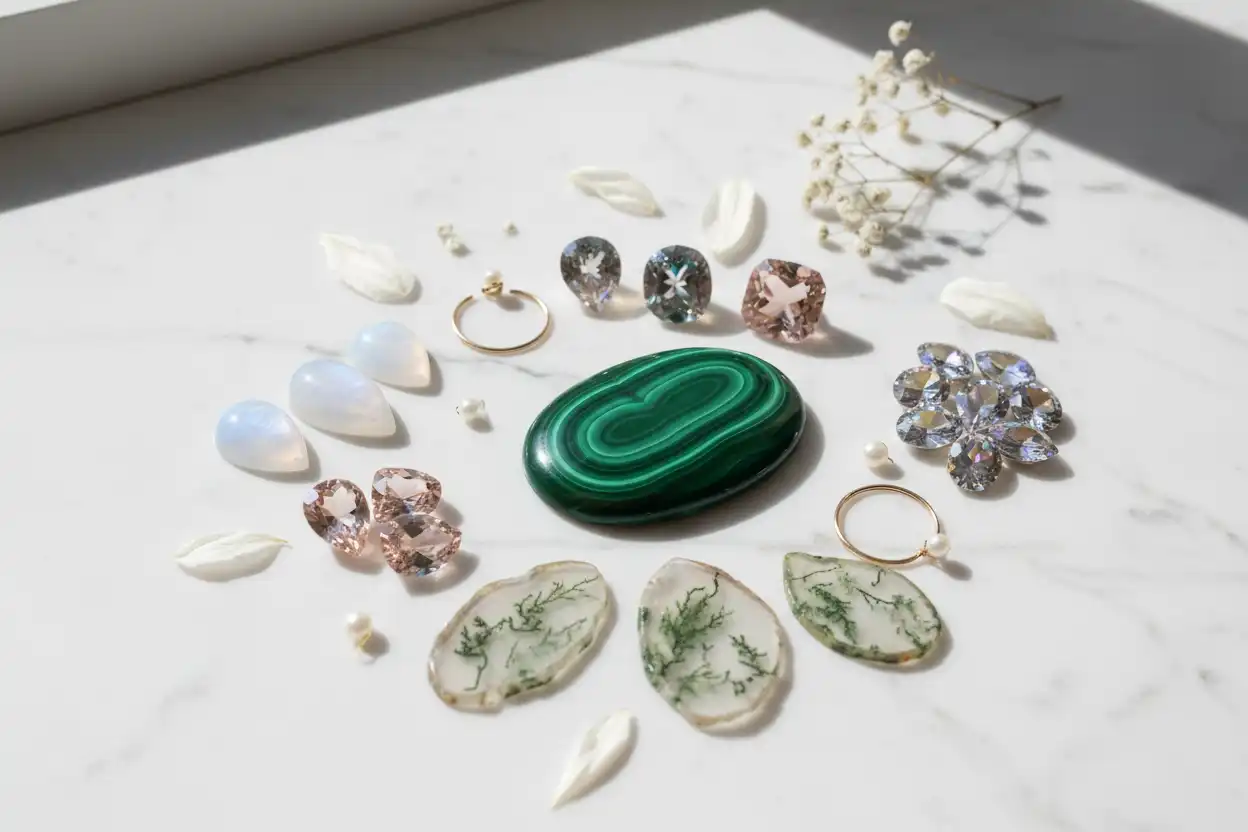
Gemstones and gem materials that start with M include magnesite, mahogany obsidian, malachite, mangano calcite, marble, marcasite, merlinite, meteorite, moissanite, moldavite, mookaite, moonstone, morganite, moss agate, mother of pearl, musgravite and mystic topaz.
This group includes natural minerals, rocks, volcanic and impact glass, organic gem material, extraterrestrial material and laboratory-created gemstones.
Traditional meanings are symbolic associations rather than scientifically proven medical effects.
Continue from Gemstones That Start With L. For a wider specimen-focused list, explore Crystals That Start With M.
M Gemstones at a Glance
| Gemstone or material | Typical appearance | Material type | Common use |
|---|---|---|---|
| Magnesite | White, cream, gray or dyed blue | Carbonate mineral | Beads and cabochons |
| Mahogany Obsidian | Black glass with reddish-brown patches | Volcanic glass | Cabochons and carvings |
| Malachite | Vivid green with light and dark bands | Copper carbonate mineral | Cabochons and inlay |
| Mangano Calcite | Pale pink to rose | Manganese-bearing calcite | Carvings and protected jewelry |
| Marble | White, gray, green or patterned | Metamorphic rock | Carvings and decorative jewelry |
| Marcasite | Pale brass to silver metallic | Iron sulfide mineral | Collector gems and antique-style jewelry |
| Merlinite | White or gray with black dendritic patterns | Variable trade-named material | Cabochons and pendants |
| Meteorite | Metallic, stony or mixed | Extraterrestrial material | Rings, pendants and inlay |
| Moissanite | Colorless or colored with strong brilliance | Laboratory-grown silicon carbide | Fine everyday jewelry |
| Moldavite | Olive to bottle-green natural glass | Tektite | Pendants and collector jewelry |
| Mookaite | Red, yellow, cream or purple | Australian lapidary stone | Cabochons and beads |
| Moonstone | White, peach, gray or rainbow-flashing | Feldspar gem | Rings, earrings and pendants |
| Morganite | Pink, peach or salmon | Beryl gemstone | Fine jewelry |
| Moss Agate | Clear or milky with green inclusions | Chalcedony variety | Rings and cabochons |
| Mother of Pearl | White, cream, pink or dark iridescence | Organic nacre | Inlay, beads and earrings |
| Musgravite | Gray-green, violet or blue-green | Rare taaffeite-group gemstone | Collector jewelry |
| Mystic Topaz | Rainbow-coated colorless topaz | Coated gemstone | Faceted fashion jewelry |
Magnesite
Magnesite is a magnesium carbonate mineral commonly found in:
- White.
- Cream.
- Gray.
- Brown.
- Pale yellow.
- Veined or webbed material.
It is traditionally associated with calm, patience and honest self-reflection.
Magnesite is frequently dyed blue or green to imitate turquoise. Dye may collect inside cracks, drill holes and porous areas.
Its softness and acid sensitivity make it better suited to beads and pendants than everyday rings.
Mahogany Obsidian
Mahogany obsidian is natural volcanic glass with black and reddish-brown patches.
The warm coloring is associated with iron-rich areas within the glass.
It is traditionally linked with:
- Strength.
- Protection.
- Grounding.
- Determination.
- Practical problem-solving.
Mahogany obsidian is commonly cut into cabochons, beads, spheres and carvings.
It is glass rather than a mineral crystal and can fracture into sharp edges. Related patterns are covered in Types of Obsidian.
Malachite
Malachite is a copper carbonate hydroxide mineral known for vivid green banding.
Its patterns may include:
- Concentric circles.
- Wavy lines.
- Light and dark stripes.
- Eye-like formations.
- Irregular swirls.
Malachite is traditionally associated with transformation, personal responsibility and emotional honesty.
It is widely used for cabochons, beads, carvings and inlay.
Malachite can resemble azurite-malachite mixtures and manufactured resin. Malachite vs. Azurite explains the differences.
Avoid acids, prolonged soaking and dust from cutting or grinding.
Mangano Calcite
Mangano calcite is manganese-bearing calcite with pale pink, rose or peach color.
It may appear:
- Cloudy.
- Translucent.
- Banded.
- Waxy when polished.
- Fluorescent under ultraviolet light.
Mangano calcite is traditionally associated with compassion, patience and emotional gentleness.
Like other calcite varieties, it is soft and acid-sensitive. It works best in carvings, pendants and protected earrings rather than rings exposed to impact.
Marble
Marble is a metamorphic rock formed mainly from recrystallized carbonate minerals.
It may occur in:
- White.
- Gray.
- Pink.
- Green.
- Black.
- Strongly veined patterns.
Marble is traditionally associated with stability, refinement and long-term achievement.
Decorative marble is used in carvings, beads, cameos and architectural objects.
Most marble is vulnerable to acids and may scratch more easily than quartz-rich materials. Mild, non-acidic cleaning is preferable.
Marcasite
Marcasite is an iron sulfide mineral with the same chemical formula as pyrite but a different crystal structure.
It may form:
- Spear-like crystals.
- Radiating groups.
- Cockscomb formations.
- Pale brass metallic surfaces.
Marcasite is traditionally associated with discipline, resilience and practical judgment.
True marcasite can deteriorate in humid conditions. Much antique-style “marcasite jewelry” actually uses small faceted pyrite stones because pyrite is more stable.
Store iron sulfide jewelry in dry conditions and monitor it for powder, cracking or unusual odor.
Merlinite
Merlinite is a commercial name commonly used for pale stone with black or dark branching inclusions.
Depending on the seller, the name may refer to:
- Dendritic opal.
- Dendritic agate.
- Other patterned chalcedony.
- Mixed or trade-named material.
Merlinite is traditionally associated with balance, insight and integrating different perspectives.
Because the name does not identify one mineral species, buyers should ask what the host material actually is.
Durability and cleaning requirements depend on whether the piece is opal, chalcedony or another stone.
Meteorite
Meteorites are natural objects from space that survive atmospheric entry and reach Earth’s surface.
Major categories include:
- Stony meteorites.
- Iron meteorites.
- Stony-iron meteorites.
Meteorite is traditionally associated with perspective, exploration and endurance.
Iron meteorites are used in rings, pendants and watch components. Some show distinctive etched patterns when properly cut and treated.
Meteorite material can rust after exposure to moisture, salts and skin oils. Industrial slag and manufactured metal are also commonly misrepresented as meteorites.
Moissanite
Moissanite is silicon carbide.
Natural moissanite is extremely rare, while jewelry-grade material is normally laboratory-created.
Moissanite is valued for:
- Strong brilliance.
- High fire.
- Good scratch resistance.
- Availability in large sizes.
- Lower cost than many diamonds.
It is traditionally associated with innovation, confidence and modern commitment.
Moissanite is not diamond, although the two can look similar. Moissanite vs. Diamond compares their optical properties, durability and origin.
It is suitable for engagement rings and other frequently worn jewelry.
Moldavite
Moldavite is a natural green tektite formed during a meteorite impact in Central Europe.
It commonly appears:
- Olive green.
- Bottle green.
- Yellow-green.
- Brownish green.
- Pitted or sculpted.
Moldavite is traditionally associated with transformation, major change and new direction.
It is natural glass rather than a mineral crystal.
Imitations are widespread. Real vs. Fake Moldavite explains how surface texture, bubbles, color and provenance can help with evaluation.
Moldavite can chip under impact and benefits from protective settings.
Mookaite
Mookaite is an Australian lapidary stone known for rich earth tones.
Its colors include:
- Red.
- Mustard yellow.
- Cream.
- Purple.
- Brown.
- White.
Mookaite is traditionally associated with adaptability, confidence and exploration.
It is widely cut into beads, cabochons and carvings.
The commercial name is sometimes expanded to “mookaite jasper,” although the geological material may be described more specifically as a silica-rich sedimentary stone.
Natural fractures and contrasting areas should be checked before drilling or setting.
Moonstone
Moonstone is a feldspar gem valued for adularescence—a floating glow that appears to move beneath its surface.
Its body colors include:
- White.
- Cream.
- Peach.
- Gray.
- Brown.
- Colorless.
Moonstone is traditionally associated with intuition, new beginnings and emotional awareness.
It is used in rings, earrings and pendants, but feldspar cleavage makes impact protection important.
Moonstone may be confused with opal or glass. Moonstone vs. Opal compares their optical effects and material properties.
Morganite
Morganite is the pink to peach variety of beryl.
Its colors range from:
- Pale pink.
- Peach.
- Salmon.
- Rose.
- Pinkish orange.
Morganite is traditionally associated with affection, compassion and calm communication.
Its hardness makes it suitable for rings and fine jewelry, although surface-reaching fractures still matter.
Heat treatment is common and may reduce yellow or orange tones. Morganite vs. Rose Quartz explains how these pink stones differ.
Moss Agate
Moss agate is translucent or milky chalcedony containing green, brown or black inclusions that resemble moss, branches or landscapes.
The inclusions are minerals rather than actual plant material.
Moss agate is traditionally associated with:
- Growth.
- Patience.
- Stability.
- Connection with nature.
- Gradual prosperity.
Its chalcedony toughness makes it suitable for rings, pendants, beads and carvings.
Thin slices and stones with open cavities still require edge protection.
Mother of Pearl
Mother of pearl is the iridescent nacre lining produced inside certain mollusk shells.
It is an organic gem material rather than a mineral.
Colors include:
- White.
- Cream.
- Silver.
- Pink.
- Green.
- Dark gray.
- Multicolored iridescence.
Mother of pearl is traditionally associated with protection, calm and nurturing.
It is used for inlay, beads, earrings, pendants and decorative watch faces.
Its varieties are explained in Types of Mother of Pearl.
Keep it away from acids, perfume, heat and abrasive cleaning.
Musgravite
Musgravite is an exceptionally rare gemstone within the taaffeite mineral group.
It may appear:
- Gray-green.
- Olive.
- Violet-gray.
- Blue-green.
- Nearly colorless.
Musgravite is traditionally associated with individuality, persistence and recognizing uncommon opportunities.
Transparent facetable material is extremely scarce. High-value stones require reliable laboratory identification because appearance alone cannot separate musgravite from similar gems.
Rarity, clarity, color and size are discussed in the musgravite price guide.
Mystic Topaz
Mystic topaz is colorless natural topaz treated with a thin surface coating that creates rainbow colors.
The stone may flash:
- Purple.
- Green.
- Blue.
- Pink.
- Gold.
- Teal.
Mystic topaz is traditionally associated with creativity, adaptability and self-expression.
The coating is less durable than the topaz beneath it and can be scratched or removed by polishing, abrasion and harsh chemicals.
The process is covered in How to Spot Treated Topaz.
Which M Gemstones Are Best for Jewelry?
Good choices for frequent wear include:
- Moissanite.
- Morganite.
- Moss agate.
- Moonstone in a protected setting.
- Musgravite in specialist jewelry.
- Mystic topaz with careful coating protection.
Good choices for casual or protected jewelry include:
- Malachite.
- Mookaite.
- Mahogany obsidian.
- Meteorite.
- Mother of pearl.
- Magnesite.
Marcasite, mangano calcite and marble require more cautious handling.
Understanding M Material Types
The M directory contains several distinct categories:
- Malachite, magnesite and calcite are minerals.
- Marble and mookaite are rocks.
- Mahogany obsidian and moldavite are natural glasses.
- Mother of pearl is organic nacre.
- Meteorite is extraterrestrial material.
- Moissanite is normally laboratory-created.
- Mystic topaz is a coated natural gemstone.
- Merlinite is a variable trade name.
These categories affect durability, authenticity testing and care. The distinctions are explained in the types of gemstones guide.
Care Guide for M Gemstones
- Keep magnesite, calcite and marble away from acids.
- Avoid malachite dust and prolonged soaking.
- Protect obsidian and moldavite from edge impacts.
- Store iron meteorites in dry conditions.
- Keep mother of pearl away from perfume and household chemicals.
- Protect moonstone from sharp blows.
- Clean moissanite according to its setting and mounting metal.
- Avoid polishing or abrasive cleaning on mystic topaz.
- Confirm the underlying material before cleaning trade-named merlinite.
Frequently Asked Questions
What is the most valuable gemstone that starts with M?
Fine musgravite can be exceptionally valuable because transparent facetable stones are extremely rare. High-quality morganite and moissanite occupy more accessible markets.
Which green gemstones start with M?
Malachite, moldavite, moss agate and some musgravite specimens are notable green examples.
Is moissanite a diamond?
No. Moissanite is silicon carbide, while diamond is crystalline carbon.
Is moldavite a meteorite?
No. Moldavite is terrestrial glass formed during a meteorite impact.
Is mother of pearl a crystal?
No. It is organic nacre produced by mollusks.
Is marcasite jewelry made from real marcasite?
Many pieces sold as marcasite jewelry contain faceted pyrite because true marcasite is less stable.
Is moonstone suitable for everyday rings?
It can be worn in rings, but feldspar cleavage makes protective settings and careful wear important.
Is mystic topaz naturally rainbow-colored?
No. Its rainbow effect comes from an applied surface coating.
Continue the Gemstone Alphabet
Continue with Gemstones That Start With N, or browse every directory through the Crystals 101 collection.