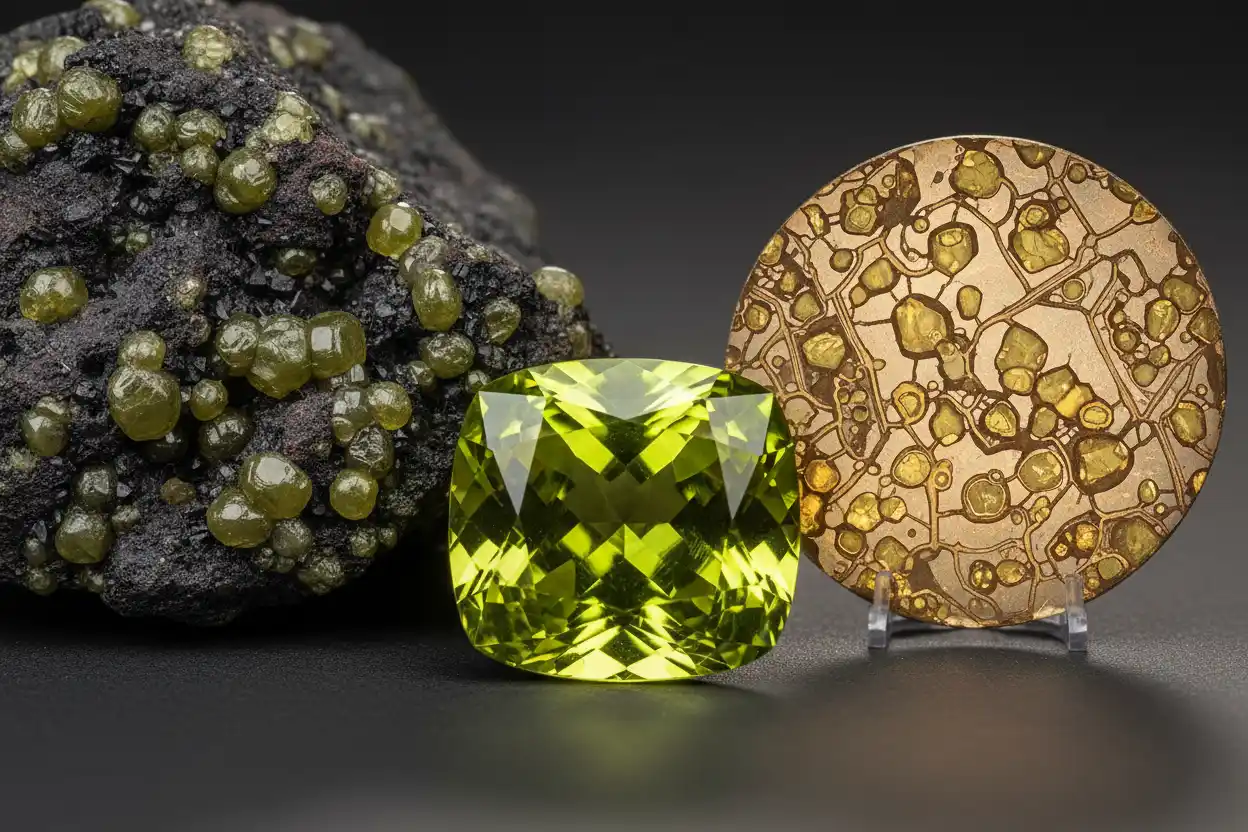
Olivine Types, Properties, Identification & Meaning
Olivine is a mineral group and compositional series of magnesium-, iron-, manganese-, calcium-, and nickel-bearing orthosilicates. In ordinary rocks and gemstones, the name most often refers to compositions between magnesium-rich forsterite and iron-rich fayalite.
Green gem-quality material from the magnesium-rich side of that series is called peridot. Therefore, all natural peridot belongs to the olivine group, but most olivine is too included, fractured, iron-rich, altered, or fine-grained to be sold as a transparent gemstone.
Olivine at a Glance
| Property | Olivine group |
|---|---|
| Material type | Mineral group and solid-solution series |
| Common rock-forming composition | (Mg,Fe)₂SiO₄ |
| Principal end members | Forsterite, Mg₂SiO₄, and fayalite, Fe₂SiO₄ |
| Other group members | Tephroite, monticellite, kirschsteinite, calcio-olivine, and related minerals |
| Common colors | Olive green, yellow-green, brown-green, yellow, brown, gray, black, colorless, and reddish brown |
| Crystal system | Orthorhombic |
| Typical habit | Short prismatic, tabular, granular, rounded grains, nodules, massive aggregates, and embedded crystals |
| Luster | Vitreous |
| Transparency | Transparent to opaque |
| Mohs hardness | Commonly approximately 6.5–7 |
| Cleavage | Poor to indistinct; fracture commonly conchoidal or uneven |
| Tenacity | Brittle |
| Specific gravity | Roughly 3.2 in magnesium-rich compositions, increasing toward more than 4 in iron-rich fayalite |
| Common uses | Peridot gemstones, mineral specimens, refractory sand, foundry applications, abrasives, slag conditioning, and geological research |
| Main care concern | Edge chipping, surface abrasion, rapid alteration in some environments, heat, acids, and confusion between olivine, peridot, glass, and other green minerals |
Olivine Is a Group, Not One Fixed Mineral
The word olivine is used in two related ways. Geologists often apply it to intermediate compositions in the forsterite-fayalite solid-solution series, while mineral classification uses the term for a wider structural group.
Forsterite is the magnesium end member, Mg₂SiO₄. Fayalite is the iron end member, Fe₂SiO₄.
Magnesium and iron substitute for one another without changing the basic orthorhombic structure. A natural crystal can therefore contain both in varying proportions.
Compositions are commonly written with Fo and Fa numbers. Fo₉₀, for example, contains approximately 90 mole percent forsterite component and 10 percent fayalite component.
Most mantle and gem olivine is magnesium rich. Nearly pure fayalite occurs in more iron-rich igneous, metamorphic, and industrially altered environments.
The wider group also includes manganese-rich tephroite and calcium-bearing species. Consequently, not every olivine-group mineral has the simplified formula (Mg,Fe)₂SiO₄.
Forsterite
Forsterite is the most common mineral species in the olivine group. Its ideal composition is Mg₂SiO₄.
Pure forsterite is colorless, but natural crystals commonly contain iron, nickel, chromium, and other elements that create pale green, yellow-green, olive, or brownish colors.
Forsterite dominates much of Earth’s upper mantle and occurs in peridotite, dunite, basalt xenoliths, magnesium-rich metamorphic rocks, skarns, and some meteorites.
Gem-quality transparent green forsterite is sold as peridot. The trade name normally applies only to attractive facetable material rather than every magnesium-rich olivine crystal.
Collector forsterite may appear as sharp crystals in marble, basalt, or metamorphic matrix. Pakistan’s Sapat Valley has produced especially notable transparent green crystal specimens.
Fayalite
Fayalite is the iron end member, Fe₂SiO₄. It is denser and generally darker than forsterite.
Colors include yellow-brown, green-brown, dark brown, gray, and black. Transparent facetable material is extremely uncommon.
Fayalite forms in iron-rich, comparatively silica-poor igneous rocks, certain granites, volcanic rocks, metamorphosed iron formations, slags, and other specialized environments.
Increasing iron content raises refractive index and density while generally shifting color away from the bright yellow-green associated with peridot.
Fayalite alters readily under surface conditions. Oxidation and hydration can produce iron oxides, clays, silica, and other secondary minerals.
A dark olivine crystal cannot be identified confidently as fayalite from color alone. Chemical analysis is needed to establish its position within the series.
Other Olivine-Group Minerals
Tephroite is the manganese end member, Mn₂SiO₄. It commonly appears gray, brown, reddish, or olive and occurs in manganese-rich metamorphic deposits.
Monticellite, CaMgSiO₄, contains calcium and magnesium. It forms in skarns, marbles, and high-temperature contact-metamorphic environments.
Kirschsteinite, CaFeSiO₄, is the iron analogue of monticellite and occurs in specialized igneous, metamorphic, and extraterrestrial settings.
These species share the olivine structure but do not form one unrestricted solid solution across every composition.
The present family guide introduces the group without taking over the detailed mineralogy that a future dedicated end-member page would need.
How Olivine Forms in Earth’s Mantle
Olivine is a major mineral of the upper mantle. It crystallizes under high temperatures in magnesium- and iron-rich rocks such as peridotite and dunite.
Mantle material rarely reaches the surface directly. Volcanic eruptions can carry pieces upward as xenoliths enclosed within basalt, kimberlite, or other rapidly ascending magma.
These xenoliths may contain olivine with pyroxene, spinel, garnet, and other mantle minerals. Green grains embedded in dark basalt are common collector examples.
Olivine also crystallizes directly from mafic and ultramafic magma. Early-formed crystals may settle and accumulate into olivine-rich layers.
Dunite consists mainly of olivine, while peridotite commonly combines olivine with pyroxenes and accessory spinel or garnet.
The related diopside guide covers one of the pyroxene minerals frequently associated with olivine in mantle rocks.
Olivine in Basalt and Volcanic Bombs
Basalt can carry individual olivine phenocrysts, granular clusters, or mantle-derived nodules.
As lava cools, bright green grains may remain visible against a dark volcanic groundmass. Some grains formed within the magma, while others arrived as fragments of deeper rock.
Volcanic bombs and cinders can contain rounded olivine nodules. Weathering may release the grains into soil, stream sediment, or green sand.
Hawaiian green-sand beaches contain olivine grains concentrated as lighter volcanic material is removed by waves. These grains are usually small and mixed with basaltic fragments rather than commercial peridot gems.
Olivine weathers more rapidly than quartz at Earth’s surface. Long exposure to water, oxygen, and carbon dioxide alters it to serpentine minerals, iron oxides, carbonates, clays, and silica-rich products.
Olivine in Metamorphic Rocks
Magnesium-rich limestone and dolostone can react with silica during contact metamorphism, producing forsterite.
The mineral may occur with calcite, dolomite, spinel, phlogopite, diopside, humite-group minerals, and other high-temperature phases.
Transparent crystals in marble can produce important collector specimens. However, marble-hosted olivine may alter along fractures or crystal edges.
Serpentinization transforms olivine and pyroxenes into serpentine, magnetite, brucite, and related products through reaction with water.
Pseudomorphs can retain the shape of an original olivine crystal even after much of the material has changed. A green crystal shape therefore does not prove that fresh olivine remains inside.
Olivine Beyond Earth
Olivine occurs in meteorites, asteroids, planetary mantles, comet dust, and cosmic dust.
Pallasite meteorites contain olivine crystals embedded in iron-nickel metal. Some crystals are transparent enough to facet, although they may contain fractures and metal-related alteration.
The broader classification and preservation of these objects belongs on the meteorite guide.
Olivine has also been detected in samples returned from comet dust and in observations of planetary and circumstellar material.
These discoveries reflect the mineral’s fundamental role in high-temperature silicate systems. They do not mean that ordinary commercial peridot necessarily came from space.
Extraterrestrial faceted peridot is exceptionally rare and requires documented meteorite provenance.
What Is Peridot?
Peridot is the yellow-green to green gem variety of magnesium-rich olivine, usually forsterite-dominant material containing enough iron to create its characteristic color.
The color is idiochromatic, meaning that iron is part of the mineral’s essential composition rather than a random impurity added to an otherwise colorless host.
Fine peridot is transparent, eye-clean, and evenly colored. Brownish or overly dark material generally contains more iron or unfavorable absorption.
The peridot page should own gem-specific formation, color, history, symbolism, localities, and market intent. Likewise, current valuation belongs on the peridot price guide, and detailed seller evaluation belongs on the peridot buying guide.
Peridot is the principal reason olivine appears in mainstream jewelry, but it represents only a small fraction of the mineral group.
Color Causes
Iron controls much of the green-to-brown color in common olivine. A moderate amount of ferrous iron produces the yellow-green associated with peridot.
As iron content increases, the crystal can become deeper olive, brown-green, brown, or nearly black.
Nickel may contribute subtle green coloration in some magnesium-rich olivines. Chromium can also influence color in certain deposits.
Alteration changes appearance significantly. Iddingsite is a reddish-brown alteration mixture that commonly replaces olivine in volcanic rocks.
Iron-oxide staining can coat fractures and crystal surfaces. Meanwhile, serpentine alteration may turn fresh olive-green grains dull green, yellow-green, or cloudy.
Bright artificial blue, purple, or neon-green “olivine” should be treated cautiously. Such colors may indicate glass, synthetic material, coating, or another mineral.
Crystal Habit and Physical Properties
Olivine crystallizes in the orthorhombic system. Well-formed crystals may be short prismatic, blocky, tabular, or wedge-shaped.
More commonly, it occurs as rounded grains or irregular granular masses within rock.
Fresh surfaces have vitreous luster. Transparent crystals show strong double refraction, which may cause the rear facet edges of a cut peridot to appear doubled under magnification.
Cleavage is poor or indistinct, although some compositions show weak planes. Fracture is commonly conchoidal or uneven.
Hardness falls around 6.5–7. Iron-rich members may differ somewhat in hardness and density from magnesium-rich forsterite.
The gemstone hardness chart places gem olivine near quartz, while gemstone toughness versus hardness explains why its brittle nature still matters.
Important Olivine and Peridot Localities
Zabargad Island in Egypt’s Red Sea is a historic peridot source. Its crystals supplied ancient and later European gem collections.
The Sapat Valley in Pakistan produces transparent lime-green crystals, including sharp mineral specimens and faceting rough.
Myanmar has yielded large peridot from the Mogok region. Some crystals produce substantial faceted stones with rich green color.
The San Carlos Apache Reservation in Arizona supplies abundant basalt-hosted peridot grains and nodules. Material is commonly smaller but commercially important.
China, Vietnam, Tanzania, Kenya, Norway, Brazil, Australia, Mexico, Ethiopia, and several other countries produce gem or collector olivine.
Pallasites provide extraterrestrial material, but their market belongs partly to meteorite collecting rather than conventional gemstone mining.
A source claim should be supported by reliable supply-chain information. Color alone cannot establish Pakistani, Burmese, Arizona, Egyptian, or meteorite origin.
How to Identify Olivine
Fresh olivine commonly has an olive-green to yellow-green color and vitreous luster. Nevertheless, color alone overlaps with epidote, diopside, garnet, glass, tourmaline, and several other materials.
Its hardness is greater than ordinary glass in many cases, but destructive testing is unsuitable for a finished gem.
Specific gravity varies strongly with iron content. Magnesium-rich peridot is commonly near 3.3, while iron-rich fayalite can exceed 4.
Strong birefringence is useful in transparent cut stones. Looking through the crown toward the pavilion may reveal doubled facet junctions.
Refractive index also rises with iron content. Gem laboratories combine refractive index, birefringence, density, absorption spectra, magnification, and chemistry.
In rock specimens, olivine commonly lacks obvious cleavage and shows irregular fractures. Altered edges, reddish iddingsite, and association with basalt or peridotite provide additional clues.
Raman spectroscopy, X-ray diffraction, electron-microprobe analysis, and other methods can determine species and composition.
The workflow in how to identify crystals helps distinguish preliminary clues from conclusive mineral testing.
Olivine Lookalikes
Chrome diopside can display a strong green color, but it has different cleavage, optical properties, chemistry, and typical hue. Its specific gem characteristics are covered in the chrome diopside guide.
Green garnet can resemble fine peridot, although garnet is singly refractive and often denser.
Green tourmaline commonly shows stronger pleochroism and different refractive behavior. It may also form elongated striated crystals unlike most olivine.
Glass can reproduce peridot’s yellow-green color and may contain round bubbles or flow lines. However, high-quality glass requires instrument testing rather than visual assumptions.
Prasiolite is green quartz and has lower refractive index, lower birefringence, and a cooler, often less yellow hue. The full distinction appears in prasiolite versus peridot.
Emerald is chromium- or vanadium-bearing beryl. Its inclusions, optical properties, color character, and market differ, as explained in peridot versus emerald.
Jewelry Suitability
Gem-quality olivine is suitable for earrings, pendants, necklaces, bracelets, brooches, and carefully worn rings.
Its hardness resists moderate abrasion but does not equal sapphire or diamond. Quartz dust can also gradually affect heavily worn surfaces.
Olivine is brittle. Thin girdles, sharp corners, surface-reaching inclusions, and high settings increase chipping risk.
A bezel or protective halo helps a ring survive everyday use. Pears, marquises, and other pointed shapes need secure protection.
The dedicated peridot ring guide owns setting and lifestyle choices for rings.
Lower-impact formats are covered separately in the peridot earrings guide, peridot necklace guide, and peridot bracelet guide.
Treatments, Synthetics, and Imitations
Natural peridot and olivine are commonly sold without routine color treatment. Their green color generally does not need heating or irradiation.
Oiling or resin filling may be used occasionally on fractured material, although it is not considered a defining commercial treatment.
Surface coating can create stronger color or an artificial effect. Foil-backed settings may also intensify a pale stone.
Synthetic forsterite has been produced for industrial and research purposes, and synthetic crystals can enter the gem market. Laboratory identification may be needed when origin matters.
Green glass, cubic zirconia, synthetic spinel, synthetic sapphire, and other gems can imitate peridot.
Assembled stones can place a green layer between transparent components. Glue lines, bubbles, mismatched refractive behavior, and separation may reveal the construction.
A seller using “created peridot” ambiguously should clarify whether the product is synthetic olivine, green glass, or another simulant.
Current Olivine Asking Prices
Olivine spans inexpensive geological specimens, fine collector crystals, industrial material, and gem-quality peridot.
| Olivine product | Broad retail asking range |
|---|---|
| Small basalt-hosted grain or educational specimen | About $3–$15 |
| Olivine nodule or peridotite specimen | About $10–$60 |
| Attractive forsterite crystal | About $25–$200 |
| Fine transparent crystal on matrix | About $150–$1,000 or more |
| Small commercial faceted peridot | About $20–$100 per carat |
| Fine larger peridot | About $100–$500 per carat or more |
| Exceptional large or documented-origin gem | Individually priced |
| Facetable pallasitic olivine | Highly variable and dependent on meteorite provenance |
These figures represent broad retail asking prices rather than formal valuations or guaranteed resale results.
Peridot’s value changes rapidly with color, clarity, cut, size, and source. Detailed current ranges should be taken from the dedicated price page rather than extrapolated from common olivine rough.
What Gives Olivine Value?
Species and composition matter for collectors. A documented forsterite or fayalite crystal carries more information than a generic olivine label.
Crystal form affects mineral specimens. Sharp complete crystals are less common than rounded grains and broken granular masses.
Transparency, color, and inclusion condition determine gem value. Fine peridot should display lively yellow-green to green color without excessive brown.
Size becomes important because large clean crystals are much scarcer than small commercial stones.
Cut controls brilliance, windowing, extinction, doubling visibility, symmetry, and face-up appearance.
Origin can add interest when documented. Sapat Valley crystals, Zabargad material, Burmese gems, San Carlos peridot, and pallasitic olivine occupy different collector markets.
Treatment disclosure and laboratory reporting become increasingly important for high-value or extraterrestrial claims.
Buying Olivine
Determine whether the item is common olivine rough, a mineral specimen, gem-quality peridot, a pallasite slice, or an olivine-bearing rock.
Ask for a specific mineral identification when a specimen is priced as forsterite, fayalite, or another group member.
For faceted stones, evaluate color under neutral light. Strong warm lighting can make yellow-green material look more saturated.
Inspect doubled facet junctions, chips, fractures, polishing marks, and dark inclusions. Doubling supports peridot identification but should not replace full testing.
A meteorite-origin stone needs documented meteorite provenance, not merely a seller’s statement that olivine also occurs in space.
General peridot buying criteria, reports, treatments, and seller policies belong on the peridot buying guide.
Olivine appears in both the crystals beginning with O directory and the gemstones beginning with O directory.
Cleaning and Storage
Clean a stable olivine or peridot gemstone with lukewarm water, mild soap, and a soft brush.
Avoid ultrasonic and steam cleaning. Internal fractures, fillings, and sudden temperature changes can create damage.
Do not expose the stone to acids or aggressive household chemicals. Olivine can be attacked chemically, while metal settings and fillers may react sooner.
Rinse briefly and dry the jewelry thoroughly. Repeated long soaking is unnecessary.
Store olivine separately from sapphire, ruby, topaz, diamond, and other harder stones. A divided jewelry box protects facet edges.
Professional prong inspection is appropriate for frequently worn rings, particularly when the stone sits high above the hand.
Detailed jewelry instructions appear in how to clean peridot jewelry.
Olivine Meaning and Symbolism
Olivine’s olive-green color has inspired modern associations with growth, renewal, resilience, and adapting to changing conditions.
Its abundance in Earth’s mantle encourages symbolism involving foundations, depth, stability, and forces operating beneath the visible surface.
The forsterite-fayalite series can also serve as a metaphor for continuity. Natural materials do not always fit into sharply separated categories.
Gem-quality peridot carries a longer cultural history than ordinary olivine specimens. Its role as the modern August birthstone is covered in the August birthstone guide.
Modern crystal traditions often connect olivine and peridot with confidence, generosity, emotional release, and prosperity. The metaphysical search intent belongs more fully on the dedicated peridot healing-properties page.
These meanings remain cultural, spiritual, artistic, or personal interpretations. Scientific evidence does not show that olivine treats disease, guarantees wealth, or produces specific psychological outcomes.
Frequently Asked Questions
Is olivine one mineral?
Olivine is both a mineral-group name and a common name for intermediate members of the forsterite-fayalite solid-solution series.
What are the two main olivine end members?
Forsterite is the magnesium end member, Mg₂SiO₄, while fayalite is the iron end member, Fe₂SiO₄.
Is peridot the same as olivine?
Peridot is transparent yellow-green to green gem-quality magnesium-rich olivine. Most olivine is not gem-quality peridot.
What gives olivine its green color?
Ferrous iron within the crystal structure produces most yellow-green and olive coloration. Nickel, chromium, and alteration can modify the appearance.
Where does olivine form?
It forms in Earth’s mantle, mafic and ultramafic magma, basalt, peridotite, metamorphosed magnesium-rich rocks, meteorites, and other high-temperature environments.
Why is olivine common in the mantle but less stable at Earth’s surface?
Olivine forms under high-temperature mantle conditions. At the surface, water, oxygen, and carbon dioxide promote alteration to serpentine, iron oxides, clays, and carbonates.
Can olivine come from meteorites?
Yes. Olivine occurs in several meteorite types, including pallasites. Extraterrestrial origin requires documented meteorite provenance.
How can olivine be distinguished from green glass?
Olivine has higher birefringence, characteristic optical measurements, and different density. Glass may show bubbles or flow lines but can require laboratory testing.
Is olivine suitable for an everyday ring?
Gem-quality material can be worn in a protected setting, although brittleness and moderate hardness require more care than sapphire or diamond.
Is natural olivine normally treated?
Most commercial peridot is untreated. Occasional filling, coating, assembly, and imitation still require disclosure.
Can olivine be cleaned in an ultrasonic machine?
Warm soapy water is safer. Ultrasonic vibration and steam should be avoided when fractures, inclusions, treatments, or setting weaknesses are possible.
What makes an olivine specimen valuable?
Confirmed species, crystal form, transparency, color, size, condition, matrix aesthetics, locality, provenance, and rarity determine collector value.
Olivine connects deep-Earth geology, volcanic rocks, meteorites, industrial minerals, and fine jewelry within one structural family. Readers whose primary interest is the transparent gem can continue with the dedicated peridot guide without repeating the entire group-level mineralogy.