Serendibite: Meaning, Properties & Symbolism
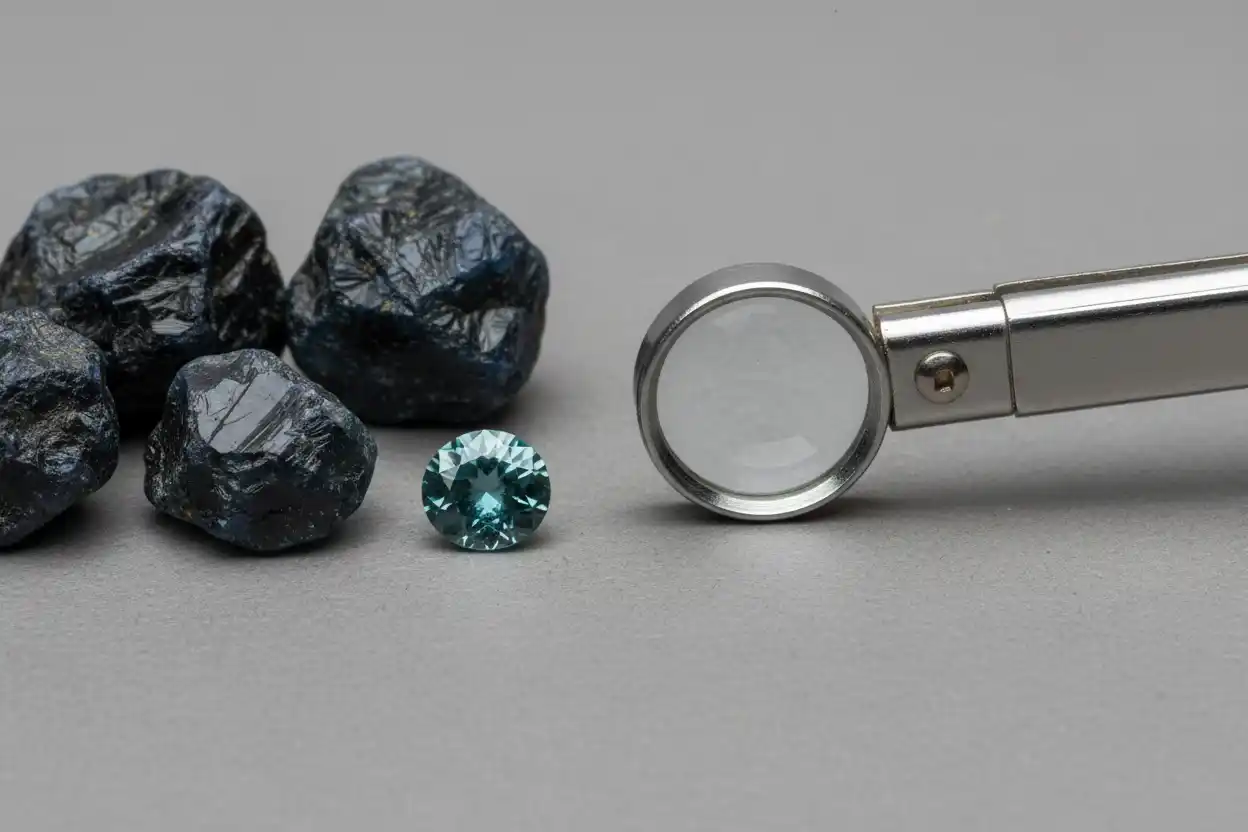
Serendibite is a rare calcium-magnesium-aluminum borosilicate that crystallizes in the triclinic system and usually occurs as dark, opaque grains in high-temperature calc-silicate rocks. Exceptionally, it produces transparent blue-green material with strong trichroism, making fine faceted stones some of the least commonly encountered gems in the specialist market.
Its rarity has also made the name vulnerable to exaggeration and misidentification. Large inexpensive stones offered without laboratory reports should not be assumed to match the scarce transparent material documented from Sri Lanka and Myanmar.
Serendibite at a Glance
| Property | Serendibite |
|---|---|
| Composition | Complex calcium-magnesium-aluminum borosilicate, commonly represented approximately as Ca₂(Mg,Al)₆(Si,Al,B)₆O₂₀ |
| Group or type | Borosilicate; aenigmatite-rhönite mineral group |
| Color | Pale yellow, grey-blue, blue-green, green-blue, dark blue, blue-black, greenish black, black |
| Crystal system or texture | Triclinic |
| Habit | Granular, massive, anhedral grains; rare blocky or tabular crystals |
| Luster | Vitreous to subvitreous |
| Transparency | Transparent to opaque |
| Mohs hardness | Approximately 6.5–7 |
| Cleavage | Distinct to good in at least one direction |
| Tenacity | Brittle |
| Common uses | Rare faceted collector gems, mineral specimens, research material |
| Primary care concern | Cleavage, brittleness, fractures, uncertain identification, and scarcity of replacement stones |
What Is Serendibite?
Serendibite is a boron-bearing silicate containing calcium, magnesium, aluminum, silicon, oxygen, and variable iron and other minor elements. Its chemistry is complex because several elements can substitute across multiple structural sites.
The mineral was named for Serendib, an old name for Sri Lanka. Its type locality lies at Gangapitiya near Ambakotte, where the mineral was identified in a high-grade metamorphic contact zone.
Most serendibite is not transparent or suitable for jewelry. Typical material appears as dark blue-green, blue-black, or black grains embedded in calc-silicate rock.
Gem-quality examples represent a minute fraction of known material. This distinction matters because internet discussions often apply the value and rarity of transparent faceted serendibite to ordinary opaque specimens.
Serendibite belongs among specialist entries in the guide to types of gemstones. It is also indexed within crystals that start with S and gemstones that start with S.
Composition and Crystal Structure
Serendibite has one of the more complicated formulas encountered among facetable minerals. Published formulas may look different because researchers normalize the unit cell in different ways and because natural specimens vary chemically.
Calcium and sodium can occupy large structural sites. Magnesium, aluminum, and iron occur in other positions, while silicon, boron, and aluminum share parts of the silicate framework.
The mineral belongs to a structurally complex group that includes aenigmatite and rhönite. However, the presence of boron and its specific calcium-magnesium-aluminum chemistry distinguish serendibite.
Iron strongly influences optical properties and color. Low-iron gem material can appear blue-green and transparent, whereas iron-rich material is commonly dark enough to look nearly black.
Triclinic symmetry means the crystal has no right-angle requirement between its three crystallographic axes. Gem cutters and laboratories therefore encounter direction-dependent optical behavior rather than the simpler symmetry seen in cubic gems.
How Serendibite Forms
Serendibite usually forms in high-temperature, boron-bearing calc-silicate environments. Limestone or dolostone reacts with silica-, aluminum-, magnesium-, and boron-rich fluids during contact metamorphism or metasomatism.
The resulting rocks may contain spinel, sapphirine, phlogopite, calcite, diopside, forsterite, grandidierite, kornerupine, or other unusual high-grade minerals.
Granulite-facies conditions can also produce serendibite. These environments involve substantial temperature and pressure, which drive reactions between carbonate rocks and surrounding metamorphic or igneous material.
Most crystals grow as irregular grains enclosed by other minerals. Open, well-formed crystals remain uncommon because the mineral typically develops inside dense metamorphic rock rather than spacious cavities.
Weathering can release durable grains into secondary deposits. Gem-quality Sri Lankan material has been recovered from alluvial gravels around the Ratnapura gem region, where water transport rounded and concentrated fragments from their original host rocks.
The formation process belongs within the wider geological context explained in how gemstones are formed, although serendibite’s boron-rich calc-silicate setting is unusually specialized.
Serendibite Colors
Documented colors include pale yellow, greyish blue, blue-green, green-blue, deep blue, greenish black, and nearly black.
Fine transparent Sri Lankan stones may show blue-green or green-blue body color. When viewed along different crystallographic directions, the same gem can display light yellowish green, bluish green, and violetish blue.
This strong three-color pleochroism is called trichroism. Proper orientation allows a cutter to emphasize the most attractive blue-green direction while reducing grey or yellow components.
Iron in different oxidation states appears to be a major contributor to color. The balance between ferrous and ferric iron, their structural positions, and interactions with other trace elements can affect the resulting absorption.
Very dark stones may only reveal blue, green, or brown color at a thin edge under strong transmitted light. A black face-up appearance does not automatically indicate poor identity, but it greatly reduces gem appeal and value.
Serendibite can appear in comparisons involving blue gemstones and black gemstones. Nevertheless, color alone provides no reliable identification.
Crystals, Rough, and Inclusions
Serendibite commonly forms anhedral grains or massive material. Rare blocky triclinic crystals may show distorted faces and deep blue-black color.
Facetable rough is more likely to occur as small fragments or waterworn pebbles than clean euhedral crystals. Valuable transparent areas can be surrounded by dark, included, or fractured material.
Microscopic features may include:
- Polysynthetic or repeated twinning
- Parallel structural planes
- Small crystals
- Healed and unhealed fractures
- Channels or tubes
- Color zoning
- Reflective cleavage-related features
- Mineral residues from the host rock
Twinning can provide a useful identification clue under crossed polarizers. However, it should be interpreted with refractive index, spectrum, chemistry, and other evidence.
Important Serendibite Localities
Sri Lanka is historically central because the mineral was first described there and later yielded transparent facetable material. Gem-quality stones have been associated with the Ratnapura region, although precise mine-to-market documentation may be limited for alluvial finds.
Myanmar’s Mogok Stone Tract has produced dark blue to blue-green serendibite, including facetable material. Much of it is strongly saturated or nearly opaque.
Additional mineral occurrences are documented in Madagascar, Tanzania, Canada, Russia, the United States, and other regions with high-grade calc-silicate rocks.
A mineral locality does not automatically constitute a commercial gem source. Many deposits produce only microscopic grains, opaque crystals, or material embedded in rock.
Origin claims deserve caution because visual appearance rarely proves locality. For a valuable transparent gem, laboratory testing may confirm identity but may not always provide a defensible geographic-origin opinion.
Why Is Gem-Quality Serendibite Rare?
Serendibite as a mineral is uncommon, but the chain of conditions needed for a fine gemstone is narrower still.
The deposit must first develop the correct boron-bearing calc-silicate chemistry. A crystal then needs low enough iron content to transmit light, sufficient size, limited fractures, attractive color, and enough structural integrity to survive extraction and cutting.
Even transparent rough may lose most of its weight during orientation. A cutter must account for cleavage, twinning, fractures, color direction, and dark zones.
Finally, the resulting stone must be conclusively identified. A rare name without analytical evidence does not create rarity.
Serendibite belongs in discussions of the rarest gemstones in the world, but rarity claims should refer specifically to transparent, verified gem quality—not every opaque black specimen carrying the label.
Serendibite Lookalikes
Several rare and more common minerals overlap with serendibite in color.
Grandidierite is a blue-green borosilicate with strong pleochroism. Its refractive indices and density are generally lower, while its birefringence is higher.
Kornerupine can be green, brown-green, or blue-green and may occur in related metamorphic settings. It differs in structure, optical properties, and composition.
Zoisite can resemble pale blue-green material. Zoisite usually has lower refractive indices and density.
Dark spinel may look similar in rough or polished form. Spinel is cubic and singly refractive, whereas serendibite is triclinic and doubly refractive.
Sapphirine is a particularly important mineralogical lookalike because it can occur in similar high-grade rocks and show deep blue color. Laboratory spectroscopy and diffraction may be needed.
Glass, synthetic spinel, sapphire, tourmaline, and dark composite stones can also be mislabeled as serendibite in online marketplaces.
How to Identify Serendibite
Transparent serendibite cannot be authenticated from color, a photograph, or a seller’s locality story.
Gemological properties reported for fine Sri Lankan material include refractive indices around 1.696–1.702, low birefringence near 0.005, specific gravity around 3.43–3.44, biaxial optical character, and little or no ultraviolet fluorescence.
Strong trichroism can reveal light yellow-green, blue-green, and violet-blue directions. Dark material may obscure these colors.
Under magnification, twinning, fractures, and structural planes can support the identification. None is exclusive to serendibite.
Raman spectroscopy, infrared spectroscopy, X-ray diffraction, chemical analysis, and carefully interpreted absorption spectra provide far stronger evidence. A respected laboratory report is essential when a transparent stone carries a rarity-based price.
The broader how to identify crystals process explains why an uncommon mineral name requires more analytical support, not less.
Treatments and Enhancement
No standard treatment is widely accepted as routine for serendibite. Most fine material is expected to be natural in color and untreated.
That expectation does not eliminate the possibility of oil, resin, surface coating, dye, fracture filling, or undocumented experimentation. Dark surface-reaching fractures could conceal foreign material.
Heating may alter color or inclusions in some minerals, but there is no established commercial heat-treatment pipeline for serendibite comparable with sapphire or zircon.
A seller should state whether the gem has been heated, irradiated, coated, filled, oiled, dyed, stabilized, or assembled. “No known treatment” is not equivalent to laboratory confirmation.
The disclosure principles in gemstone treatments explained remain important because treatment claims can be difficult to verify in such a small market.
Synthetic Serendibite and Misrepresentation
Serendibite can be synthesized for scientific research, yet laboratory-grown gem material does not form a recognized commercial jewelry category.
The larger marketplace problem is misidentification. Dark glass, spinel, sapphire, other borosilicates, and unidentified black stones may receive the serendibite name because buyers associate it with extreme rarity.
Listings for large transparent stones at very low prices deserve particular caution. Genuine fine serendibite is unlikely to appear repeatedly in large calibrated sizes without documentation.
A report should come from an independent gemological laboratory rather than a seller-created card. The report needs to identify the material specifically, not merely describe it as a natural gemstone.
The distinction between genuine laboratory growth, simulants, and false naming is covered in lab-grown vs natural gemstones.
Cutting Behavior
Serendibite is hard enough to accept a fine polish, but cutting remains difficult because valuable rough is small, fractured, pleochroic, and scarce.
Orientation determines which color faces upward. A cutter may sacrifice considerable weight to emphasize blue-green rather than yellowish or excessively dark directions.
Cleavage and twinning increase the risk of splitting. Polishing pressure must remain controlled around thin girdles and sharp corners.
A shallow design can create a window, while excessive depth may retain weight without improving brilliance. Dark stones need enough light return to avoid appearing completely black.
Precision cutting can add substantial value when it improves color and transparency. Conversely, recutting an already documented rare gem carries serious risk because replacement rough may be impossible to obtain.
Durability and Jewelry Suitability
A hardness of 6.5–7 gives serendibite reasonable resistance to light scratching. However, hardness does not prevent cleavage or brittle fracture.
Pendants, earrings, brooches, and protected collector rings offer the safest jewelry options. A low-profile bezel can reduce edge exposure.
Daily-wear rings remain risky because a sharp blow may chip the girdle or open cleavage. The financial and practical difficulty of replacing a verified transparent stone adds to the concern.
Opaque cabochons may tolerate moderate wear better than highly included faceted gems, but identity and stability still need confirmation.
A jeweler should examine the stone before setting, resizing, or repairing the mounting. Direct torch heat and strong mechanical pressure should be avoided.
Serendibite Value and July 2026 Asking Prices
Serendibite has no stable, transparent price grid because the market combines fundamentally different materials: ordinary opaque specimens, dark faceted stones, unverified internet listings, and extremely scarce transparent gems with laboratory documentation.
As of July 2026, commercial opaque or nearly opaque pieces may be offered from under $10 to several hundred dollars per stone. One specialist dealer’s current inventory spans approximately $7 to $867 per stone, with significant variation in size and transparency.
Dark faceted material may appear around tens to hundreds of dollars per carat, but a rare name alone does not justify the price. Identity, transparency, color, cut, and documentation remain decisive.
Transparent blue-green serendibite with a respected independent report is too scarce for a dependable retail average. Specialist asking levels may reach several thousand dollars per carat, while exceptional historical examples have been quoted considerably higher.
Claims that all serendibite is automatically worth an enormous fixed amount per carat are misleading. The dedicated serendibite price guide owns the detailed valuation intent, including the difference between opaque, dark faceted, transparent, verified, and unverified material.
The broader how gemstone prices work guide explains why rarity cannot replace quality, market liquidity, and reliable identification.
Buying Serendibite
Do not buy an expensive serendibite solely from a photograph, verbal guarantee, or seller-issued certificate.
For a transparent stone, require an independent laboratory report that specifically identifies serendibite. Confirm the report number with the laboratory when possible.
Ask for weight, dimensions, transparency, color under neutral daylight, treatment disclosure, origin wording, and magnified video. A stone described as blue may appear black in ordinary lighting.
Compare dimensions with weight. An unexpectedly large, low-priced transparent stone should trigger additional verification rather than excitement.
Return rights should remain valid after independent testing. Avoid sellers who prohibit laboratory examination or pressure the buyer to accept rarity claims immediately.
Detailed purchasing channels and report checks belong on the dedicated buy serendibite page.
Rare-gem comparisons with painite, taaffeite, musgravite, and benitoite can provide context, but none supplies a direct price substitute for serendibite.
Cleaning and Storage
Clean serendibite by hand with lukewarm water, mild soap, and a soft brush. Rinse briefly and dry with a lint-free cloth.
Avoid steam, sudden temperature changes, harsh chemicals, bleach, acids, and aggressive jewelry dips. Surface-reaching fractures may trap liquids or react unpredictably if filled.
Ultrasonic cleaning is not recommended for included, fractured, cleaved, or exceptionally valuable stones. The potential benefit does not justify the risk.
Store the gem separately from harder stones and metal edges. A padded individual box also protects documentation from becoming separated from the stone.
Keep the laboratory report, invoice, measurements, photographs, and provenance together. For rare gems, documentation forms an important part of practical ownership.
Serendibite Meaning and Symbolism
Serendibite has little documented ancient symbolic history under its present mineral name. Modern interpretations developed mainly after collectors and crystal communities became aware of its extreme scarcity.
Its connection with the word Serendib sometimes encourages associations with serendipity, meaningful discovery, fortunate encounters, and finding value in unexpected places.
Blue-green material may symbolize insight, honest communication, emotional perspective, or the integration of thought and feeling. Its strong trichroism can also serve as a metaphor for examining one situation from several directions.
Dark serendibite may be interpreted as a symbol of persistence, depth, protection, or remaining steady when outcomes are uncertain.
These meanings are personal or spiritual interpretations rather than gemological properties. Scientific research does not show that serendibite heals disease, changes bodily systems, or attracts guaranteed luck.
Frequently Asked Questions
1. Is serendibite one of the world’s rarest gemstones?
Transparent, laboratory-confirmed gem-quality serendibite is exceptionally rare, although opaque mineral specimens are less extraordinary.
2. Why is serendibite named after Sri Lanka?
Its name comes from Serendib, an old name for Sri Lanka, where the mineral’s type locality is located.
3. What color is fine serendibite?
Fine transparent material is typically blue-green or green-blue and may show violet-blue and yellow-green pleochroic directions.
4. Is black serendibite valuable?
Some dark material has collector value, but black appearance alone does not prove identity or justify transparent-gem pricing.
5. How does serendibite differ from grandidierite?
Serendibite generally has higher refractive indices and density, lower birefringence, and different chemistry and spectroscopy.
6. Can serendibite be identified from a photograph?
No. Reliable identification requires gemological testing and often advanced spectroscopy or diffraction.
7. Does serendibite fluoresce under ultraviolet light?
Documented transparent Sri Lankan material has generally been inert under longwave and shortwave ultraviolet light.
8. Is synthetic serendibite sold in jewelry?
Commercial synthetic serendibite is not established; misidentified natural stones and simulants are a larger concern.
9. Is serendibite suitable for an engagement ring?
Its hardness is adequate for occasional wear, but cleavage, brittleness, rarity, and replacement difficulty make daily wear risky.
10. Why do online serendibite prices vary so widely?
Listings mix opaque, transparent, verified, unverified, misidentified, treated, and differently cut material under one name.
11. Should every expensive serendibite have a laboratory report?
Yes. Independent identification is essential whenever rarity materially affects the price.
12. Can a large cheap blue-black stone be genuine serendibite?
It is possible, but the combination of large size, low price, and no report warrants laboratory verification before purchase.
For serendibite, documentation is not an optional extra added after the sale. It is the evidence that separates a genuinely rare mineral from an attractive dark stone carrying a valuable name.