Orthoclase Meaning, Properties, Identification & Value
Orthoclase is a potassium-rich feldspar mineral with the ideal formula KAlSi₃O₈. It is an abundant constituent of granites, syenites, pegmatites, and some metamorphic rocks, although transparent crystals clean enough for faceting are comparatively uncommon.
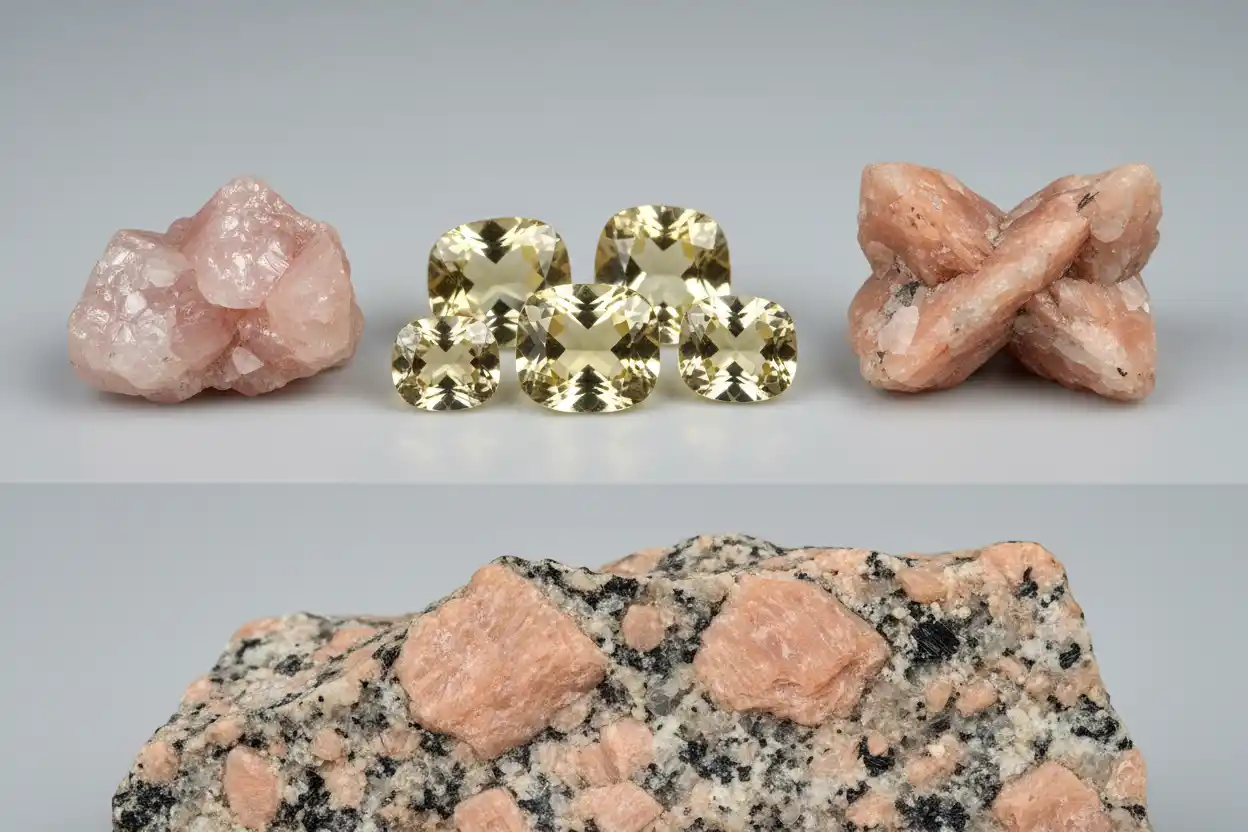
Most orthoclase appears white, cream, gray, pale pink, flesh red, or yellowish. Gem material may be colorless to golden yellow, while microscopic intergrowths with sodium-rich feldspar can produce the floating glow associated with certain moonstones.
Orthoclase at a Glance
| Property | Orthoclase |
|---|---|
| Material type | Potassium feldspar mineral and tectosilicate |
| Composition | KAlSi₃O₈, commonly with some sodium and minor barium or other substitutions |
| Mineral group | Alkali feldspar subgroup of the feldspar group |
| Common colors | Colorless, white, cream, gray, pale yellow, golden yellow, pink, flesh red, and pale green |
| Crystal system | Monoclinic |
| Typical habit | Short prismatic, tabular, blocky, granular, massive, cleavable, and twinned crystals |
| Common twins | Carlsbad, Baveno, and Manebach |
| Luster | Vitreous; pearly on cleavage surfaces |
| Transparency | Transparent to opaque |
| Mohs hardness | Approximately 6–6.5 |
| Cleavage | Perfect in two directions meeting close to 90 degrees |
| Tenacity | Brittle |
| Specific gravity | Approximately 2.55–2.63 |
| Common uses | Mineral specimens, faceted collector gems, moonstone, cabochons, ceramics, glass, and decorative stone |
| Main care concern | Cleavage chipping, surface abrasion, confusion with other feldspars, and heat or vibration during cleaning |
Orthoclase within the Feldspar Family
Orthoclase belongs to the potassium-rich branch of the feldspar family. Feldspars are framework silicates that dominate many common igneous and metamorphic rocks.
The ideal potassium end-member composition is KAlSi₃O₈. However, natural crystals commonly contain some sodium, and their aluminum-silicon ordering depends partly on cooling history.
The name comes from Greek words referring to a straight fracture. It alludes to the two prominent cleavage directions that meet close to a right angle.
Orthoclase should not be used as a generic name for every potassium feldspar. Microcline and sanidine can share the same ideal formula while possessing different structural ordering and symmetry.
Likewise, the word feldspar alone cannot establish whether a polished stone is orthoclase, plagioclase, microcline, sanidine, or an intergrowth containing more than one phase.
Orthoclase, Microcline, and Sanidine
Orthoclase, microcline, and sanidine are structural forms of potassium feldspar whose stability relates to temperature and aluminum-silicon ordering.
Sanidine forms at high temperatures and commonly occurs in rapidly cooled volcanic rocks. Its structure retains greater disorder because cooling happened too quickly for aluminum and silicon to arrange more completely.
Orthoclase represents an intermediate state of ordering and is common in intrusive felsic rocks that cooled more gradually.
Microcline is the lower-temperature, more highly ordered form. It has triclinic symmetry rather than orthoclase’s monoclinic structure.
These minerals can be difficult or impossible to separate confidently by color and ordinary appearance. X-ray diffraction, optical orientation, twinning, and structural analysis may be needed.
Amazonite is usually green microcline rather than green orthoclase. Therefore, an ordinary green potassium feldspar should not be called orthoclase without testing.
Orthoclase and Albite
Albite is the sodium end member of plagioclase feldspar, NaAlSi₃O₈.
At high temperatures, potassium- and sodium-rich feldspar components can mix more extensively. As the crystal cools, sodium-rich albite may separate from potassium feldspar as microscopic layers, strings, patches, or veins.
The resulting intergrowth is called perthite when potassium feldspar forms the host and albite forms the exsolved component.
Perthitic textures can be visible in ordinary rock or microscopic inside transparent gems. They also play an important role in some feldspar optical effects.
A coarse perthite specimen is a mineral intergrowth rather than one chemically uniform orthoclase crystal.
Orthoclase and Anorthite
Anorthite is the calcium end member of plagioclase, CaAl₂Si₂O₈.
It belongs to a different solid-solution series from orthoclase, although potassium feldspar and plagioclase commonly occur together in igneous rocks.
Granite can contain orthoclase or another potassium feldspar alongside sodium-rich plagioclase and quartz. Basalt generally favors calcium-rich plagioclase and contains little orthoclase.
The distinction helps geologists interpret magma chemistry and cooling history. It also explains why not every blocky white feldspar grain within a rock has the same composition.
How Orthoclase Forms
Orthoclase crystallizes principally from silica-rich, potassium-bearing magma.
In granite and granite pegmatite, it may grow with quartz, albite-rich plagioclase, muscovite, biotite, tourmaline, beryl, and other late-stage minerals.
Pegmatites can produce very large crystals because water-rich residual melts remain mobile while coarse mineral grains develop.
Orthoclase also occurs in syenite, where potassium feldspar is abundant but quartz is absent or limited.
High-grade metamorphism can recrystallize potassium-bearing sedimentary or igneous rocks into gneiss containing orthoclase.
Potassium-rich hydrothermal fluids may alter earlier minerals and deposit or produce orthoclase. Meanwhile, sedimentary rocks can contain detrital grains eroded from granite and authigenic feldspar grown during burial.
Crystal Form and Twinning
Orthoclase commonly forms blocky, tabular, or short prismatic crystals. Cleavage fragments may appear rectangular because the two principal planes meet near 90 degrees.
Carlsbad twins consist of two intergrown crystal individuals related by rotation around a crystallographic axis. Large examples can show a recognizable central boundary.
Baveno and Manebach twins follow different twin laws and produce separate external shapes.
Twinning can improve a specimen’s collector appeal when both individuals remain complete and well formed.
However, a visible twin shape does not prove orthoclase alone. Other feldspars can form related twin structures, so chemical and structural testing may still be required.
Yellow and Golden Orthoclase
Transparent pale-yellow to golden-yellow orthoclase is the principal non-phenomenal gem variety.
Fine material is especially associated with Madagascar, including the Itrongay and surrounding southern gem districts. Additional transparent feldspar comes from Sri Lanka, Myanmar, Tanzania, and other regions, although composition should be tested rather than inferred from country.
Yellow orthoclase commonly has modest saturation and a warm champagne, straw, honey, or golden appearance.
Its vitreous luster and relatively low refractive index produce gentle brightness rather than the intense fire of diamond or zircon.
Large transparent stones can be cut because feldspar crystals may reach substantial size. Nevertheless, cleavage and internal fractures make recovery from rough unpredictable.
Yellow orthoclase is included in the wider yellow gemstone guide but should not be confused with citrine, yellow beryl, scapolite, topaz, or sapphire.
Orthoclase and Moonstone
Some moonstone consists largely of orthoclase containing microscopic albite layers. Light scatters between these intergrowths, creating the moving glow called adularescence.
The phenomenon appears best when the lamellae have suitable thickness, regularity, and orientation. A cutter positions a cabochon so the glow moves across the dome.
The main moonstone guide owns the trade variety’s history, symbolism, quality factors, jewelry use, and broader market.
Meanwhile, the guide to types of moonstone distinguishes orthoclase-rich material from plagioclase moonstones and color-based commercial categories.
Not every adularescent feldspar is orthoclase. Sanidine, albite-rich plagioclase, oligoclase, and labradorite can also produce moonstone-like effects.
In particular, rainbow moonstone is usually transparent white labradorite rather than orthoclase.
Orthoclase and Sunstone
Reflective platelets or oriented inclusions can give some feldspars an aventurescent appearance marketed as sunstone.
However, most familiar sunstones are plagioclase or potassium feldspar varieties whose exact composition differs by deposit.
The parent sunstone guide owns the general phenomenon and market category.
Oligoclase can carry hematite inclusions and produce classic aventurescence, while Oregon material is usually labradorite-range plagioclase.
Consequently, the word sunstone does not prove orthoclase composition.
A transparent yellow orthoclase without reflective inclusions should be described simply as orthoclase rather than sunstone.
Orthoclase and Labradorite
Labradorite belongs to the calcium-rich portion of the plagioclase series.
It commonly displays broad blue, green, gold, orange, or multicolored labradorescence caused by internal exsolution structures.
Orthoclase has lower density and different optical properties. Its ordinary crystals also lack the fine polysynthetic twinning typical of plagioclase.
Both minerals can be pale, transparent, adularescent, or included, so visual appearance alone may not establish identity in a cut gem.
How to Identify Orthoclase
Orthoclase has a hardness of approximately 6–6.5. It resists scratching by ordinary steel in many orientations but is scratched by quartz.
Its two strong cleavage directions meet near 90 degrees. Fresh surfaces may look pearly, while other faces have vitreous luster.
Specific gravity usually falls between approximately 2.55 and 2.63, making orthoclase lighter than many transparent yellow gemstones.
Refractive indices fall around 1.518–1.525, with low birefringence. These measurements help distinguish it from quartz, topaz, chrysoberyl, scapolite, and beryl.
Transparent orthoclase is biaxial, usually optically negative, although structural state and composition affect exact values.
Under magnification, a gem may show cleavage, exsolution lamellae, mineral inclusions, healed fractures, twinning, or cloudy alteration.
The systematic process in how to identify crystals explains why hardness, density, optics, habit, and spectroscopy must agree.
X-ray diffraction is particularly valuable when separating orthoclase from microcline and sanidine because their ideal chemical formulas overlap.
Orthoclase and Quartz
Orthoclase and quartz commonly occur together in granite, so rough fragments can be confused.
Quartz has no cleavage and generally breaks conchoidally. Orthoclase possesses two strong cleavage directions meeting close to a right angle.
Quartz is harder at Mohs 7, while orthoclase defines approximately 6 on the scale. The comparative positions appear in the gemstone hardness chart.
Orthoclase usually has lower refractive index and weaker birefringence than quartz. However, destructive testing is inappropriate for a finished stone.
A pale yellow faceted gem sold as orthoclase should receive instrument testing when the price depends on species identity.
Durability and Jewelry Suitability
Orthoclase’s hardness provides moderate scratch resistance, but quartz-rich dust can abrade its polish during frequent wear.
Cleavage creates the more serious concern. A sharp impact can chip a facet junction, split a cabochon, or break a stone during setting.
The distinction is explained in gemstone toughness versus hardness.
Pendants, earrings, brooches, and collector jewelry suit transparent orthoclase better than exposed everyday rings.
A low bezel or protective halo reduces edge impact. Prongs should not press directly over a cleavage-reaching fracture.
Moonstone cabochons require similar care, although their rounded surfaces generally avoid the vulnerable sharp corners found on faceted orthoclase.
Treatments and Imitations
Most transparent orthoclase is sold without routine color treatment, but treatment should not be assumed absent.
Fracture filling can improve apparent clarity or stabilize cracks. Clear filler may be difficult to detect without magnification or spectroscopy.
Coatings can add stronger yellow, green, blue, or iridescent color. Worn facet edges and scratches may reveal a surface film.
Dye can enter fractures in pale porous feldspar or feldspar-bearing rock. Resin impregnation is more relevant to massive and heavily fractured material than to clean faceted gems.
Glass, quartz, yellow beryl, scapolite, synthetic spinel, and other feldspars can imitate transparent orthoclase.
The general processes behind filling, coating, dyeing, and impregnation appear in gemstone treatments explained.
Broader signs of mislabeling, fabricated certificates, and substitutes are covered in how to spot fake crystals.
Current Orthoclase Asking Prices
Common orthoclase is abundant as a rock-forming mineral. Prices rise only when crystals have attractive form, transparency, color, associations, or documented locality.
| Orthoclase product | Broad retail asking range |
|---|---|
| Small educational crystal or cleavage fragment | About $4–$15 |
| Basic mineral specimen | About $10–$40 |
| Attractive twinned or matrix specimen | About $30–$150 |
| Fine aesthetic crystal association | About $100–$500 |
| Large, historic, or exceptional cabinet specimen | About $500–$2,000 or more |
| Small pale-yellow faceted gem | About $15–$75 per carat |
| Fine clean golden orthoclase | About $50–$200 per carat |
| Exceptional large collector gem | Individually priced |
These figures represent broad July 2026 asking prices rather than appraisals or expected resale values.
Moonstone should be priced through its own quality factors rather than by applying ordinary orthoclase rates to an adularescent cabochon.
What Gives Orthoclase Value?
Transparency matters for faceted material. Eye-clean yellow crystals large enough to cut are much less common than opaque feldspar.
Color should appear even and attractive rather than muddy, overly brown, or dependent on one artificial lighting condition.
Cut influences brilliance, face-up size, windowing, extinction, symmetry, and protection of cleavage-prone edges.
Large clean stones command more per carat when they retain good color and cut. However, orthoclase remains a specialist collector gem rather than a high-liquidity precious stone.
Mineral specimens gain value from sharp faces, complete twinning, luster, crystal size, associated minerals, and undamaged terminations.
A documented classic locality can add interest. Old labels and collection history may contribute more than unsupported terms such as museum grade or Himalayan.
Buying Orthoclase
Ask whether the seller has identified the stone specifically as orthoclase or merely as potassium feldspar.
For a transparent gem, request refractive-index, density, and laboratory information when species identity affects the price.
Inspect the girdle, corners, and pavilion for cleavage chips and surface-reaching fractures.
Confirm whether moonstone, sunstone, or adularia is being used as an optical or trade description rather than as proof of exact mineral composition.
Request provenance for Madagascar golden orthoclase or another locality premium. Country-level claims may reflect cutting or wholesale location rather than geological origin.
Avoid relying on hardness tests performed by the seller, particularly when they may have damaged the stone.
Orthoclase appears in both the crystals beginning with O directory and the gemstones beginning with O directory.
Cleaning and Storage
Clean orthoclase with lukewarm water, mild soap, and a soft cloth or brush. Rinse briefly and dry it thoroughly.
Avoid ultrasonic and steam cleaning. Cleavage, internal fractures, filling, and sudden temperature changes make hand cleaning safer.
Do not use acidic household products, bleach-based cleaners, or abrasive polishing paste.
Remove orthoclase rings before gardening, exercise, cleaning, and work involving hard surfaces.
Store the gem separately from quartz, topaz, sapphire, ruby, and diamond. A padded compartment protects facet junctions and cleavage-prone edges.
Orthoclase Meaning and Symbolism
Modern crystal traditions associate orthoclase with organization, practical decision-making, cooperation, and establishing structure before beginning a large task.
Its nearly right-angle cleavage inspires symbolism involving clear boundaries and identifying where one responsibility ends and another begins.
The mineral’s central role in granite can represent dependable support rather than visible prominence.
Transparent yellow material also receives modern color associations involving optimism, curiosity, confidence, and intellectual energy.
Orthoclase has a geological history far older than its modern crystal-market symbolism, so broad claims about one universal ancient spiritual meaning should be treated cautiously.
These interpretations remain personal, cultural, artistic, or spiritual. Scientific evidence does not show that orthoclase treats illness, improves memory, or guarantees productivity.
Frequently Asked Questions
Is orthoclase a type of feldspar?
Yes. Orthoclase is a monoclinic potassium feldspar within the alkali-feldspar subgroup.
What is orthoclase’s chemical formula?
Its ideal formula is KAlSi₃O₈, although natural crystals commonly contain some sodium and minor substitutions.
How does orthoclase differ from microcline?
Both have the same ideal composition, but microcline is more structurally ordered and triclinic. Orthoclase is monoclinic and represents an intermediate ordering state.
How does orthoclase differ from sanidine?
Sanidine is the high-temperature, more disordered potassium feldspar typical of rapidly cooled volcanic rocks. Orthoclase generally forms under slower or lower-temperature conditions.
Is moonstone always orthoclase?
No. Many traditional moonstones contain orthoclase and albite, but sanidine, oligoclase, albite-rich material, and labradorite can also show adularescence.
Is rainbow moonstone orthoclase?
Usually not. Rainbow moonstone is generally transparent white labradorite, a plagioclase feldspar.
What colors can orthoclase show?
It can be colorless, white, gray, cream, pale yellow, golden yellow, pink, flesh red, or pale green.
Where does gem-quality yellow orthoclase come from?
Madagascar is the best-known source, although transparent feldspar from other countries requires testing before being assigned to orthoclase.
Is orthoclase suitable for an everyday ring?
It can be worn carefully in a protective setting, but cleavage and moderate hardness make earrings and pendants less risky.
Is orthoclase commonly treated?
Routine color treatment is not considered standard, but filling, coating, dyeing, impregnation, and misidentification can occur.
Can orthoclase go in water?
Brief washing is generally suitable for intact untreated material. Avoid soaking fractured, filled, glued, or matrix-bearing pieces.
What makes orthoclase valuable?
Transparency, color, size, cut, crystal form, twinning, associated minerals, condition, locality, treatment disclosure, and reliable identification all influence value.
Orthoclase is most useful as the potassium-feldspar reference point linking ordinary granite crystals, golden collector gems, perthitic intergrowths, and traditional moonstone. Its optical gem variety can then be considered separately without turning every orthoclase specimen into moonstone.