Oligoclase Meaning, Properties, Identification & Value
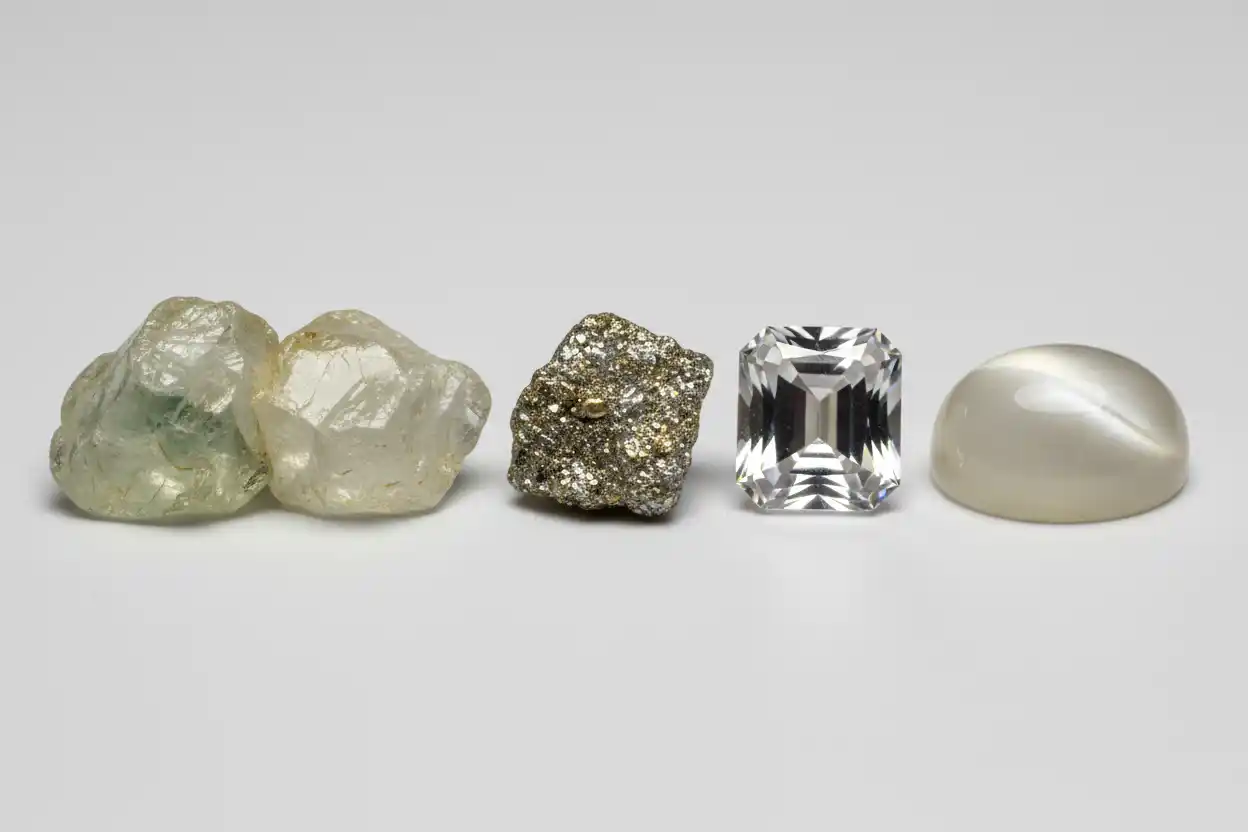
Oligoclase is a traditional compositional name for sodium-rich plagioclase feldspar lying between albite and anorthite. Transparent material may be faceted as a pale yellow, greenish, colorless, or pinkish collector gem, while inclusion-rich material can produce sunstone-like aventurescence, chatoyancy, or soft moonstone effects.
Modern mineralogy treats oligoclase as a compositional range within the continuous plagioclase series rather than a chemically fixed end-member species. Its chemistry, optical properties, density, and appearance therefore change gradually according to the proportions of sodium-rich albite and calcium-rich anorthite.
Oligoclase at a Glance
| Property | Oligoclase |
|---|---|
| Material type | Sodium-rich plagioclase feldspar compositional range |
| Typical composition | Approximately Ab₇₀–₉₀An₁₀–₃₀ between albite and anorthite |
| General formula | (Na,Ca)[Al(Si,Al)Si₂O₈] |
| Mineral group | Feldspar group, plagioclase series |
| Common colors | Colorless, white, cream, pale yellow, gray, greenish, pink, orange, reddish brown, and light blue |
| Crystal system | Triclinic |
| Typical habit | Tabular, blocky, prismatic, granular, massive, twinned, or embedded rock-forming crystals |
| Luster | Vitreous to subvitreous; pearly on cleavage surfaces |
| Transparency | Transparent to opaque |
| Mohs hardness | Approximately 6–6.5 |
| Cleavage | Perfect in one direction and good in a second direction, meeting at nearly right angles |
| Tenacity | Brittle |
| Common uses | Faceted collector gems, sunstone, moonstone-like material, cabochons, beads, carvings, mineral specimens, and rock collections |
| Main care concern | Cleavage damage, scratching, fracture filling, incorrect variety names, heat, and harsh chemical cleaning |
Oligoclase within the Feldspar Family
Oligoclase belongs to the plagioclase branch of the feldspar family. Plagioclase compositions range continuously from sodium-rich albite to calcium-rich anorthite.
Albite represents the sodium end member, NaAlSi₃O₈. Anorthite represents the calcium end member, CaAl₂Si₂O₈.
Oligoclase occupies the sodium-rich portion between them, commonly expressed as approximately 70–90 percent albite component and 10–30 percent anorthite component.
Because natural composition varies continuously, a crystal near a boundary may be called albite-oligoclase, oligoclase-andesine, or simply plagioclase depending on the analytical method and nomenclature used.
For this reason, oligoclase should not be assigned one perfectly fixed formula. The general formula records interchangeable sodium, calcium, silicon, and aluminum proportions.
Why Oligoclase Is Triclinic
Oligoclase has an ordered framework of silicon-oxygen and aluminum-oxygen tetrahedra. Sodium and calcium occupy spaces within that framework.
Replacing sodium with calcium requires a corresponding change in aluminum and silicon to preserve electrical balance. These substitutions alter lattice dimensions and measurable optical properties.
The feldspar framework produces triclinic symmetry and two prominent cleavage directions that intersect near 90 degrees.
Fine parallel striations may appear on some cleavage surfaces because of repeated polysynthetic twinning. Such twinning is characteristic of plagioclase and provides an important distinction from many potassium feldspars.
Nevertheless, striations can be microscopic or absent on a polished gem. A smooth cabochon should not be scratched or broken merely to search for them.
How Oligoclase Forms
Oligoclase forms in igneous and metamorphic rocks whose chemistry favors sodium-rich plagioclase.
It occurs in granites, granodiorites, tonalites, syenites, pegmatites, and volcanic equivalents. As magma cools, plagioclase composition may change from more calcium-rich cores to more sodium-rich rims.
This chemical zoning can create visible bands under a microscope. It may also produce variable refractive index and density within a single crystal.
Metamorphic oligoclase occurs in gneiss, amphibolite, schist, and other rocks formed under moderate-to-high temperatures. It may develop through recrystallization of earlier feldspar or reactions among clay, quartz, amphibole, and other minerals.
Pegmatites can produce larger crystals, although clear facetable zones remain uncommon. Weathering alters oligoclase to clay minerals, sericite-like mica, epidote-group minerals, and other secondary products.
Color and Transparency
Pure oligoclase is colorless. White and gray commonly result from light scattering by microscopic fractures, exsolution, inclusions, and alteration.
Iron-bearing inclusions or trace elements can create yellow, orange, reddish, brown, or greenish tones.
Pink material may contain hematite, iron-rich inclusions, or subtle structural coloration. Blue-gray stones can owe their appearance to inclusions, internal scattering, or a moonstone-like optical phenomenon.
Transparent colorless or pale yellow crystals are sometimes faceted. However, most commercial oligoclase appears as included sunstone, chatoyant material, rough crystals, or a component of decorative rock.
A color name does not prove composition. Pale yellow orthoclase, scapolite, quartz, beryl, and glass can all resemble transparent oligoclase.
Oligoclase Sunstone
Some oligoclase contains flat reflective inclusions that produce aventurescence. The resulting material may be marketed as oligoclase sunstone or aventurine feldspar.
Hematite and related iron-rich platelets can create red, gold, orange, or coppery flashes. Their size, spacing, and orientation control whether the stone shows fine shimmer, broad glitter, or distinct reflective patches.
Traditional Norwegian sunstone is associated with oligoclase from the Tvedestrand and Arendal region. India and Tanzania have also produced aventurescent oligoclase.
Tanzanian “confetti sunstone” can contain scattered reddish platelets that appear like floating metallic fragments within pale yellow, orange, or greenish feldspar.
The name sunstone describes appearance rather than one fixed feldspar composition. Both plagioclase and potassium feldspar can show the effect, as detailed in the sunstone guide.
The wider commercial categories belong on the types of sunstone page. Meanwhile, copper-bearing Oregon Sunstone is generally labradorite-range plagioclase and should not be treated as synonymous with oligoclase sunstone.
Oligoclase and Moonstone
Moonstone is a feldspar trade variety defined by adularescence rather than by one universal chemical composition.
Some moonstone consists primarily of potassium feldspar, while other material falls within sodium-rich plagioclase, including albite or oligoclase compositions.
The glow develops when light scatters or interferes within finely intergrown feldspar layers. Layer spacing, orientation, and transparency determine whether the effect appears white, silver, blue, or another color.
A seller should therefore identify both the optical variety and the underlying feldspar when possible. “Oligoclase moonstone” provides more mineralogical information than moonstone alone.
The parent moonstone guide owns general formation, symbolism, and market use, while types of moonstone distinguishes color and compositional categories.
Rainbow Moonstone is commonly transparent white labradorite rather than oligoclase, despite its commercial moonstone name.
Oligoclase and Labradorite
Labradorite lies farther toward the calcium-rich side of the plagioclase series than oligoclase.
Labradorite commonly falls around Ab₃₀–₅₀An₅₀–₇₀, although nomenclature boundaries and individual compositions require analysis.
The broad blue, green, gold, orange, or multicolored effect called labradorescence results from light interacting with submicroscopic exsolution layers.
Oligoclase can display aventurescence, chatoyancy, adularescence, or no optical phenomenon at all. Consequently, an optical effect alone does not establish where a feldspar lies within the plagioclase series.
The dedicated labradorite-versus-moonstone comparison explains how two related feldspar effects differ visually and structurally.
Oligoclase and Orthoclase
Orthoclase is a potassium feldspar with monoclinic symmetry, while oligoclase is a sodium-calcium plagioclase with triclinic symmetry.
Both can be colorless, yellow, white, or transparent, and both may occur as sunstone or moonstone varieties.
Specific gravity, refractive index, twinning, cleavage surfaces, spectroscopy, and chemical analysis help distinguish them.
Simple color comparison is unreliable. A transparent yellow feldspar may be orthoclase, oligoclase, labradorite, or another feldspar composition.
The distinction matters because origin claims, value, optical effects, and durability can differ even when the stones look similar.
Important Oligoclase Localities
Southern Norway is historically important, particularly the Arendal, Tvedestrand, Bamble, and Telemark areas. These localities have produced crystals and classic aventurescent oligoclase sunstone.
Tanzania has supplied transparent-to-translucent oligoclase and confetti-style sunstone containing visible hematite platelets.
India produces reddish and golden aventurescent feldspar, some of which falls within oligoclase composition. Tamil Nadu and other southern regions are especially associated with commercial sunstone.
Sri Lanka’s gem gravels yield several feldspars, including transparent and phenomenal plagioclase. Accurate composition may require laboratory testing because water-worn stones lack obvious crystal habit.
Other occurrences include Brazil, Canada, Russia, Madagascar, Kenya, the United States, and numerous igneous and metamorphic regions worldwide.
A source name does not prove composition. Oregon origin, for example, does not automatically mean oligoclase because much Oregon Sunstone is labradorite-range feldspar.
How to Identify Oligoclase
Oligoclase has a vitreous luster and a hardness of approximately 6–6.5. It can scratch softer materials but is scratched by quartz.
Two strong cleavage directions intersect at nearly right angles. However, testing cleavage on a finished stone would destroy it.
Specific gravity commonly falls around 2.63–2.66. This range overlaps other feldspars and cannot identify oligoclase by itself.
Refractive indices vary according to composition. Gemologists interpret the full range, birefringence, optic sign, twinning, and density rather than relying on one measurement.
Microscopic polysynthetic twinning can support plagioclase identification. Inclusions may indicate sunstone or moonstone varieties but do not always establish the exact plagioclase composition.
Raman spectroscopy, infrared spectroscopy, X-ray diffraction, electron-microprobe analysis, and refractive-index measurements can establish a more reliable position in the albite-anorthite series.
The broader testing sequence in how to identify crystals helps buyers decide when laboratory confirmation is justified.
Durability and Jewelry Suitability
Oligoclase’s hardness provides moderate resistance to scratching, but quartz dust and harder gemstones can abrade its polish.
Its two cleavage directions create a greater practical concern. A blow delivered at an unfavorable angle can split or chip a stone.
The gemstone hardness chart places oligoclase near other feldspars, while gemstone toughness versus hardness explains why cleavage lowers toughness.
Pendants, earrings, brooches, and protected cabochons are safer than exposed rings. A low bezel reduces edge impact.
A clean faceted stone can be worn in a ring with care, but sharp corners, thin girdles, and fractures increase risk.
Phenomenal material should be oriented precisely. Recutting a damaged sunstone or moonstone may reduce or completely remove the optical effect.
Treatments and Imitations
Most natural oligoclase needs no treatment beyond cutting and polishing.
Fracture filling can improve apparent clarity or stabilize cracks. Filled stones require gentler cleaning because heat, solvents, and ultrasonic vibration may affect the filler.
Surface coatings can add iridescence or strengthen color. A coating may show scratches, peeling, concentrated color near facet edges, or a different luster from the underlying feldspar.
Diffusion or copper-related treatment controversies have affected parts of the plagioclase market, especially stones sold historically as andesine or Tibetan sunstone. These cases demonstrate why origin and treatment should be supported rather than inferred from color.
Glass, quartz, synthetic spinel, and other feldspars can imitate transparent oligoclase. Dyed or resin-filled material may imitate sunstone or moonstone.
The general treatment mechanisms are described in gemstone treatments explained, while moonstone-specific imitation warning signs appear in real versus fake moonstone.
Current Oligoclase Asking Prices
The oligoclase market combines inexpensive mineral specimens, modestly priced transparent gems, and higher-priced phenomenal feldspar.
| Oligoclase product | Broad retail asking range |
|---|---|
| Small rough or educational specimen | About $5–$25 |
| Attractive crystal or matrix specimen | About $20–$100 |
| Tumbled or small polished stone | About $5–$20 |
| Standard cabochon | About $10–$40 |
| Chatoyant or aventurescent cabochon | About $25–$100 |
| Common transparent faceted oligoclase | About $20–$100 per carat |
| Fine clean or strongly phenomenal gem | About $75–$250 per carat or more |
| Exceptional collector stone | Individually priced |
These figures represent broad current asking prices rather than formal appraisals or guaranteed resale values.
Sunstone prices vary according to composition, inclusion type, origin, color, and transparency. Detailed market analysis belongs on the sunstone price guide rather than being repeated under oligoclase.
What Gives Oligoclase Value?
Transparency matters for ordinary faceted gems. Clean material large enough to cut remains less common than cloudy rock-forming feldspar.
Body color can add value when it is attractive and natural. Pale yellow, greenish, orange, and pink stones generally need good brilliance to avoid appearing washed out.
Phenomena can dominate value. Strong aventurescence, a sharp cat’s-eye, or a centered moonstone glow may be more important than clarity.
Inclusion orientation determines whether a sunstone flashes face-up. A large stone with poorly positioned platelets can look dull.
Cut quality affects windowing, extinction, symmetry, face-up size, and optical-effect placement.
Origin matters when it can be documented, especially for classic Norwegian or distinctive Tanzanian material. However, a geographic name should not replace gemological identification.
Treatments, fractures, cleavage chips, polish quality, and laboratory documentation also influence confidence and price.
Buying Oligoclase
Ask whether the stone was identified merely as feldspar or analyzed specifically as oligoclase.
For phenomenal material, request a video under one moving light. Static photographs can hide weak aventurescence or an off-center eye.
Confirm whether the name sunstone or moonstone describes an optical effect, a precise composition, or both.
Examine facet edges and girdles for cleavage chips. In cabochons, look for fractures reaching the surface and filler collecting around them.
Ask about coating, fracture filling, diffusion, dye, and any claimed origin. A seller should not call all pale aventurescent feldspar untreated oligoclase without evidence.
Anyone shopping mainly for aventurescent jewelry should use the dedicated sunstone buying guide rather than relying on a group-level mineral description.
Oligoclase appears in both the crystals beginning with O directory and the gemstones beginning with O directory.
Cleaning and Storage
Clean oligoclase with lukewarm water, mild soap, and a soft brush. Rinse briefly and dry it with a lint-free cloth.
Avoid steam and ultrasonic cleaning. Cleavage, internal fractures, inclusions, and possible filling make warm soapy water safer.
Keep the stone away from sudden heat. Thermal stress can extend fractures or damage filled material.
Do not use hydrochloric-acid-based products, bleach-containing cleaners, or strong household chemicals. Feldspars can be attacked by aggressive acids, while jewelry settings may react even sooner.
Store oligoclase separately from quartz, topaz, sapphire, ruby, and diamond. A padded compartment protects its facet edges and optical-effect orientation.
Setting-specific care for aventurescent material appears in how to clean sunstone jewelry.
Oligoclase Meaning and Symbolism
Modern crystal traditions commonly associate oligoclase with adaptability, cooperation, clear communication, and balancing several priorities.
Its position between albite and anorthite inspires symbolism involving continuity rather than rigid categories. Natural composition changes gradually across the plagioclase series.
Aventurescent oligoclase receives many of the confidence and optimism associations assigned to sunstone, while adularescent pieces may inherit symbolism connected with reflection and transition.
Those meanings depend on modern gemstone culture and visual interpretation rather than scientifically demonstrated effects.
Scientific evidence does not show that oligoclase treats illness, controls emotions, improves communication, or produces guaranteed energetic changes.
Frequently Asked Questions
Is oligoclase a separate mineral species?
It is a traditional compositional name within the albite-anorthite plagioclase series. Modern mineralogy often treats it as a defined sodium-rich range rather than an independent end member.
What percentage of albite does oligoclase contain?
Oligoclase commonly falls around Ab₇₀–₉₀, meaning approximately 70–90 percent albite component and 10–30 percent anorthite component.
Is oligoclase a type of feldspar?
Yes. It belongs to the sodium-calcium plagioclase branch of the feldspar group.
Can oligoclase be sunstone?
Yes. Oligoclase containing oriented reflective inclusions can be sold as oligoclase sunstone or aventurine feldspar.
Is Oregon Sunstone oligoclase?
Most well-known Oregon Sunstone is labradorite-range plagioclase rather than oligoclase, although composition should be determined analytically.
Can moonstone be oligoclase?
Yes. Some moonstone material falls within sodium-rich plagioclase, including albite or oligoclase compositions.
How does oligoclase differ from orthoclase?
Oligoclase is a triclinic sodium-calcium plagioclase. Orthoclase is a monoclinic potassium feldspar.
Where is gem-quality oligoclase found?
Important gem or collector sources include Norway, Tanzania, India, Sri Lanka, Brazil, Canada, Russia, and the United States.
Is oligoclase suitable for an everyday ring?
It can be worn carefully in a protective setting, but cleavage and moderate hardness make pendants and earrings less risky.
Is oligoclase normally treated?
Many stones are untreated, but fracture filling, coating, dye, and treatment-related origin controversies occur in the wider plagioclase market.
Can oligoclase go in water?
Brief cleaning with lukewarm soapy water is generally suitable for intact untreated material. Prolonged soaking is unnecessary, especially when filling or fractures are present.
What makes oligoclase valuable?
Transparency, natural color, optical phenomena, cut, size, condition, documented origin, treatment status, and reliable compositional identification determine value.
Oligoclase is most useful as the mineralogical bridge between ordinary plagioclase and several familiar phenomenal gems. Readers primarily interested in glittering inclusions can next compare its behavior with the broader varieties described in the sunstone guide.