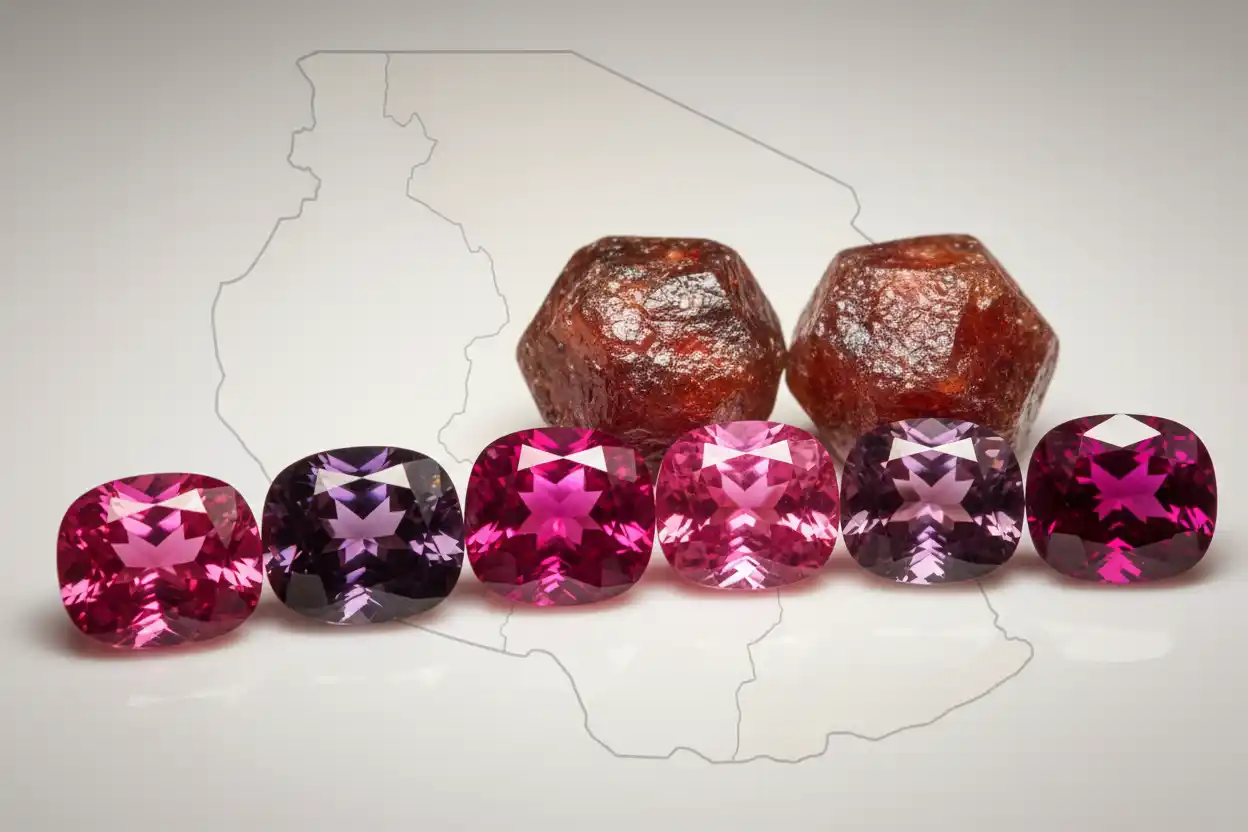
Umbalite Garnet Meaning, Properties, Value and Color
Umbalite garnet is a locality-linked trade name for pink, red, purplish and orange-pink garnets historically associated with Tanzania’s Umba Valley. Rather than representing one formally defined mineral species, it occupies a variable part of the garnet solid-solution system, commonly combining pyrope, spessartine and almandine components.
Its saturated raspberry and magenta colors can resemble fine rhodolite garnet, spinel or purple sapphire. However, Umbalite’s name, chemistry and geographic history give it a distinct position within the wider garnet family.
Umbalite Garnet at a Glance
| Property | Umbalite Garnet |
|---|---|
| Material type | Natural mixed-composition garnet |
| Common composition | Variable pyrope-spessartine-almandine solid solution |
| Name status | Trade and locality-linked name, not a separate mineral species |
| Typical colors | Pink, raspberry, reddish pink, purplish red, magenta, orange-pink and red-purple |
| Crystal system | Cubic |
| Crystal habit | Commonly dodecahedral or rounded grains; gem rough often waterworn |
| Luster | Vitreous to subadamantine |
| Transparency | Transparent to translucent |
| Refractive index | Commonly about 1.75–1.79, depending on composition |
| Specific gravity | Commonly about 3.75–3.95 |
| Optical character | Singly refractive, sometimes with anomalous strain effects |
| Mohs hardness | About 7–7.5 |
| Cleavage | None |
| Tenacity | Brittle |
| Common cuts | Ovals, cushions, rounds, pears and mixed cuts |
| Main care concern | Facet edges can chip under sharp impact; included stones dislike sudden heat |
What Is Umbalite Garnet?
Umbalite is a gem-trade term applied to garnets from the Umba region of Tanzania and nearby East Africa, particularly stones with pink, reddish, purplish or magenta colors.
Garnet species form broad chemical solid solutions. Therefore, one Umbalite Garnet may contain more pyrope, while another may contain greater almandine or spessartine components.
This variability explains why published descriptions do not always give exactly the same formula. Some stones plot between pyrope and spessartine, while others show a substantial almandine component.
Umbalite is consequently better understood as a trade and provenance category than as a tightly bounded mineral variety. The broader types of garnet guide retains the family-wide classification intent.
Where Did the Name Umbalite Come From?
The name derives from the Umba River and Umba Valley area near the Tanzania-Kenya border. Gem gravels in this region became known for sapphire, spinel, tourmaline and several unusual garnet mixtures.
The term entered trade usage to distinguish attractive pink-to-purple garnets from more familiar red pyrope-almandine material. Some early gemologists considered Umbalite Garnet a more geographically appropriate name than malaia for certain Umba Valley garnets.
However, trade usage never became fully standardized. One seller may reserve Umbalite for raspberry or purple material from the Umba Valley, while another may use it broadly for pinkish malaia-type garnet from East Africa.
A responsible description should therefore state color, weight, treatment and known origin rather than relying on the name alone.
Is Umbalite the Same as Malaia Garnet?
Umbalite and malaia garnet overlap, but the terms are not always used identically.
Malaia, also spelled malaya, generally describes mixed-composition garnets that fall outside established color and chemical boundaries for familiar varieties. These stones often contain pyrope and spessartine with varying almandine, grossular or andradite components.
Traditional malaia colors include peach, pinkish orange, reddish orange and cinnamon. Umbalite Garnet is more often associated with the Umba locality and raspberry, magenta, purplish pink or red-purple colors.
Nevertheless, some historical gemological references have treated Umba Valley malaia garnet and Umbalite as the same commercial material. Because the compositions form continuous ranges, laboratory data may not create a simple line between the two names.
For buyers, the useful questions are whether the stone is natural garnet, what its dominant color is, whether it shows a genuine color shift, and whether the claimed Umba provenance is documented.
Umbalite Versus Rhodolite Garnet
Rhodolite is a purplish-red to pinkish-red pyrope-almandine garnet. Its chemistry commonly emphasizes pyrope and almandine rather than the more variable pyrope-spessartine-almandine balance encountered in many Umbalites.
Both can display raspberry, grape and magenta tones. As a result, visual identification alone may not separate them.
Umbalite Garnet often shows warmer flashes, an orange or red secondary hue, or a more complex shift between daylight and incandescent light. Yet those traits vary and do not constitute a universal test.
The dedicated rhodolite garnet buying guide owns deeper rhodolite quality assessment, while the rhodolite price guide retains that variety’s market intent.
Umbalite garnet Versus Pyrope, Almandine and Spessartine
Pyrope garnet supplies magnesium-rich chemistry and often contributes a vivid red or purplish-red appearance.
Almandine garnet contributes iron and can deepen a stone toward red, violet-red or brownish red. Excessive tone may cause extinction in poorly cut gems.
Spessartine garnet contributes manganese and is associated with orange, reddish orange and warm internal flashes.
Umbalite Garnet commonly combines components from all three. The exact proportions determine its refractive index, density, absorption spectrum and face-up color.
Grossular may also occur in some mixed East African garnets. However, Umbalite Garnet should not be presented simply as a subtype of grossular garnet unless laboratory chemistry supports that classification.
Umbalite garnet Colors
Raspberry Pink
Raspberry is one of the most characteristic commercial descriptions. Fine stones show a lively balance of pink, red and purple without becoming overly dark.
Purplish Red
Purplish-red Umbalite can resemble rhodolite, red spinel or some sapphires. Strong brilliance and red flashes help the best stones remain lively under mixed lighting.
Magenta and Fuchsia
Highly saturated magenta or fuchsia stones attract collectors because the hue is unusual among untreated natural gems. These colors can appear more purple in daylight and warmer under incandescent light.
Orange-Pink and Peach
Some Umbalite Garnet overlaps with malaia garnet in peach, salmon and pinkish-orange colors. Stones with a distinct warm orange component may be marketed under either name.
Deep Red-Purple
Larger or iron-rich stones can become dark maroon or aubergine. Careful cutting is essential because garnet absorbs light strongly and can show black extinction when the pavilion is too deep.
Umbalite Garnet Color Shift and Color Change
Many Umbalites look somewhat different under daylight-equivalent and incandescent illumination. A stone may appear purplish pink in daylight and redder or warmer under incandescent light.
A modest color shift is not automatically a strong color-change phenomenon. True color-change classification normally requires a meaningful change in dominant hue rather than a small adjustment in saturation or warmth.
Sellers should describe the observed colors under named light sources and avoid using “color-change Umbalite” when the effect is only subtle.
The Umba region also produces recognized color-change garnets with different compositional and optical behavior. Those stones should not be assumed to be ordinary Umbalite Garnet merely because their source overlaps.
Umbalite Garnet Geology and Formation
Umbalite garnets formed within the tectonically complex East African Mozambique Belt. This region contains ancient metamorphic rocks that experienced high temperatures, pressure, deformation and fluid movement during continental collision.
Garnet grew within metamorphic rocks such as gneiss and related lithologies as iron, magnesium, manganese, aluminum and silica reacted under suitable conditions.
Weathering later released resistant garnet crystals from their host rocks. Streams concentrated the dense grains in secondary alluvial and eluvial deposits, where miners recovered them alongside sapphire, spinel, zircon and other gems.
Waterworn rough may no longer preserve a complete crystal form. Its rounded surfaces reflect transport through soil and stream gravels rather than an artificial treatment.
Umbalite Garnet Sources and Localities
The classic source lies in and around Tanzania’s Umba Valley, near the Kenyan border. The district became known for an unusually diverse suite of colored stones rather than one single gem deposit.
Similar mixed pink and purple garnets have been reported from other parts of Tanzania, Kenya, Mozambique and Madagascar. However, a comparable color does not prove Umba Valley origin.
Some modern sellers use Umbalite Garnet as a broad color term for East African purple garnet. Strict locality-based usage would reserve it for documented Umba-region material.
A laboratory may identify a stone’s garnet composition but may not always be able to prove a precise mine. Provenance can therefore depend on the seller’s chain of custody, mine records and acquisition history.
The family-wide geographic context appears in where garnet is found.
Umbalite Garnet Inclusions and Internal Features
Umbalite may contain fine rutile needles, short rutile crystals, apatite, quartz, zircon and sulfide minerals. Rounded zircon crystals and intersecting needle networks are particularly useful microscopic features in some East African garnets.
Partially healed fractures can form fingerprint-like patterns. Small crystals may also produce strain halos or localized tension cracks.
Color zoning is generally less conspicuous than in sapphire or tourmaline because garnet commonly develops more even body color. Nevertheless, subtle growth zones and uneven concentrations of trace elements can occur.
Some garnets show anomalous birefringence under crossed polarizers even though garnet is nominally singly refractive. Internal strain, chemical ordering or growth structure can create this weak optical anomaly.
Inclusions do not automatically reduce value. Fine needles can confirm natural origin, while a well-placed crystal may interest inclusion collectors. Large surface-reaching fractures, however, can compromise durability.
Identifying Umbalite Garnet
A gemologist first confirms that the material is garnet. Typical evidence includes single refraction, a refractive index in the garnet range, substantial density and characteristic absorption features.
Exact classification then requires chemical analysis because Umbalite overlaps pyrope, almandine, spessartine, rhodolite and malaia compositions.
Energy-dispersive X-ray fluorescence, Raman spectroscopy and more advanced elemental analysis can quantify the iron, magnesium, manganese and calcium balance. The result may describe the stone as pyrope-almandine-spessartine rather than using the trade name Umbalite.
The general real-versus-fake garnet guide covers basic authenticity concerns. However, proving that a natural garnet is specifically Umbalite requires more than confirming the garnet group.
The ruby, garnet and spinel comparison explains how red transparent gems can overlap visually despite having different optical properties.
Realistic Lookalikes
Rhodolite Garnet
Rhodolite is the closest common overlap. Both may be raspberry or purplish red, and chemical boundaries can be gradual.
Pink or Purple Spinel
Spinel can match Umbalite’s bright pink-purple color and is also singly refractive. Refractive index, density, spectroscopy and inclusions separate them.
Purple Sapphire
Purple sapphire is harder and doubly refractive. Its inclusions and absorption spectrum differ, although fine stones can look similar without instruments.
Rubellite Tourmaline
Rubellite may show comparable magenta or raspberry colors. Tourmaline is doubly refractive and strongly pleochroic, while garnet is normally singly refractive.
Amethyst
Amethyst generally has a lower refractive index and specific gravity. It also shows quartz-related optical properties that differ from garnet.
Glass and Synthetic Spinel
Manufactured imitations may appear unusually clean or contain rounded bubbles. Nevertheless, visual inspection alone is insufficient for a high-value purchase.
Umbalite Garnet Treatments, Synthetic Material and Imitations
Most Umbalite garnet is sold without treatment. Heating does not routinely improve the material in the predictable way it alters sapphire, zircon or tanzanite.
Because untreated color is a major advantage, a seller should disclose any unusual enhancement. Fracture filling with glass or resin is possible in garnet generally, although it is not considered a standard Umbalite treatment.
Surface coatings can create stronger purple or red color on pale stones. Coating is uncommon but should be considered when color collects around facet junctions or appears damaged at scratches.
Synthetic garnets are manufactured for industrial, laser and jewelry applications, but there is no major commercial market for laboratory-grown material that reproduces Umbalite’s exact natural composition and provenance.
Glass, cubic zirconia, synthetic spinel and synthetic corundum are more realistic imitations. The lab-grown versus natural gemstone guide explains why a simulant is not the same as a synthetic counterpart.
The broader gemstone treatment guide retains the full disclosure framework.
Cutting and Polishing Behavior
Umbalite’s high refractive index can produce strong brilliance when the pavilion angles return light efficiently. Ovals, cushions and rounds are common because they suit waterworn rough and preserve weight.
Dark rough requires careful depth control. An overly deep pavilion may conserve carat weight but create a black center or large extinction zones.
Cutters often orient purplish stones to emphasize their liveliest red or magenta direction, even though garnet lacks the strong pleochroism found in tourmaline.
Windowing becomes a concern when the pavilion is too shallow. The viewer can then see through the center instead of receiving reflected color and brilliance.
Garnet takes a good polish, but sharp points and thin girdles can chip during setting. A medium, even girdle offers better protection than an extremely thin edge.
Umbalite Garnet Durability and Jewelry Suitability
Umbalite has a Mohs hardness of approximately 7–7.5 and no cleavage. It therefore offers better everyday durability than softer gems such as opal, fluorite or moonstone.
However, garnet remains brittle. A sharp blow can chip a facet edge or extend an existing fracture.
The dedicated guide to garnet durability explains why hardness alone does not make every stone impact-proof.
Umbalite works well in earrings, pendants and necklaces. It can also perform in a ring when the stone is structurally sound and the setting protects vulnerable edges.
The general garnet ring guide covers setting choices, while garnet necklaces, garnet earrings and garnet bracelets retain their jewelry-specific styling intent.
Umbalite Garnet Prices
Umbalite pricing overlaps the broader malaia and rhodolite markets because sellers do not use the name consistently.
Small commercial stones with moderate color or visible inclusions may retail around $30–$100 per carat. Attractive one- to three-carat gems with lively raspberry or purplish-red color commonly fall near $100–$300 per carat.
Fine stones with saturated magenta color, strong brilliance and good clarity may range from approximately $300–$500 per carat. Exceptional large gems, unusual color-shift stones or well-documented Umba Valley specimens can exceed $500 per carat.
A July 2026 specialist inventory index for malaia garnet showed a broad range from under $10 to more than $460 per carat, illustrating how strongly size, color, clarity and cutting affect the market.
Umbalite should not be valued only by its trade name. A dark, poorly cut stone may be worth less than a vivid rhodolite, while an exceptional Umbalite can command a specialist premium.
The dedicated garnet price guide and garnet price-per-carat guide own the broader pricing framework.
Umbalite Garnet Value Factors
Color is usually the strongest factor. Raspberry, vivid purplish red and magenta stones tend to attract more interest than brownish, grayish or excessively dark material.
Clarity also matters, although tiny natural inclusions are acceptable. Eye-visible fractures, cloudy areas and large black crystals reduce brilliance and can affect durability.
Cut quality determines whether the stone appears lively or extinct. A lower-weight gem with balanced proportions can be more valuable than a deeper stone that retains weight but looks black.
Size premiums become more noticeable above three to five carats when color and clarity remain strong. Large dark stones do not receive the same premium as bright gems.
Documented Umba Valley provenance may appeal to collectors. However, origin should not compensate for weak beauty or poor cutting.
The complete family grading principles appear in garnet quality and grading.
Umbalite Garnet Buying Guidance
Start by asking how the seller defines Umbalite Garnet. The answer should mention mixed garnet composition, color and East African or Umba Valley association rather than claiming it is a separate garnet species.
Examine the stone under daylight-equivalent and warm indoor light. Note whether the color genuinely changes hue or merely becomes warmer.
Check for extinction by rocking the gem slowly. Some dark areas are normal, but a large black center can indicate poor orientation or excessive depth.
Inspect the girdle and pavilion for chips, cavities and fractures. Garnet’s lack of cleavage helps durability, but surface-reaching inclusions still matter.
A laboratory report is worthwhile for an expensive or unusually large stone. The report may identify the material as natural garnet and provide chemical classification, even when it does not use the trade name Umbalite.
The broader garnet buying guide retains seller, report and quality-assessment guidance.
Umbalite Garnet Cleaning, Water, Heat and Storage
Clean Umbalite Garnet with lukewarm water, mild soap and a soft brush. Rinse thoroughly and dry with a lint-free cloth.
The full procedure appears in how to clean garnet jewelry.
Sound garnet tolerates brief water contact, but extended soaking is unnecessary. Fracture-filled stones, glued settings and antique jewelry require greater caution, as discussed in garnet water and sunlight safety.
Avoid steam and sudden temperature changes. Heat can expand inclusions, damage fillers or place stress around internal crystals.
Ultrasonic cleaning may be acceptable for a clean, untreated stone, but it should be avoided when inclusions, fractures or treatment status are uncertain.
Store Umbalite separately from diamond, sapphire and other harder stones. A fabric-lined compartment protects polished facets and girdle edges.
Umbalite Garnet Meaning and Symbolism
Umbalite inherits much of its modern symbolism from the broader garnet family. Garnet has long been associated in different traditions with commitment, vitality, protection, friendship and safe travel.
Umbalite’s pink and purple colors have encouraged additional modern associations with affection, creativity, emotional openness and personal confidence. These interpretations belong to cultural, spiritual or personal practice rather than established mineral science.
The broader garnet color meaning guide explores how people interpret different garnet colors. Historical context remains with the history of garnet.
Garnet is also the principal January birthstone, although Umbalite is a less conventional choice than classic red garnet.
Frequently Asked Questions
1. Is Umbalite a separate garnet species?
No. Umbalite is a trade and locality-linked name for mixed-composition garnets, commonly containing pyrope, spessartine and almandine components.
2. Where does Umbalite garnet come from?
The classic material comes from the Umba Valley region of Tanzania near the Kenyan border. Similar-looking mixed garnets also occur elsewhere in East Africa.
3. Is Umbalite the same as malaia garnet?
The names overlap in some historical and commercial usage. Umbalite is more strongly tied to the Umba locality and pink-purple colors, while malaia generally covers a wider range of mixed orange, peach and pink garnets.
4. How is Umbalite different from rhodolite?
Rhodolite is typically a pyrope-almandine garnet, while Umbalite Garnet may contain a stronger spessartine component and is linked to the Umba region. Their colors and chemistry can overlap.
5. Does Umbalite change color?
Some stones show a noticeable shift between purplish pink and warmer red under different lighting. Not every example meets strict standards for a true color-change gemstone.
6. Is Umbalite garnet treated?
Most material is believed to be untreated because garnet’s natural color does not normally require enhancement. Any filling, coating or unusual treatment should still be disclosed.
7. What inclusions occur in Umbalite?
Reported inclusions include rutile needles, apatite, quartz, zircon, sulfides and partially healed fractures. Inclusion scenes vary with individual stones and deposits.
8. Is Umbalite suitable for an engagement ring?
A clean stone can work in a protected setting because garnet has good hardness and no cleavage. However, facet edges can chip under sharp impact.
9. Why can two Umbalites have different refractive indices?
The pyrope, almandine and spessartine proportions vary. Those chemical differences alter refractive index, density, color and absorption.
10. Is purple garnet always Umbalite?
No. Purple garnets occur in several compositions and localities. The Umbalite name should reflect trade usage, chemistry and ideally an East African or Umba provenance.
11. How much does Umbalite garnet cost?
Commercial stones may begin around $30–$100 per carat, while fine vivid gems commonly reach $100–$500 per carat. Exceptional large or provenance-rich stones can exceed that range.
12. Does Umbalite have scientifically proven healing properties?
No scientific evidence shows that Umbalite produces medical or emotional healing effects. Its symbolism may still carry personal, cultural or spiritual value.
Umbalite’s appeal comes from the meeting point of chemistry, locality and color: no single rigid formula defines every stone, yet the finest examples share a vivid raspberry-to-magenta character that stands apart from ordinary red garnet. Understanding that flexible boundary helps buyers appreciate the gem without treating a trade name as a formal mineral species.
Umbalite appears in Crystals That Start With U and Gemstones That Start With U.