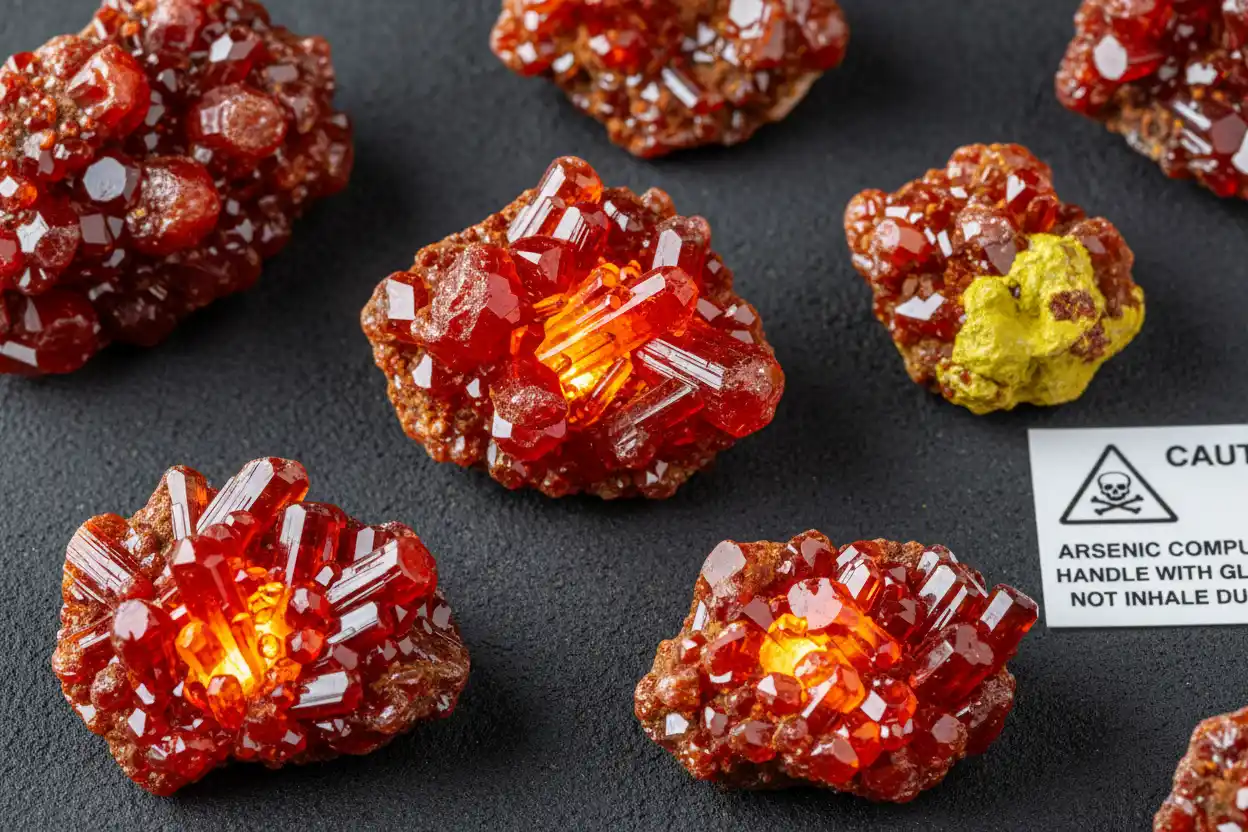
Realgar Meaning, Properties, Identification & Safe Handling
Realgar is a soft red-to-orange arsenic sulfide mineral commonly written with the molecular formula As₄S₄, although its empirical formula is AsS. Fresh crystals can be transparent, intensely colored, and resinous, but exposure to light causes them to alter into yellow-orange products and eventually lose their original structure.
Its composition, extreme softness, light sensitivity, and potential to generate toxic arsenic-bearing dust make Realgar unsuitable for ordinary jewelry, mineral elixirs, powdering, burning, or casual lapidary work. It belongs in a carefully labeled and light-controlled mineral collection.
Realgar at a Glance
| Property | Realgar |
|---|---|
| Material type | Arsenic sulfide mineral |
| Composition | Molecular formula As₄S₄; empirical formula AsS |
| Mineral class | Sulfide |
| Common colors | Red, ruby red, vermilion, orange-red, yellow-orange, and dark red |
| Alteration colors | Yellow, orange-yellow, pale orange, white, and powdery mixed tones |
| Crystal system | Monoclinic |
| Typical habit | Prismatic, striated, tabular, granular, massive, crust-like, and powdery after alteration |
| Luster | Resinous to greasy |
| Transparency | Transparent when fresh; translucent to opaque after alteration |
| Mohs hardness | Approximately 1.5–2 |
| Cleavage | Good in one direction with several weaker directions |
| Tenacity | Sectile to slightly brittle |
| Specific gravity | Approximately 3.56–3.59 |
| Streak | Red-orange to red |
| Common uses | Mineral specimens, scientific collections, historic pigment studies, ore-mineral displays, and museum collections |
| Main care concern | Arsenic toxicity, light-induced transformation, crumbling alteration products, contamination, heat, and loss of provenance |
What Realgar Is
Realgar consists entirely of arsenic and sulfur in its ideal composition.
Its structure contains discrete As₄S₄ molecules arranged within a monoclinic crystal lattice.
Older mineral references commonly write the simplified formula AsS because arsenic and sulfur occur in a one-to-one atomic ratio.
Modern molecular notation, As₄S₄, describes the structural unit more accurately.
Realgar is not a red variety of quartz, calcite, ruby, or another familiar gemstone.
It belongs to the arsenic sulfide group and is closely related compositionally to pararealgar and alacránite, which contain the same elements in different structural arrangements.
The broader distinction between ore minerals and wearable gemstones appears in types of gemstones.
Origin of the Name
The name Realgar is generally traced to Arabic wording associated with powder or dust from a mine.
The mineral has been known for centuries because of its vivid color and occurrence in arsenic-rich ore deposits.
Historic sources used Realgar as a pigment, medicinal ingredient, poison, pyrotechnic component, and mineral reagent.
Those practices reflect earlier technological and cultural contexts rather than modern safety recommendations.
Powdered Realgar contains arsenic and should not be recreated as an art material, cosmetic, remedy, incense ingredient, or ceremonial powder.
The historic pigment’s tendency to change color under light also created conservation problems in paintings and manuscripts.
How Realgar Forms
Realgar commonly forms in low-temperature hydrothermal veins.
Arsenic- and sulfur-bearing fluids move through fractures and deposit minerals as temperature, pressure, pH, and chemical conditions change.
It also develops around hot springs, volcanic fumaroles, and other environments where arsenic-bearing gases or fluids reach cooler surfaces.
Some deposits contain Realgar within carbonate rocks, clay-rich sediment, or altered volcanic material.
Common associated minerals include Orpiment, calcite, barite, stibnite, arsenic, arsenolite, pyrite, quartz, and other arsenic or antimony minerals.
Realgar may form as sharp prismatic crystals, granular masses, coatings, or fracture fillings.
Several mineral generations can occur together. A red crystal may be partly coated by yellow alteration material, while white calcite or barite provides contrasting matrix.
Why Realgar Is Light Sensitive
Visible and ultraviolet light provide energy that changes Realgar’s molecular and crystal structure.
The first conspicuous product is commonly pararealgar, a yellow-to-orange arsenic sulfide with the same overall As₄S₄ composition but a different arrangement.
The altered layer can begin as small yellow patches, powder, or a coating on the red crystal.
As alteration progresses, the surface can crack, expand, flake, and crumble.
Further exposure and interaction with oxygen can produce arsenic oxides, including arsenolite, along with other arsenic-sulfur products.
The original crystal may eventually become a friable yellow-orange or pale powder while losing its sharp form and transparency.
This process is not merely a reversible color change. It represents physical and chemical degradation.
Direct sunlight causes the greatest obvious risk, but prolonged indoor display lighting can also damage the specimen.
Realgar and Pararealgar
Pararealgar is a distinct mineral with the same overall chemical components as Realgar but a different crystal structure.
It commonly forms through light-induced alteration of Realgar.
Fresh pararealgar is bright yellow in powdery material and can become yellow-orange or orange-brown when granular.
The altered product often forms directly on a Realgar surface.
Because it occupies a different volume and texture, the layer can crack and detach, exposing more Realgar beneath.
A partly altered specimen may display red cores surrounded by yellow-orange powder.
This transformation should not be mistaken for attractive natural zoning or a desirable treatment.
The specimen’s current appearance and degree of alteration must be disclosed during sale.
Realgar and Orpiment
Orpiment is a yellow-to-orange arsenic sulfide with the formula As₂S₃.
It commonly occurs with Realgar in low-temperature hydrothermal deposits and hot-spring environments.
Realgar is usually redder and can form prismatic crystals. Orpiment commonly appears lemon yellow, golden yellow, orange-yellow, foliated, fibrous, or massive.
Both minerals are soft, light sensitive, and arsenic bearing.
Realgar does not simply “turn into Orpiment” through every exposure pathway. Pararealgar is the principal recognized light-induced structural product, while Orpiment and arsenic oxides can occur among additional alteration products.
The two should be stored and handled with similar caution.
A mixed Realgar-Orpiment specimen can become difficult to conserve because several fragile phases may respond differently to light, vibration, and humidity.
Realgar and Cinnabar
Cinnabar is mercury sulfide, HgS.
Both minerals can appear vivid scarlet or red-orange and have been used historically as pigments.
Cinnabar is much denser and commonly has an adamantine-to-dull luster, while Realgar tends to appear resinous.
Their crystal structures, streaks, optical properties, and associated minerals differ.
Cinnabar presents a mercury hazard, whereas Realgar contains arsenic.
Neither should be powdered or used in decorative preparations.
A red mineral’s apparent pigment history cannot distinguish them reliably. Raman spectroscopy and chemical analysis provide safer identification.
Realgar and Proustite
Proustite is a silver arsenic sulfosalt with the formula Ag₃AsS₃.
Fresh Proustite commonly shows a deeper scarlet or cochineal red and a strong adamantine luster.
Its high silver content gives it much greater density than Realgar.
Proustite forms in silver-bearing hydrothermal deposits, whereas Realgar is more widely associated with arsenic-antimony systems, hot springs, and fumarolic environments.
Both minerals darken or alter under light and require protected storage.
Their overlapping red transparency makes laboratory identification important for valuable or historic specimens.
Realgar and Ruby
Realgar has occasionally received ruby-like descriptive language because of its red transparency.
However, Ruby is chromium-bearing corundum with hardness 9 and excellent resistance to ordinary abrasion.
Realgar has hardness near 1.5–2 and can be scratched by many common objects.
Ruby is suitable for long-term jewelry use, while Realgar degrades in light and contains arsenic.
No responsible seller should use ruby terminology in a way that suggests equivalence.
Crystal Form and Physical Behavior
Well-developed Realgar crystals can be prismatic, tabular, striated, and several centimeters long.
Twins and complex intergrowths also occur.
Fresh crystals have resinous-to-greasy luster and can transmit intense red or orange light.
The mineral is sectile, meaning a blade can cut or shave it under controlled mineralogical testing.
However, no collector should attempt that test because it damages the specimen and creates contaminated fragments.
Realgar has good cleavage and several weaker cleavage directions.
Its low hardness makes edges and faces vulnerable to scratches from packaging, brushes, cloth, and neighboring minerals.
Even gentle handling can loosen altered powder from an exposed surface.
Important Realgar Localities
The Allchar deposit in North Macedonia is a classic arsenic-antimony-thallium locality known for Realgar and numerous rare associated minerals.
The Shimen deposit in Hunan, China, has produced large brilliant red crystals, commonly with calcite and other arsenic minerals.
The Getchell Mine in Nevada is famous for fine Realgar crystals and gold-arsenic ore associations.
Baia Sprie and Cavnic in Romania have produced historic European specimens.
Jáchymov in the Czech Republic, Lengenbach in Switzerland, the Harz Mountains of Germany, Quiruvilca in Peru, and several Japanese, Russian, Turkish, and American localities are also known.
Locality has a major effect on value because fine crystals from classic deposits may no longer be available.
A permanent mine label is especially important when the specimen has altered so far that its original identity is less visually obvious.
Historical Pigment Use
Realgar was ground into an orange-red pigment used in manuscripts, paintings, decorative surfaces, and other historical objects.
The color could be vivid when fresh, but light exposure gradually altered it toward yellow and pale tones.
Conservators may encounter Realgar beside Orpiment in Asian, Middle Eastern, European, and Mediterranean artworks.
Pigment identification commonly uses Raman spectroscopy, X-ray diffraction, reflectance methods, and microscopic analysis.
Historical use does not make powdered mineral safe for modern artists.
Commercial pigment alternatives can reproduce orange-red color without exposing the user to arsenic sulfide.
How to Identify Realgar Safely
Color and habit provide preliminary clues but cannot confirm Realgar.
Its resinous luster, red-orange transparency, density near 3.56, low hardness, and association with Orpiment support identification.
Streak testing would produce red-orange powder but should not be performed because it creates arsenic-bearing dust.
Scratch, flame, heat, and solubility tests are similarly inappropriate.
Raman spectroscopy can distinguish Realgar, pararealgar, Orpiment, Cinnabar, Proustite, sulfur, and artificial pigments.
X-ray diffraction confirms the monoclinic structure.
Chemical analysis identifies arsenic and sulfur, although mixed or altered surfaces may contain several phases.
The non-destructive approach in how to identify crystals is essential for a mineral that is both hazardous and fragile.
Treatments, Repairs, and Imitations
Natural Realgar does not need color treatment when fresh.
Specimens may be coated with clear resin or oil in an attempt to strengthen an altered surface or improve luster.
Such treatment does not reverse structural degradation and may complicate future conservation.
Glue can secure detached crystals or unstable matrix.
Dyed calcite, red resin, sulfur mixtures, glass, plastic, Cinnabar-like material, and other arsenic sulfides can imitate its appearance.
Artificial pigment can also be pressed onto a matrix to create a specimen-like object.
A high-quality seller should disclose coating, repair, recent color change, and the lighting conditions used for photography.
The definitions of coating, filling, and assembly appear in gemstone treatments explained.
General signs of manufactured mineral objects appear in how to spot fake crystals.
Why Realgar Is Not a Practical Gemstone
Realgar is too soft for ordinary polishing and wear.
Its hardness near 1.5–2 means a cloth carrying dust can scratch it.
Good cleavage and sectile-to-brittle behavior complicate cutting.
The mineral degrades under the light needed for faceting, inspection, photography, display, and jewelry use.
Cutting would also create arsenic-bearing fragments and dust.
A faceted Realgar stone may exist as a scientific curiosity, but it should remain inside a sealed, dark-controlled collection.
The gemstone hardness chart places it far below practical jewelry materials.
The distinction between softness, cleavage, and toughness appears in gemstone toughness versus hardness.
Current Realgar Asking Prices
Realgar is priced as a mineral specimen rather than a wearable gemstone.
| Realgar product | Broad July 2026 retail asking range |
|---|---|
| Small low-grade or altered specimen | About $15–$60 |
| Small visible crystal on matrix | About $50–$200 |
| Attractive miniature with fresh color | About $150–$500 |
| Fine Shimen, Getchell, or classic-locality specimen | About $400–$2,000 |
| Large gemmy crystal group | About $1,500–$5,000 or more |
| Exceptional historic or museum-quality specimen | Several thousand to tens of thousands of dollars |
| Extensively altered specimen | Valued mainly by locality, history, and remaining structure rather than original color |
These figures represent broad asking-price context rather than formal appraisals or guaranteed transaction values.
Recent specialist offerings range from several hundred dollars for fresh Shimen miniatures to approximately $4,000 or more for exceptionally large gemmy crystals.
What Gives Realgar Value?
Freshness and preservation come first.
A bright red transparent crystal carries stronger demand than one largely converted into powder.
Crystal form matters. Complete prismatic crystals with undamaged faces and terminations are uncommon.
Size raises value only when the specimen remains structurally sound.
Matrix contrast can improve appearance. Red Realgar against white calcite or barite is especially striking.
Associated Orpiment, stibnite, arsenic minerals, and ore textures can add scientific interest.
Classic locality and old provenance can outweigh visual condition in a historic collection.
A specimen collected from Allchar, Getchell, Shimen, Baia Sprie, or another renowned deposit should retain every original label.
Repairs, coatings, loose powder, light alteration, missing crystals, and vague source claims reduce value.
Buying Realgar
Ask whether the photographs show the specimen’s current condition.
Older images may depict a red crystal that has since become yellow, orange, dull, or powdery.
Request recent photographs taken under brief controlled lighting.
Confirm the exact locality, dimensions, matrix, repairs, coatings, and degree of alteration.
The seller should explain how the piece has been stored.
Do not request scratch, streak, heat, flame, or water tests.
Shipping should immobilize the matrix without pressing material against the crystals.
The package should include a clear arsenic and light-sensitivity warning.
Realgar belongs in the crystals beginning with R directory rather than ordinary jewelry-oriented gemstone listings.
Its vivid color can also be placed visually within the red-crystal directory without suggesting that it is safe to wear.
Safe Display and Storage
Store Realgar inside an opaque sealed specimen box.
A transparent display case should be used only for brief examination under low-intensity, low-ultraviolet light.
Avoid direct sunlight completely.
Do not place the box near heat, food, medicine, cosmetics, children’s collections, or frequently handled jewelry.
Handle the container rather than the crystal.
Wear disposable gloves when working with altered, powdery, damaged, or unlabeled material.
Wash hands thoroughly afterward, even when gloves were used.
Never blow, shake, dry-brush, or use compressed air to remove dust.
Do not place the specimen in water. Water does not neutralize arsenic and can spread contamination or damage associated minerals and glue.
A deteriorating museum-quality specimen should be evaluated by a minerals conservator rather than cleaned at home.
Realgar Meaning and Symbolism
Realgar’s symbolic associations must be separated from its hazardous physical composition.
Its red-orange color has inspired modern themes involving vitality, urgency, visibility, and decisive action.
The way light destroys its original structure can symbolize the need to understand when exposure, attention, or intensity becomes harmful.
Transformation into yellow pararealgar offers another metaphor: change can preserve chemical components while altering structure and identity completely.
Historic pigment use may evoke creativity and cultural continuity, but those associations do not make the raw mineral safe for art, body contact, or ritual powder.
Realgar lacks a defensible universal ancient crystal-healing tradition. Many modern claims borrow from color symbolism rather than documented use of wearable specimens.
These meanings remain personal, historical, artistic, cultural, or spiritual interpretations. Scientific evidence does not show that Realgar treats illness, removes toxins, increases confidence, or produces guaranteed spiritual effects.
Frequently Asked Questions
What is Realgar made from?
Realgar is an arsenic sulfide with the molecular formula As₄S₄ and the empirical formula AsS.
Why are two formulas used for Realgar?
AsS shows the one-to-one ratio of arsenic and sulfur, while As₄S₄ reflects the molecular units present in the crystal structure.
What color is fresh Realgar?
Fresh material ranges from red and ruby red to vermilion and orange-red, commonly with resinous luster.
Why does Realgar turn yellow?
Light transforms it into yellow-orange pararealgar and can promote additional arsenic-sulfide and arsenic-oxide alteration.
Is Realgar the same as Orpiment?
No. Realgar is As₄S₄ and generally red-orange, while Orpiment is As₂S₃ and commonly yellow to orange-yellow.
Is Realgar the same as Cinnabar?
No. Cinnabar is mercury sulfide, HgS. Realgar contains arsenic and sulfur.
Can degraded Realgar be restored?
No safe home process restores the original crystal reliably. Polishing, chemicals, heat, and stronger light can worsen the damage.
Is Realgar safe to touch?
Intact specimens should be handled minimally through their container. Use gloves for dusty or damaged pieces and wash hands afterward.
Can Realgar be worn as jewelry?
No. It is extremely soft, light sensitive, arsenic bearing, and unsuitable for normal wear.
Can Realgar go in water?
No. It should not be soaked or used in drinking-water preparations, and water does not remove the arsenic hazard.
How should Realgar be stored?
Keep it sealed, clearly labeled, cool, and dark, with only brief exposure to low-intensity light.
What makes a Realgar specimen valuable?
Fresh red color, transparency, complete crystal form, size, matrix contrast, classic locality, associated minerals, preservation, and documented provenance determine value.
Realgar’s beauty survives only when its limits are respected. A carefully stored specimen preserves evidence of arsenic-sulfide mineralization, while unnecessary light, cleaning, or cutting can destroy both its structure and its scientific value.
Realgar contains inorganic arsenic compounds. Never ingest, lick, burn, heat, powder, cut, grind, place in drinking water, or use it as pigment, medicine, cosmetics, incense, or an elixir ingredient. Avoid all dust generation. Damaged specimens require sealed containment and professional hazardous-mineral handling procedures.