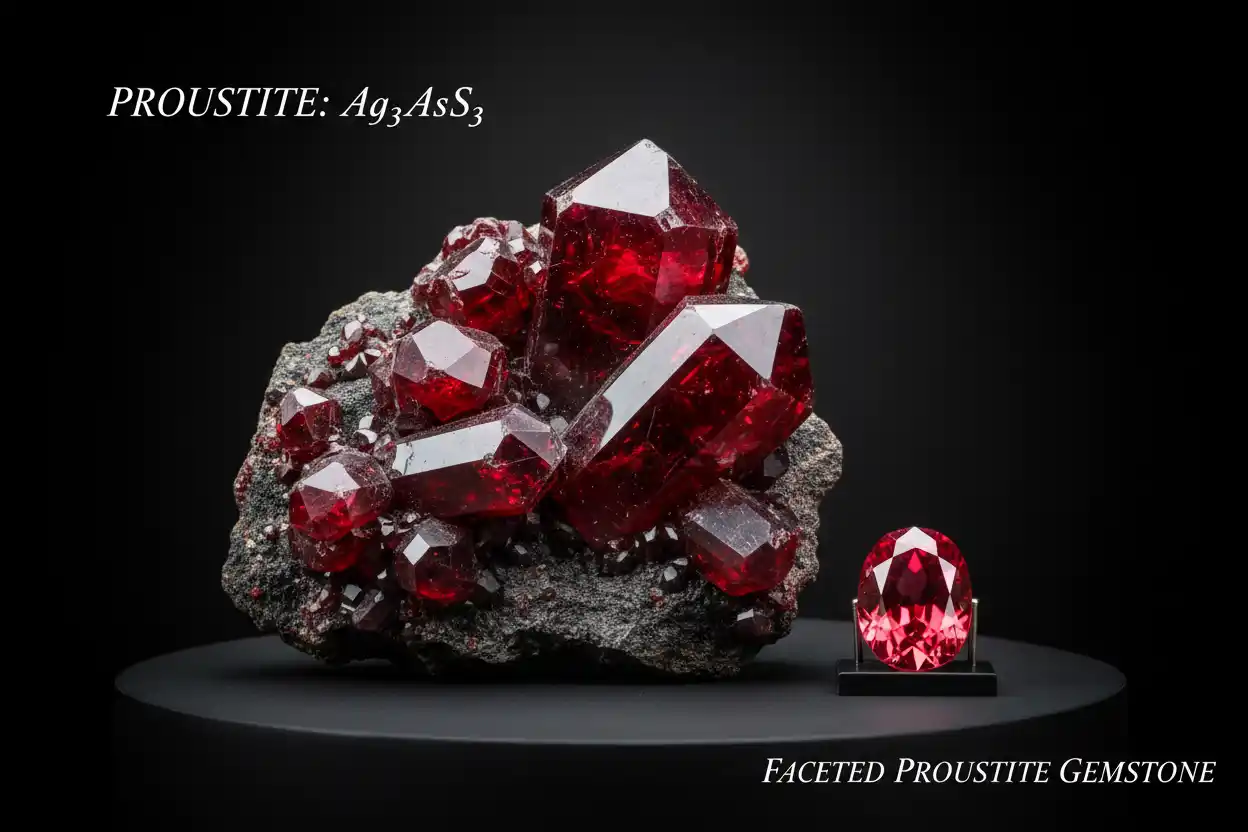
Proustite: Meaning, Properties & Symbolism
Proustite is a soft, dense silver arsenic sulfosalt recognized for scarlet, vermilion, cochineal-red, and blood-red crystals with an unusually brilliant adamantine luster. Historic miners grouped it with several red silver ores under the name ruby silver because thin crystals can glow deep red when illuminated from behind.
Its beauty is unusually difficult to preserve. Strong light can darken Proustite from transparent red to dull gray or nearly black, while its arsenic content makes it unsuitable for elixirs, ingestion, casual lapidary work, or frequently handled jewelry.
Proustite at a Glance
| Property | Proustite |
|---|---|
| Material type | Silver arsenic sulfosalt mineral |
| Composition | Ag₃AsS₃ |
| Common names | Light-red silver ore, ruby silver, ruby silver ore, arsenic ruby silver |
| Common colors | Scarlet, vermilion, cochineal red, blood red, dark red, gray-black after light alteration |
| Crystal system | Trigonal |
| Typical habit | Prismatic, scalenohedral, rhombohedral, twinned, divergent, massive, compact, or granular |
| Luster | Adamantine to subadamantine; may become dull after alteration |
| Transparency | Transparent to translucent when fresh; often becomes opaque with light exposure |
| Mohs hardness | Approximately 2–2.5 |
| Cleavage | Distinct |
| Tenacity | Brittle |
| Fracture | Conchoidal to uneven |
| Specific gravity | Approximately 5.5–5.6 |
| Streak | Scarlet to vermilion red |
| Common use | Protected mineral specimens, scientific collections, ore-mineral displays, and rare historic collections |
| Main care concern | Light-induced darkening, scratches, arsenic-bearing dust, surface contamination, and loss of locality information |
What Proustite Is
Proustite is a naturally occurring compound of silver, arsenic, and sulfur. Its ideal formula, Ag₃AsS₃, contains three silver atoms for every arsenic-sulfur group.
Mineralogically, it belongs to the sulfosalts. These minerals combine a metal such as silver, copper, or lead with sulfur and a semimetal or metal such as arsenic, antimony, or bismuth.
A sulfosalt is not simply a sulfide with an insignificant impurity. Arsenic forms an essential part of Proustite’s crystal structure.
The mineral is also an economically important silver ore in some deposits. Silver accounts for a large proportion of its mass, although an individual collector specimen should not be destroyed for metal recovery.
Proustite is classified more accurately as a mineral specimen than as a conventional gemstone. The wider distinction among minerals, gems, rocks, and organic materials appears in types of gemstones.
Why Proustite Is Called Ruby Silver
The ruby-silver name developed from appearance and mining history rather than a relationship with ruby.
Fresh Proustite can display vivid red transparency, especially in thin crystals or illuminated edges. Its high refractive indices and adamantine luster produce a brilliance that resembles certain red gemstones.
However, Ruby is chromium-bearing corundum with the composition Al₂O₃ and a Mohs hardness of 9. Proustite is an arsenic-bearing silver sulfosalt with a hardness near 2.
Proustite can be scratched by a fingernail or copper coin under suitable conditions, whereas ruby resists nearly every common abrasive.
The word ruby in ruby silver should therefore be understood as an old color description. It does not make Proustite a corundum variety or a substitute for ruby jewelry.
The wider visual category is represented in the red-crystal directory, although Proustite requires stricter safety and display controls than most entries.
Proustite and Pyrargyrite
Pyrargyrite is Proustite’s closest familiar comparison.
Proustite has the formula Ag₃AsS₃ and contains essential arsenic. Pyrargyrite has the formula Ag₃SbS₃ and contains antimony instead.
Both occur in silver deposits, form trigonal crystals, display red internal color, possess high density, and have historically been called ruby silver.
Proustite is generally associated with a lighter scarlet or vermilion red, which led to the term light-red silver ore. Pyrargyrite commonly appears darker and was called dark-red silver ore.
That color distinction is useful historically but not conclusive. Thick Proustite crystals can look almost black, while thin Pyrargyrite edges may transmit red light.
Chemical analysis, Raman spectroscopy, X-ray diffraction, and optical testing provide a defensible separation. A visual label based solely on red color and silver locality remains provisional.
The two minerals can also occur together, complicating the identification of aggregates and older collection specimens.
Crystal Form and Optical Appearance
Proustite crystallizes in the trigonal system.
Well-developed crystals can be elongated prisms terminated by rhombohedral, scalenohedral, or pyramidal faces. Divergent groups and complex twins also occur.
Some crystals resemble pointed calcite forms, particularly when their color has darkened. Others form clusters of narrow red prisms on pale calcite, quartz, or ore matrix.
Fresh surfaces have an adamantine luster comparable with diamond-like or high-index minerals. This luster can remain visible even when the crystal is too dark to transmit much light.
Proustite is strongly birefringent and optically uniaxial negative. In a suitably transparent crystal, different directions can show cochineal, scarlet, or blood-red tones.
These optical properties are scientifically distinctive, but most museum and collector specimens should not undergo prolonged testing beneath powerful light sources.
How Proustite Forms
Proustite is a late-stage mineral in silver-bearing hydrothermal systems.
Hot mineral-bearing fluids move through fractures and veins, depositing quartz, carbonates, sulfides, sulfosalts, native silver, and other ore minerals as conditions change.
Proustite commonly forms during relatively late vein stages or within oxidized and supergene-enrichment zones.
Groundwater interacting with an ore body can dissolve, transport, and redeposit silver and arsenic-bearing components closer to the surface.
Associated minerals include native silver, acanthite, stephanite, tetrahedrite-group minerals, chlorargyrite, xanthoconite, arsenic, calcite, quartz, and several additional silver sulfosalts.
Pyrite may occur in the wider ore assemblage, but its brass-yellow cubic appearance, greater hardness, and iron-sulfide composition distinguish it from fresh Proustite.
The exact sequence differs by mine. A pale calcite matrix beneath red crystals may record several episodes of fluid flow rather than one simultaneous growth event.
Why Proustite Darkens in Light
Light sensitivity is Proustite’s defining preservation problem.
Fresh transparent crystals can darken after exposure to visible and ultraviolet light. The change may begin as a dulling of luster or a gray surface film before the crystal becomes brown-black or opaque.
The process involves light-driven changes within the silver-bearing material, including decomposition and the development of silver-rich alteration products.
Intensity and duration both matter. Strong sunlight, ultraviolet lamps, photography lights, and prolonged display illumination can accelerate the change.
A low-wattage bulb is not automatically safe because its spectrum can still include damaging wavelengths.
Darkening should be treated as potentially irreversible. Heating, polishing, chemical cleaning, or exposing the specimen to stronger light will not safely restore its original appearance.
Museums and careful collectors commonly store important Proustite in darkness and display it only briefly under low-intensity, low-ultraviolet lighting.
Photographs taken before darkening become part of the specimen’s documentation, but digital images should not be used to imply that an altered specimen still retains its former transparency.
Important Proustite Localities
Chañarcillo in Chile’s Atacama Region produced some of the most celebrated historic crystals. Fine specimens can display elongated red prisms, complex groups, and strong transmitted color.
Freiberg and other Saxon mining districts in Germany are classic European sources. Their specimens often carry historical labels from important silver-mining collections.
Jáchymov in the Czech Republic, historically called Joachimsthal, has produced Proustite with calcite, silver minerals, arsenides, and related ore species.
The Imiter Mine in Morocco has supplied more recent groups of lustrous red crystals, expanding the modern specimen market.
Sainte-Marie-aux-Mines in France, the Harz Mountains in Germany, Mexico, Peru, Bolivia, Romania, and several United States silver districts have also produced Proustite.
Locality strongly affects collector value. A small crystal from a closed classic mine can command more than a larger specimen with vague or incorrect provenance.
Mine-level documentation should remain with the specimen even when the crystal has darkened.
Proustite, Realgar, and Cinnabar
Realgar is an arsenic sulfide with a vivid red-to-orange appearance and strong light sensitivity.
Its formula, As₄S₄, lacks silver. Realgar is also softer, less dense, and commonly develops orange-yellow alteration products after light exposure.
Cinnabar is mercury sulfide, HgS. It commonly appears scarlet to dark red, has a red streak, and is extremely dense.
Proustite’s silver-arsenic chemistry, adamantine luster, crystal form, optical properties, and ore associations distinguish it from both.
All three require careful handling because their compositions contain toxic elements. None belongs in drinking water, powdered preparations, cosmetics, incense, or unventilated lapidary work.
How to Identify Proustite
Color provides an initial clue but cannot confirm the mineral.
A fresh crystal may show scarlet transparency and adamantine luster. An altered specimen may be black, dull, and visually indistinguishable from several silver minerals.
High density is noticeable in a compact specimen. Proustite feels unusually heavy for its dimensions because silver accounts for much of its composition.
Its hardness of approximately 2–2.5 is low, but scratch and streak testing should not be performed on a valuable or arsenic-bearing specimen.
Creating a streak produces mineral powder and permanently damages the crystal.
Raman spectroscopy can distinguish Proustite from Pyrargyrite, Realgar, Cinnabar, garnet, and glass without requiring a large sample.
X-ray diffraction confirms crystal structure, while chemical analysis identifies silver, arsenic, and sulfur.
Some handheld instruments detect silver and arsenic effectively, but surface coatings, mixed specimens, geometry, and calibration can complicate interpretation.
The multi-method workflow in how to identify crystals is particularly important for mislabeled historic ore minerals.
Can Proustite Be Faceted?
Transparent Proustite can technically be cut, but it is one of the least practical faceting materials.
Hardness near 2–2.5 means polishing scratches easily. The crystal is brittle, sensitive to heat, and vulnerable to surface damage.
Light used during cutting, inspection, photography, display, and ordinary wear can darken the finished gem.
Arsenic-bearing dust adds a serious occupational hazard for the cutter.
A faceted stone would also require dark storage, making conventional jewelry use contradictory to preservation.
For these reasons, complete natural crystals are usually more valuable and scientifically useful than cut material.
A historic faceted example belongs in a protected collector or museum setting rather than an exposed ring.
The gemstone hardness chart places Proustite far below mainstream jewelry gems, while gemstone toughness versus hardness explains why brittleness creates a separate breakage risk.
Treatments, Repairs, and Misidentification
Natural Proustite does not require color treatment when fresh.
However, specimens may be oiled or coated to restore temporary surface gloss after darkening. Such a coating does not reverse the underlying light damage.
Glue may secure detached crystals or stabilize a fragile matrix. Repairs should be disclosed because they affect both value and safe handling.
Paint, resin, dyed minerals, red glass, garnet fragments, and artificial crystals can imitate the appearance in photographs.
A specimen sold as vivid transparent Proustite should be photographed under controlled conditions without encouraging prolonged bright-light exposure.
Artificially saturated red images can also conceal darkening and surface alteration.
The broader distinctions among coating, filling, dye, and repair appear in gemstone treatments explained.
General signs of glass, molded resin, fabricated reports, and renamed common minerals appear in how to spot fake crystals.
Current Proustite Asking Prices
Proustite is priced as a rare mineral specimen rather than by carat.
| Proustite product | Broad July 2026 retail asking range |
|---|---|
| Tiny crystal fragment or low-grade specimen | About $30–$125 |
| Small visible crystal on matrix | About $100–$300 |
| Gemmy crystal from a recognized locality | About $250–$750 |
| Attractive multi-crystal specimen | About $500–$1,500 |
| Fine historic Freiberg, Jáchymov, or Chañarcillo specimen | About $1,000–$5,000 or more |
| Exceptional large, undamaged, documented specimen | Several thousand to tens of thousands of dollars |
| Faceted collector stone | Individually priced, with too few safe and reliable comparables for a standard per-carat range |
These figures represent broad asking-price context rather than formal appraisals or guaranteed transaction values.
Recent specialist listings include small gemmy German crystals around a few hundred dollars and larger historic specimens near or above $1,000.
A lower price may reflect darkening, damage, incomplete crystals, poor locality information, arsenic-related handling concerns, or incorrect identification.
What Gives Proustite Value?
Crystal preservation comes first. Fresh red transparency and adamantine luster are difficult to retain.
Shape matters because complete prismatic or scalenohedral crystals are less common than massive or granular material.
Size raises value only when the crystal remains well formed and minimally damaged.
Matrix contrast can improve visual appeal. Red crystals on pale calcite or quartz display more strongly than dark crystals crowded into black ore.
Historic locality and provenance add substantial collector importance. An old mine label may preserve information that can no longer be reconstructed from appearance.
Associated minerals can raise value when they clarify the deposit and create an aesthetic composition.
Light alteration, gray-black coating, scratches, broken terminations, glue, and unstable matrix reduce value unless the specimen is historically important.
Safe storage history also matters. A specimen repeatedly displayed beneath strong lights may continue to change after purchase.
Buying Proustite
Ask whether the photograph shows the specimen’s current appearance.
Old images may depict brighter red color than the crystal retains today.
Request recent photographs under brief, controlled illumination and ask how the specimen has been stored.
Confirm the mine, district, country, crystal dimensions, total specimen size, repairs, and collection history.
A seller should disclose whether the crystal has darkened, been coated, received glue, or detached from its original matrix.
Do not request scratch, streak, acid, or heat tests. These methods create damage and unnecessary exposure.
Shipping requires immobilizing the matrix without placing tissue, foam, or pressure against the crystals.
The specimen should arrive with a permanent hazard label noting arsenic content and light sensitivity.
Proustite appears in the crystals beginning with P directory but is not assigned automatically to the matching gemstone directory because it is unsuitable for ordinary gem use.
Safe Handling and Storage
Store Proustite inside a closed opaque box or cabinet when it is not being examined.
For brief display, use low-intensity lighting with minimal ultraviolet output. Avoid direct sunlight completely.
Handle the specimen by a stable matrix or container rather than touching the crystals.
Disposable nitrile gloves are sensible for handling damaged, dusty, or crumbly material. At minimum, wash hands thoroughly afterward.
Do not brush, blow, vacuum, soak, or use compressed air on a loose specimen.
Water does not make an arsenic-bearing specimen suitable for cleansing or elixir use. The broader crystal water-safety guide should not be interpreted as permission to immerse Proustite.
Never store it loose with jewelry, children’s collections, food utensils, cosmetics, or frequently handled stones.
A sealed specimen box reduces dust transfer while preserving the label and protecting the crystal from light.
Proustite Meaning and Symbolism
Proustite’s modern symbolism is shaped by its vivid red color, silver content, rarity, and extreme sensitivity to light.
Collectors may associate it with preservation, restraint, discernment, and recognizing that visibility can sometimes cause damage.
Its transformation from transparent red to opaque black offers a metaphor for irreversible consequences and the need to understand a material before exposing it.
The ruby-silver name can also symbolize the difference between appearance and identity. A stone may resemble a familiar gem while belonging to a completely different chemical and historical category.
Proustite does not have a well-supported universal ancient crystal-healing tradition. Most detailed metaphysical claims developed recently around material that rarely entered personal use.
These meanings remain personal, artistic, historical, or spiritual interpretations. Scientific evidence does not show that Proustite treats disease, increases courage, changes blood chemistry, or produces guaranteed emotional effects.
Frequently Asked Questions
What is Proustite made from?
Proustite is a silver arsenic sulfosalt with the formula Ag₃AsS₃.
Why is Proustite called ruby silver?
Fresh crystals can transmit vivid ruby-red light and contain a high proportion of silver. The name describes appearance and ore history, not a relationship with ruby.
Does Proustite contain real silver?
Yes. Silver is an essential part of its chemical composition and accounts for much of the mineral’s high density.
Why does Proustite turn black?
Light can trigger structural and chemical alteration in the silver-bearing material, producing a dark, dull, and increasingly opaque surface.
Can darkened Proustite be restored?
No safe and reliable home method restores the original red transparency. Polishing, chemicals, heating, and stronger illumination can cause further damage.
How should Proustite be displayed?
Use brief low-intensity display periods, exclude direct sunlight and ultraviolet radiation, and return the specimen to opaque storage afterward.
Is Proustite the same as Pyrargyrite?
No. Proustite contains arsenic, whereas Pyrargyrite contains antimony. Both belong to the historic ruby-silver category.
Is Proustite safe to touch?
An intact specimen can be handled briefly with precautions, but unnecessary contact should be avoided. Wash hands afterward and use gloves for dusty, damaged, or crumbly material.
Can Proustite go in water?
It should not be soaked or used in drinking-water preparations. Water can affect the matrix or repairs and does not remove the arsenic hazard.
Can Proustite be worn as jewelry?
It is too soft, brittle, light sensitive, rare, and hazardous to cut for practical everyday jewelry.
How can Proustite be identified without damaging it?
Raman spectroscopy, X-ray diffraction, optical testing, density measurements, and chemical analysis can identify it without creating a streak or scratch.
What makes a Proustite specimen valuable?
Fresh red color, transparency, crystal form, size, undamaged terminations, attractive matrix, classic locality, historic provenance, and limited light alteration determine value.
Proustite is best preserved as a carefully documented ore-mineral specimen rather than treated as a red gemstone for handling or wear. Collectors choosing between natural display pieces and extensively altered products can apply the principles in the guide to raw versus polished crystals.
Proustite contains arsenic and must never be ingested, licked, powdered, burned, heated, placed in drinking water, or used in mineral elixirs. Avoid generating dust. Cutting or specimen preparation requires professional containment, wet methods where chemically appropriate, local extraction, protective clothing, eye protection, and correctly selected respiratory controls.