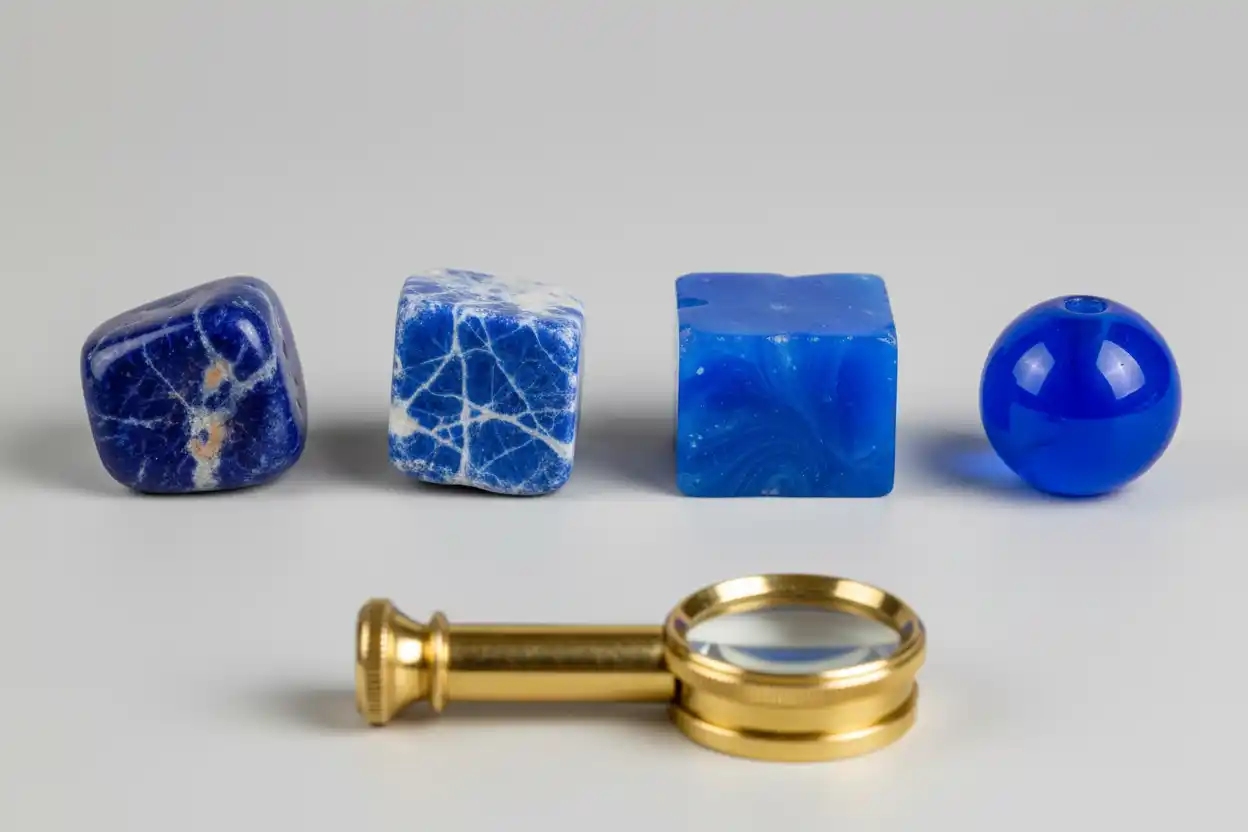
How to Spot Treated or Synthetic Sodalite
Treated Sodalite has been altered after mining to deepen its blue color, improve surface luster, conceal fractures or strengthen weak material. Products marketed as “synthetic Sodalite” require an additional distinction: true synthetic Sodalite would share the mineral’s essential composition and crystal structure, whereas blue glass, plastic, resin and dyed stone are imitations rather than synthetics.
In ordinary jewelry and carving markets, dyed substitutes, reconstructed material and misidentified blue stones are generally more relevant concerns than a true gem-quality laboratory-grown Sodalite counterpart.
No single visual sign proves treatment in every case. Color concentration, surface coatings, bubbles, mold seams and unnatural repetition can raise suspicion, but a laboratory may be needed when identity and treatment materially affect price.
Treated Sodalite at a Glance
| Product type | What it means | Common clues |
|---|---|---|
| Natural untreated Sodalite | Mined material without intentional enhancement | Variable blue, white or gray areas and natural mineral texture |
| Dyed Sodalite | Genuine Sodalite whose color has been strengthened | Color concentrated in cracks, pores or drill holes |
| Waxed or oiled material | Surface luster or color temporarily improved | Uneven greasy sheen or residue in recesses |
| Resin-stabilized Sodalite | Polymer added to weak or porous material | Plastic-like luster, filled cavities or altered response to repair |
| Reconstructed Sodalite | Crushed natural material bound with resin | Granular texture, repeated fragments or visible binder |
| Coated material | Colored or clear film applied to the surface | Abrasion along edges, peeling or color limited to the exterior |
| True synthetic Sodalite | Laboratory-grown material with Sodalite structure | Requires laboratory identification; uncommon in normal gem retail |
| Sodalite imitation | Different material made to resemble Sodalite | Glass bubbles, plastic feel, dye patterns or wrong physical properties |
What Is Natural Sodalite?
Sodalite is a sodium-rich feldspathoid mineral most commonly encountered as an opaque to translucent blue ornamental material.
White, gray or cream-colored Calcite often forms veins, patches and irregular areas through the blue body. Pyrite is generally absent or much less prominent than it is in many pieces of Lapis Lazuli.
Natural Sodalite can also occur in colorless, gray, green, yellow, pinkish and violet material. Transparent crystals are rare compared with the massive blue rock used for cabochons, beads and carvings.
The main Sodalite meaning guide owns mineralogy, symbolism and general uses. This page concentrates on treatments, synthetic terminology and disclosure.
Treated, Synthetic and Imitation: Three Different Terms
A treated stone began as natural Sodalite and was altered after mining.
A synthetic stone would be grown by people with essentially the same composition and crystal structure as natural Sodalite.
An imitation only resembles Sodalite visually. Blue glass, resin, plastic and dyed Magnesite can imitate Sodalite without being chemically related to it.
These terms should not be used interchangeably. A dyed natural Sodalite remains natural but treated. A blue glass bead is manufactured, yet it is not synthetic Sodalite.
The completed lab-grown versus natural gemstones guide explains the distinction between natural, synthetic and imitation materials.
Is Synthetic Sodalite Real?
Sodalite-structure materials can be produced in laboratories for scientific and industrial purposes.
That fact does not mean faceted or carved gem-quality synthetic Sodalite is a common jewelry product. Most suspicious blue ornaments are more likely to be glass, resin, composite material or a dyed natural stone.
A seller using the phrase “synthetic Sodalite” should state what the material actually is. It may be a legitimate laboratory-grown Sodalite structure, but it may also be inaccurate retail shorthand for an imitation.
Ask for a report or technical specification when the claim affects price.
Dyed Sodalite
Dye may be used to deepen pale, grayish or uneven blue Sodalite.
The treatment can make low-grade material appear more uniformly saturated. It may also conceal natural color variation that would otherwise reduce commercial appeal.
Dye often enters pores, fractures and drill holes more readily than solid areas. Under magnification, these features may appear darker or more intensely blue than the surrounding stone.
A polished exterior can look even while the edge of a hole or chipped section reveals a paler interior.
Some dyes remain stable during normal wear. Others can fade, bleed or react with alcohol, acetone, heat and prolonged sunlight.
Dye Concentration in Cracks
Color concentrated along fractures is one of the most useful visual clues.
Examine the stone under neutral light with a loupe. Blue lines that appear much darker than the main body may contain dye.
However, natural mineral staining can also collect along fractures. One colored line should not be treated as automatic proof.
Look for several related signs: concentrated color around drill holes, uneven penetration, pale chipped areas and residue on stringing material.
The completed real-versus-fake Sodalite guide owns the broader authentication workflow.
Drill-Hole Clues
Beads often reveal treatment more clearly around their drill holes.
Dye may accumulate inside the opening, particularly where the drilling created small fractures.
The hole may also expose a paler core beneath an intensely blue surface.
Resin and wax can collect as glossy residue near the opening.
A clean hole does not prove that the bead is untreated. Manufacturers may dye rough before drilling or use treatments that penetrate deeply.
Inspect several beads rather than drawing a conclusion from one example.
Wax and Oil Enhancement
Wax or oil can deepen color and improve surface luster temporarily.
The treatment may make pale blue material appear richer and reduce the visibility of fine surface cracks.
Excess product can collect in carved recesses, drill holes and unpolished areas.
A waxed surface may develop uneven dullness as the material wears. Oil can attract dust or migrate from cracks after exposure to heat.
Wax and oil are not necessarily deceptive when disclosed. Their presence changes care and may require periodic professional maintenance.
Resin Stabilization
Weak or fractured material may be impregnated with polymer resin.
Stabilization can improve durability and allow porous material to accept a better polish.
A stabilized stone may remain useful for beads and carvings, but it should not be represented as equivalent to untreated solid material.
Possible clues include filled cavities, a plastic-like shine, unusual surface smoothness and small bubbles within transparent filler.
Infrared spectroscopy is much more reliable than appearance for confirming polymer impregnation.
Heat, solvents and jewelry repair can damage or discolor resin.
Reconstructed Sodalite
Reconstructed material is made by combining crushed Sodalite or Sodalite-rich fragments with resin or another binder.
The resulting block can be cut into beads, cabochons and decorative objects.
A reconstructed piece may show repeated blue fragments separated by fine binder lines. The texture may appear granular under magnification.
Gas bubbles, flow marks and an unusually uniform distribution of chips can also occur.
The product may contain genuine Sodalite particles, but the complete object is a composite. Disclosure should use terms such as reconstructed, reconstituted or composite rather than implying one solid natural stone.
Coated Sodalite
A colored coating can intensify blue or create a glossy finish.
Clear coatings may protect a weak surface, while blue films can make pale material look darker.
Look for wear along edges, scratches and drill-hole rims. A chipped coating may reveal a different color beneath.
Pooling around recessed areas or a surface that resembles varnish can provide additional clues.
Coatings are usually more vulnerable than the stone itself. Abrasive polishing, solvents and repeated friction can remove them.
Blue Glass Imitations
Glass can imitate Sodalite when it is colored blue and mixed with white streaks or swirls.
Round gas bubbles, flow lines and mold seams may appear under magnification.
Some glass has a smoother, more uniform appearance than natural Sodalite. However, manufactured glass can also be deliberately made irregular.
The white areas in glass may look suspended or melted rather than crystalline.
A destructive scratch test should not be used. Professional refractive-index, density and Raman testing can separate glass from Sodalite safely.
Plastic and Resin Imitations
Plastic and resin can be molded into beads, carvings and decorative shapes.
The material may feel unusually light or warm quickly in the hand, although these observations are subjective.
Mold seams, surface dimples, repeated patterns and round bubbles may appear.
A hot-needle test can damage the object and release fumes. It should not be used.
Some resin products contain crushed natural mineral, making them composites rather than simple plastic imitations.
Dyed Magnesite, Howlite and Marble
Pale porous materials can be dyed blue to imitate Sodalite, Turquoise and Lapis Lazuli.
Magnesite and Howlite commonly retain darker color in their veins and pores. Marble may show a coarser Calcite texture.
These materials differ in hardness, density, optical properties and reaction to acids.
Do not apply acid as a home test. A professional can identify carbonate-rich substitutes using non-destructive methods.
The broad guide to identifying crystals explains why appearance should be combined with controlled gemological observations.
Sodalite Versus Lapis Lazuli
Sodalite and Lapis Lazuli can both show blue bodies with white Calcite.
Lapis Lazuli is a rock whose blue component is mainly Lazurite, and it commonly contains Pyrite. Sodalite is a distinct mineral and usually lacks the characteristic metallic Pyrite flecks.
Not every Lapis specimen contains obvious Pyrite, and not every metallic fleck proves Lapis. Composite and dyed materials can imitate both.
The completed Lapis Lazuli versus Sodalite guide owns the detailed comparison.
The main Lapis Lazuli meaning guide provides additional material context.
Sodalite Versus Azurite
Azurite is a copper carbonate with a deeper blue color and different physical properties.
Azurite may occur with Malachite and other copper minerals, while Sodalite more commonly appears with Calcite and feldspathoid-bearing rock.
The completed Sodalite versus Azurite guide owns the full identification boundary.
A seller should not rely only on “royal blue” as proof of either material.
Hackmanite and Tenebrescence
Hackmanite is a Sodalite variety that can change color after exposure to ultraviolet light and then fade back.
This reversible effect is called tenebrescence.
Tenebrescence can support identification of Hackmanite, but it does not prove natural origin by itself. Laboratory-made Sodalite structures can also show luminescent or photochromic behavior.
Furthermore, some natural Sodalite fluoresces without showing a visible color change.
UV response should therefore be treated as one observation rather than a complete authentication method.
Can Heat Reveal Treatment?
Heating Sodalite at home is unsafe and unreliable.
Heat may damage dye, resin, wax, stringing material or the stone itself. It can also change luminescence and color in ways that are difficult to interpret.
A stone that fades, darkens or develops an odor after heating has already been damaged.
Treatment detection should rely on magnification, spectroscopy and professional testing rather than destructive experiments.
Solvent Tests
Alcohol or acetone can dissolve some dyes, waxes and coatings.
That does not make a solvent wipe an appropriate home test. Solvents can permanently alter the surface, remove legitimate treatments and damage jewelry adhesives.
They can also affect metal finishes and create harmful fumes.
A qualified gemologist may use a controlled solvent test on an inconspicuous area when appropriate. The owner should not experiment on a valuable or sentimental object.
Magnification
A loupe or microscope may reveal useful evidence without damaging the stone.
Look for color concentration, coating wear, bubbles, binder lines, mold seams, resin-filled cavities and repeated artificial patterns.
Natural Sodalite may show irregular mineral boundaries, granular Calcite and uneven blue distribution.
No single feature is universally diagnostic. A treated natural stone can retain many natural structures, while a sophisticated imitation may reproduce irregular patterns convincingly.
Refractive Index and Specific Gravity
Sodalite has gemological properties that differ from glass, plastic, Magnesite and many other substitutes.
A refractometer can help identify a polished surface, although massive aggregate material may provide limited readings.
Hydrostatic specific-gravity testing can also narrow the possibilities.
These methods require suitable equipment and experience. Mounted jewelry, porous material and composites can complicate results.
Values should be interpreted with microscopy and spectroscopy rather than used in isolation.
Raman and Infrared Spectroscopy
Raman spectroscopy can identify the mineral structure without requiring destructive sampling in many cases.
Infrared spectroscopy can reveal polymers, waxes and some binders.
These methods are particularly useful for composites and stabilized material whose surface appearance remains ambiguous.
A laboratory may also use ultraviolet-visible spectroscopy, X-ray methods or chemical analysis when necessary.
The goal is to answer several separate questions: what the material is, whether it is natural or synthetic, and whether any treatment is present.
Buying Treated Sodalite
Begin by asking for the exact material description.
The invoice should distinguish untreated natural Sodalite, dyed Sodalite, stabilized Sodalite, reconstructed material and imitation.
A seller should not call resin or blue glass “synthetic Sodalite” unless it genuinely shares Sodalite’s composition and crystal structure.
Compare price with the treatment. Dyed and reconstructed products may be attractive, but they should not carry the same value as fine untreated material.
The planned guide on where to buy real Sodalite will own seller selection and marketplace checks.
Caring for Treated Sodalite
Use a soft dry cloth for routine care.
When the treatment history is known and the piece is structurally sound, brief cleaning with lukewarm water and mild soap may be acceptable. Do not soak it.
Avoid alcohol, acetone, bleach, acids and abrasive cleaners.
Keep the stone away from high heat and prolonged intense sunlight, particularly when dye or resin may be present.
The guide to crystals that can go in water explains why a mineral’s treatment and setting matter alongside its name.
The guide to crystals that fade in sunlight covers light-sensitive dyes and minerals.
Spiritual Cleansing
Spiritual cleansing does not verify whether Sodalite is natural or treated.
Sound, visualization and placement on a clean dry cloth are conservative options for stones with uncertain treatment.
Avoid salt, prolonged water immersion and strong sunlight.
The completed guide to cleansing and charging Sodalite owns that separate intent.
Treatment disclosure should come from the seller or laboratory rather than a ritual response.
Storage
Keep Sodalite in a separate fabric pouch or padded compartment.
Quartz, Topaz, Sapphire and Diamond can scratch it. Sodalite may also be damaged by rough metal edges.
Do not store treated beads against absorbent white fabric if dye transfer is suspected.
Keep the material away from heat sources, solvent fumes and sunny windows.
Sodalite appears in the blue crystals guide and blue gemstones guide, as well as the crystals beginning with S and gemstones beginning with S directories.
Final Perspective
The phrase “synthetic Sodalite” is often less useful than a precise material description. The important questions are whether the object is natural Sodalite, treated natural material, a reconstructed composite or an unrelated imitation.
Visual clues can reveal obvious dye, resin and glass, but they cannot resolve every case. When the stone’s identity affects price, provenance or conservation, non-destructive laboratory analysis is more reliable than scratch tests, solvents or heat.
Frequently Asked Questions
1. Is Sodalite commonly dyed?
Dye can be used to strengthen pale or uneven blue material, although not every dark-blue stone is treated.
2. How can dyed Sodalite be recognized?
Look for concentrated color in fractures, pores, drill holes and chipped areas. These clues are useful but not conclusive alone.
3. Does synthetic Sodalite exist?
Sodalite-structure materials can be synthesized in laboratories, especially for scientific and industrial uses. True gem-quality synthetic Sodalite is not a common mainstream jewelry product.
4. Is blue glass synthetic Sodalite?
No. Glass is an imitation because it does not share Sodalite’s essential composition and crystal structure.
5. Can Sodalite be stabilized with resin?
Yes. Weak, fractured or porous material may be impregnated with polymer to improve durability and polish.
6. What is reconstructed Sodalite?
It is a composite made from crushed Sodalite or mineral fragments held together with resin or another binder.
7. Can UV light prove Sodalite is natural?
No. Natural and laboratory-made Sodalite materials can fluoresce or show photochromic behavior.
8. Is Hackmanite treated Sodalite?
No. Hackmanite is a natural tenebrescent Sodalite variety, although individual stones or imitations may still be treated.
9. Can acetone reveal dye?
Some dyes and coatings react to acetone, but solvent testing can damage the stone and should be left to a professional.
10. Is dyed Magnesite the same as Sodalite?
No. Magnesite is a different mineral that can be dyed blue to imitate Sodalite, Turquoise or Lapis Lazuli.
11. Does treated Sodalite need special care?
Yes. Avoid solvents, prolonged soaking, high heat, abrasive cleaning and intense sunlight when dye, wax or resin may be present.
12. When is a laboratory report useful?
Testing is worthwhile when natural identity, treatment, synthetic origin or composite construction materially affects value.