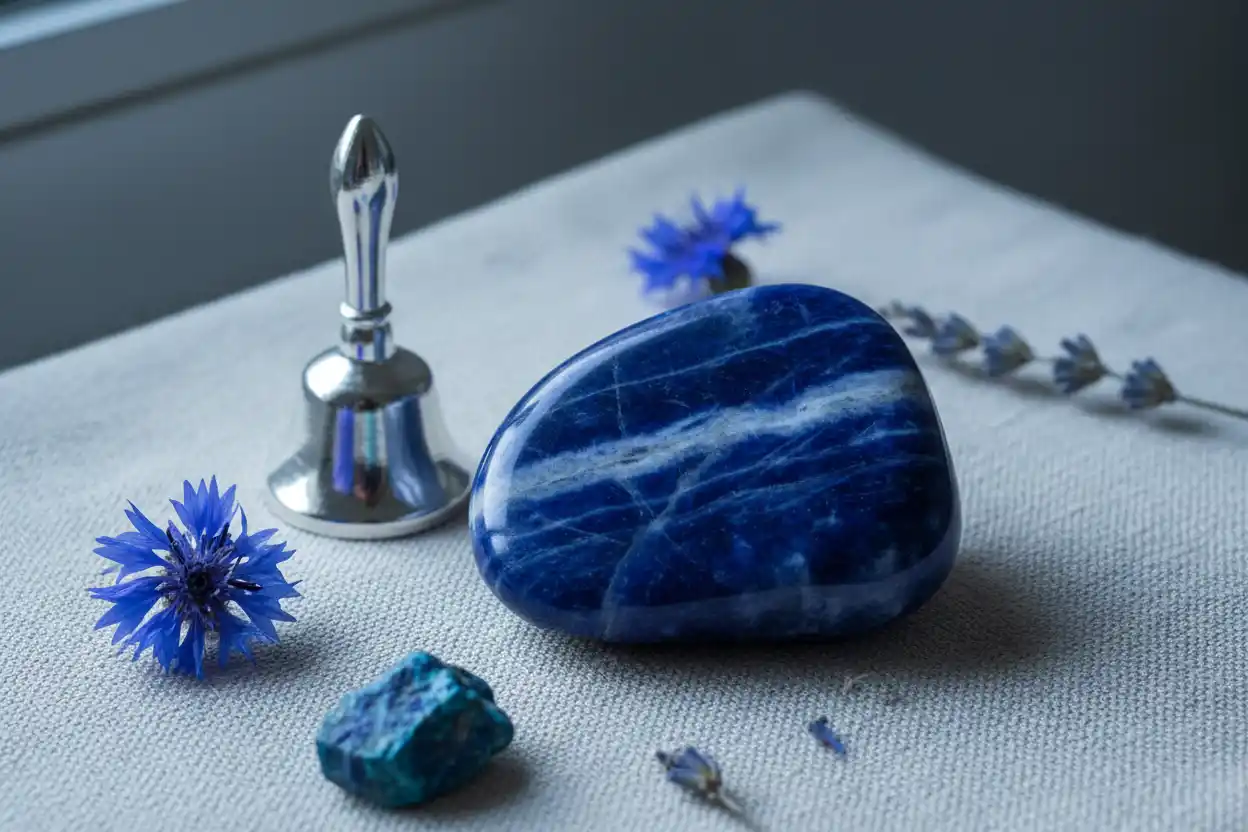
How to Cleanse and Charge Sodalite
The safest ways to cleanse and charge Sodalite are sound, intention, visualization, gentle breath, indirect indoor moonlight, a written dedication, and careful dry-cloth handling. A stable polished stone may tolerate brief contact with lukewarm water, but soaking is unnecessary because commercial Sodalite can contain fractures, white carbonate-rich veins, dye, glue, elastic, or other minerals.
Sodalite should not be buried directly in salt, cleaned with vinegar or acidic products, placed in steam or ultrasonic equipment, or rubbed against harder crystals. Although it has moderate hardness, its brittle tenacity makes polished edges, beads, carvings, and natural crystals vulnerable to chips.
What Cleansing and Charging Mean
Cleansing is a personal or spiritual ritual used to mark a new beginning, release earlier associations, or prepare an object for meditation.
Charging generally means connecting the stone with a purpose, habit, memory, value, or behavioral reminder.
Neither process is required to preserve Sodalite as a mineral. No established scientific evidence shows that cleansing changes its chemistry, fluorescence, color, health effects, or measurable physical energy.
The mineral’s geology, blue color, cultural symbolism, and traditional uses belong to the broader Sodalite guide. This page remains focused on physically conservative ritual methods.
Why Sodalite Needs Gentle Handling
Sodalite is a sodium aluminum silicate chloride and a member of the sodalite mineral group.
It usually occurs as massive blue material rather than well-formed transparent crystals. White, gray, violet, greenish, and colorless forms also exist.
| Property | Ritual implication |
|---|---|
| Mineral group | Sodalite group |
| Typical composition | Sodium aluminum silicate chloride |
| Common color | Royal blue to violet blue, often with white areas |
| Mohs hardness | Approximately 5.5 to 6 |
| Tenacity | Brittle |
| Cleavage | Poor |
| Fracture | Uneven to conchoidal |
| Safest ritual methods | Sound, intention, visualization, breath, and indoor moonlight |
| Water exposure | Prefer brief controlled contact rather than soaking |
| Main risks | Chips, scratches, fractures, white matrix, dye, glue, and acids |
The gemstone hardness chart explains why Quartz, Topaz, Sapphire, ceramic, and many common stones can scratch Sodalite.
Moderate hardness does not guarantee resistance to impact. That distinction appears in Gemstone Toughness vs Hardness.
Sodalite has poor rather than perfect cleavage, but brittle material can still chip or fracture. The broader structural concept appears in Gemstone Cleavage Explained.
White Veining Is Not Dirt
Blue Sodalite often contains irregular white, cream, gray, or pale areas.
These may consist of Calcite or other associated minerals within the host rock. They are part of the specimen rather than residue that should be scrubbed away.
Some commercial pieces also contain dark matrix, small fractures, or uneven blue saturation.
Do not scrape the white areas with a blade or use acid to remove them. Carbonate-rich veins may react to acidic cleaners, while scratching permanently damages the polish.
A visually uniform blue surface is not automatically more natural than a veined one. Dye and reconstruction can create strong color, so appearance alone does not determine treatment.
Inspect the Sodalite Before Beginning
Examine the object beneath bright, indirect light.
Look for chipped edges, open fractures, powdery white areas, damaged drill holes, loose beads, stretched elastic, peeling coatings, color concentrated in cracks, cloudy glue, and movement within a setting.
Dark or pale internal lines are not automatically damage. However, a line that catches on a soft cloth or reaches a fresh chip may be an open fracture.
Do not flex a thin slab, twist a bead around its cord, or press against a white vein.
When the surface appears crumbly or color transfers onto cloth, leave the object on a padded support and use a completely non-contact ritual.
Physical Cleaning Is Separate
Symbolic cleansing does not remove skin oil, cosmetics, soap residue, dust, or grime.
A stable polished Sodalite can be wiped gently with a dry microfiber cloth. When physical dirt requires moisture, use a cloth lightly dampened with lukewarm water and dry the stone promptly.
Do not soak bead strands, glued cabochons, elastic bracelets, carved inlay, coated material, or pieces with uncertain white matrix.
Steam and ultrasonic equipment should be avoided because heat and vibration can affect brittle material, fractures, glue, stringing, and mixed-mineral areas.
The broader machine-cleaning limits belong to Which Gemstones Can Go in an Ultrasonic Cleaner?.
Method 1: Cleanse Sodalite with Sound
Place the Sodalite on a thick folded cloth or padded tray.
Ring a bell, chime, tuning fork, or singing bowl nearby. You may also hum, chant, clap softly, or play quiet music.
Do not place the stone inside a hard metal bowl while striking it. Concentrated vibration and direct contact can chip an edge or damage a bead hole.
Several gentle tones are sufficient.
Sound is suitable for natural, dyed, treated, glued, strung, carved, and matrix-rich Sodalite because it introduces no moisture or chemical residue.
Method 2: Use Intention
Leave the Sodalite supported on a soft surface or hold a smooth stone loosely above a cloth.
Choose one concise purpose. It might remind you to communicate clearly, verify information before reacting, study consistently, listen without interrupting, or organize a complicated decision.
State the intention silently or aloud.
A specific behavioral intention creates a clearer personal association than a broad promise of healing or transformation.
Return the stone to padded storage when the ritual feels complete.
Method 3: Use Visualization
Place Sodalite where it cannot roll or fall.
Imagine previous associations fading while the blue surface becomes connected with your chosen purpose.
Some practitioners visualize blue, white, silver, or neutral light. Others follow the natural contrast between blue areas and pale veins.
The imagery is symbolic rather than a physical emission from the stone.
Continue for several slow breaths or a few minutes.
Visualization is especially suitable for cracked, dyed, glued, antique, or valuable Sodalite because it requires no environmental exposure.
Method 4: Use Gentle Breath
Keep the object on a padded cloth.
Take several slow breaths and exhale gently toward it once or twice.
Avoid forceful blowing or visible condensation around fractures, drill holes, glue seams, elastic, and white matrix.
Do not hold a bead strand by one end during the ritual. Lay it flat so the cord remains supported.
State the intention afterward.
Method 5: Use Indirect Moonlight Indoors
Place Sodalite indoors near a window on a lined tray or inside an open jewelry box.
An hour, an evening, or overnight indoor placement may be used according to personal preference.
Outdoor exposure introduces dew, rain, grit, animals, theft, and temperature changes.
The moon phase affects personal symbolism rather than Sodalite’s mineral structure.
Indirect indoor placement also avoids unnecessary exposure to strong ultraviolet light when the material may include photochromic Hackmanite.
The broader light framework belongs to Which Crystals Can and Can’t Go in the Sun.
Method 6: Use a Brief Damp-Cloth Ritual
A stable polished Sodalite may receive a brief wipe with a soft cloth dampened in clean lukewarm water.
Test an inconspicuous area first when dye or coating is possible.
Stop if blue color transfers, a white area softens, the surface becomes patchy, or moisture enters a fracture.
Do not immerse the stone for hours or leave it under running water.
The wider material-selection framework belongs to Which Crystals Can and Can’t Go in Water.
Water is optional. Sound and intention provide the same symbolic purpose with less uncertainty.
Method 7: Use a Written Dedication
Write one concise statement and place it beside the Sodalite.
A practical statement might focus on completing a study session, checking a source before sharing information, speaking directly, or protecting uninterrupted thinking time.
Keep clips, staples, pens, and rough objects away from the polished surface.
Leave the arrangement for several minutes or an evening.
This method is particularly useful for bead strands and carvings that should not receive repeated moisture.
Method 8: Use a Companion Object with Separation
Sodalite may be placed near Lapis Lazuli, Azurite, Clear Quartz, a photograph, a journal, or another meaningful object.
Use separate padded supports.
Quartz is harder and may scratch Sodalite. Sharp Azurite crystals, jewelry posts, and metal chains can also cause chips.
Direct contact is unnecessary for symbolic charging.
The complete comparison among ritual formats belongs to How to Cleanse Crystals.
Sodalite and Hackmanite
Hackmanite is a photochromic variety of Sodalite.
Exposure to ultraviolet light can trigger a reversible color change called tenebrescence. Depending on the material, pale Hackmanite may become pink, violet, purple, or more strongly colored before gradually fading.
This response is an optical property rather than evidence that the stone has absorbed spiritual energy.
A sunlight ritual is therefore not visually neutral for every Sodalite-group specimen.
When preserving the baseline appearance matters, use sound, intention, visualization, or protected moonlight instead of deliberate ultraviolet exposure.
Sodalite Versus Lapis Lazuli
Sodalite and Lapis Lazuli can both appear deep blue with pale veining.
Sodalite is a mineral species. Lapis Lazuli is a rock normally containing lazurite, Calcite, Pyrite, and other minerals.
The complete distinction belongs to Lapis Lazuli vs Sodalite.
Lapis often contains visible gold-colored Pyrite flecks, whereas these are not typical of ordinary Sodalite.
The broader Lapis material profile belongs to the Lapis Lazuli guide, while its ritual limits appear in How to Cleanse and Charge Lapis Lazuli.
Because both materials may contain white carbonate areas, acids and prolonged soaking should be avoided when identity is uncertain.
Sodalite Versus Azurite
Sodalite and Azurite can overlap in royal-blue color, but their chemistry and physical behavior differ.
Azurite is a soft copper carbonate mineral, while Sodalite is a sodium-rich aluminosilicate.
The complete identification distinction belongs to Sodalite vs Azurite.
Azurite’s broader material profile appears in the Azurite guide, while its ritual care belongs to How to Cleanse and Charge Azurite.
When an unidentified blue specimen may be Azurite, use completely dry methods and avoid water, acid, salt, and rubbing.
Avoid Vinegar and Acidic Products
Sodalite and its associated white minerals should not be exposed to vinegar, lemon juice, descaling products, bathroom cleaner, or acid-based metal dips.
Acid can attack Sodalite and may react more visibly with carbonate-rich veins.
Do not interpret bubbling, fading, a sulfurous odor, or surface dulling as successful cleansing.
These are signs of chemical interaction or damage.
Acid should never be used as an authenticity test on a polished stone.
Avoid Direct Salt Contact
Salt grains can scratch Sodalite and become trapped inside fractures, drill holes, setting gaps, and carved recesses.
Saltwater adds prolonged moisture and may affect dye, glue, elastic, metal, white matrix, and companion materials.
Do not bury the stone directly in coarse salt.
When salt carries personal symbolism, keep it in a separate bowl while the Sodalite remains on a lined dish nearby.
Avoid Soil Burial
Soil contains Quartz grains, moisture, fertilizers, microorganisms, organic acids, and mineral debris.
These materials can scratch Sodalite, enter fractures, stain white veins, and make carvings difficult to clean.
Outdoor burial also creates pressure and loss risks.
A safer nature-based ritual places the stone near a plant while keeping it dry and separated from soil.
Use Smoke Conservatively
A brief cool-smoke ritual may be used cautiously in traditions that include it.
Keep the stone away from flame, hot ash, incense coals, and heated containers.
Smoke can leave oils and soot on pale veins and porous surfaces, reducing the polish until the object is cleaned again.
Sound and visualization provide cleaner alternatives.
Treatments, Imitations, and Buying Context
Sodalite may be dyed, coated, filled, reconstructed, stabilized, or imitated with glass, resin, ceramic, dyed stone, and composite materials.
Treatment-specific boundaries belong to How to Spot Treated or Synthetic Sodalite.
The full comparison with imitations belongs to Real vs Fake Sodalite.
Purchase and disclosure checks belong to Where to Buy Real Sodalite.
Sodalite also belongs to the broader visual family in Blue Gemstones.
A cleansing ritual cannot establish whether a blue stone is natural, dyed, reconstructed, Lapis Lazuli, Azurite, or glass.
Safe Ritual Handling
Do not lick, grind, burn, drill without controls, or place Sodalite directly in drinking water.
Commercial specimens may contain Calcite, sulfide-bearing material, dye, glue, coating, polish, or contamination.
Ordinary intact handling differs from ingesting mineral material or deliberately producing dust.
The broader handling framework belongs to the Toxic Crystals safety list.
Frequently Asked Questions
1. What is the safest way to cleanse Sodalite?
Sound, intention, visualization, gentle breath, writing, and indirect indoor moonlight are safest.
2. Can Sodalite be cleansed in water?
A stable polished stone may receive a brief damp wipe. Avoid prolonged soaking, especially when dye, white matrix, glue, or fractures are present.
3. Can Sodalite be left in moonlight overnight?
Yes, when kept indoors on a dry padded surface.
4. Can Sodalite be charged in sunlight?
Ordinary Sodalite may tolerate normal light, but Hackmanite can change color under ultraviolet exposure. Sunlight is therefore not visually neutral for every specimen.
5. Can Sodalite be cleansed with salt?
Direct salt contact is not recommended because grains can scratch the stone and lodge in fractures or drill holes.
6. Can Sodalite be cleansed with smoke?
A brief cool-smoke ritual is possible, but sound or visualization avoids soot and oily residue.
7. Can vinegar clean Sodalite?
No. Acid can damage Sodalite and react with carbonate-rich white veins.
8. Can Clear Quartz charge Sodalite?
Some practitioners use it symbolically. Keep the stones separated because Quartz is harder and may scratch Sodalite.
9. Is Sodalite the same as Lapis Lazuli?
No. Sodalite is a mineral, while Lapis Lazuli is a multi-mineral rock.
10. Why does some Sodalite change color in ultraviolet light?
Photochromic Sodalite called Hackmanite can undergo reversible tenebrescence.
11. How long should Sodalite charge?
A few minutes or an evening is sufficient. There is no scientifically required duration.
12. Does cleansing change Sodalite scientifically?
No established evidence shows that cleansing changes its chemistry, fluorescence, health effects, or measurable physical energy.
Conclusion
Sodalite’s blue color may appear robust, but its brittle structure, white mineral veins, treatment uncertainty, and Hackmanite variants reward conservative handling. Sound, intention, visualization, and protected moonlight create a meaningful ritual without exposing the stone to acid, salt, abrasion, or prolonged water. The safest practice keeps every vein, edge, and color response physically unchanged.
Crystal cleansing and charging are spiritual or personal practices, not scientifically established methods for changing health, energy, or the physical properties of Sodalite.