How to Clean Garnet Jewelry Safely: Water, Soap & Care Guide
Learning how to clean garnet jewelry safely starts with a conservative method: inspect the piece, use lukewarm water with a small amount of mild liquid soap, clean gently with a soft brush or lint-free cloth, rinse briefly, and dry the jewelry completely. That approach works for many sound, untreated garnets in secure settings, but it should not be applied blindly to every ring, necklace, bracelet, or pair of earrings.
Garnet is a mineral group rather than a single identical material. Almandine, pyrope, rhodolite, spessartine, grossular, tsavorite, hessonite, and demantoid differ in composition, inclusions, rarity, and sometimes practical durability. The garnet meaning profile explains the family’s mineral properties and varieties, while the types of garnet guide shows why the label “garnet” can cover very different gemstones.
The jewelry itself can be more vulnerable than the garnet. Glue, thread, elastic, antique solder, enamel, plating, fracture filling, foil backing, accent gems, or a loose setting can turn an otherwise simple wash into a bad idea. So the safest answer to how to clean garnet jewelry is always based on the complete piece, not only the gemstone.
At Gems Lore, garnet care is kept separate from symbolic cleansing: one concerns physical residue, gemstone condition, and jewelry construction, while the other belongs to personal or spiritual practice.
Garnet Cleaning at a Glance
| Method | General guidance |
|---|---|
| Soft lint-free cloth | Excellent for routine wiping |
| Lukewarm water | Usually suitable for brief contact with sound garnet |
| Mild liquid soap | Good default for ordinary oils and residue |
| Very soft brush | Useful around prongs, galleries and bead holes |
| Long soaking | Usually unnecessary |
| Ultrasonic cleaner | Conditional; avoid when condition or treatment is uncertain |
| Steam | Not needed for routine home care |
| Boiling or very hot water | Avoid |
| Vinegar or lemon juice | Avoid |
| Toothpaste or abrasive paste | Avoid |
| Bleach or strong household cleaner | Avoid |
| Salt-water soak | Unnecessary |
| Alcohol or solvents | Avoid as a routine method |
| Professional cleaning | Best for valuable, antique, damaged or complex pieces |
Garnet generally ranks around 6.5–7.5 on the Mohs scale and lacks cleavage, but hardness is not the same as resistance to every form of damage. The difference between scratching, chipping, cleavage, and toughness is covered in gemstone toughness vs hardness.
What You Need
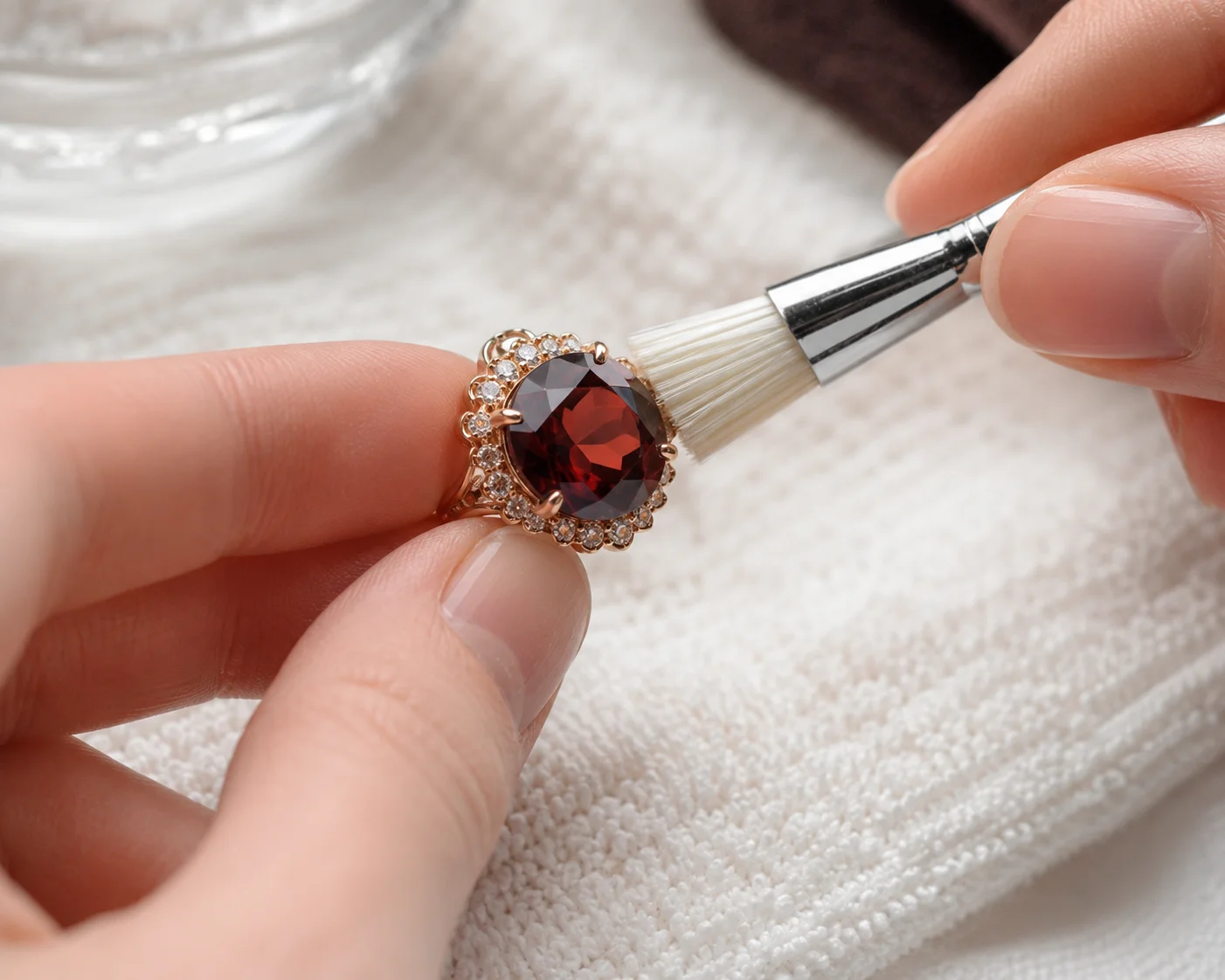
You do not need specialized chemicals to learn how to clean garnet jewelry at home. A shallow bowl, lukewarm water, a small amount of mild liquid soap, a very soft jewelry brush or soft toothbrush, a lint-free cloth, and a clean towel are enough for most routine cleaning.
Work over a bowl or towel rather than directly over an open sink. A loose garnet, earring back, small bead, or accent stone can disappear down a drain before you realize the setting was already weakened.
Use soap without bleach, abrasive particles, aggressive degreasers, heavy moisturizers, or polishing compounds. More chemical strength does not mean better cleaning.
Step 1: Inspect the Jewelry Before Water Touches It
The first step in how to clean garnet jewelry is inspection, not soaking.
Look at the garnet under bright, neutral light. Check for chips, surface-reaching fractures, abraded facet junctions, cloudy filler, loose movement, coatings, visible glue, damaged drill holes, or fractures around a bead.
Then examine the construction. Look closely at prongs, bezels, chain links, clasps, elastic, thread, soldered areas, pavé, enamel, and companion stones.
If the garnet moves in its setting, a prong catches on cloth, a bead hole has a spreading crack, or a repair looks unstable, stop. Cleaning does not fix mechanical damage. A jeweler should inspect the piece before it is worn or washed.
This inspection is especially important for expensive stones. The garnet quality and grading guide explains why color, clarity, cut, structural condition, and variety can materially affect value.
Step 2: Prepare Lukewarm Soapy Water
Fill a shallow bowl with lukewarm water and add only a small amount of mild liquid soap. The solution should be lightly soapy rather than concentrated.
Avoid very hot or very cold water. Sudden temperature changes add avoidable stress to gemstones that may contain inclusions or fractures. Do not move jewelry directly from a hot car, heater, strong lamp, or sunny windowsill into cold water.
For owners wondering how to clean garnet jewelry without soaking it, simply dampen the soft cloth or brush in the solution and work on the piece while keeping immersion to a minimum.
Step 3: Clean the Garnet and Setting Gently
Dip the soft brush into the solution and clean with light pressure. Focus on the areas that actually collect residue: the underside of a faceted stone, the gallery of a ring, prongs, bezel edges, bead holes, pendant bails, earring backs, and spaces where skin oil and soap film accumulate.
Garnet can look darker or less brilliant when grease coats the pavilion or sits beneath the setting. Removing that film often produces a noticeable improvement without polishing or aggressive scrubbing.
Do not force bristles into fractures. Do not scrape the setting with pins, needles, knives, or metal picks. Internal inclusions are not dirt and cannot be scrubbed out.
Understanding how to clean garnet jewelry safely means accepting that “cleaner” does not require more pressure.
Step 4: Rinse Briefly
For a sound, uncomplicated piece, rinse with clean lukewarm water at roughly the same temperature as the wash solution. Keep the rinse controlled and brief.
If the jewelry includes glue, stringing, elastic, foil, delicate antique construction, porous companion gems, coatings, or an uncertain treatment, use a second clean damp cloth to remove soap instead of immersing the whole item.
The broader crystals and water guidance explains why a mineral’s ability to tolerate brief water contact does not automatically make every finished object suitable for soaking.
Step 5: Dry Completely
Blot the piece with a lint-free cloth and let hidden moisture around prongs, clasps, bead holes, and galleries evaporate at room temperature.
Do not accelerate drying with a hair dryer, radiator, steam jet, or direct heater. Heat is unnecessary and may affect glue, coatings, thread, plating, or another gemstone in the design.
Once the jewelry is dry, inspect it again. Cleaning can reveal scratches, abrasion, setting wear, or fractures that were hidden under dirt.
The safest routine for how to clean garnet jewelry finishes with a second condition check, not merely a shinier stone.
Can Garnet Go in Water?
Most intact gem-quality garnets tolerate brief contact with ordinary lukewarm water. Garnet is not normally considered a water-soluble gemstone, and many varieties have no cleavage.
That does not make prolonged soaking a good default. The complete object may contain materials that respond differently from garnet. Adhesive, plated metal, elastic, thread, filler, antique repairs, coatings, enamel, and secondary gemstones can all impose stricter limits.
If you do not know how a piece was made or treated, use a damp cloth and short controlled cleaning instead of leaving it submerged.
Should You Soak Garnet Jewelry?
Usually not. Long soaking rarely removes ordinary jewelry residue better than a few minutes of careful hand cleaning.
When people ask how to clean garnet jewelry after months of accumulated grime, the answer is still not an overnight soak. Persistent residue beneath a closed or complicated setting may require professional equipment and inspection rather than more time in water.
Avoid long soaking when the piece contains beads, stretch cord, silk, glue, repairs, an antique mount, mixed gems, or unknown treatments.
Can Garnet Go in Salt Water?
Salt water offers no useful advantage for physical cleaning. Salt can collect around prongs and joints, requires extra rinsing, and may be unsuitable for some metals or construction methods.
If salt exposure is part of a spiritual practice, remember that physical cleaning and symbolic cleansing are different activities. How to cleanse crystals explains symbolic methods while keeping those practices separate from material care.
A garnet does not scientifically require energetic cleansing. If the stone has personal or spiritual significance, dry or non-contact practices avoid unnecessary salt and moisture.
Can Garnet Go in an Ultrasonic Cleaner?
Some untreated, structurally sound garnets in secure modern settings may tolerate ultrasonic cleaning, but ultrasound should not be the default home method.
Ultrasonic machines use high-frequency vibration. The concern is not simply whether garnet is “hard.” Vibration can exploit existing fractures, disturb filler, loosen pavé, expose weak prongs, affect glue, or damage another material in a mixed-gem piece.
Avoid ultrasound when the garnet is fractured, filled, repaired, heavily included, glued, antique, or mounted with more delicate stones. If treatment or structural condition is unknown, hand cleaning gives you much more control.
This is one reason how to clean garnet jewelry should not be reduced to a single yes-or-no machine recommendation.
Can Garnet Be Steam Cleaned?
Steam is unnecessary for ordinary home care. High heat and rapid temperature change add risk without solving a problem that mild soap and lukewarm water cannot usually handle.
Steam may also affect adhesives, fillers, enamel, antique solder, coatings, plating, or heat-sensitive companion materials.
For routine care, skip it.
Why Vinegar, Lemon Juice and Toothpaste Are Poor Choices
Vinegar and lemon juice are popular household-cleaning suggestions, but acids have no meaningful advantage for normal garnet jewelry. They can interact with metals, solder, coatings, filler, or other gemstones.
Toothpaste is also a poor choice. Many formulas contain abrasive particles designed for teeth rather than polished jewelry. Even if a particular garnet resists some abrasion, the metal surface, plating, or adjacent gem may not.
Baking-soda scrubs, scouring powders, bleach, metal dips, and strong degreasers should also stay out of routine garnet care.
When learning how to clean garnet jewelry, the least aggressive effective method is generally the best one.
How to Clean a Garnet Ring
Rings collect more hand lotion, soap, sanitizer, food residue, sunscreen, and household grime than most other jewelry forms.
Remove the ring and inspect every prong. Clean with mild soapy water and a soft brush, paying special attention to the underside of the stone and the gallery. Rinse briefly and dry completely.
Do not clean the ring while wearing it, and stop using it if a stone rocks or a prong catches on fabric.
The garnet ring guide explains settings, everyday wear, and variety-specific buying considerations that can affect long-term care.
How to Clean Garnet Earrings
Earrings accumulate hair products, makeup, skin oil, and residue around posts and backs. Remove detachable backs before cleaning.
Use the same mild solution and gently clean the front and rear of the setting. Dry posts, hooks, and backs fully before wearing the earrings again.
Gemstone cleaning is not the same as managing an infected or irritated piercing. If there is redness, pain, swelling, or discharge, follow appropriate healthcare advice rather than relying on jewelry cleaner.
For construction and wear considerations, the garnet earrings page covers studs, drops, hoops, matching, settings, and quality.
How to Clean a Garnet Necklace
A pendant is usually better protected from impact than a ring, but it still collects perfume, sunscreen, cosmetics, and skin oils.
Inspect the chain, clasp, bail, and stone before washing. If the garnet is securely mounted in a compatible metal, brief mild-soap cleaning is usually straightforward.
Do not immerse a pendant if glue is visible. For a beaded necklace, consider the stringing material before getting the full strand wet. Some threads and cords can stretch, weaken, or retain moisture.
The garnet necklace page covers pendants, bead strands, chains, and settings.
How to Clean a Garnet Bracelet
Bracelets receive repeated contact with desks, clothing, door frames, and household surfaces. Stretch bracelets add another vulnerable component: elastic.
Inspect clasps, links, wire, knots, bead holes, spacers, and elastic before cleaning. Use a damp cloth or brief wash rather than prolonged soaking when stringing is involved.
Lay the bracelet flat to dry instead of hanging wet elastic or thread under the weight of the beads.
The garnet bracelet page explains stretch bracelets, tennis styles, station designs, fit, and construction.
How to Clean Rhodolite Garnet Jewelry
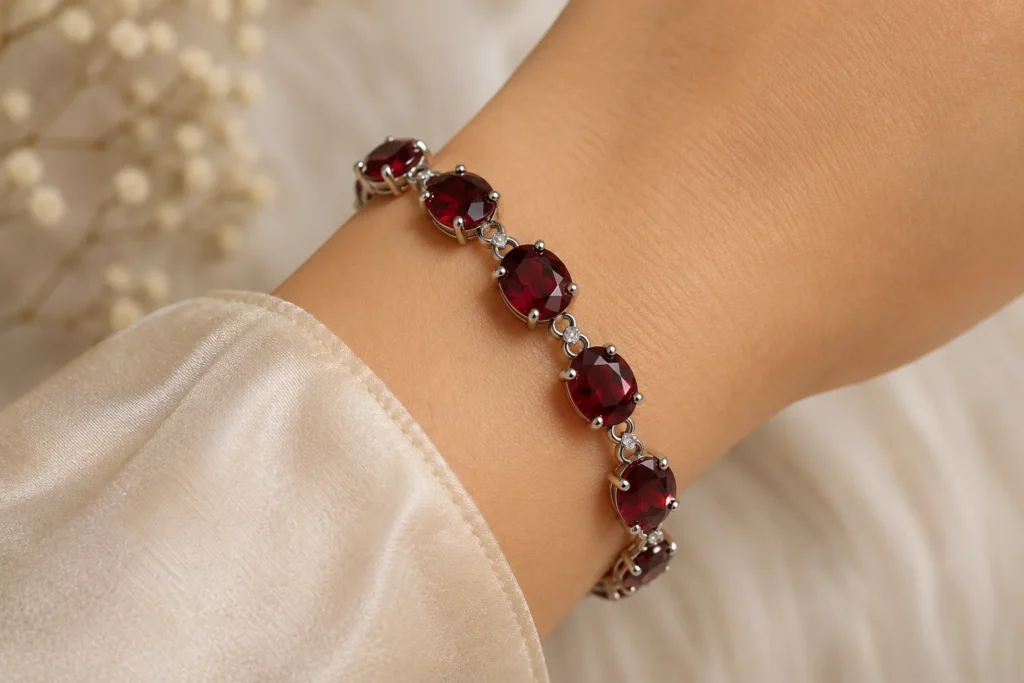
Rhodolite garnet is generally a pyrope-almandine garnet with raspberry, rose-red, or purplish-red color. Its different color does not require a fundamentally different cleaning system.
For intact rhodolite, use lukewarm water, mild soap, gentle brushing, brief rinsing, and careful drying. Pay attention to setting condition, fractures, treatment, and other materials in the jewelry.
Fine rhodolite can be valuable, so aggressive cleaning is not a sign of better care. Controlled hand cleaning is usually enough.
How to Clean Spessartite Garnet Jewelry
Spessartite garnet is the orange-to-reddish-orange garnet species also widely called spessartine. Fine bright material may be marketed as mandarin garnet.
Use mild soapy water and a soft brush on sound stones. Clean beneath the pavilion where skin oil can suppress brilliance.
Spessartite may contain visible inclusions. Those internal features are not dirt. Do not scrub more aggressively because a stone appears included, and do not assume a high-value gem should automatically go into a machine cleaner.
For fine orange stones, conservative hand cleaning gives more control.
How to Clean Demantoid Garnet Jewelry
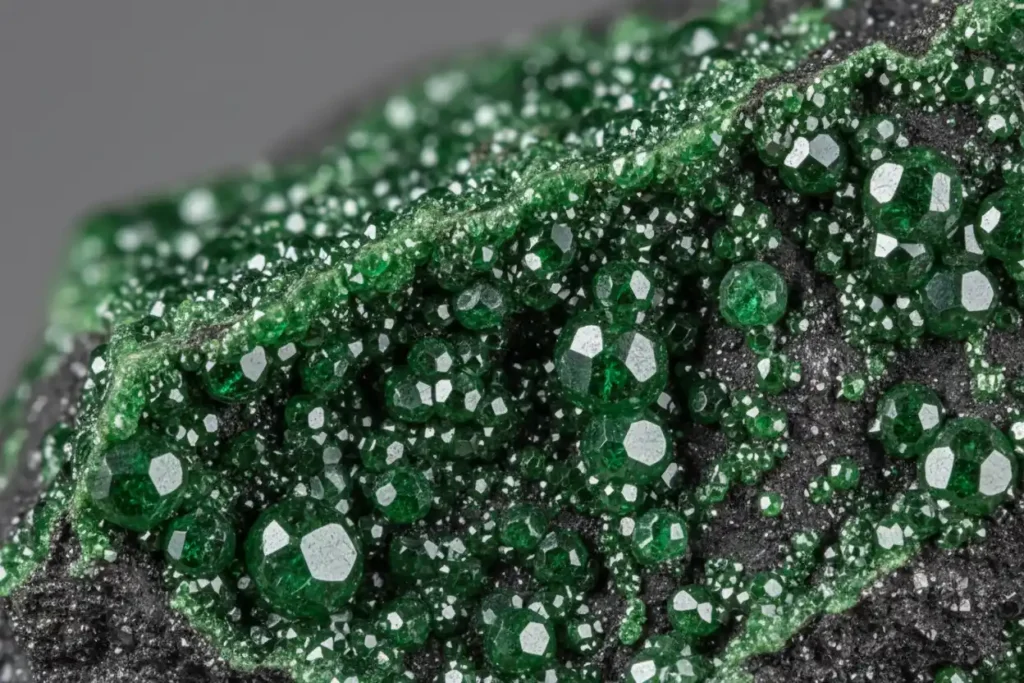
Demantoid garnet is green andradite prized for brilliance and dispersion. It deserves additional care because andradite sits toward the softer end of the garnet group and fine demantoid can be highly valuable.
Use lukewarm water, mild soap, a very soft brush, brief cleaning, and careful drying. Avoid forceful brushing around thin edges or visible fractures.
Some demantoid, particularly material historically associated with Russia, may contain characteristic horsetail-like inclusions. Such inclusions are part of the gemstone, not contamination that can be cleaned away.
For a valuable demantoid, antique mounting, heavily included stone, or piece with questionable stability, professional cleaning is preferable to experimenting with ultrasound or steam.
What About Hessonite and Tsavorite?
Hessonite garnet is an orange-to-brown grossular variety that can show a distinctive roiled internal appearance. Do not mistake internal texture for grime. Surface oil can be removed; internal inclusions cannot.
Tsavorite is green grossular. Fine examples can be valuable and may contain inclusions or surface-reaching fractures. For sound stones, mild soap and lukewarm water remain the sensible home method, while fracture condition should be checked before any machine cleaning.
The main principle behind how to clean garnet jewelry remains the same across the family: identify the stone, inspect the structure, and choose the gentlest method that removes the actual dirt.
Treated, Filled or Uncertain Garnet
Many garnets reach the market without routine color treatment, but that does not justify assuming every garnet is untreated.
Fracture filling, coatings, assembled construction, repairs, unusual treatments, and imitation material can occur. If the surface has an unusual film, fractures appear filled, color concentrates in cracks, or a seller disclosed enhancement, avoid aggressive chemicals and mechanical cleaning.
If you are not certain the stone is garnet at all, the real vs fake garnet page explains identification limits and when professional testing is appropriate.
For an important purchase, the garnet buying guide is also useful because treatment disclosure and construction quality affect care after the sale.
How to Tell Dirt From Damage
A dull garnet is not necessarily dirty.
Oil, lotion, soap film, and dust can reduce brilliance and usually improve after cleaning. Scratches, abraded facet junctions, chipped edges, damaged polish, internal fractures, worn metal, and a loose setting will not disappear with soap.
If careful cleaning leaves the stone cloudy or lifeless, inspect it under neutral light. If the problem appears to be physical wear, a jeweler or lapidary professional may be able to assess whether repair, repolishing, or setting work is appropriate.
Repeatedly cleaning harder will not restore missing material.
How Often Should Garnet Jewelry Be Cleaned?
There is no fixed schedule. Clean according to wear and visible residue.
A ring worn frequently may need gentle cleaning every few weeks, especially if lotion or soap collects beneath the stone. Earrings and pendants may need less frequent washing. A soft cloth after wear can delay the need for deeper cleaning.
Frequent aggressive cleaning is unnecessary. Good maintenance is more about preventing residue and inspecting settings than constantly washing the gemstone.
Keep Garnet Cleaner Between Washes
Put jewelry on after lotion, perfume, sunscreen, makeup, and hair products have been applied and allowed to settle.
Remove rings and bracelets before gardening, exercise, house cleaning, swimming, bathing, cooking, repairs, or heavy manual work. These habits reduce both grime and impact damage.
Garnet may tolerate brief water contact, but swimming pools and hot tubs expose jewelry to chemicals and create a real risk of loss. Ocean swimming adds salt, sand, impact, cold water, and the possibility that a ring or earring will disappear permanently.
Knowing how to clean garnet jewelry is useful; avoiding unnecessary contamination and damage is even better.
Hand Sanitizer and Garnet Rings
Alcohol-based hand sanitizer may leave residue and can repeatedly contact plating, glue, coatings, or other materials in a ring.
When practical, remove a garnet ring before repeated sanitizer use. If residue builds up, return to mild soap and water rather than escalating to stronger solvents.
The garnet itself may tolerate more than the mounting, which is why the entire piece must determine the care method.
Storage After Cleaning
Never store a damp piece. Allow every hidden area to dry first.
Keep garnet jewelry in a lined compartment, separate pouch, or individual section of a jewelry box. Diamonds, rubies, and sapphires can scratch garnet when pieces rub together. Garnet can also scratch softer materials.
The broader how to store crystals safely page explains separation by hardness, impact risk, light, humidity, and fragile construction.
If the piece is January birthstone jewelry, the January birthstone page also explains why garnet can appear in red, orange, purple-red, and green rather than only the traditional dark-red color.
When Professional Cleaning Is Better
Home cleaning should stop when the risk becomes hard to evaluate.
Professional assessment is sensible when the garnet is loose, the setting is antique, the piece is highly valuable, a fracture reaches the surface, glue or filler is visible, treatment is unknown, several gemstones share the setting, prongs are worn, enamel is present, or dirt is trapped beneath an inaccessible mount.
It is also worth seeking help when careful home cleaning does not restore the appearance you expected. A professional can distinguish contamination from polish wear, internal inclusions, structural damage, or setting problems.
For a valuable demantoid, rhodolite, or spessartite piece, protecting the stone and setting matters more than achieving maximum temporary shine.
Physical Cleaning Is Different From Spiritual Cleansing
Physical cleaning removes skin oil, cosmetics, soap residue, dust, and other contamination. Spiritual cleansing is a symbolic practice within some crystal traditions.
Garnet does not scientifically accumulate negative energy that must be removed. If a symbolic cleansing ritual is meaningful to you, use a method that does not compromise the physical jewelry. Sound, visualization, intention, or another dry practice avoids many of the risks associated with salt, prolonged soaking, smoke deposits, or heat.
This distinction keeps both the material care and the traditional symbolism clear.
Frequently Asked Questions
What is the safest way to clean garnet jewelry?
Use lukewarm water, a small amount of mild liquid soap, and a soft brush or lint-free cloth. Rinse briefly when the complete piece is suitable for water, then dry it thoroughly.
Is garnet safe in water?
Most sound garnets tolerate brief water contact. The setting, glue, thread, filler, coatings, repairs, and companion stones may require a more conservative method.
Can I soak garnet jewelry overnight?
No routine cleaning benefit justifies an overnight soak. Brief controlled cleaning is normally sufficient.
Can garnet go in an ultrasonic cleaner?
Some sound untreated garnets may tolerate ultrasound, but avoid it for fractured, filled, glued, repaired, heavily included, antique, or mixed-material pieces. Hand cleaning is the safer default when condition is uncertain.
Can garnet be steam cleaned?
Steam is unnecessary for routine home care. Mild soapy water gives more control and avoids unnecessary heat.
Can I clean garnet with vinegar?
Vinegar is not recommended. Acid provides little cleaning advantage and can affect metals, finishes, filler, or other gemstones.
Can I clean garnet with toothpaste?
No. Toothpaste may contain abrasives that can scratch jewelry metal, plating, and softer associated materials.
How do I clean rhodolite garnet?
Use lukewarm water, mild soap, a soft brush, a brief rinse, and thorough drying, provided the stone and setting are sound.
How do I clean spessartite garnet?
Use the same gentle hand-cleaning method. Do not treat internal inclusions as surface dirt or automatically use machine cleaning on a valuable stone.
How do I clean demantoid garnet?
Clean demantoid conservatively with lukewarm water, mild soap, and a very soft brush. Valuable, included, fractured, or antique demantoid jewelry is a good candidate for professional care.
How often should I clean garnet jewelry?
Clean it when oils and residue become noticeable. Regular wiping after wear can reduce the need for deeper cleaning.
Why is my garnet still dull after cleaning?
The cause may be scratches, abraded facet edges, internal inclusions, damaged polish, a worn setting, or dirt in an area that home cleaning cannot reach.
Can I wear garnet jewelry in the shower?
It is better to remove it. Repeated soap, shampoo, water exposure, and unnecessary wear on the setting provide no benefit.
Keep the Method Simple
The safest way to understand how to clean garnet jewelry is to avoid treating every garnet object as identical. Inspect the stone and setting first, use mild soap and lukewarm water only when the complete piece can tolerate them, clean with light pressure, rinse briefly, and dry thoroughly.
Rhodolite, spessartite, demantoid, hessonite, tsavorite, almandine, and pyrope do not need separate repetitive routines. Their differences matter where hardness, inclusions, value, fractures, and setting condition change the level of caution.
Avoid abrasive pastes, strong acids, bleach, boiling water, long salt-water soaks, unnecessary steam, and automatic ultrasonic cleaning. When condition, treatment, or construction is uncertain, a damp cloth or professional assessment is safer than experimenting.
Good garnet care is not about using the strongest cleaner. It is about removing ordinary contamination while preserving the gemstone, the setting, and the information that makes the piece valuable.