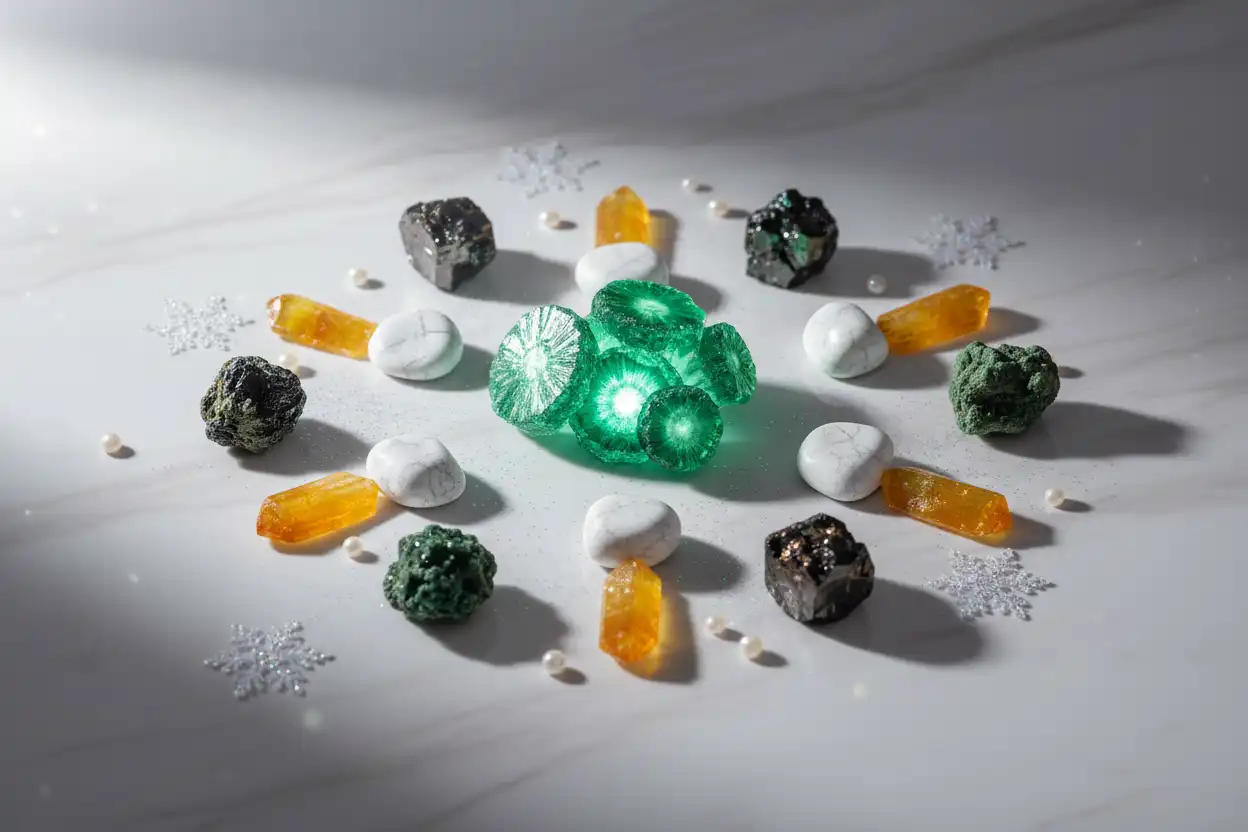
Crystals That Start With W: Names and Meanings
Crystals and gem materials that start with W include watermelon tourmaline, wavellite, white agate, white calcite, white jade, white moonstone, white opal, white sapphire, white topaz, willemite, wonderstone and wulfenite.
This group combines naturally color-zoned gemstones, white varieties of established mineral families, fluorescent collector minerals, patterned rocks and lead-bearing specimens.
The meanings below are traditional symbolic associations rather than scientifically proven medical effects.
Continue alphabetically from Crystals That Start With V.
W Crystals at a Glance
| Crystal or material | Typical appearance | Traditional symbolic meaning |
|---|---|---|
| Watermelon Tourmaline | Pink center surrounded by green | Balance and emotional openness |
| Wavellite | Green, yellow or white radiating clusters | Organization and gradual growth |
| White Agate | White, cream or translucent chalcedony | Calm and stability |
| White Calcite | Milky white, clear or cream calcite | Clarity and simplicity |
| White Jade | White, ivory or pale gray jade | Harmony and thoughtful judgment |
| White Moonstone | White feldspar with a floating glow | Intuition and new beginnings |
| White Opal | White or light-gray opal, sometimes with play-of-color | Creativity and hope |
| White Sapphire | Colorless transparent corundum | Clarity and commitment |
| White Topaz | Colorless transparent topaz | Focus and honest intention |
| Willemite | Green, yellow, white, brown or pink mineral | Direction and adaptability |
| Wonderstone | Banded brown, red, cream or yellow rock | Creativity and resilience |
| Wulfenite | Orange, yellow or red tabular crystals | Motivation and disciplined action |
Watermelon Tourmaline
Watermelon tourmaline is a color-zoned tourmaline with a pink or reddish center and a green outer zone. Some slices also show a pale or colorless band between the two main colors.
Tourmaline’s changing chemistry during growth can produce multiple color zones within one crystal. GIA describes watermelon tourmaline as pink in the center and green around the outside.
It is traditionally associated with:
- Emotional balance.
- Affection.
- Healthy boundaries.
- Openness.
- Combining compassion with practical judgment.
Slices are often cut across the crystal to display the watermelon-like pattern. Longitudinal cuts may instead show parallel bands.
Tourmaline is durable enough for many jewelry styles, but thin slices and heavily included stones can chip under impact.
Wavellite
Wavellite is a hydrated aluminum phosphate mineral commonly found as radiating, globular or starburst-like groups of fine crystals.
Its colors include:
- Green.
- Yellow-green.
- White.
- Cream.
- Brown.
- Blue-green.
Wavellite characteristically forms hemispherical or globular aggregates with an internal radial structure. Distinct individual crystals are less common.
Its traditional meanings include:
- Organization.
- Gradual growth.
- Patience.
- Recognizing connections.
- Turning scattered ideas into a plan.
Broken spherical formations may reveal attractive internal rays. However, fine crystal surfaces are delicate and should not be scrubbed or carried loose with harder stones.
White Agate
White agate is a white, cream, gray-white or translucent variety of chalcedony. It may be evenly colored or show subtle bands, clouds and layered patterns.
It is traditionally associated with:
- Calm.
- Stability.
- Patience.
- Clear communication.
- Creating a peaceful routine.
Commercial material may be naturally pale, bleached, dyed or treated. Perfectly uniform white coloring should not be assumed to prove authenticity.
Its mineral structure belongs to the broader chalcedony family.
White Calcite
White calcite ranges from transparent and colorless to milky white, cream or pale gray.
It may occur as:
- Rhombohedral crystals.
- Scalenohedral crystals.
- Massive material.
- Banded formations.
- Fibrous or granular aggregates.
White calcite is traditionally associated with:
- Clarity.
- Simplicity.
- Reflection.
- Mental organization.
- Releasing unnecessary complications.
Like other members of the calcite family, it is soft and reacts with acids.
Avoid vinegar, citrus juice, abrasive cleaners and storage beside harder quartz gemstones.
White Jade
White jade is a gem and carving term that may refer to white nephrite or white jadeite.
Nephrite commonly occurs in white, gray and muted green tones, while jadeite can also appear white, gray, lavender and several stronger colors. Both materials are valued for their interlocking structures and toughness.
White jade is traditionally associated with:
- Harmony.
- Wisdom.
- Fair judgment.
- Self-control.
- Peaceful decision-making.
Its wider material family is explained in the jade guide.
The name “white jade” is also incorrectly applied to calcite, quartz, serpentine and manufactured materials. Valuable pieces may require professional identification.
White Moonstone
White moonstone is a pale feldspar material that displays adularescence—a floating glow that appears to move beneath its surface.
It commonly appears:
- White.
- Cream.
- Colorless.
- Pale gray.
- Slightly translucent.
White moonstone is traditionally associated with:
- Intuition.
- New beginnings.
- Reflection.
- Emotional awareness.
- Adapting to natural cycles.
Its glow differs from the sharper rainbow flashes seen in some labradorite sold as rainbow moonstone.
Moonstone belongs to the broader feldspar family. Cleavage and internal fractures make it vulnerable to sharp impacts.
White Opal
White opal has a white, cream or light-gray body color. It may be common opal without spectral flashes or precious opal displaying play-of-color.
GIA describes white or light opal as translucent to semitranslucent material with play-of-color against a white or light-gray background.
White opal is traditionally associated with:
- Creativity.
- Hope.
- Imagination.
- Emotional expression.
- Openness to new possibilities.
Its properties and major varieties are covered in the opal guide.
Opal can scratch or break more easily than harder gems and may require a protective jewelry setting.
White Sapphire
White sapphire is colorless corundum. Sapphire includes corundum in colors other than the red material classified as ruby, so colorless corundum is known as white sapphire in the gem trade.
It is traditionally associated with:
- Clarity.
- Commitment.
- Discipline.
- Honest intention.
- Long-term focus.
White sapphire may be natural, laboratory-grown or treated. It can also be confused with diamond, moissanite, white topaz and colorless zircon.
Its mineral properties are explained in the sapphire guide.
Sapphire’s hardness makes it suitable for frequent wear, although fractures and treatments still influence safe cleaning.
White Topaz
White topaz is colorless transparent topaz.
It is commonly used in:
- Rings.
- Earrings.
- Pendants.
- Accent-stone jewelry.
- Diamond-alternative designs.
White topaz is traditionally associated with:
- Focus.
- Clarity.
- Honest communication.
- Purpose.
- Following through on decisions.
Topaz occurs naturally in colorless, yellow, brown, blue, pink and other colors. Although it is hard, its cleavage means a strong impact can split the stone.
Learn more about its mineral family in the topaz guide.
Willemite
Willemite is a zinc silicate mineral found in many colors, including:
- Colorless.
- White.
- Green.
- Yellow.
- Brown.
- Pink.
- Red.
- Blue.
- Gray.
It is especially popular in fluorescent mineral collections because some specimens glow intensely under ultraviolet light.
Willemite has a Mohs hardness of about 5.5, good to distinct cleavage and a brittle tenacity. Its ideal formula is zinc silicate.
Traditional meanings include:
- Direction.
- Adaptability.
- Learning.
- Recognizing overlooked qualities.
- Responding constructively to change.
Fluorescence is not equally strong in every specimen, and color under daylight does not reliably predict the ultraviolet response.
Wonderstone
Wonderstone is a commercial lapidary name most commonly associated with patterned volcanic rock.
Material from Nevada may show:
- Red.
- Brown.
- Cream.
- Yellow.
- Gray.
- Curving or concentric bands.
Wonderstone is often described as rhyolite, although some well-known material is more precisely classified as welded volcanic tuff of rhyolitic composition with Liesegang-style banding.
It is traditionally associated with:
- Creativity.
- Resilience.
- Adaptability.
- Perspective.
- Finding patterns within change.
Because the trade name can be applied to different rocks, ask for the locality and geological description when identity matters.
Wulfenite
Wulfenite is a lead molybdate mineral famous for thin, square or rectangular tabular crystals.
Its colors include:
- Orange.
- Red-orange.
- Yellow.
- Honey yellow.
- Brown.
- Gray.
- Rare greenish tones.
Wulfenite commonly forms in the oxidized zones of lead deposits. It is soft, brittle and usually too delicate for exposed jewelry.
It is traditionally associated with:
- Motivation.
- Disciplined action.
- Creativity.
- Using time effectively.
- Turning plans into visible progress.
Wulfenite contains lead. Avoid dust, grinding, ingestion, water preparations and unnecessary handling. Store it away from children, pets and food.
White W Crystals Compared
The white entries belong to different material families:
- White agate is chalcedony.
- White calcite is a carbonate mineral.
- White jade may be nephrite or jadeite.
- White moonstone is feldspar.
- White opal is hydrated silica.
- White sapphire is corundum.
- White topaz is an aluminum silicate mineral.
Color alone cannot identify a white stone. Hardness, luster, internal features, cleavage, density and professional testing may be required.
Which W Crystals Are Suitable for Jewelry?
Common jewelry choices include:
- Watermelon tourmaline.
- White agate.
- White jade.
- White moonstone.
- White opal.
- White sapphire.
- White topaz.
- Polished wonderstone.
White sapphire and many tourmalines are among the stronger options for frequent wear.
Moonstone, opal and topaz require protection from impact. Wavellite, willemite and wulfenite are primarily collector materials.
Compare cutting, durability and value in Gemstones That Start With W.
Care Notes for W Crystals
- Protect thin watermelon tourmaline slices from bending and impact.
- Avoid brushing delicate wavellite formations.
- Keep white calcite away from acidic cleaners.
- Verify whether white jade has been dyed, bleached or polymer-treated.
- Protect moonstone and topaz from cleavage-related blows.
- Use gentle cleaning for opal and avoid sudden heat.
- Keep fluorescent specimens out of prolonged ultraviolet exposure when color stability is uncertain.
- Store lead-bearing wulfenite securely and prevent dust.
- Treat wonderstone according to its underlying rock rather than its trade name.
Damage does not automatically indicate a spiritual event. The practical causes covered in Why Did My Crystal Break? include cleavage, thermal shock, internal fractures and unsuitable storage.
Frequently Asked Questions
What is the most popular crystal that starts with W?
Watermelon tourmaline is one of the most recognized jewelry stones. Wavellite, willemite and wulfenite are popular among mineral collectors.
Which white crystals start with W?
White agate, white calcite, white jade, white moonstone, white opal, white sapphire and white topaz are notable examples.
Is watermelon tourmaline naturally colored?
Yes. Its green and pink zones can form naturally as the crystal’s chemical environment changes during growth.
Is white sapphire a diamond?
No. White sapphire is colorless corundum, while diamond is crystalline carbon.
Is white jade always jadeite?
No. The name may refer to white jadeite or white nephrite.
Does every willemite specimen fluoresce?
No. Fluorescence varies with composition, impurities, locality and ultraviolet wavelength.
Is wonderstone one mineral?
No. It is a lapidary trade name commonly applied to patterned volcanic rock.
Is wulfenite safe to handle?
It contains lead and should be handled minimally. Avoid dust, ingestion and prolonged contact, and wash your hands after handling.
Continue Exploring
Continue alphabetically with Crystals That Start With X, or browse the complete Crystals 101 collection.