Willemite Meaning, Fluorescence, Properties and Value
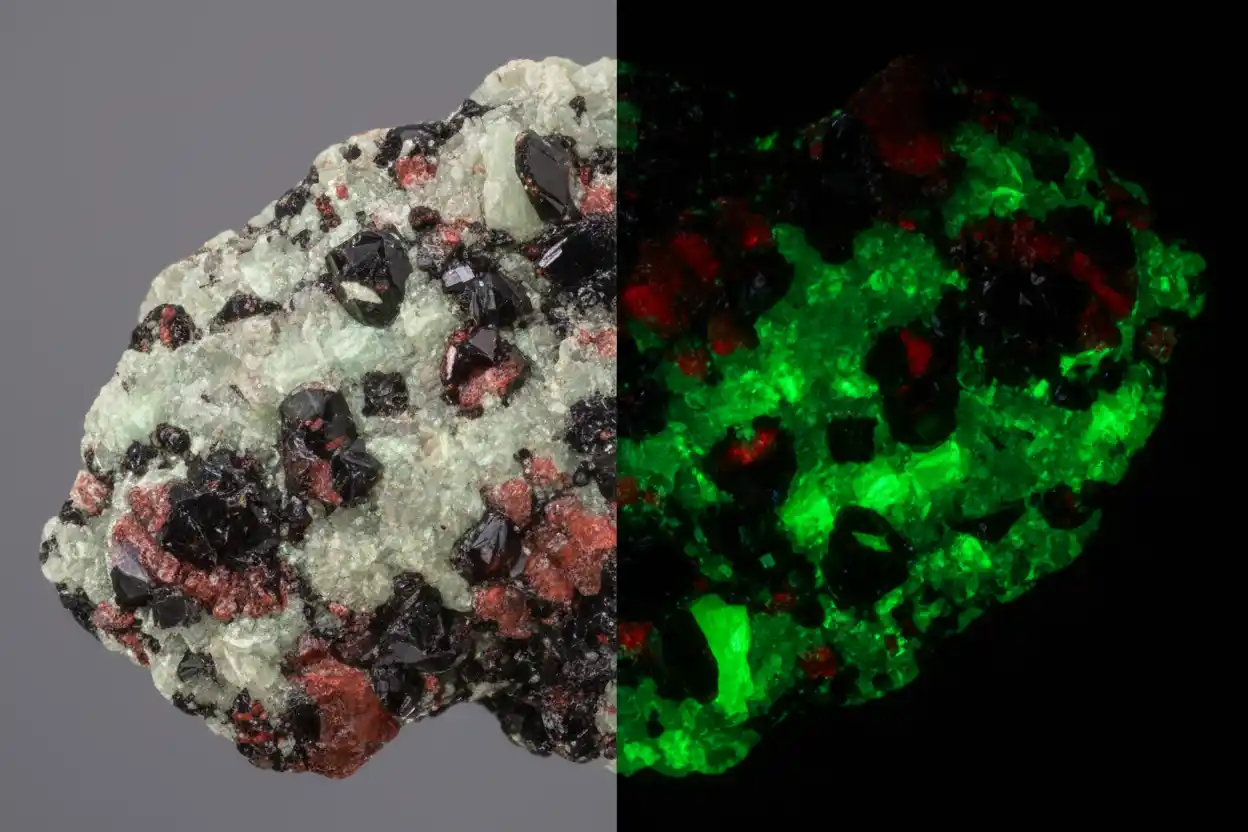
Willemite is a zinc silicate mineral best known for the intense green fluorescence shown by many specimens from Franklin and Sterling Hill, New Jersey. Under ordinary light it can appear white, yellow, green, brown, red, blue or nearly colorless, making ultraviolet response an important—but not conclusive—part of identification.
The mineral served as a major zinc ore at Franklin and Sterling Hill and also forms attractive crystals at localities such as Tsumeb in Namibia. Most willemite remains a collector specimen, although transparent material is occasionally faceted.
Willemite at a Glance
| Property | Willemite |
|---|---|
| Mineral class | Nesosilicate |
| Chemical formula | Zn₂SiO₄ |
| Mineral group | Phenakite group |
| Principal metal | Zinc |
| Common colors | White, colorless, yellow, green, brown, reddish brown, red, pink, blue and black |
| Crystal system | Trigonal |
| Common habit | Prismatic, rhombohedral, acicular, fibrous, botryoidal, granular and massive |
| Luster | Vitreous to resinous |
| Transparency | Transparent to opaque |
| Refractive indices | Approximately 1.69–1.73 |
| Birefringence | Approximately 0.010–0.028 |
| Optical character | Uniaxial positive |
| Specific gravity | Approximately 3.9–4.2 |
| Mohs hardness | About 5.5 |
| Cleavage | Poor |
| Tenacity | Brittle |
| Luminescence | Commonly bright green fluorescence and possible phosphorescence, especially in manganese-activated material |
| Common use | Fluorescent specimens, zinc-ore collections, mineral displays and rare faceted gems |
| Main care concern | Brittle edges, mixed ore matrix and safe operation of ultraviolet lamps |
What Is Willemite?
Willemite is a zinc silicate with the formula Zn₂SiO₄. Its structure consists of isolated silicate tetrahedra linked through zinc.
It belongs to the phenakite mineral group, whose members share related structures despite containing different elements.
Pure willemite can be colorless. Natural specimens commonly contain manganese, iron and other elements that produce visible color and luminescence.
Within the broader types of gemstones guide, transparent willemite qualifies as a rare facetable mineral, while most commercial material remains a fluorescent or ore specimen.
How Willemite Got Its Name
Willemite was named after Willem I, King of the Netherlands. The mineral was described during the nineteenth century from zinc deposits in Europe.
The name has no connection with William Wavell, after whom wavellite was named. Despite similar spelling, the minerals differ completely in chemistry, hardness, crystal structure and appearance.
Older labels may also use the name troostite for manganese-bearing willemite. Troostite is a historical variety term rather than a separate modern species.
Willemite Colors and Forms
Colorless and White Willemite
Colorless crystals are uncommon but can be transparent enough for faceting. White granular material is more widespread and may fluoresce strongly.
In daylight, white willemite can resemble calcite, quartz or feldspar. Density and optical testing provide better separation than appearance.
Green Willemite
Green material ranges from pale mint and apple green to deeper gray-green. Some green specimens are translucent and attractive even without ultraviolet light.
Many Franklin specimens fluoresce a far brighter electric green than their ordinary daylight color suggests.
Yellow and Brown Willemite
Yellow, honey-brown and reddish-brown material occurs in crystals and massive ore. Manganese and iron can influence these colors.
Brown massive willemite containing manganese has historically been called troostite.
Red and Pink Willemite
Pinkish, red-brown and red willemite occurs at Franklin and several other deposits. Daylight color can be subtle, while fluorescence remains green.
The combination of red daylight color and green ultraviolet response can be visually striking.
Blue Willemite
Blue and sky-blue willemite is rare and strongly associated with certain Tsumeb specimens. Botryoidal or crystalline blue material can command substantial collector premiums.
Blue color does not guarantee strong fluorescence. Luminescence depends on activators and structural details rather than visible color alone.
Fibrous and Acicular Willemite
Needle-like crystals can form radiating sprays, crusts and compact fibrous masses. Fine sprays are highly collectible but fragile.
Granular Franklin Willemite
At Franklin and Sterling Hill, willemite commonly appears as granular masses mixed with calcite, franklinite and zincite. These pieces may look ordinary in daylight but become vivid under ultraviolet light.
Why Does Willemite Fluoresce Green?
Manganese commonly acts as the activating element. When ultraviolet radiation excites manganese ions occupying zinc sites, the absorbed energy is released as visible green light.
The most famous response occurs under shortwave ultraviolet light, commonly near 254 nanometers. Some specimens also react under medium-wave or longwave ultraviolet lamps.
Fluorescence ends quickly when the lamp is switched off in many specimens. Others show phosphorescence, continuing to glow briefly after the ultraviolet source is removed.
Not every willemite specimen fluoresces strongly. Material lacking sufficient manganese, containing quenching elements or possessing a different structural environment may show a weak or absent response.
The green fluorescence should therefore support identification rather than replace it.
Willemite, Calcite and Franklinite Under UV
Classic New Jersey ore commonly combines green-fluorescing willemite, red- or orange-fluorescing calcite and nonfluorescent black franklinite.
The contrast produces the famous “Christmas rock” appearance. In ordinary light, the same specimen may look gray, white, green and black.
Some thin coatings can create misleading fluorescence. The Sterling Hill Mining Museum notes that microscopic willemite coatings can cause another mineral’s surface to glow green.
Similarly, green fluorescence attributed to calcite may sometimes come from intergrown opal or willemite. Magnification and laboratory testing help resolve the actual source.
The parent calcite guide and types of calcite retain calcite’s separate mineral and color classification.
Troostite
Troostite is an old name for manganese-bearing willemite, particularly brown, reddish-brown or massive material from Franklin.
The term remains common on historic labels and among Franklin mineral collectors. However, it does not identify a separate species.
Manganese content can strengthen fluorescence, but the commercial name alone does not indicate brightness. Two troostite specimens can respond very differently under the same lamp.
Historic labels should be preserved because they provide collection and locality context, even when modern mineral descriptions use willemite.
How Willemite Forms
Willemite forms in several geological settings, including metamorphosed zinc deposits, hydrothermal veins and oxidized zones of primary zinc ores.
At Franklin and Sterling Hill, zinc-rich sedimentary material underwent intense metamorphism. The resulting ore bodies contain willemite, franklinite and zincite enclosed within Franklin Marble.
Hydrothermal and replacement processes can also create willemite where zinc-rich fluids react with silicate or carbonate rocks.
In oxidized zinc deposits, weathering can transform primary minerals such as sphalerite into secondary zinc silicates and carbonates.
The geological relationship connects willemite with smithsonite and hemimorphite, although those minerals have different chemistry, hardness and crystal structures.
Zincite is another important zinc mineral at Franklin. It commonly appears red or orange and may occur directly beside willemite.
Franklin and Sterling Hill, New Jersey
The Franklin and Sterling Hill deposits are among the world’s most mineralogically diverse localities. Hundreds of mineral species have been documented, including an exceptional number of fluorescent minerals.
Willemite was one of the principal zinc ores mined there. It commonly occurs with black franklinite and white or pale calcite.
Shortwave ultraviolet displays reveal brilliant green willemite throughout ore surfaces and underground exposures. The effect helped make the district internationally famous among mineral collectors.
Franklin material can be granular, fibrous, crystalline or massive. Provenance matters because specific mine levels, veins and historic collections can add value.
The deposits have also produced unusual associated minerals such as hardystonite, clinohedrite, esperite, tephroite, rhodonite and numerous rare species.
Tsumeb Willemite
The Tsumeb Mine in Namibia produced some of the most aesthetic crystallized willemite outside New Jersey.
Material includes colorless, white, yellow, green and rare blue crystals, sometimes associated with dolomite, calcite, conichalcite or other secondary minerals.
Unlike much granular Franklin ore, Tsumeb pieces may feature isolated transparent crystals or botryoidal coatings valued primarily for form and daylight color.
Fine blue Tsumeb willemite is especially scarce. Exceptional cabinet pieces can reach several thousand dollars.
Other Important Localities
Belgium is historically important in the mineral’s naming and early study.
Zambia, the Democratic Republic of the Congo, Mexico and several United States zinc districts have produced willemite.
Arizona and New Mexico contain occurrences in oxidized zinc deposits, while smaller localities exist across Europe, Australia and Asia.
A locality label should distinguish Franklin from Sterling Hill when possible. Although both lie in the same New Jersey district, collectors treat them as separate mines with different mineral associations.
Inclusions and Internal Features
Transparent willemite can contain fluid inclusions, mineral crystals, growth zones and partially healed fractures.
Manganese may be distributed unevenly, causing fluorescence to vary between zones that look similar in daylight.
Granular specimens often contain calcite, franklinite, zincite, tephroite and other minerals at a microscopic scale. These intergrowths affect density, polish and ultraviolet response.
Tsumeb material may include dolomite, calcite or copper-bearing secondary minerals. Some blue coatings are extremely thin and require magnification to distinguish from solid crystals.
Phosphorescence can also vary within one specimen. One patch may continue glowing after the lamp is switched off while an adjacent area goes dark immediately.
How to Identify Willemite
Green ultraviolet fluorescence is a useful first clue, especially for Franklin material, but it is not definitive.
Willemite has a relatively high specific gravity near 4 and a refractive index around 1.69–1.73. These properties separate it from many lighter silicates.
The mineral is uniaxial positive and moderately birefringent. Transparent stones can be tested with standard gemological instruments.
Its hardness of approximately 5.5 places it below quartz but above calcite on the gemstone hardness chart.
Poor cleavage does not make it impact-proof. As explained in gemstone toughness versus hardness, brittle crystals can still chip even when they resist moderate scratching.
Raman spectroscopy, X-ray diffraction and chemical analysis provide reliable confirmation. The general crystal identification guide remains useful when fluorescence comes from a coating or mixed matrix.
Willemite Lookalikes
Smithsonite
Smithsonite is zinc carbonate and can appear green, yellow, blue or pink. It is softer, has a different refractive response and commonly forms botryoidal surfaces.
Hemimorphite
Hemimorphite is a hydrated zinc silicate that often forms white or blue crystal sprays. Its orthorhombic structure and lower density distinguish it from willemite.
Sphalerite
Sphalerite is zinc sulfide and can be yellow, brown, red or green. It has much stronger dispersion, lower hardness and prominent cleavage.
Calcite
White calcite may occur directly beside willemite and can fluoresce red. Calcite is softer and reacts with dilute acid.
Fluorite
Fluorite is well known for fluorescence and can appear green, yellow or colorless. It has perfect octahedral cleavage, lower hardness and lower density.
Glass and Synthetic Materials
Green fluorescent glass, pigments and resin can imitate the ultraviolet response. Bubbles, mold lines, uniform fluorescence and low density reveal many manufactured products.
Treatments, Synthetic Willemite and Imitations
Most collector willemite is untreated. Its natural fluorescence, locality and mineral associations create its value.
Repairs are common in large crystal specimens. Adhesive may reattach matrix sections or secure delicate sprays.
Oil or resin can improve the appearance of fractured massive material, though such treatment is not standard. Disclosure remains important.
Laboratory-grown zinc silicate activated with manganese is widely used as a phosphor and research material. It can reproduce bright green luminescence but should not be sold as natural Franklin willemite.
The difference between a laboratory-grown equivalent and a fluorescent glass imitation follows the distinctions in lab-grown versus natural gemstones.
The broader disclosure framework remains with gemstone treatments explained.
Cutting and Polishing Behavior
Transparent willemite is rare enough that faceting usually occurs for collections rather than mainstream jewelry.
Its refractive index can create good brilliance, while moderate birefringence may produce visible doubling under magnification.
The cutter must avoid fractures and cleavage-related weaknesses. Thin girdles and sharp points can chip during polishing or setting.
Massive Franklin material can be polished into slabs and cabochons that display attractive green, red, white and black patterns in daylight and under ultraviolet light.
Different component minerals polish at different rates. Calcite is softer than willemite, while franklinite is harder and opaque, so mixed ore may develop a slightly uneven finish.
Fine natural crystal specimens should normally remain uncut. Exceptional facetable rough is scarce enough to belong among discussions of the rarest gemstones in the world rather than ordinary commercial jewelry.
Durability and Jewelry Suitability
Willemite’s hardness of about 5.5 offers modest scratch resistance, but it remains brittle.
Faceted stones work best in pendants, earrings and protected collector rings. Daily-wear rings are risky because facet edges can abrade or chip.
Massive fluorescent cabochons are more practical than transparent crystals, though mixed mineral boundaries may still fracture.
Do not expose jewelry to repeated ultraviolet inspection more often than necessary. The mineral may remain stable, but the wearer’s skin and eyes require protection from shortwave lamps.
Willemite Prices in 2026
Small educational Franklin specimens commonly retail for approximately $7–$30. Pieces with stronger fluorescence, better pattern or precise locality information often fall around $30–$100.
Attractive miniature and cabinet fluorescent specimens commonly range from $100–$500. Complex Franklin assemblages containing rare associated minerals may sell for more.
Well-formed Tsumeb crystals and fine botryoidal material often range from $300–$1,500.
Exceptional crystallized willemite, particularly rare blue Tsumeb material, can command several thousand dollars. One current specialist cabinet specimen is listed at $7,500.
Faceted willemite has no standardized market. Small commercial-quality collector stones may cost tens to hundreds of dollars per carat, while unusually large, clean or strongly colored examples can exceed broad estimates.
What Determines Willemite Value?
Fluorescence intensity matters for Franklin material. Bright, evenly distributed electric-green response generally commands more interest than weak isolated spots.
Daylight pattern also contributes value. Balanced combinations of willemite, calcite, franklinite and zincite create stronger display pieces.
Crystal form dominates the Tsumeb market. Sharp transparent crystals, uncommon blue color and undamaged terminations receive premiums.
Locality and provenance are especially important. Historic Franklin labels, documented mine levels and old collections can add substantial value.
Repairs, coatings and incomplete ultraviolet photographs should be disclosed. A specimen may look excellent under UV while having significant daylight damage.
Buying Guidance
Ask for both daylight and ultraviolet photographs. A fluorescent mineral should not be evaluated from a UV image alone.
Confirm the lamp wavelength used in the photograph. Shortwave, medium-wave and longwave lamps can produce very different responses.
Check whether the specimen is Franklin, Sterling Hill, Tsumeb or another locality. Broad labels such as “New Jersey fluorescent rock” provide limited provenance.
Inspect for glue, reattached crystals and artificial fluorescent paint. Bright fluorescence should follow natural mineral boundaries rather than pooling around cracks or surface scratches.
A laboratory report is appropriate for expensive faceted material or rare blue crystals. Ordinary fluorescent ore can often be identified through provenance, microscopy and mineral testing.
Cleaning, Water, Heat and Sunlight
Clean durable massive material with a soft brush and a small amount of lukewarm water. Dry it thoroughly, particularly when the specimen contains calcite, fractures or old labels.
Do not soak mixed ore indefinitely. Different associated minerals and adhesives can respond differently to water, as explained in which crystals can and cannot go in water.
Avoid acids because calcite and other carbonate minerals can dissolve even when willemite remains intact.
Ultrasonic and steam cleaners are not recommended for crystal specimens or fractured jewelry. Vibration and heat may loosen crystals or extend fractures.
Willemite’s ordinary daylight colors are generally stable. However, excessive sunlight can heat labels, adhesive and associated minerals, so the display guidance in crystals that fade in sunlight remains useful.
For spiritual cleansing practices, dry methods from how to cleanse crystals avoid chemical and moisture risks.
Ultraviolet Lamp Safety
Many mineral collectors use shortwave lamps operating near 254 nanometers. This radiation can damage eyes and skin.
Use a properly enclosed lamp with an intact filter, follow the manufacturer’s instructions and wear UV-rated protective eyewear designed for the lamp’s wavelength.
Do not stare into the bulb, point an unshielded lamp toward people or use shortwave ultraviolet equipment around children or pets.
Longwave hobby lamps generally present a lower risk than shortwave equipment but still require responsible use.
Meaning and Symbolism
Modern crystal traditions often associate willemite with clarity, inspiration, optimism and recognizing qualities that are not immediately visible.
Its dramatic change under ultraviolet light encourages symbolism involving hidden potential, discovery and seeing beyond surface appearance.
Green-fluorescing specimens may also receive contemporary associations with renewal and creative energy, while yellow and red material can carry different color-based interpretations.
These meanings are cultural, spiritual or personal rather than scientifically established effects.
Willemite may appear in collections of green crystals and yellow crystals, but its fluorescence and zinc-silicate chemistry determine its mineral identity.
Frequently Asked Questions
1. Is willemite a zinc mineral?
Yes. Willemite is zinc silicate with the formula Zn₂SiO₄ and was an important zinc ore at Franklin and Sterling Hill.
2. Why does willemite glow green?
Trace manganese commonly activates the fluorescence. Ultraviolet energy is absorbed and released as visible green light.
3. Does all willemite fluoresce?
No. Fluorescence varies with manganese concentration, crystal chemistry and quenching elements.
4. Which UV wavelength works best for willemite?
Many Franklin specimens respond most strongly to shortwave ultraviolet light near 254 nanometers, although some also react under medium-wave or longwave lamps.
5. What is troostite?
Troostite is a historical name for manganese-bearing willemite, often brown or reddish-brown material from Franklin.
6. Why do Franklin specimens glow green and red?
Willemite typically fluoresces green, while associated calcite commonly fluoresces red or orange.
7. Can fluorescence prove that a specimen is willemite?
No. Coatings and other fluorescent minerals can produce green light. Optical or spectroscopic testing may be necessary.
8. Is willemite radioactive?
No. Willemite is not inherently radioactive.
9. Can willemite be faceted?
Yes, but transparent rough is rare. Most faceted stones are small collector gems rather than mainstream jewelry.
10. Can willemite go in water?
Brief gentle washing may be acceptable for sound material, but mixed ore, repairs and labels make soaking inappropriate.
11. How much does willemite cost?
Small educational pieces may cost under $30, while good specimens range from $100 to $500. Exceptional crystallized material can cost several thousand dollars.
12. Does willemite have scientifically proven healing properties?
No. Its symbolism may hold personal meaning, but scientific evidence does not establish healing effects.
Willemite can look unremarkable in daylight and then dominate a dark room with electric-green fluorescence. That contrast explains its enduring appeal, yet the best specimens also reward daylight study through their zinc-ore geology, rare crystal habits and associations with one of the world’s most unusual mineral districts.
Willemite appears in Crystals That Start With W.
Safety disclaimer: Shortwave ultraviolet mineral lamps can damage eyes and skin. Use a properly shielded lamp, wavelength-appropriate protective eyewear and the manufacturer’s safety procedures; never look directly into an operating UV source.