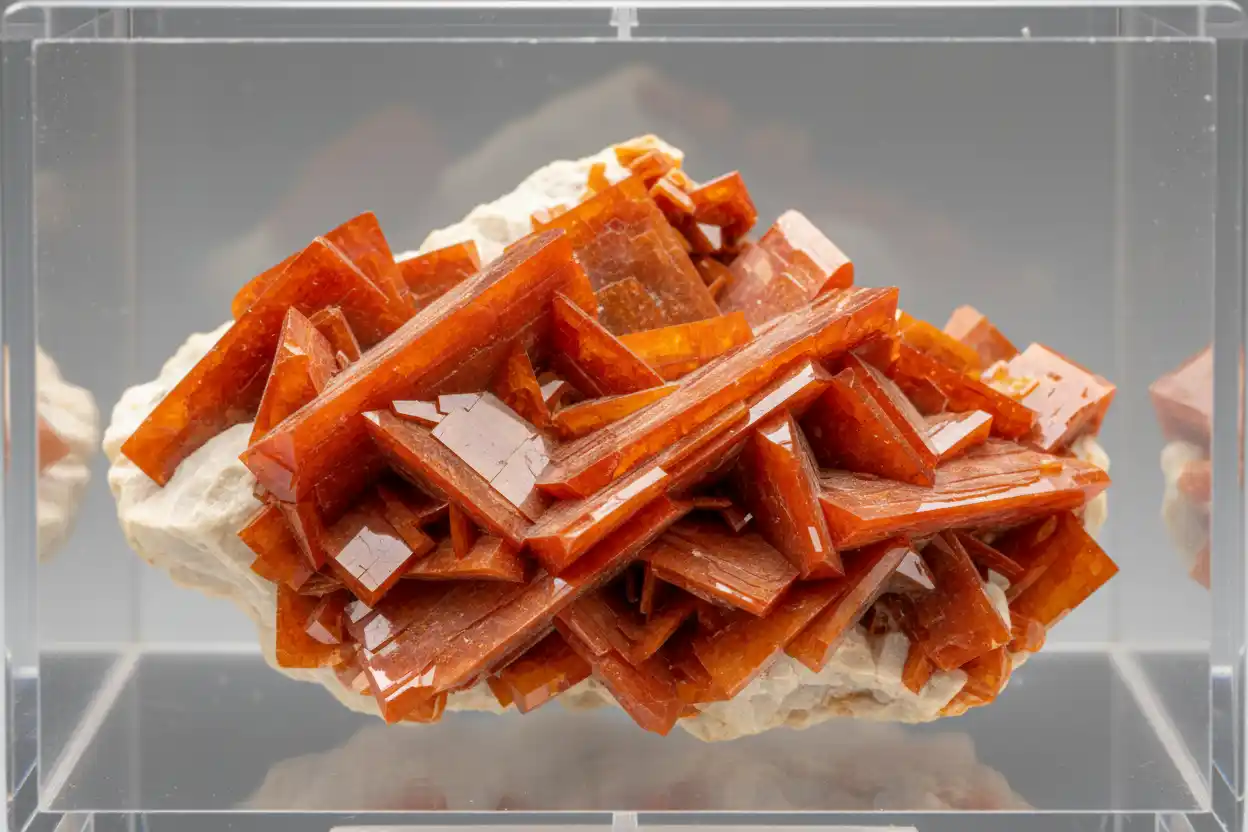
Wulfenite Meaning, Properties, Value and Safe Handling
Wulfenite is a lead molybdate mineral known for thin, glassy crystals in yellow, orange, red and caramel-brown tones. Its high density, brilliant luster and sharply geometric forms make it a major collector mineral, although its softness, brittleness and lead content make it unsuitable for ordinary jewelry or direct-contact spiritual practices.
Rather than functioning as a conventional gem in the wider types of gemstones guide, wulfenite is best appreciated as a carefully handled mineral specimen.
Wulfenite at a Glance
| Property | Wulfenite |
|---|---|
| Mineral class | Molybdate |
| Chemical formula | PbMoO₄ |
| Principal elements | Lead, molybdenum and oxygen |
| Typical colors | Yellow, honey yellow, orange, orange-red, red-brown, brown, olive and rarely colorless or gray |
| Crystal system | Tetragonal |
| Common habit | Thin square tablets, thick plates, short prisms, pyramids and granular masses |
| Luster | Adamantine to resinous |
| Transparency | Transparent to opaque |
| Refractive indices | Approximately 2.28–2.41 |
| Birefringence | Very strong, approximately 0.12 |
| Optical character | Uniaxial negative, sometimes anomalously biaxial |
| Specific gravity | Approximately 6.5–7.5 |
| Mohs hardness | About 2.75–3 |
| Cleavage | Distinct in one direction; weaker in others |
| Tenacity | Brittle |
| Common use | Mineral specimens, scientific collections and exceptionally rare collector cuts |
| Main care concern | Soft, easily cleaved and lead-bearing; dust and residues must be avoided |
What Is Wulfenite?
Wulfenite is a naturally occurring lead molybdate with the ideal composition PbMoO₄. Lead accounts for much of the mineral’s exceptional density, while molybdate groups help define its crystal structure and optical properties.
Its tetragonal structure belongs to the same broad structural family as scheelite, a calcium tungstate mineral. However, the two differ in chemistry, density, color range and fluorescent behavior.
Individual wulfenite crystals frequently form thin square or rectangular plates. Some resemble sheets of orange glass balanced on edge, while others grow as thick caramel-colored tablets or squat pyramids.
The mineral’s high refractive index produces strong surface brilliance. Nevertheless, most crystals are too thin, fractured or fragile for faceting, so natural specimens preserve more value than cut stones.
How Wulfenite Got Its Name
Wulfenite was named for Franz Xaver von Wulfen, an Austrian naturalist and mineralogist who studied the lead-mining region around Bleiberg in Carinthia.
The mineral’s type locality lies at Bad Bleiberg in Austria. Early collectors also used descriptive labels such as yellow lead ore because of the mineral’s color and lead content.
Those historical terms should not be confused with modern species names. Wulfenite is the accepted mineral name regardless of whether a crystal appears yellow, red, brown or nearly colorless.
Wulfenite Colors
Yellow Wulfenite
Yellow crystals range from pale lemon to honey and mustard tones. Thin specimens may appear nearly transparent, while thicker crystals commonly develop a richer golden color.
The phrase yellow lead ore is an old descriptive name, not a separate mineral variety. Yellow wulfenite may occur with green or yellow mimetite, creating attractive color combinations.
Orange Wulfenite
Orange is one of the mineral’s most familiar collector colors. Fine crystals combine strong saturation with enough transparency to transmit light through their edges.
Orange material from Mexico and Morocco commonly appears as square plates, thick tablets or clustered blades. Its color may range from pumpkin orange to reddish amber.
Red and Orange-Red Wulfenite
Deep orange-red and red crystals are particularly associated with Arizona’s Red Cloud Mine. Fine examples can show exceptional transparency, luster and geometric form.
Pure wulfenite would be nearly colorless. Trace chromium, structural defects, oxidation state and minor chemical substitutions can contribute to yellow, orange and red coloration.
Brown and Caramel Wulfenite
Brown, butterscotch and caramel-colored crystals commonly form thicker tablets than many bright red specimens. Although brown material may receive lower prices when dull, highly lustrous thick crystals can be very collectible.
Olive, Gray and Rare Dark Colors
Olive, gray, blackish and nearly colorless wulfenite occur far less commonly. These colors may reflect impurities, surface coatings, included minerals or unusual structural conditions.
A rare color should not automatically receive a premium. Crystal form, condition, transparency and reliable identification remain more important than novelty alone.
Crystal Habits and Forms
Thin Tabular Crystals
Thin tabular wulfenite forms square or rectangular plates with sharp edges. The broad faces can be highly reflective, while the narrow edges reveal yellow, orange or red transparency.
These crystals are visually spectacular but extremely fragile. A slight impact or pressure from packaging can chip a corner or split a plate.
Thick Tablets
Thicker crystals may resemble square blocks or caramel-colored tiles. They generally tolerate handling slightly better than paper-thin plates, though they remain soft and brittle.
Pyramidal and Bipyramidal Crystals
Some localities produce pyramidal, dipyramidal or modified tetragonal crystals. Their form reflects differences in growth conditions and the relative development of individual crystal faces.
Prismatic and Stubby Crystals
Short prismatic material can resemble scheelite or other tetragonal minerals. Optical and chemical testing becomes important when color and habit overlap.
Granular and Earthy Wulfenite
Not all wulfenite forms attractive individual crystals. Granular coatings, earthy masses and compact ore occur in many oxidized lead deposits.
Such material may have geological significance but normally receives less collector demand than sharp, brightly colored crystals.
How Wulfenite Forms
Wulfenite is primarily a secondary mineral in the oxidized zones of hydrothermal lead deposits.
Primary lead sulfide, usually galena, reacts with oxygen-rich groundwater near Earth’s surface. Weathering releases lead, while molybdenum enters the system from molybdenite, surrounding rocks or circulating fluids.
When lead and molybdate meet under suitable chemical conditions, wulfenite precipitates along fractures, cavity walls and altered ore surfaces.
The same oxidation zones can produce cerussite, vanadinite, smithsonite, mimetite, pyromorphite and numerous iron or manganese oxides.
Wulfenite can replace an earlier mineral or grow directly over it. Consequently, crystals sometimes occur as delicate coatings on galena, calcite, fluorite, barite or iron-rich matrix.
Rarely, wulfenite has formed in high-temperature volcanic fumarolic environments. However, this occurrence is exceptional rather than representative of most collector material.
Wulfenite and Stolzite
Wulfenite forms a solid-solution relationship with stolzite, a lead tungstate mineral with the formula PbWO₄.
Molybdenum dominates in wulfenite, whereas tungsten dominates in stolzite. Intermediate crystals may contain both elements in significant proportions.
Historically, mineralogists used several names for intermediate compositions. Modern practice generally describes them according to the dominant end member rather than assigning every mixture a separate species name.
Visual inspection cannot determine the molybdenum-to-tungsten ratio. Chemical analysis is required when the compositional boundary matters.
Important Wulfenite Localities
Red Cloud Mine, Arizona
The Red Cloud Mine in La Paz County is one of the world’s most famous wulfenite localities. It produced transparent orange-red to red crystals with sharp square outlines and exceptional luster.
Classic pieces from important historical pockets rarely enter the market. Documented old-stock specimens can receive large provenance premiums.
Wulfenite became Arizona’s official state mineral in recognition of the state’s world-class deposits.
Los Lamentos, Mexico
The Los Lamentos district in Chihuahua produced thick orange, caramel and red-brown tablets, sometimes several centimeters across.
Fine crystals from this locality commonly show strong luster and well-developed square faces. Repairs and edge chips require careful evaluation because many specimens were extracted from fractured cavities.
Ojuela Mine, Mexico
The Ojuela Mine in Mapimí, Durango, has produced orange, yellow and brown wulfenite with mimetite, calcite and other secondary lead minerals.
Ojuela specimens often feature numerous smaller crystals over broad matrix surfaces. Their value depends on coverage, contrast, condition and the quality of accompanying minerals.
Bleiberg, Austria
Bad Bleiberg is historically important as the type locality. Austrian specimens are commonly yellow and may occur with galena, fluorite or carbonate minerals.
Tsumeb, Namibia
The Tsumeb Mine produced yellow, brown and orange wulfenite associated with mimetite and other complex secondary minerals.
Although Tsumeb is better known for other species, documented wulfenite from the mine appeals to locality collectors.
Morocco and Other Sources
Moroccan lead districts, including the Touissit area, have supplied yellow-orange and orange-red wulfenite on contrasting matrix.
Additional occurrences exist in Slovenia, China, Australia, Iran, England and several American mining districts. Locality names should remain attached to reliable labels because appearance alone cannot establish origin.
Associated Minerals and Internal Features
Wulfenite commonly occurs with secondary lead and zinc minerals. Green or yellow smithsonite may create attractive matrix contrast, although the two have very different structures and hardness.
Crocoite can overlap wulfenite in vivid orange-red color. However, crocoite typically forms elongated prismatic crystals rather than square tetragonal plates.
Iron oxides can coat crystal edges or darken matrix cavities. Mimetite may form yellow or green botryoidal masses between wulfenite tablets.
Internal features include growth zoning, microscopic solid inclusions, fractures, cleavage planes and color concentrations along crystal faces.
Some crystals show slightly curved, stepped or hopper-like growth. These forms can be natural, though heavy damage may imitate irregular growth when viewed only in photographs.
Identifying Wulfenite
Wulfenite’s high density provides an immediate clue. A compact specimen feels unusually heavy for its size because lead contributes strongly to its mass.
Its thin square crystals, orange-to-red colors and adamantine luster also support identification. However, no visual feature proves the species independently.
A refractive index above 2.2 and very strong birefringence distinguish transparent wulfenite from many common minerals. These values exceed the range of most conventional gems.
A professional laboratory may use Raman spectroscopy, X-ray diffraction or elemental analysis. Those methods can also distinguish wulfenite from stolzite-rich compositions.
The general crystal identification guide explains why destructive hardness tests and color matching are unreliable for valuable specimens.
Wulfenite’s low position on the gemstone hardness chart also means that scratch testing would permanently damage the mineral.
Wulfenite Lookalikes
Vanadinite
Vanadinite can show red, orange and brown colors in hexagonal crystals. Its six-sided barrels differ from wulfenite’s square tetragonal tablets.
Both minerals contain lead and require similar handling precautions.
Crocoite
Crocoite forms elongated orange-red needles and prisms. Wulfenite more commonly develops thin square plates or short tetragonal forms.
Scheelite
Scheelite and wulfenite share related crystal structures and can form yellow or orange crystals. Scheelite usually has greater hardness, lower density and potentially strong fluorescence under ultraviolet light.
Mimetite and Pyromorphite
Mimetite and pyromorphite form hexagonal barrels, needles or botryoidal masses. Their arsenate or phosphate chemistry differs from wulfenite’s molybdate composition.
Cerussite
Cerussite can form pale yellow or colorless crystals in the same deposits. Its orthorhombic symmetry, strong twinning and carbonate chemistry provide useful distinctions.
Glass, Resin and Constructed Specimens
Colored resin or glass can imitate transparent orange crystals. Bubbles, mold marks, low density and unrealistic attachment points are common warning signs.
Some constructed specimens use natural loose crystals glued onto unrelated matrix. Adhesive around crystal bases and repeated artificial placement can reveal assembly.
Treatments, Repairs and Synthetic Wulfenite
Wulfenite is not routinely heated, irradiated or dyed. Its natural color and crystal habit create its commercial appeal.
Repairs are more relevant than conventional gemstone treatments. Collectors may reattach broken crystals, repair matrix sections or consolidate fragile surfaces with adhesive.
A repaired specimen can remain collectible when restoration is limited and disclosed. Undisclosed reconstruction substantially affects value.
Clear coatings or oils may increase apparent luster temporarily. Such treatments can attract dust, change with age and complicate conservation.
Scientists can produce synthetic lead molybdate crystals for optical, scintillation and materials research. Laboratory material can match wulfenite’s essential chemistry and structure, but it has no significant mainstream jewelry market.
Glass, resin and assembled natural fragments remain more likely commercial imitations than faceted synthetic wulfenite. The difference between synthetic equivalents and simulants appears in lab-grown versus natural gemstones.
The broader disclosure framework remains with gemstone treatments explained.
Cutting and Faceting
Transparent wulfenite can theoretically produce brilliant faceted gems because of its exceptionally high refractive index and dispersion.
In practice, cutting presents severe challenges. The mineral is soft, brittle, cleavable and commonly available only as thin crystals with little usable depth.
Heat from polishing can damage the surface or extend fractures. Excess pressure can split the rough before the cutter completes a facet.
Finished stones usually remain small and receive a collector value rather than a conventional jewelry price. Faceting a fine natural crystal often destroys more value than it creates.
For that reason, wulfenite belongs more appropriately among rare collector materials discussed in the rarest gemstones in the world than among everyday faceted gems.
Hardness, Toughness and Durability
Wulfenite measures only about 2.75–3 on the Mohs scale. Metal objects, quartz dust and most jewelry gems can scratch it.
Furthermore, the mineral is brittle and has recognizable cleavage. A crystal can split even when its broad face shows no obvious scratch.
The distinction explained in gemstone toughness versus hardness is especially important for thin wulfenite plates.
Ordinary rings, bracelets and exposed pendants are inappropriate. Even enclosed jewelry can experience abrasion, heat and contamination.
A stable mineral box or display cabinet provides better protection than a wearable setting.
Wulfenite Prices in 2026
Wulfenite pricing depends on specimen size, crystal color, transparency, luster, locality, damage and restoration rather than carat weight.
Small commercial thumbnails and matrix pieces commonly retail for approximately $15–$60. Current dealer inventories include ordinary Mexican and Chinese specimens around $35–$50.
Better miniatures with sharp orange or red crystals often range from $60–$250. Documented Red Cloud pieces can begin around this range even when small.
Fine cabinet specimens commonly sell for approximately $250–$1,500, particularly when they feature large undamaged crystals and strong matrix contrast.
Premier Red Cloud, Los Lamentos, Tsumeb or historic-pocket specimens can exceed $1,500–$10,000. Exceptional museum-quality pieces with major provenance may sell for considerably more.
Faceted wulfenite has no reliable standardized per-carat market. Small collector stones may sell for hundreds of dollars per carat, but total value depends more on rarity and successful cutting than on a repeatable grading system.
What Determines Wulfenite Value?
Color matters, with transparent orange-red and red crystals generally receiving the strongest demand. Nevertheless, a sharp honey-yellow crystal may outperform a damaged red one.
Crystal form is equally important. Thin, complete square plates with reflective faces command more than granular or poorly developed material.
Transparency adds value when light passes through the crystal without broad cloudy zones. Thick opaque crystals can still be desirable when their form and luster are exceptional.
Condition requires close inspection. Edge chips are common, but major cleavage breaks, glued corners and crushed crystal groups reduce value.
Locality and provenance can create substantial premiums. A documented classic Red Cloud specimen carries different historical significance from an unlabeled commercial plate.
Buying Guidance
Purchase from a mineral dealer who supplies exact dimensions, locality and restoration disclosure.
Request photographs from several angles. A front view can hide broken rear crystals, repairs or large contact marks.
Ask whether the specimen has been glued, coated, consolidated or reconstructed. Even limited restoration should appear in the description.
Compare the size of individual crystals rather than only the overall matrix. A large rock with a few tiny crystals may have less collector value than a compact specimen with one exceptional plate.
Shipping matters greatly. Padding must support the matrix without pressing against fragile crystal faces.
Keep children and pets away from the specimen, and choose a display location before purchase. The handling principles in the toxic crystals safety list apply because wulfenite contains lead.
Safe Handling and Cleaning
An intact specimen presents less exposure potential than powdered material, but careful handling remains necessary because lead-bearing dust or residue can transfer to hands and surfaces.
Handle wulfenite as little as possible. Wear nitrile gloves when cleaning, repacking or examining a damaged specimen.
Wash hands thoroughly with soap and water after contact. Hand sanitizer does not remove mineral or lead residues reliably.
Never lick the crystal, place it in the mouth, carry it against bare skin or use it to prepare drinking water.
Do not cut, grind, drill, sand or tumble wulfenite. Those processes generate lead-bearing dust and can destroy a valuable specimen.
Avoid soaking the mineral. The broad guidance in which crystals can and cannot go in water must be adapted for wulfenite’s lead content, soft surfaces and associated minerals.
Use a hand air blower inside a controlled workspace to remove loose dust. A very soft brush may be used sparingly while wearing gloves and working over a disposable liner.
Do not use compressed air, steam, ultrasonic equipment, acids or household cleaners.
Heat, Sunlight and Storage
Wulfenite’s natural color is generally stable under ordinary indoor lighting. However, direct sunlight can overheat a display case, degrade adhesive and expose the specimen to unnecessary handling.
The broader sunlight safety guide provides useful display context even though fading is not wulfenite’s primary risk.
Store the mineral in a closed display case or specimen box. An enclosure reduces dust accumulation and accidental contact.
Support the matrix from below. Never lift a specimen by a projecting crystal.
Keep food, drinks, cosmetics and children’s objects away from the display area. Label the specimen as lead-bearing so future owners understand the handling requirements.
Meaning and Symbolism
Modern crystal traditions associate wulfenite with creativity, motivation, persistence and turning ideas into practical action.
Its vivid orange and red colors encourage symbolism connected with enthusiasm and productive focus, while the square crystal form may represent structure and organization.
Some collectors prefer to use wulfenite as a contact-free visual focus object. This approach allows personal symbolism without placing a lead-bearing mineral on the skin.
These interpretations are cultural, spiritual or personal rather than scientifically proven effects. Color-based associations may also overlap with modern lists of orange crystals, yellow crystals and red crystals.
Frequently Asked Questions
1. What is wulfenite made of?
Wulfenite is lead molybdate with the ideal chemical formula PbMoO₄.
2. Why is wulfenite orange or red?
Trace elements, especially chromium, along with structural defects and oxidation-related factors can produce yellow, orange and red coloration.
3. Is wulfenite a gemstone?
Transparent crystals can be faceted, but wulfenite is primarily a collector mineral because it is extremely soft, brittle and cleavable.
4. Is wulfenite toxic to touch?
Brief contact with an intact specimen presents less risk than exposure to dust. However, wulfenite contains lead, so handling should be minimized and followed by thorough handwashing.
5. Can wulfenite go in water?
It should not be soaked or used in drinking water. Water can spread contaminated residue and affect associated minerals or repairs.
6. Can wulfenite be used in a crystal elixir?
No. Never place wulfenite directly or indirectly in water intended for drinking.
7. Is Red Cloud wulfenite rare?
Fine transparent crystals from historic Red Cloud pockets are scarce and highly collectible, particularly when they retain reliable provenance.
8. How is wulfenite different from vanadinite?
Wulfenite is lead molybdate and usually forms tetragonal square plates. Vanadinite is lead chlorovanadate and commonly forms hexagonal barrels.
9. How is wulfenite different from scheelite?
Scheelite is calcium tungstate, while wulfenite is lead molybdate. Scheelite is generally harder and less dense and may fluoresce strongly.
10. Is wulfenite normally treated?
Routine color treatment is uncommon. Repairs, glue, coatings and reconstructed matrix are more relevant concerns.
11. How much does wulfenite cost?
Small commercial specimens may cost $15–$60, while fine cabinet pieces commonly sell for hundreds or thousands of dollars. Premier historic specimens can exceed $10,000.
12. Does wulfenite have scientifically proven healing properties?
No. Its symbolic associations may have personal meaning, but scientific evidence does not establish medical, emotional or metaphysical healing effects.
Wulfenite combines the brilliance of a gem with the fragility and chemistry of a specialist mineral specimen. The best examples deserve protection not only because their thin orange-red crystals can break easily, but also because responsible lead-mineral handling preserves both the collector’s health and the specimen’s long-term condition.
Wulfenite appears in Crystals That Start With W and Gemstones That Start With W.
Safety disclaimer: Wulfenite contains lead. Do not ingest it, lick it, place it in drinking water, wear it against the skin for extended periods, or cut, grind, drill or tumble it. Minimize handling, keep it away from children and pets, and wash your hands thoroughly after contact.