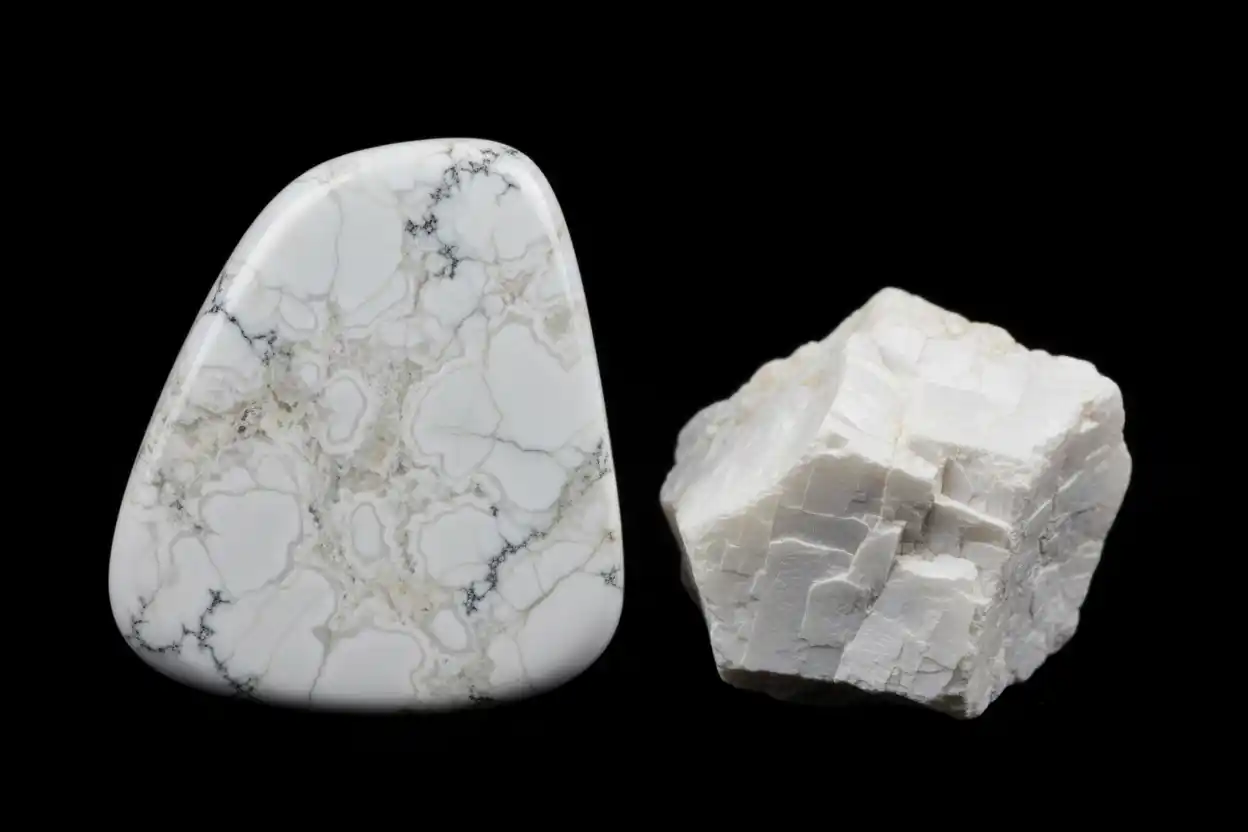
Magnesite: Meaning, Properties & Symbolism
Magnesite is a magnesium carbonate mineral best known in the gem trade as a white, cream, gray, or brown lapidary material. Although collectors occasionally encounter distinct rhombohedral crystals, most jewelry-grade magnesite occurs as compact, porous masses that cut well into beads, carvings, and cabochons.
Its natural appearance can be understated, yet magnesite has an unusually complicated market identity. White material readily absorbs dye, so blue-dyed magnesite has long served as a turquoise simulant. Consequently, understanding magnesite requires separating its mineral identity from the colors, trade descriptions, and treatments applied after mining.
What Is Magnesite?
Magnesite is a mineral with the ideal chemical formula MgCO₃. It belongs to the calcite group of carbonate minerals and shares a related rhombohedral structure with calcite, siderite, rhodochrosite, and other carbonates.
Despite that structural relationship, magnesite is not a variety of calcite. Calcite contains calcium carbonate, whereas magnesite contains magnesium carbonate. Their chemistry affects hardness, density, reaction to acid, formation environment, and typical appearance.
Most lapidary magnesite is massive, fine-grained, and opaque. Crystalline examples may appear transparent to translucent, but these are more often collected as mineral specimens than cut for commercial jewelry.
Magnesite at a Glance
| Property | Magnesite |
|---|---|
| Material type | Carbonate mineral |
| Ideal composition | Magnesium carbonate, MgCO₃ |
| Mineral group | Calcite group |
| Common colors | White, cream, gray, pale yellow, brown, faint pink, colorless; frequently dyed blue or other colors |
| Crystal system | Trigonal, within the hexagonal crystal family |
| Typical habit | Massive, compact, earthy, chalky, granular, fibrous, or rhombohedral crystals |
| Luster | Vitreous in crystals; dull, waxy, or porcelain-like in massive material |
| Transparency | Transparent to opaque |
| Mohs hardness | Approximately 3.5–4.5 |
| Cleavage | Perfect rhombohedral cleavage |
| Tenacity | Brittle |
| Common uses | Cabochons, beads, carvings, decorative objects, mineral specimens |
| Main care concern | Scratching, cleavage damage, acids, dye alteration, and prolonged soaking |
How Magnesite Forms
Magnesite develops in several geological settings, although magnesium-rich rocks provide one of its most characteristic environments. Fluids carrying carbon dioxide can react with serpentinite, peridotite, and other ultramafic rocks, replacing or altering their magnesium-bearing minerals and depositing magnesite.
Metamorphism can also produce magnesite where magnesium-rich rocks interact with carbon-bearing fluids. In these settings, it may occur with talc, antigorite, chlorite-group minerals, dolomite, and calcite.
Other deposits form in sedimentary basins, evaporitic environments, and hydrothermal veins. However, the compact white or veined material used for beads and cabochons often looks very different from sharply crystallized collector specimens.
The relationship between magnesite and dolomite can cause confusion because both contain magnesium and belong to the carbonate class. Dolomite includes both calcium and magnesium in an ordered structure, while magnesite is ideally magnesium carbonate.
Magnesite also differs from aragonite, another carbonate frequently sold in crystal shops. Aragonite is a calcium carbonate polymorph with an orthorhombic structure, whereas magnesite has magnesium-dominant chemistry and a trigonal structure.
Color and Texture
Pure magnesite is colorless or white. Nevertheless, natural masses frequently appear cream, gray, tan, yellowish, brown, or faintly pink because of iron, manganese, clay, silica, organic material, or other impurities.
Fine-grained material can develop a porcelain-like surface after polishing. Other pieces remain chalky or visibly porous, especially when unfinished. Brown matrix lines, patches, and veining may create attractive landscape-like patterns in cabochons.
Some dealers use names such as “white buffalo,” “wild horse,” or similar southwestern-style labels for pale stones with brown matrix. Those terms do not automatically prove a precise mineral identity. Several visually similar materials circulate under overlapping trade names, so buyers should request a clear mineral description rather than relying on pattern alone.
Porosity strongly affects appearance and treatment. Fine pores allow magnesite to absorb dye evenly, which explains why vivid blue, green, red, purple, and pink products are common in bead and craft markets.
Important Magnesite Localities
Brumado in Bahia, Brazil, is renowned for large, well-developed magnesite crystals and remains especially important to mineral collectors. Austria has also produced notable material near Sunk in Styria and Radenthein in Carinthia.
Other documented sources include Snarum in Norway, the historical Magnesia region of Greece, Mount Brussilof in British Columbia, Canada, and the Gabbs district of Nevada in the United States. Significant industrial deposits also occur in China, particularly in Liaoning Province.
A locality can matter greatly for a crystal specimen with documented provenance. However, most inexpensive beads, carvings, and tumbled pieces arrive without mine-level records. In that market, workmanship, natural pattern, treatment disclosure, and durability usually affect the asking price more than the source country.
How to Identify Magnesite
Visual inspection provides useful clues, but it cannot confirm every piece. Natural massive magnesite commonly has a white, cream, or gray body with a dull-to-waxy luster before polishing. Brown veining may cross the surface, while tiny pores can remain visible under magnification.
Its hardness generally falls between 3.5 and 4.5. Therefore, quartz can scratch it easily, and ordinary wear may gradually abrade a high-polish surface. Destructive scratch testing is not suitable for finished jewelry, so consult the broader gemstone hardness chart rather than testing a valuable piece directly.
Like other carbonates, magnesite reacts with acid. However, massive magnesite usually reacts less vigorously than calcite at room temperature unless powdered, scratched, or warmed. Acid testing can permanently etch a polished surface and should not be used casually.
A gemologist or mineral laboratory can distinguish magnesite through refractive-index testing, specific gravity, spectroscopy, Raman analysis, infrared spectroscopy, or X-ray diffraction. The general principles in how to identify crystals are helpful, although definitive identification may require more than appearance.
Magnesite, Howlite, and Turquoise
Magnesite is frequently confused with howlite because both commonly occur as white porous material with gray or dark veining. Both are also routinely dyed blue.
Howlite is a calcium borosilicate hydroxide mineral, not a carbonate. Its veining often forms fine web-like networks, while magnesite may display broader cream, tan, or brown patches. Nevertheless, their visual overlap is substantial enough that unaided identification can remain uncertain.
Natural turquoise is a hydrated copper-aluminum phosphate. Its natural blue-to-green color comes from its chemistry, whereas the strong blue of imitation magnesite usually comes from dye. Genuine turquoise may also contain matrix, so veining alone does not establish authenticity.
Under magnification, dye can concentrate in pores, fractures, drill holes, or surface recesses. A chipped area may reveal a white interior beneath the blue layer. However, destructive scraping is inappropriate for jewelry. The dedicated guide to real versus fake turquoise explains the distinction more fully.
Treatment disclosure remains essential because stabilized or treated turquoise can also show artificial substances. Therefore, blue color by itself cannot establish whether an item is turquoise, magnesite, howlite, or another simulant. More detailed treatment clues appear in the guide to treated and synthetic turquoise.
Jewelry Suitability
Magnesite accepts a smooth polish and works well for beads, pendants, earrings, brooches, carvings, and protected cabochons. Its pale natural colors also coordinate easily with silver, copper, leather, and mixed-stone designs.
However, its moderate softness and perfect cleavage limit durability. A hard impact can chip an edge or split the material along a cleavage direction. Consequently, magnesite is less suitable for an unprotected ring that receives daily knocks.
Pendant and earring settings expose the stone to less abrasion. Beaded bracelets can work, although beads may become dull where they repeatedly rub against metal spacers or harder gemstones. The distinction between surface hardness and resistance to breaking is explained in gemstone toughness versus hardness.
Drill holes also deserve inspection. Porous or fractured beads can chip around the opening, especially when strung too tightly. Knotted cord or flexible wire often reduces direct bead-to-bead impact.
Treatments and Imitations
Dyeing is the most important magnesite treatment. White material may be colored blue to resemble turquoise, but manufacturers also produce vivid green, red, orange, purple, and pink beads.
Some material receives resin or polymer impregnation to strengthen pores, improve polish, or retain dye. Surface coatings can add shine or intensify color. These treatments may be practical for inexpensive jewelry, but sellers should disclose them clearly.
Dyed magnesite is not synthetic turquoise. It remains natural magnesite whose appearance has been altered. Marketing it simply as “turquoise,” without identifying it as a simulant, misrepresents the material.
Artificial resin, ceramic, glass, and reconstructed products may also imitate dyed magnesite or turquoise. Mold marks, abundant round bubbles, overly regular matrix patterns, low weight, and a plastic-like feel can indicate manufactured material, although no single clue proves identity. The broader fake-crystal buying guide covers these warning signs.
Treatments such as dyeing, impregnation, filling, and coating affect many gem materials. Their purposes and disclosure standards are covered in gemstone treatments explained.
Current Magnesite Asking Prices
Magnesite is generally affordable. Size, cutting quality, natural pattern, treatment status, crystal form, provenance, and workmanship create a much wider price spread than the raw mineral alone would suggest.
| Product type | Broad retail asking range |
|---|---|
| Small tumbled stone | About $1–$5 each |
| Common bead strand | About $5–$25 |
| Dyed bead strand | About $6–$30 |
| Standard cabochon | About $5–$25 |
| Patterned or well-cut cabochon | About $15–$50 |
| Simple magnesite pendant or earrings | About $15–$75 |
| Attractive mineral specimen | About $20–$200 |
| Large or exceptional documented crystal specimen | From roughly $150 to several hundred dollars or more |
These figures represent broad retail asking prices, not formal appraisals or expected resale values. Highly discounted marketplace listings may also use ambiguous labels such as “magnesite turquoise,” which can obscure whether turquoise is being claimed as a color, a trade term, or a mineral identity.
Anyone shopping specifically for turquoise should use a dedicated turquoise buying guide rather than treating low-priced blue magnesite as an equivalent product.
What Gives Magnesite Value?
Natural pattern is one of the main value factors in lapidary magnesite. Balanced brown veining, clean white areas, an attractive landscape pattern, and minimal undercutting can produce distinctive cabochons.
Polish quality also matters. A smooth, reflective surface without pits, flat spots, chipped edges, or visible polishing compound indicates more careful cutting. Matching pairs command more than unrelated single stones because earrings require similar color, shape, and pattern.
Treatment affects value according to disclosure and purpose. Dyed beads can be attractive and functional, yet they normally carry less mineral-collector value than untreated, naturally patterned material. Conversely, a well-made designer piece may derive most of its price from craftsmanship rather than the cost of the stone.
Crystalline specimens follow different standards. Crystal size, transparency, sharpness, luster, damage, associated minerals, and verified locality determine collector demand.
Buying Magnesite
Begin by deciding whether you want natural-colored magnesite or deliberately dyed material. Neither choice is inherently wrong, but the invoice and product description should identify the treatment.
Inspect cabochons for pits, cracks, chalky edges, and unstable matrix. Slight pores are normal in some material, although a heavily undercut surface may collect dirt or lose its polish quickly.
For blue pieces, ask whether the stone is magnesite, howlite, genuine turquoise, reconstructed material, or another imitation. Avoid descriptions that combine unrelated mineral names without explanation.
When buying mineral specimens, request the locality and any available collection history. A precise mine or district matters more than a generic country label, particularly for crystallized magnesite.
Magnesite appears in both the crystals beginning with M directory and the gemstones beginning with M directory, although its most common commercial forms are beads, cabochons, carvings, and specimens rather than faceted gems.
Cleaning and Storage
Clean magnesite with a soft cloth or a soft brush dampened with lukewarm water and a small amount of mild soap. Wipe away the soap promptly, then dry the item completely.
Avoid prolonged soaking. Porous material can absorb liquid, and dyed stones may release color or develop uneven patches. The broader guide to which crystals can and cannot go in water provides useful context, but treatment condition still matters for an individual piece.
Do not use acidic cleaners, vinegar, lemon juice, jewelry dips, bleach, steam, or ultrasonic equipment. Acid can etch carbonate minerals, while heat and vibration may damage fractures, cleavage planes, dye, or polymer impregnation.
Store magnesite separately from quartz, corundum, topaz, and other harder stones. A fabric pouch or divided jewelry box reduces scratches. Also keep dyed material away from prolonged high heat and intense light because some colorants can fade.
Magnesite Meaning and Symbolism
Modern crystal traditions often associate white magnesite with patience, quiet reflection, emotional composure, and a willingness to pause before reacting. Its pale surface and subtle matrix patterns have also inspired interpretations involving simplicity, self-observation, and openness to change.
Blue-dyed magnesite is sometimes assigned symbolism similar to turquoise. However, those associations come primarily from its manufactured color and market presentation rather than magnesite’s natural appearance or mineral history.
These meanings are spiritual, cultural, or personal interpretations. Scientific research has not established that wearing or handling magnesite produces medical or psychological effects.
Frequently Asked Questions
Is magnesite a real mineral?
Yes. Magnesite is a recognized magnesium carbonate mineral with the ideal formula MgCO₃. Dyed magnesite remains real magnesite, although its color is treated.
Is magnesite the same material as howlite?
No. Magnesite is a carbonate, whereas howlite is a calcium borosilicate hydroxide. Their porous white appearance and use as dyed turquoise simulants create frequent confusion.
Why is so much magnesite dyed blue?
White magnesite absorbs dye easily and can develop a turquoise-like blue color at low cost. The treatment is acceptable when sellers disclose the stone as dyed magnesite rather than natural turquoise.
How can I distinguish blue magnesite from turquoise?
Look for dye concentrated in pores, fractures, and drill holes, along with white material exposed at chips. Because stabilized turquoise and other simulants can look similar, laboratory testing may be necessary.
Does magnesite fizz in acid?
Yes, but its reaction is often slower than calcite unless the surface is powdered, scratched, or warmed. Acid testing damages polished stones and should not be performed on jewelry.
Which countries produce notable magnesite?
Documented sources include Brazil, Austria, Norway, Greece, Canada, the United States, and China. Brumado in Brazil is particularly celebrated for crystallized specimens.
Can magnesite be worn in a ring?
It can, but a protective bezel and occasional wear are preferable. Its moderate softness, brittleness, and perfect cleavage make an exposed daily-wear ring vulnerable to damage.
Can magnesite jewelry get wet?
Brief contact during gentle cleaning is usually manageable for untreated, intact material. Prolonged soaking is unsuitable, especially for dyed, porous, filled, or glued pieces.
Does dyed magnesite lose its color?
Some dyes remain stable for years, while others fade through sunlight, heat, chemicals, perspiration, or repeated soaking. Treatment quality and depth vary widely.
Is magnesite commonly stabilized?
Some porous material receives resin or polymer impregnation to improve strength, polish, or dye retention. Stabilization is not universal, so buyers should ask the seller.
What makes one magnesite cabochon more valuable than another?
Natural pattern, balanced color, polish, symmetry, thickness, structural stability, treatment disclosure, and cutting quality matter more than carat weight alone.
Is magnesite safe to wear?
Finished magnesite jewelry is generally suitable for normal external wear. It should not be ingested, placed in drinking water, or exposed to acids and harsh cleaning chemicals.
Magnesite is most rewarding when purchased for what it genuinely is: a soft, expressive carbonate whose natural patterns and workability make it especially suitable for the cabochon and carving styles discussed in the guide to carving gemstones.