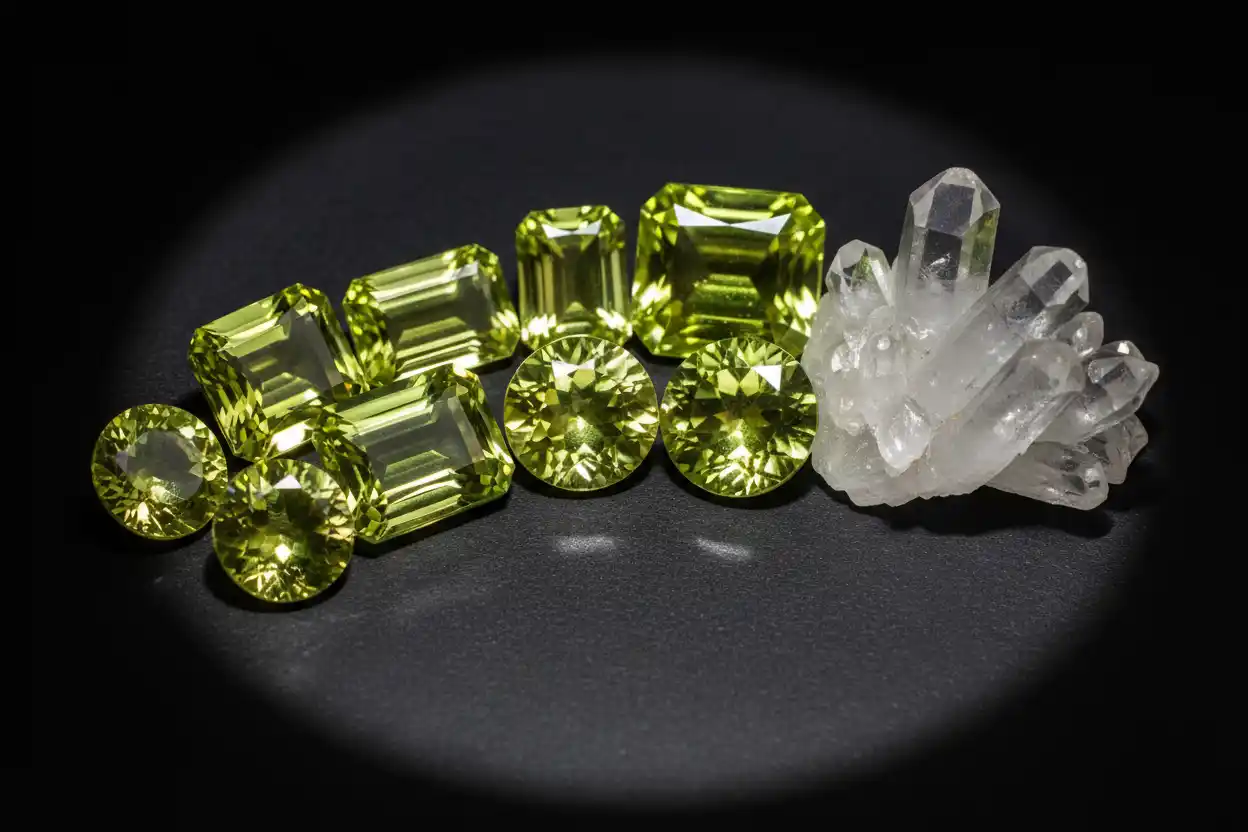
Ouro Verde Quartz Meaning, Treatment, Properties & Value
Ouro Verde Quartz is transparent quartz whose yellow-green, lime-gold, or greenish-yellow color is produced through artificial irradiation followed by controlled heating. The Portuguese name means “green gold,” describing the resulting color rather than a naturally occurring quartz species.
The quartz itself may be natural rock crystal, but the distinctive commercial color is treatment-created. Therefore, Ouro Verde should be sold as irradiated-and-heated quartz rather than as a rare naturally green crystal from one exclusive geological deposit.
Ouro Verde Quartz at a Glance
| Property | Ouro Verde Quartz |
|---|---|
| Material type | Irradiated and heat-treated transparent quartz |
| Starting material | Usually natural colorless or pale quartz suitable for treatment |
| Composition | Silicon dioxide, SiO₂ |
| Color source | Treatment-created color centers modified by irradiation and controlled heating |
| Common colors | Canary yellow, lemon yellow, yellow-green, lime, olive-gold, green-gold, and chartreuse |
| Crystal system | Trigonal |
| Typical form | Faceted gems, polished crystals, beads, briolettes, and finished jewelry |
| Luster | Vitreous |
| Transparency | Transparent to translucent |
| Mohs hardness | 7 |
| Cleavage | None; weak rhombohedral parting may occur in some material |
| Tenacity | Brittle |
| Specific gravity | Approximately 2.65 |
| Common uses | Rings, earrings, pendants, bracelets, necklaces, collector cuts, and decorative crystals |
| Main care concern | Treatment disclosure, possible color alteration from excessive heat, imitation by other yellow-green gems, and quartz chipping |
Ouro Verde Is a Treatment Name
Ouro Verde Quartz belongs to the broader quartz family. Its basic physical properties come from quartz rather than from a separate mineral species.
The treatment begins with suitable transparent quartz, commonly colorless material comparable to clear quartz.
Irradiation creates or modifies defects known as color centers within the crystal. The treated material can initially become smoky, dark brown, or nearly black.
Controlled heating then changes those color centers. If the starting material and processing conditions are suitable, the color progresses into yellow, lime, green-gold, or related hues.
The final appearance depends on the quartz source, impurity content, radiation dose, heating temperature, heating duration, and treatment sequence.
Consequently, two gems carrying the Ouro Verde name may differ significantly in tone and saturation.
What “Green Gold” Means
Ouro verde translates directly from Portuguese as green gold.
The name describes a color positioned between yellow and green. Fine stones may resemble golden chrysoberyl, light peridot, greenish citrine, yellow-green beryl, or certain tourmalines.
However, the presence of the Portuguese name does not prove that the material came from one Brazilian mine.
Brazil is strongly associated with the treatment’s development and commercial supply, and particular sellers promote material from named mines. Nevertheless, quartz from several sources can respond to irradiation and heating.
The meaningful disclosure is the starting material’s natural or synthetic status, the color treatment, and any documented source—not the romance of the trade name alone.
How Irradiation Changes Quartz
Natural quartz contains trace impurities and structural defects. Aluminum can substitute for silicon, while hydrogen, alkali ions, and other components occupy charge-balancing positions.
High-energy radiation displaces electrons and alters the charge state of these defects. The new color centers absorb selected wavelengths of visible light.
In suitable quartz, irradiation commonly produces smoky or dark coloration. The process may resemble color mechanisms that also occur through natural geological radiation, but commercial treatment accelerates and controls the exposure.
The word irradiated does not automatically mean that a stone remains dangerously radioactive. However, treatment facilities and regulators must assess the irradiation source, possible activation, and any required decay or holding period before distribution.
A responsible seller should obtain material through a legitimate gem supply chain rather than making unsupported safety claims about home or unregulated treatment.
Why Heating Is Necessary
Irradiated quartz does not automatically emerge with the final Ouro Verde color.
Heating changes the stability and population of color centers. Some absorption features disappear, while others remain or shift, causing the crystal to pass through smoky, clear, yellow, orange, green, or related stages.
Temperature control is crucial. Too little heat may leave a dark, unattractive stone, while too much can remove most color and return the quartz toward near-colorless material.
The process is highly dependent on origin. Quartz from one deposit may become bright yellow-green, while another batch produces weak yellow, orange, smoky brown, or no useful color.
Treatment developers therefore test small samples before processing larger quantities.
The defining treatment belongs within the processes explained in gemstone treatments.
Is Ouro Verde Natural?
The starting quartz may be natural. The green-gold color is not considered natural when it results from commercial irradiation and heating.
A product description such as “natural Ouro Verde Quartz” is incomplete unless it also states that the color has been treated.
The word natural should describe the geological origin of the quartz core, not imply that the finished color formed underground.
Laboratory-grown quartz can theoretically receive similar treatment. Therefore, a report may need to distinguish both natural-versus-synthetic origin and treated-versus-untreated color.
The dedicated guide to treated clear quartz owns the wider market for irradiated, coated, crackled, dyed, aura-treated, and synthetic transparent quartz.
Ouro Verde and Lemon Quartz
Lemon Quartz is a broad commercial name for transparent yellow to yellow-green quartz.
Some lemon quartz is produced through the same irradiation-and-heating sequence used for Ouro Verde. In that context, the names can overlap.
Other sellers use lemon quartz for greenish-yellow quartz regardless of the precise treatment route. The term may also be applied loosely to pale citrine-like material.
Ouro Verde usually suggests a more explicitly green-gold or lime-yellow product associated with the treatment developed in Brazil.
Neither name is a formal mineral variety. A precise invoice should state quartz, color, treatment, and whether the starting material is natural or synthetic.
Ouro Verde and Prasiolite
Prasiolite is transparent green quartz, commonly produced by heating certain amethyst or through combinations of treatment.
Its preferred colors tend to be mint, sage, leek green, or yellowish green. Ouro Verde usually carries stronger yellow, lime, or golden components.
Commercial boundaries can overlap. A pale green-yellow stone may be sold as prasiolite by one dealer and Ouro Verde or lemon quartz by another.
The name should not override treatment disclosure. Refractive index and density confirm quartz but cannot always establish the exact commercial color category.
A green quartz seller should explain whether the color results from heat alone, irradiation followed by heat, another treatment, or an undetermined process.
Ouro Verde, Citrine, and Yellow Quartz
Natural and treated citrine ranges from pale yellow to orange and brownish orange. Green is not normally its dominant face-up component.
Ouro Verde contains enough green to create a chartreuse, lime, olive-gold, or chrysoberyl-like appearance.
Yellow Quartz is a broader visual category that may include naturally or artificially colored quartz products.
Quartz nomenclature becomes unreliable when sellers use citrine, lemon quartz, yellow quartz, green amethyst, and Ouro Verde as interchangeable marketing terms.
The most accurate description should prioritize mineral identity and treatment over the most fashionable color name.
Ouro Verde and Smoky Quartz
Smoky Quartz obtains its brown-to-black color from radiation-related color centers involving aluminum-associated defects.
Commercial treatment can turn suitable clear quartz smoky before heating modifies the color into yellow-green Ouro Verde.
This relationship does not mean that every smoky quartz can be heated successfully into green-gold material.
Source chemistry and color-center stability differ. Some specimens bleach toward colorless, while others become yellow, orange, green, or remain brown.
Heating a finished smoky quartz at home is unsafe for the gem and may cause cracking, color loss, or unpredictable results.
Physical and Optical Properties
Ouro Verde retains quartz’s trigonal structure, hardness, density, and general optical constants.
Its Mohs hardness of 7 makes it resistant to many everyday scratches. Nevertheless, quartz can abrade against topaz, sapphire, ruby, diamond, and harder manufactured materials.
The stone has no true mineral cleavage but remains brittle. Sharp impacts can chip facet junctions, girdles, and pointed ends.
Refractive index falls near 1.544–1.553, and birefringence is approximately 0.009.
These values separate quartz from peridot, chrysoberyl, scapolite, topaz, glass, and many synthetic substitutes.
The comparison is summarized in the gemstone hardness chart and the guide to gemstone toughness versus hardness.
How to Identify Ouro Verde Quartz
Basic testing can establish that a transparent yellow-green gem is quartz. It cannot necessarily prove how the color was produced.
A gemologist measures refractive index, birefringence, optic character, density, fluorescence, absorption spectrum, and microscopic features.
Natural quartz may contain two-phase inclusions, mineral needles, negative crystals, growth zoning, healed fractures, and Brazil-law twinning.
Laboratory-grown quartz can show distinctive growth features, seed-related structures, or impurity patterns, although separation may require advanced testing.
Spectroscopy can study color centers, but treatment history is not always detectable conclusively after heating.
Consequently, commercial disclosure and traceable supply remain important. A report may identify quartz and state indications of treatment or color origin when the laboratory can support that conclusion.
The broader workflow appears in how to identify crystals.
Common Lookalikes
Peridot commonly has a more olive or yellow-green appearance and strong birefringence that doubles rear facet edges. It is denser and has different refractive indices.
Chrysoberyl can show a bright greenish-yellow color with greater hardness, density, and refractive index.
Yellow-green beryl generally has lower refractive index but may overlap visually in larger pale stones.
Scapolite can resemble lemon-colored quartz but has different density, optics, cleavage, and fluorescence.
Glass can match almost any yellow-green hue. Round bubbles, flow lines, low birefringence, and different refractive response may reveal it.
Cubic zirconia and synthetic spinel can also receive yellow-green color or coatings.
The general warning signs of glass, coatings, fabricated certificates, and renamed common stones appear in how to spot fake crystals.
Jewelry Suitability
Ouro Verde Quartz is suitable for rings, pendants, earrings, necklaces, brooches, and bracelets.
Large clean stones are widely available because quartz rough occurs in substantial sizes. This supports cocktail rings, fantasy cuts, briolettes, and statement pendants.
A low protective setting reduces chipping risk in rings. Pointed pears, marquises, and trillion cuts require secure corner protection.
Earrings and pendants preserve polish more easily because they receive less impact than rings and bracelets.
The color pairs naturally with yellow gold, which strengthens golden tones, while white metals emphasize lime and green components.
A jeweler should be told that the quartz is irradiated and heated before repair. Excessive torch heat can alter the color or create thermal stress.
Color Stability and Care
The treatment can be durable under ordinary jewelry use, but stability is not necessarily identical across every quartz source and processing route.
High heat poses the clearest risk because heating created the final color and can alter it again.
Prolonged exposure to intense sunlight or strong artificial radiation should also be avoided when the treatment history and stability are not documented.
Steam cleaning is unsuitable because rapid heating may crack the stone or affect color.
Ultrasonic cleaning can be risky when fractures, filling, glue, or an unstable setting are present.
The conservative cleaning method is lukewarm soapy water and a soft brush.
Plain quartz tolerates brief water contact, but assembled jewelry, coatings, fillers, and glue require additional caution under the principles in which crystals can and cannot go in water.
Current Ouro Verde Quartz Asking Prices
Ouro Verde is attractive but not geologically rare. Large treated stones are available at prices far below naturally rare yellow-green gems.
| Ouro Verde product | Broad retail asking range |
|---|---|
| Small polished crystal or display piece | About $8–$30 |
| Small faceted stone below about 5 ct | About $15–$75 total |
| Commercial loose gem | About $3–$12 per carat |
| Fine color or precision-cut gem | About $8–$25 per carat |
| Large fancy cut around 20–50 ct | About $75–$400 |
| Exceptional large precision or designer cut | About $250–$1,000 or more |
| Sterling-silver jewelry | About $40–$250 |
| Gold jewelry | About $300–$2,000 or more |
| Designer or branded jewelry | Determined mainly by metal, craftsmanship, and brand |
These are broad July 2026 asking prices rather than appraisals or resale guarantees.
Marketplace listings frequently describe the material as natural without placing the treatment prominently. Buyers should not pay a natural-color rarity premium for a disclosed irradiation-and-heat product.
What Gives Ouro Verde Value?
Color is the first factor. Fine material shows an attractive balance of yellow and green without appearing muddy, gray, brown, or fluorescently artificial.
Saturation should remain visible under ordinary lighting. Some stones look intensely green under studio lights but pale yellow in daylight.
Clarity matters because inclusions become more visible in large transparent gems. However, a few natural inclusions can support geological origin.
Cut determines brilliance, face-up color, windowing, extinction, apparent size, and symmetry.
Precision fantasy cuts can add significant labor value even when the rough was inexpensive.
Large size raises total price but usually not rarity at the same rate seen in sapphire or chrysoberyl.
Treatment disclosure improves confidence. A correctly represented treated quartz is more desirable than an ambiguously labeled “rare natural Brazilian green gold gem.”
Buying Ouro Verde Quartz
Confirm in writing that the stone is quartz whose color was created by irradiation and heating.
Ask whether the starting quartz is natural or laboratory-grown. The phrase genuine quartz does not resolve that distinction.
View the gem under daylight-equivalent, warm indoor, and direct lighting to understand its yellow-green balance.
Inspect the girdle and pointed ends for chips. Large stones should also be checked for windows, extinction, and uneven color.
Avoid listings claiming that all Ouro Verde comes naturally from one mine or forms as green-gold quartz underground.
Radiation treatment should have been performed and released through a legitimate regulated supply chain. A retailer is unlikely to possess technical irradiation records for every small gem, but credible disclosure remains preferable to denial of treatment.
Ouro Verde appears in the crystals beginning with O directory and the gemstones beginning with O directory.
It can also be compared visually with entries in the yellow gemstone directory without treating those different minerals as equivalent.
Ouro Verde Quartz Meaning and Symbolism
Ouro Verde is a modern treated gemstone, so claims of ancient traditions specific to its commercial name are historically implausible.
Contemporary symbolism often connects its green-gold color with optimism, opportunity, creativity, practical ambition, and developing an idea into a visible result.
Its transformation from colorless quartz through irradiation and heat inspires associations with deliberate change rather than passive waiting.
The treatment history can also support a useful ethical theme: enhancement does not remove beauty, but disclosure determines whether the product is represented honestly.
These meanings remain personal, artistic, spiritual, or cultural interpretations. Scientific evidence does not show that Ouro Verde Quartz attracts money, treats illness, or guarantees confidence.
Frequently Asked Questions
Is Ouro Verde Quartz natural?
The quartz core may be natural, but the yellow-green color is commercially produced through irradiation followed by heating.
What does Ouro Verde mean?
The Portuguese phrase means green gold and refers to the gem’s greenish-yellow or golden-lime color.
Is Ouro Verde a separate mineral?
No. It is treated quartz with the composition SiO₂.
Is Ouro Verde the same as lemon quartz?
The names often overlap, especially for irradiated-and-heated yellow-green quartz. Lemon quartz is a broader and less standardized trade term.
Is Ouro Verde the same as prasiolite?
No. Both are treated green quartz products, but prasiolite usually appears mint-to-sage green, while Ouro Verde typically contains stronger yellow or gold.
How is Ouro Verde Quartz made?
Suitable transparent quartz is irradiated to create color centers and then heated in controlled stages until the desired yellow-green color develops.
Does irradiation make Ouro Verde radioactive?
Irradiation does not automatically make a gem radioactive, but some irradiation methods can create temporary residual activity. Regulated material must meet applicable release standards before distribution.
Can the color fade?
Color stability depends on starting material and treatment conditions. Avoid high heat and prolonged intense light when no stability documentation is available.
How can a laboratory identify the treatment?
A laboratory can confirm quartz and examine spectra, inclusions, and color centers, although the exact treatment history may not always be conclusively detectable.
Is Ouro Verde suitable for an everyday ring?
Yes, with reasonable care. Quartz is hard enough for regular wear but remains brittle and can chip after a sharp impact.
Is Ouro Verde expensive?
It is usually affordable because transparent quartz is abundant and the color is treatment-created. Precision cutting, large size, metal, and brand often determine most of the final price.
How should Ouro Verde jewelry be cleaned?
Use lukewarm water, mild soap, and a soft brush. Avoid steam, strong heat, harsh chemicals, and ultrasonic cleaning when fractures or fillings are possible.
Ouro Verde’s defining feature is not a rare natural deposit but a controlled change in quartz color. Its closest internal comparison is lemon quartz, where trade-name overlap makes treatment disclosure more useful than relying on either name alone.