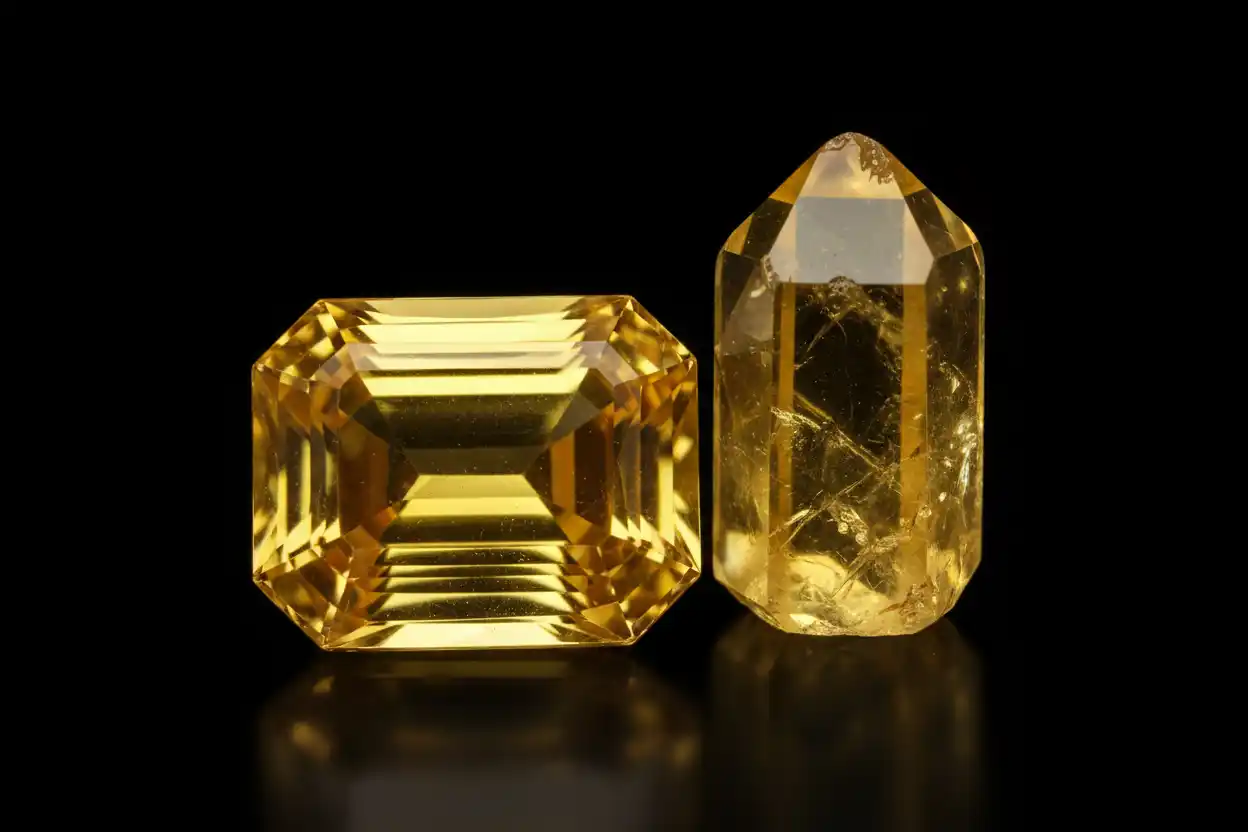
Lemon Quartz: Meaning, Properties & Symbolism
Lemon quartz is a commercial name for transparent quartz with a bright lemon-yellow or yellow-green color. Although naturally yellow quartz exists, most material sold specifically as lemon quartz has been irradiated and heated to create its distinctive fresh, slightly greenish hue.
Lemon Quartz at a Glance
| Property | Lemon Quartz Characteristics |
|---|---|
| Material type | Yellow-to-yellow-green trade variety of crystalline quartz |
| Composition | Silicon dioxide, SiO₂ |
| Colors | Pale lemon yellow, vivid yellow, greenish yellow and golden yellow |
| Crystal system | Trigonal |
| Habit or texture | Usually sold as faceted gems cut from transparent quartz rough |
| Luster | Vitreous |
| Transparency | Transparent to translucent |
| Mohs hardness | 7 |
| Cleavage | None |
| Tenacity | Brittle |
| Common uses | Rings, earrings, pendants, bracelets, cocktail jewelry and fantasy-cut gems |
| Main care concern | Treatment disclosure, color stability, impact chipping and confusion with citrine or broader yellow quartz |
What Is Lemon Quartz?
Lemon quartz is quartz selected or treated to display a bright, relatively pure yellow or greenish-yellow color.
It is not a formally recognized mineral species. Every genuine example remains crystalline quartz with the formula SiO₂.
The name describes a trade appearance rather than a fixed laboratory color range. Some sellers reserve it for cool lemon-yellow stones with a slight green modifier, while others use it for nearly any bright transparent yellow quartz.
That inconsistency creates overlap with yellow quartz, citrine and several treated quartz products.
The broader quartz family guide should own general quartz mineralogy. This page instead focuses on the lemon trade name, its usual treatment route, identification and market position.
Lemon Quartz vs Yellow Quartz
Yellow quartz is the wider color category.
It can include natural citrine, heat-treated amethyst, irradiated quartz, lemon quartz, smoky-yellow material and other commercial yellow products.
Lemon quartz is therefore one subset of the larger yellow-quartz market.
The most useful distinction is appearance and trade intent. Lemon quartz typically aims for a fresh yellow with limited orange or brown and may show a greenish modifier.
By contrast, yellow quartz can range from pale straw through golden yellow to brownish yellow.
The dedicated Yellow Quartz page should own the broad classification of natural and treated yellow quartz. Lemon Quartz should remain focused on the specific lemon-yellow product sold in jewelry.
Is Lemon Quartz Natural?
The quartz crystal itself is natural in most commercial products.
However, the lemon-yellow color is commonly produced or strengthened through irradiation followed by heat treatment.
Calling such a stone natural quartz is chemically accurate but incomplete if the seller does not disclose the color treatment.
A fully transparent description would state that the gem is natural quartz with irradiated and heated color.
Untreated natural material with a similar yellow-green appearance can occur, but it is much less predictable and cannot be confirmed by appearance alone.
The distinction matters primarily for disclosure and informed buying. Treatment does not make the gem glass or synthetic quartz, but it changes the history of its color.
How Irradiation and Heat Create Lemon Color
Quartz can contain aluminum and other trace defects within its crystal lattice.
Natural or artificial irradiation displaces electrons and changes the charge state of these defects, creating new absorption in visible light. The quartz may initially become smoky, brown, greenish or another intermediate color.
Controlled heating then reorganizes or removes some of the radiation-related centers.
Under suitable conditions, the remaining absorption produces bright yellow or yellow green.
The exact result depends on the starting quartz, defect chemistry, radiation dose, heating temperature and duration.
Not every clear or smoky quartz crystal will become attractive lemon quartz. Material is selected because its defect structure responds predictably.
Treatment outcomes may range from pale yellow to green gold. Some stones are marketed as lemon citrine, green gold quartz or related proprietary names.
The detection framework in treated clear quartz owns the broader discussion of irradiated, heated and synthetic quartz.
What Causes the Color?
Commercial lemon quartz usually derives its color from radiation-related defects rather than a high concentration of visibly colored inclusions.
The color remains inside the lattice, so it does not sit on the surface like a coating.
This distinction matters during wear. An atomic-level color cannot peel from a facet edge, although it may respond to prolonged heat or intense light.
Natural yellow quartz and citrine involve overlapping iron- and defect-related mechanisms. Consequently, determining whether a specific lemon-yellow stone was treated can require spectroscopy and knowledge of its absorption patterns.
A seller should not claim untreated color merely because the gem lacks dye or coating.
The general disclosure terminology in gemstone treatments explained helps separate irradiation, heat, coating and fracture filling.
Lemon Quartz vs Citrine
Citrine is the pale-yellow-to-brownish-orange gem variety of quartz.
In ordinary trade, citrine generally leans warmer and may contain golden, orange, brown or reddish modifiers.
Lemon quartz usually appears cooler and brighter, with a purer yellow or slight green component.
The boundary is not standardized. One seller may call a stone lemon quartz while another calls the same color light citrine.
Treatment history also overlaps. Much commercial citrine comes from heat-treated amethyst, while lemon quartz is commonly associated with irradiation followed by heating.
Neither name alone proves natural color.
The exact hue, treatment disclosure and visual appeal matter more than forcing every stone into a rigid boundary that the market does not consistently follow.
Lemon Quartz vs Prasiolite
Prasiolite is green quartz, commonly produced through heating or irradiation and heating of suitable amethyst or quartz.
Lemon quartz contains more yellow, while prasiolite should appear predominantly green.
Intermediate yellow-green stones can be marketed under either name depending on the seller.
When green dominates, prasiolite is the clearer description. When yellow remains dominant and the green component acts only as a modifier, lemon quartz is more appropriate.
The distinction is commercial rather than a change in quartz species.
Lemon Quartz vs Ouro Verde Quartz
Ouro Verde Quartz is a vivid yellow-green-to-chartreuse treated quartz product.
Its color often appears more saturated, greener and more neon than ordinary lemon quartz.
Both products can be made through combinations of irradiation and heat.
Ouro Verde should therefore own the high-saturation chartreuse trade intent, while Lemon Quartz should remain centered on lighter lemon-yellow and greenish-yellow stones.
The names occasionally overlap in retail listings. Buyers should judge the exact gem rather than relying on a label that may change between wholesalers.
Formation of the Quartz Base Material
Before treatment, the quartz forms through ordinary geological processes.
Crystalline quartz grows from silica-rich hydrothermal fluids, pegmatitic melts and cavities in igneous or metamorphic rocks.
Brazil supplies much of the transparent rough used for lemon quartz because its deposits produce large, clean crystals suitable for irradiation, heating and faceting.
Once mined, selected rough is treated and then cut into ovals, cushions, rounds, pears, checkerboard cuts and fantasy shapes.
The geological origin of the quartz does not prove where the treatment occurred. Rough may be mined in one country, enhanced in another and cut in a third.
How to Identify Lemon Quartz
Standard gemological tests identify quartz rather than the lemon trade name.
Quartz has a refractive index around 1.544–1.553, specific gravity near 2.65 and Mohs hardness 7. It is doubly refractive and typically shows characteristic optical behavior under a polariscope.
These properties separate it from yellow glass, synthetic spinel, sapphire, chrysoberyl and topaz.
Determining color origin is more difficult. Microscopy may reveal natural inclusions, but those inclusions do not establish whether irradiation or heat modified the color.
Visible and infrared spectroscopy can provide evidence about defect-related absorption. Even so, laboratories may not always determine every treatment sequence conclusively.
The real versus fake clear quartz guide helps distinguish quartz from glass and resin, while treatment detection remains a separate question.
Lemon Quartz Lookalikes
Yellow glass provides the simplest imitation. It may contain round bubbles, curved flow lines and softer facet edges.
Yellow topaz has greater density, a higher refractive index and perfect cleavage. The citrine versus yellow topaz comparison provides relevant identification principles even when the quartz is sold as lemon quartz.
Yellow sapphire is harder and more brilliant, while chrysoberyl has different optical measurements and greater toughness.
Synthetic quartz can match natural quartz closely because it has the same composition and structure. Growth features, twinning and spectroscopy may be needed to separate it from natural material.
The warning signs in how to spot fake crystals remain useful for obvious coatings and simulants but cannot resolve sophisticated quartz origin questions.
Jewelry Suitability
Lemon quartz has the same basic durability as other macrocrystalline quartz.
Its Mohs hardness of 7 offers reasonable scratch resistance for earrings, pendants, necklaces and occasional-wear rings.
Quartz has no true cleavage, which reduces directional splitting. However, it remains brittle and can chip around thin girdles, pointed corners and drilled holes.
The gemstone hardness chart places it above glass and feldspar but below topaz, sapphire and diamond.
The discussion of gemstone cleavage explains why no cleavage does not make quartz unbreakable.
Likewise, gemstone toughness versus hardness supports protective settings for large cocktail stones.
Lemon quartz works especially well in earrings and pendants because large clean gems remain affordable. Rings should use adequate girdles and settings that protect exposed points.
Treatments Beyond Color
Irradiation and heat are the primary commercial treatments.
Surface coating can also modify yellow or green color, though it is less central to the lemon-quartz market. A coating may show wear along facet junctions or concentrated color at the surface.
Fracture filling is possible in heavily included material but is rarely justified for inexpensive clean quartz.
Some fantasy-cut stones are backed or assembled with reflective material to strengthen color. Any composite construction should be disclosed.
Synthetic quartz exists and is produced commercially for electronics and gem use. However, treatment of natural quartz remains more common in ordinary lemon-quartz jewelry.
Lemon Quartz Price and Value
Lemon quartz is affordable because transparent quartz rough is abundant and the treatment process can produce large quantities of consistent color.
| Lemon Quartz Product | Broad Current Asking Range |
|---|---|
| Small calibrated loose stone | $5–$20 |
| Commercial 5–20 ct faceted gem | $10–$50 per stone |
| Large checkerboard or buff-top cut | $20–$75 per stone |
| Precision or fantasy-cut gem | $50–$150+ per stone |
| Unusual star or collector quartz | $75–$300+ |
| Silver jewelry | Commonly $30–$200 |
| Gold designer jewelry | Determined mainly by metal, workmanship and brand |
Color uniformity, transparency and cut quality create more value than rarity.
A vivid lemon-yellow gem with strong brilliance can command more than a larger pale or windowed stone.
The material should not be marketed as an investment gem. Treatment and reproducible supply limit secondary-market scarcity.
Buying Lemon Quartz
Ask whether the stone has been irradiated and heated. The expected answer for most commercial material is yes or presumed treated.
A seller who describes the color as completely natural should provide credible laboratory support.
Evaluate the gem in neutral lighting. Dark backgrounds and warm lamps can strengthen yellow saturation, while overexposed photography hides green or brown modifiers.
Check for windowing through the center. Large inexpensive quartz is often cut shallowly to preserve weight, producing a transparent area with weak brilliance.
Treatment disclosure, exact dimensions and cut quality matter more than a generic AAA label.
Cleaning and Color Care
Clean lemon quartz with lukewarm water, mild soap and a soft brush.
Sound untreated or lattice-treated quartz may tolerate some ultrasonic systems, but hand cleaning remains safer for stones with fractures, coatings or uncertain assembly. The guidance in gemstones and ultrasonic cleaners should be applied to the complete jewelry item.
Avoid steam, sudden temperature changes and prolonged high heat.
Strong light may affect some radiation-related quartz colors. Store the gem away from a hot sunny window or intense display lamp when its stability is undocumented.
Keep it separate from topaz, sapphire and diamond, which can scratch its facets.
Lemon Quartz Meaning and Symbolism
Lemon quartz has no separate ancient tradition under its modern commercial name.
Contemporary symbolism draws from its bright yellow and greenish-yellow color.
Common themes include optimism, mental clarity, practical confidence and turning an idea into a visible result.
The treatment history can also support a material-specific interpretation. An initially pale or smoky quartz crystal develops a new color when its atomic defects respond to radiation and heat.
Some people use that transformation as a symbol of adapting constructively to changing conditions.
These meanings remain personal or cultural interpretations. Scientific evidence does not show that lemon quartz improves concentration, attracts wealth or changes physical health.
The broader yellow gemstones and yellow crystals pages provide color-based symbolism without replacing this treatment-focused guide.
Frequently Asked Questions About Lemon Quartz
Is lemon quartz a separate mineral?
No. It is a commercial yellow-to-yellow-green variety of crystalline quartz.
Is lemon quartz the same as citrine?
Not exactly. The names overlap, but lemon quartz is usually cooler, brighter and slightly greener than typical citrine.
Is lemon quartz natural?
The base quartz is usually natural, while the commercial color is commonly produced by irradiation and heat.
How is lemon quartz made?
Suitable quartz is irradiated to create color centers and then heated to produce the desired lemon-yellow or greenish-yellow appearance.
Is lemon quartz color stable?
Many stones remain stable during normal wear, but prolonged heat or strong light can affect some irradiation-related colors.
Is lemon quartz the same as yellow quartz?
Lemon quartz is one commercial subset of the broader yellow-quartz category.
Is lemon quartz the same as Ouro Verde quartz?
No. Ouro Verde generally has a more saturated chartreuse or green-yellow appearance.
How hard is lemon quartz?
It ranks 7 on the Mohs scale.
Is lemon quartz suitable for rings?
Yes, especially in a protective setting, although sharp impacts can still chip the stone.
Is synthetic lemon quartz available?
Synthetic quartz exists, but treated natural quartz is more common in the lemon-quartz jewelry market.
Can lemon quartz go in an ultrasonic cleaner?
Sound unfilled quartz may tolerate it, but hand cleaning is safer when treatment, fractures or the setting are uncertain.
Is lemon quartz valuable?
It is generally affordable. Cut quality, color and design add more value than rarity.
Lemon quartz belongs in both Crystals That Start With L and Gemstones That Start With L, but accurate treatment disclosure is more important than the trade name itself.
Safety disclaimer: Cutting or polishing lemon quartz can release respirable crystalline-silica dust. Use wet lapidary methods, effective local extraction, eye protection and suitable respiratory protection. Do not inhale grinding residue or place powdered quartz in drinking water.