
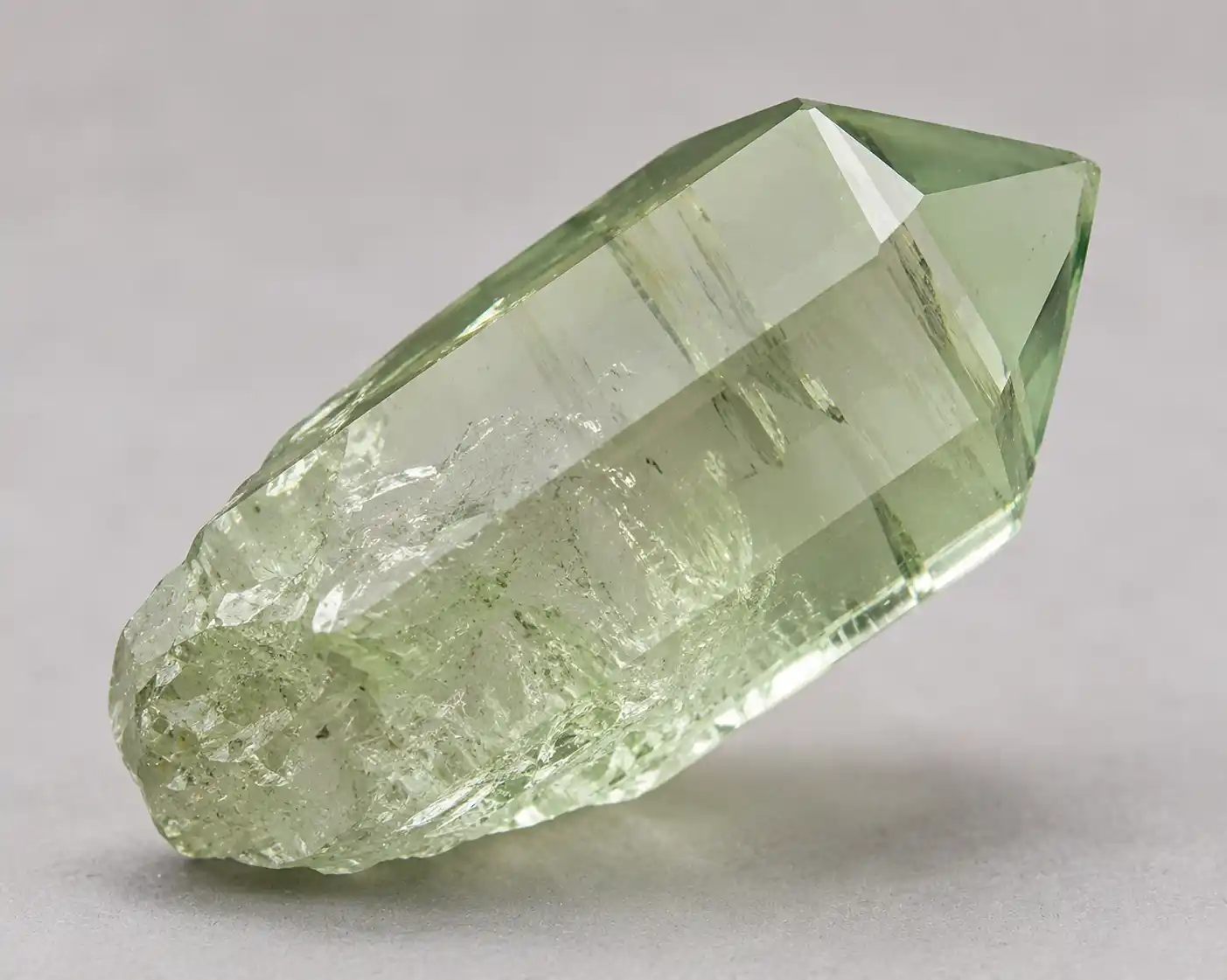

Prasiolite is the transparent pale-green to yellowish-green variety of macrocrystalline quartz. Much of the material sold today begins as amethyst whose color changes from purple to green through controlled heating, although naturally green quartz also occurs in limited geological settings.
“Green amethyst” remains a familiar commercial synonym, but prasiolite or green quartz describes the material more precisely. Once the stone appears green, it is no longer an amethyst color variety in the ordinary gemological sense, even when the rough began as purple amethyst.
In modern spiritual practice, prasiolite represents thoughtful growth, emotional openness, constructive prosperity and cooperation between feeling and judgment. These meanings are cultural and personal interpretations rather than scientifically demonstrated effects.
Prasiolite at a Glance
| Property | Prasiolite |
|---|---|
| Mineral family | Quartz |
| Composition | Silicon dioxide |
| Color | Pale leek green, yellowish green or grayish green |
| Crystal system | Trigonal |
| Luster | Vitreous |
| Transparency | Transparent to translucent |
| Refractive index | Approximately 1.544–1.553 |
| Birefringence | Approximately 0.009 |
| Specific gravity | Approximately 2.65 |
| Mohs hardness | 7 |
| Toughness | Generally good |
| Cleavage | None |
| Common cuts | Oval, cushion, round, pear, emerald and checkerboard |
| Common treatment | Heating amethyst to produce green |
| Main care concern | High heat, abrupt temperature changes and possible color sensitivity |
| Common symbolism | Growth, emotional balance, opportunity and heart-centered action |
Prasiolite belongs within the broader quartz family. That parent page owns quartz-wide structure, formation and variety classification, while this page remains focused on green quartz, its treatment history and its specific symbolism.
What Is Prasiolite?
Prasiolite is green crystalline quartz. Like clear quartz, amethyst and citrine, it consists primarily of silicon dioxide arranged in the quartz crystal structure.
Its color is usually light rather than intensely saturated. Typical stones appear pale leek green, mint-green, grayish green or yellowish green. Material marketed as deep emerald green deserves scrutiny because natural and conventionally treated prasiolite normally occupies a restrained color range.
Most faceted examples are highly transparent and relatively free from eye-visible inclusions. This clarity allows cutters to use open step cuts, large cushions and checkerboard patterns that would expose inclusions in less transparent gems.
Is Green Amethyst the Same as Prasiolite?
Green amethyst is a widely used retail synonym for prasiolite. The phrase communicates that much commercial material originates as amethyst before heating changes the color.
However, the name can also cause confusion. Amethyst normally refers to purple quartz, so a green stone is more accurately described as prasiolite or green quartz.
The tracker treats Green Amethyst as an alias rather than a separate gemstone page. This prevents one material from competing across duplicate mineral and trade-name articles.
The amethyst meaning guide retains the purple variety’s geology, symbolism and use. Readers comparing quartz colors can also review citrine, whose yellow-to-orange color may likewise result from heating suitable quartz.
How Prasiolite Forms
Natural green quartz is rare. It can form when iron-bearing quartz experiences the particular geological conditions needed to create and preserve a green color.
In some documented deposits, natural heating associated with volcanic or geological activity changed amethyst-bearing quartz to green. The resulting material may resemble deliberately heated prasiolite closely.
Commercial prasiolite is usually produced by heating selected amethyst. Only amethyst with appropriate chemistry responds by becoming green; many stones turn yellow, orange, brown or colorless instead.
The treatment does not transform quartz into another mineral. It modifies color centers associated with iron while leaving the basic quartz structure intact.
Natural Versus Heat-Treated Prasiolite
Natural green quartz exists, but it represents only a small part of the market. Heat-treated amethyst supplies most faceted prasiolite because the process creates predictable quantities of pale green material.
Standard observation may not reveal whether geological heat or a treatment furnace caused the final color. Both pathways can produce quartz with closely comparable properties.
Therefore, claims such as “completely natural-color prasiolite” should be supported rather than inferred from appearance. A routine retail card may identify the stone as quartz without resolving the precise origin of the green color.
The gemstone treatments guide explains why a stable treatment can be commercially accepted while still requiring accurate disclosure.
Can Prasiolite Be Synthetic?
Synthetic quartz can be grown hydrothermally in laboratories, and green synthetic quartz has appeared in the gem trade. It shares many basic physical and optical properties with natural quartz because it has essentially the same crystal structure.
Separating natural, treated-natural and synthetic green quartz may require microscopic growth analysis, spectroscopy and other laboratory testing. Features such as unusual color zoning, characteristic synthetic inclusions or the absence of expected natural twinning can contribute to an identification.
A clean appearance alone does not prove synthetic origin because natural and treated quartz can also be highly transparent. Likewise, visible inclusions do not automatically establish natural origin.
The crystal identification guide provides a non-destructive starting framework, while important stones should be examined professionally.
Prasiolite Color
Fine prasiolite displays an even, attractive green that remains visible without becoming muddy or gray. The preferred shade depends on personal taste, although brighter leek or mint-green stones usually attract more interest than nearly colorless examples.
Because prasiolite is often pale, cut depth and background influence its apparent saturation. A stone may look greener over dark fabric or within a closed setting and lighter when held against white paper.
Yellow modifiers create a warmer spring-green appearance. Gray modifiers produce a quieter sage or sea-glass tone. Extremely blue-green material is unusual and may represent another gemstone, coated quartz or digitally altered photography.
The broader green gemstones guide compares prasiolite with peridot, emerald, tourmaline, jade and other green materials. The green crystals guide owns the color-based spiritual roundup.
Clarity and Inclusions
Faceted prasiolite is generally expected to appear eye-clean. Common quartz inclusions can include liquid-filled cavities, negative crystals, mineral particles, growth zoning and healed fractures.
A minor internal feature may confirm natural growth without affecting beauty. Large dark inclusions, surface-reaching fissures or cloudy zones have a stronger effect on transparency and value.
Synthetic green quartz may contain growth features that differ from natural material, but distinguishing them requires experience. A single bubble-like inclusion or straight line is not enough for a reliable home diagnosis.
In carvings, beads and crystal specimens, internal veils can add visual texture. Faceted stones receive stricter clarity expectations because their open color exposes internal features readily.
Prasiolite Cut and Brilliance
Prasiolite’s high transparency and moderate refractive index create a clean, glassy brilliance rather than the intense dispersion of diamond or zircon.
Large cushions, ovals and emerald cuts are common. Step cuts display clarity and color evenly, while checkerboard crowns create more surface movement in pale material.
Windowing is a frequent concern. A shallow pavilion may leave a transparent center through which the setting or skin is plainly visible.
Very deep cutting can strengthen color but hide unnecessary weight beneath the face. The carat-versus-millimeter size chart helps compare two stones by visible dimensions rather than carat weight alone.
Prasiolite Versus Amethyst
Prasiolite and amethyst are quartz varieties with the same basic hardness, density and refractive properties. Their principal visible difference is color.
Amethyst is purple because of iron-related color centers and irradiation within the crystal. Heating some amethyst alters those centers, producing prasiolite, citrine-like colors or colorless quartz depending on the starting material and conditions.
The types of amethyst guide covers naturally occurring purple patterns and trade varieties. The treated-amethyst guide owns heating, irradiation, coatings and synthetic identification.
A stone cannot be authenticated as prasiolite merely because a seller demonstrates that it once looked purple. Documentation must describe the finished material accurately.
Prasiolite Versus Citrine
Citrine is yellow to orange quartz, while prasiolite is green quartz. Both may be produced by heating suitable amethyst, although their color centers and response conditions differ.
Pale yellowish prasiolite can approach greenish citrine visually. Observe the dominant hue under neutral light: prasiolite should remain principally green, while citrine remains yellow, golden or orange.
Some jewelry combines green and yellow quartz, whether naturally zoned, deliberately treated or assembled. Each component should be represented clearly rather than described under one ambiguous trade name.
Prasiolite Versus Peridot
Prasiolite is quartz; peridot is olivine. Peridot generally appears warmer, more strongly yellow-green and more saturated.
Peridot is denser, has a higher refractive index and displays much stronger double refraction. Prasiolite commonly appears paler, cooler and more glassy.
The full comparison belongs in prasiolite versus peridot, which covers optical readings, facet doubling, inclusions, treatments and safe identification.
Hardness and Jewelry Durability
Prasiolite ranks 7 on the gemstone hardness chart. It can be worn in earrings, necklaces, bracelets and rings when protected from harder materials and severe impact.
Quartz has no cleavage and generally offers good toughness. Nevertheless, thin corners, existing fractures and abrupt temperature changes can cause damage.
The distinction between scratch resistance and breakage is covered in gemstone toughness versus hardness.
Pendants and earrings provide comparatively safe wear. Rings should use substantial prongs, a bezel or another setting that protects exposed edges.
Prasiolite Jewelry
White gold, silver and platinum reinforce prasiolite’s cool, pale-green appearance. Yellow gold creates warmer contrast and may make the green appear more yellow.
Rose gold creates a soft complementary palette, particularly with mint-green stones. However, a very pale gem can disappear within a large amount of warm metal.
A diamond halo increases contrast and apparent diameter, but it may also make weakly saturated prasiolite appear almost colorless. A well-cut solitaire can be more effective than an elaborate setting around a poor center.
Prasiolite works particularly well in pendants and drop earrings because larger stones are available and face less impact than they would in rings.
Buying Prasiolite
Begin with color. The stone should show an attractive green in ordinary indoor light rather than only under a seller’s concentrated illumination.
Next, inspect the cut. Avoid large windows, deep bellies and uneven outlines. Clarity should generally be high, although a minor natural feature can be acceptable.
Ask whether the stone is natural quartz, treated quartz or synthetic quartz and whether the green color is represented as natural or heat-produced. The prasiolite buying guide owns the complete purchase sequence.
Market figures and size premiums belong in the prasiolite price guide. Treated commercial material should not be priced as though every pale green stone were a documented natural-color rarity.
The real-versus-fake amethyst guide is useful when a seller bases the story on purple starting material, although it does not replace testing of the finished green stone.
Prasiolite Meaning and Symbolism
Prasiolite is associated with growth, opportunity, emotional balance and constructive use of resources. The green color encourages connections with spring, vegetation and renewal.
Modern practitioners often interpret it as a bridge between thought and feeling. In this framework, prasiolite represents making decisions that respect emotional information without becoming controlled by immediate reactions.
Its prosperity symbolism is best understood as responsible development rather than effortless wealth. A prasiolite intention may accompany budgeting, business planning, education or a practical opportunity.
Prasiolite Healing Properties
Crystal-healing traditions associate prasiolite with emotional calm, self-respect, compassion and renewed motivation.
The stone has not been shown to change mood disorders, hormone levels, cardiovascular health or physical recovery. It may function as a reminder to pause, communicate clearly or follow a chosen coping strategy.
Within the wider crystals for emotional healing guide, prasiolite can represent converting insight into a manageable action.
The useful change comes from reflection, behavior and appropriate support rather than a scientifically measurable force emitted by quartz.
Prasiolite and the Heart Chakra
Contemporary crystal practices usually associate prasiolite with the heart chakra because of its green color.
The heart chakra guide explains that spiritual framework, while heart chakra crystals compares green and pink stones assigned to it.
Prasiolite is often interpreted as supporting compassion that remains practical. A person might use it while considering how to be generous without abandoning boundaries or how to express care without assuming responsibility for every outcome.
Chakras are spiritual concepts rather than anatomical structures. Physical chest symptoms require medical evaluation.
Prasiolite for Manifestation and Prosperity
Prasiolite appears in modern crystal manifestation practices because its green color is associated with growth and possibility.
A grounded manifestation practice defines an outcome, identifies controllable actions and reviews progress. The crystal can mark that intention but cannot override economic conditions, another person’s decisions or chance.
The crystals for money guide provides the broader symbolic context. Prasiolite may represent using opportunities responsibly rather than expecting spontaneous financial gain.
Meditation with Prasiolite
A polished stone or faceted gem can be placed on a stable surface and used as a visual focus. Notice its pale color, transparency and reflections before choosing one intention.
A useful theme might be balancing generosity with practical limits or identifying the next step in a long-term goal.
After the meditation, write one action that can be completed. The stone’s role is to anchor attention, not provide hidden information or guarantee an outcome.
Cleansing and Charging Prasiolite
Spiritual cleansing is a symbolic practice, whereas physical cleaning removes residue. The two should remain separate.
Sound, quiet reflection, moonlight through a window or placement on a clean cloth offers low-risk symbolism. Strong heat, salt, harsh chemicals and prolonged intense sunlight are unnecessary.
The dedicated prasiolite cleansing and charging guide owns the complete traditional-practice workflow.
Physical Cleaning and Storage
Warm water, mild soap and a soft brush provide a safe cleaning method. Rinse carefully and dry with a lint-free cloth.
Avoid steam, high heat and abrupt temperature changes. Ultrasonic cleaning may be unsuitable when the stone is fractured, filled, coated or mounted with delicate components.
The complete procedure appears in how to clean prasiolite jewelry safely.
Store prasiolite away from diamonds, sapphires and other harder stones. Prolonged intense light and heat should be avoided when the treatment history or color stability is uncertain.
Frequently Asked Questions
1. What is prasiolite?
Prasiolite is transparent green macrocrystalline quartz, typically pale leek green, mint green or yellowish green.
2. Is green amethyst a correct name?
Green amethyst is a familiar commercial synonym, but prasiolite or green quartz is more precise because amethyst normally refers to purple quartz.
3. Is prasiolite natural?
Natural green quartz exists, but most commercial prasiolite is produced by heating suitable amethyst.
4. How does amethyst become prasiolite?
Controlled heating changes iron-related color centers in responsive amethyst, turning the quartz from purple to green.
5. Is natural-color prasiolite rare?
Yes. Naturally green quartz is uncommon, and claims of natural color should be supported when they affect price.
6. Can a laboratory tell whether prasiolite was naturally or artificially heated?
In some cases, laboratories cannot separate geological heating from deliberate heat treatment because the resulting material can be extremely similar.
7. Does prasiolite fade in sunlight?
Color stability depends on the material and treatment history. Avoid prolonged intense sunlight and high heat to reduce unnecessary risk.
8. Is prasiolite the same as peridot?
No. Prasiolite is quartz, while peridot is olivine with greater density, higher refractive index and much stronger double refraction.
9. Is prasiolite suitable for everyday jewelry?
It can be worn regularly with normal quartz precautions. Rings need more protection than earrings or pendants.
10. Which chakra is prasiolite associated with?
Modern crystal traditions usually connect it with the heart chakra because of its green color and compassion symbolism.
11. What healing properties are attributed to prasiolite?
Practitioners associate it with emotional balance, growth and constructive prosperity, but these claims are not scientifically proven.
12. How should prasiolite be cleaned?
Use warm soapy water and a soft brush. Avoid steam, high heat, harsh chemicals and abrupt temperature changes.
Prasiolite is most accurately appreciated as green quartz whose pale color records either a rare natural process or a widely used heat treatment. Its commercial synonym connects it with amethyst, yet its finished identity, buying criteria and symbolism deserve their own boundaries. Choose it for an even green, transparent cutting and honest disclosure rather than for claims that every stone is an untreated rarity.
Prasiolite appears in Crystals That Start With P, Gemstones That Start With P and the quartz-family Gemstones That Start With Q directory.
Prasiolite healing, chakra and manifestation practices are cultural, spiritual or personal-belief traditions. The gemstone does not diagnose, prevent or cure medical or mental-health conditions and cannot guarantee financial or relationship outcomes.