Yellow Quartz Explained: Citrine, Lemon Quartz and Treatments
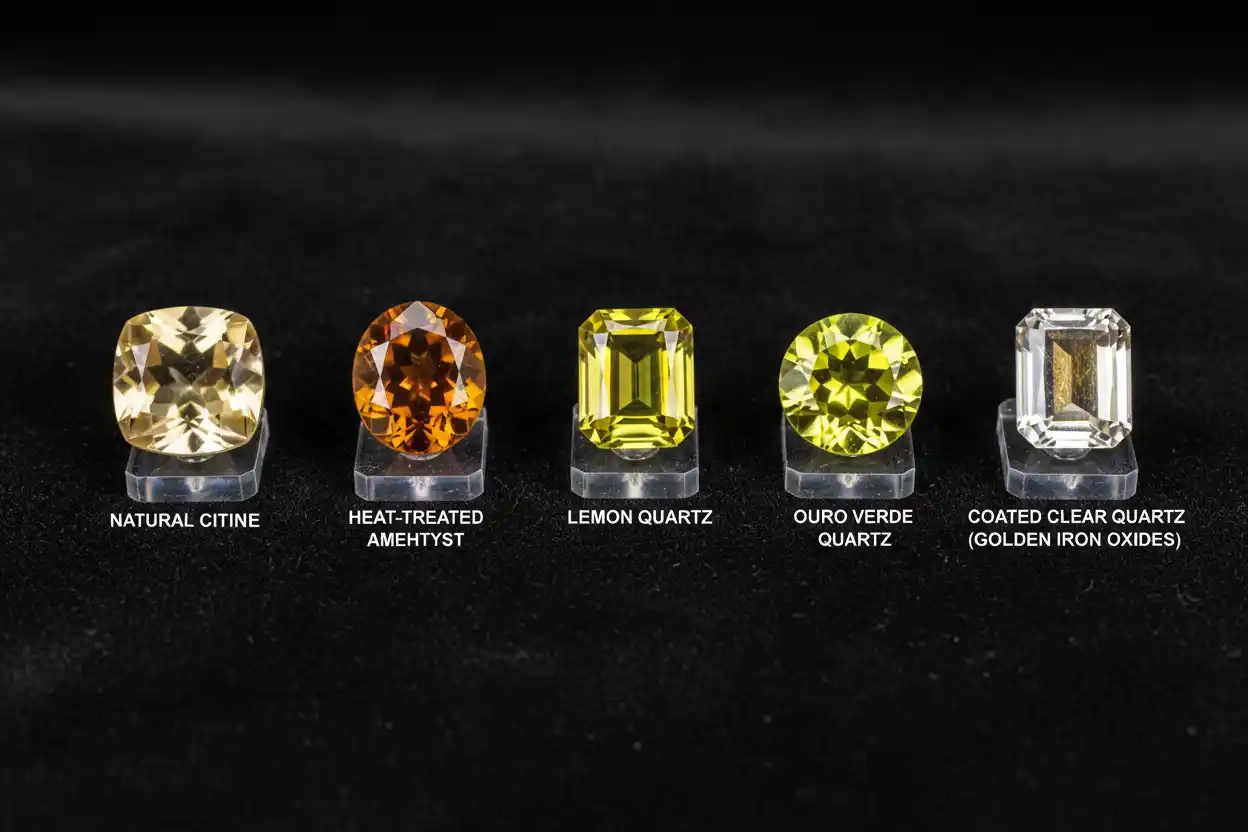
Yellow quartz is an umbrella description rather than one formally defined mineral variety. Depending on the stone, the name can refer to natural citrine, heat-treated amethyst, irradiated lemon quartz, treated Ouro Verde Quartz, quartz with iron-oxide coatings or an unidentified yellow quartz product.
These materials share the physical framework of quartz but differ in color origin, treatment, market value and naming. A useful yellow-quartz identification begins by determining which category the stone belongs to rather than assuming every transparent yellow crystal is natural citrine.
Yellow Quartz at a Glance
| Property | Yellow Quartz |
|---|---|
| Mineral species | Quartz |
| Chemical formula | SiO₂ |
| Name status | Broad descriptive phrase rather than one standardized variety |
| Main yellow categories | Natural citrine, heat-treated amethyst, irradiated lemon quartz, Ouro Verde Quartz and iron-stained quartz |
| Crystal system | Trigonal |
| Typical colors | Pale lemon, golden yellow, greenish yellow, brownish yellow, orange-yellow and yellow with surface staining |
| Common habit | Six-sided prisms, clusters, geodes, massive quartz and faceted stones |
| Luster | Vitreous |
| Transparency | Transparent to opaque, depending on inclusions and coatings |
| Refractive indices | Approximately 1.544–1.553 |
| Birefringence | Approximately 0.009 |
| Optical character | Uniaxial positive |
| Specific gravity | Approximately 2.65–2.66 |
| Mohs hardness | 7 |
| Cleavage | None |
| Tenacity | Brittle |
| Common use | Faceted gems, crystal specimens, cabochons, beads, carvings and decorative objects |
| Main buying concern | Confusion among natural color, heat treatment, irradiation and surface iron staining |
Is Yellow Quartz a Separate Mineral?
No. Yellow quartz is quartz whose apparent body or surface color is yellow.
The phrase does not identify one accepted mineral variety or treatment history.
Citrine is the recognized transparent yellow-to-orange gem variety of quartz.
Lemon Quartz and Ouro Verde Quartz are trade varieties commonly associated with irradiation and heat treatment.
Golden Healer Quartz is normally clear or milky quartz containing or coated by yellow-to-brown iron oxides.
Tangerine Quartz carries orange iron-rich surface coatings.
A seller using yellow quartz should therefore provide a more specific identification whenever possible.
The parent Quartz: Types, Properties & Meaning page owns general quartz mineralogy, while this page owns the yellow-name clarification and cannibalization boundary.
Natural Citrine
Citrine is transparent quartz whose natural color ranges from pale yellow to brownish orange.
Natural citrine is uncommon compared with treated commercial material.
Its color is associated with iron-related defects within the quartz structure rather than a removable surface coating.
Natural crystals frequently show relatively even pale yellow, smoky yellow or subtle orange-brown color.
They do not normally display the chalky white base and burnt-orange tips typical of strongly heated amethyst clusters.
Natural citrine can occur with smoky zoning because the defect systems responsible for smoky and yellow color may coexist.
A laboratory can sometimes identify features consistent with natural or treated color, but not every stone yields a simple conclusion.
Heat-Treated Amethyst Sold as Citrine
Most citrine in the commercial market is produced by heating amethyst.
Heat alters iron-related color centers and converts purple material into yellow, orange, brown or reddish-orange quartz.
The result remains natural quartz whose color has been treated. It is not synthetic stone.
Heated amethyst geodes commonly retain white or pale bases because the original amethyst color was concentrated near the crystal tips.
Strong heating can create dark burnt-orange, reddish-brown or opaque tips.
Faceting rough may be cut away from those visible clues, making treatment harder to identify without spectroscopy and inclusion study.
Heat treatment is accepted in the quartz trade, but it should be disclosed rather than represented as rare natural citrine.
Detailed authenticity checks remain with Real vs Fake Citrine.
Lemon Quartz
Lemon Quartz is a trade name for bright lemon-yellow to greenish-yellow quartz.
Much commercial lemon quartz receives irradiation followed by heat treatment.
The starting material can be colorless quartz, smoky quartz or quartz containing suitable iron-related defects.
Irradiation creates color centers, while controlled heating modifies the final yellow or greenish-yellow hue.
Trade usage is inconsistent. Some sellers apply lemon quartz to pale natural citrine, while others use it only for treated vivid yellow quartz.
Therefore, the name alone does not reveal treatment.
This page summarizes the distinction but leaves complete lemon-quartz history, treatment and symbolism to the dedicated article.
Ouro Verde Quartz
Ouro Verde Quartz is a vivid yellow-green treated quartz variety.
The Portuguese name means green gold.
Commercial material is generally created through irradiation and controlled heating of suitable colorless or pale quartz.
Its intense neon-like yellow-green differs from most natural citrine.
The treatment can be stable under ordinary wear, but some treated quartz colors are sensitive to prolonged strong light or heat.
Ouro Verde should be disclosed by trade name and treatment rather than sold as rare natural greenish citrine.
Golden Healer Quartz
Golden Healer Quartz usually consists of clear, milky or included quartz colored by iron oxides or hydroxides.
The yellow-to-brown material may occur as a natural coating, internal fracture filling, inclusion cloud or altered surface zone.
Because the color often lies on the surface or inside fractures, Golden Healer Quartz is not necessarily citrine.
A clear quartz crystal coated with goethite or limonite-related material remains colorless quartz with an iron-rich coating.
Polishing or chemical cleaning may remove some surface coloration.
The dedicated Golden Healer page owns its coatings, source claims and metaphysical trade use.
Iron-Stained Quartz
Iron-stained quartz has yellow, orange or brown color concentrated on its exterior or along fractures.
Groundwater carries dissolved iron through cracks and pore spaces.
When conditions become more oxidizing, goethite, hematite and other iron compounds precipitate.
Surface staining may highlight growth lines and etched areas.
A broken or polished interior can remain completely colorless.
Iron-stained quartz should not be sold as citrine when the apparent yellow exists only as a coating.
Acid treatments can remove iron staining, but home chemical cleaning can cause burns, toxic fumes and damage to associated minerals. Professional preparation is safer.
Tangerine Quartz
Tangerine Quartz is generally quartz coated by orange-to-red iron oxides.
Its color is stronger and more orange than most yellow iron-stained quartz.
Some commercial pieces are artificially coated or treated, so natural-looking iron coverage should still be evaluated.
The color can rub away or become pale where the surface has been polished.
Tangerine Quartz remains distinct from transparent orange citrine because its color is usually surface-related.
Yellow Quartz Color Categories
Pale Yellow Quartz
Pale transparent yellow quartz may be natural citrine, lightly heated quartz or treated material with weak color.
Color distribution, inclusions and spectroscopy help determine the likely category.
Golden Yellow Quartz
Golden transparent material is commonly sold as citrine.
A rich color does not prove natural origin because heating creates strong golden and orange shades easily.
Greenish-Yellow Quartz
Greenish-yellow material is commonly marketed as lemon quartz or Ouro Verde Quartz.
Natural greenish citrine exists, but vivid neon color should prompt treatment disclosure.
Brownish-Yellow Quartz
Brownish-yellow quartz can combine smoky and citrine color centers.
It may be natural, heated or irradiated.
Yellow-Coated Quartz
Opaque or surface-concentrated yellow generally indicates iron staining, coating, dye or another external material rather than structural citrine color.
What Causes Citrine’s Yellow Color?
Citrine color involves iron-related defects within the quartz structure.
Iron can substitute for silicon or occupy positions between the ordinary silicon-oxygen framework.
Natural radiation and geological heating influence the electronic states associated with the color.
Different quartz deposits contain iron in different structural positions, which helps explain why some amethyst becomes citrine when heated while other material becomes green or colorless.
The exact color mechanism is more complex than saying quartz simply contains iron.
Iron oxide particles outside the crystal structure produce staining or inclusions but do not necessarily create true citrine body color.
How Yellow Quartz Forms
Quartz crystallizes from silica-rich magma, hydrothermal fluids and metamorphic solutions.
Pegmatites can produce large transparent crystals.
Hydrothermal veins create quartz beside calcite, fluorite, sulfide ores and many other minerals.
Amethyst develops when iron-bearing quartz encounters natural radiation under suitable conditions.
Natural heating or later geological processes can modify purple, smoky and yellow colors.
Weathering introduces iron-rich groundwater that coats existing quartz.
Commercial treatment continues this color modification through controlled heat and irradiation after mining.
Therefore, two visually similar yellow stones can have very different geological and treatment histories.
Important Natural Citrine Sources
Brazil is the dominant commercial source of quartz and provides both natural citrine and large quantities of amethyst used for heat treatment.
Bolivia produces citrine, amethyst and naturally bicolored ametrine from the same deposit system.
Madagascar has produced natural smoky-yellow and golden citrine crystals.
Zambia, Namibia, the Democratic Republic of the Congo and South Africa contain natural citrine occurrences.
Russia, Spain and the United States also have documented localities.
A country name cannot prove natural color because treatment occurs after mining and commercial parcels from several sources can be mixed.
Inclusions and Internal Features
Natural quartz can contain fluid inclusions, negative crystals, mineral needles, growth zoning and healed fractures.
Natural citrine may show subtle color zoning linked to crystal growth.
Heated amethyst can retain remnant purple areas or strong color concentration near former amethyst zones.
Irradiated quartz may show color distribution related to penetration depth and starting material, though modern treatment can be visually uniform.
Iron-stained quartz shows colored material concentrated along fractures, pits and outer surfaces.
Gas bubbles indicate glass or resin rather than natural quartz.
Synthetic hydrothermal quartz can contain breadcrumb-like inclusions, seed-plate boundaries and characteristic growth features.
Yellow Quartz Versus Yellow Topaz
Yellow Topaz has greater density, hardness 8 and perfect basal cleavage.
Quartz has hardness 7 and no cleavage.
Topaz’s refractive index is higher, while quartz may show clearer doubled facet edges depending on orientation.
Color alone cannot distinguish them.
The complete comparison remains with Citrine vs Yellow Topaz.
Yellow Quartz Versus Yellow Sapphire
Yellow sapphire is corundum with hardness 9 and much greater density.
It has stronger brilliance and usually commands a higher price.
Quartz is softer, more abundant and available in much larger inexpensive stones.
The dedicated comparison appears in Citrine vs Yellow Sapphire.
Yellow Quartz Versus Yellow Fluorite
Yellow fluorite has hardness 4 and perfect octahedral cleavage.
It commonly forms cubes and may fluoresce strongly.
Quartz forms six-sided prisms, has no cleavage and is far more durable.
Faceted stones can be separated by refractive index and polarized-light behavior.
Yellow Quartz Versus Yellow Glass
Glass may contain rounded bubbles, flow lines and mold marks.
Quartz normally feels harder and has a different refractive response.
Manufactured glass can be extremely clean and uniformly colored.
A lack of inclusions does not prove glass, because both natural and synthetic quartz can be eye-clean.
The broader distinction appears in Glass vs Crystal.
Identifying the Type of Yellow Quartz
First confirm that the stone is quartz through refractive index, hardness, density, optical character and Raman spectroscopy.
Next examine where the color occurs.
Surface and fracture concentration suggest iron staining, dye or coating.
Transparent body color supports citrine, lemon quartz or another structurally colored variety.
Purple remnants or white geode bases support heated amethyst.
Vivid greenish-yellow color may indicate irradiation and heat treatment.
Infrared, ultraviolet-visible and electron-paramagnetic-resonance spectroscopy can provide information about color centers and treatment.
However, some treatments are difficult to prove conclusively after processing.
The complete identification workflow follows How to Identify Crystals.
Natural, Treated and Synthetic Quartz
Natural citrine formed its color through geological processes.
Treated citrine began as natural quartz but was heated or irradiated after mining.
Synthetic citrine is laboratory-grown quartz whose color developed during or after manufactured crystal growth.
Glass and cubic zirconia are simulants rather than synthetic quartz.
A treatment does not make natural quartz fake, but it changes rarity and disclosure requirements.
The distinction appears in Lab-Grown vs Natural Gemstones and Gemstone Treatments Explained.
The broader synthetic and treatment checks for quartz appear in How to Spot Treated or Synthetic Clear Quartz.
Cutting and Polishing
Transparent yellow quartz is widely faceted into rounds, ovals, cushions, pears, emerald cuts and fantasy forms.
Quartz’s moderate refractive index produces attractive but not exceptional brilliance.
Large clean rough allows cutters to create dramatic stones at affordable prices.
A shallow pavilion creates a window, while an overly deep stone hides weight beneath the setting.
Color zoning should be oriented so the strongest yellow appears evenly face-up.
Iron-stained crystals are usually preserved as specimens because polishing removes the surface color.
Cabochons suit heavily included, star or cat’s-eye yellow quartz.
Hardness, Toughness and Jewelry Suitability
Quartz measures 7 on the gemstone hardness chart.
It resists ordinary scratches better than opal, fluorite, calcite and feldspar.
Quartz has no cleavage but remains brittle.
Sharp impacts can chip facet edges, crystal points and thin girdles.
The difference between scratch resistance and breakage resistance appears in Gemstone Toughness vs Hardness.
Faceted citrine and lemon quartz work well in pendants, earrings and occasional-to-regular rings.
Large stones should use settings that protect corners and thin edges.
Yellow Quartz Prices in 2026
Because yellow quartz covers several materials, one price range cannot represent every category.
Commercial heat-treated citrine commonly retails for approximately $10–$30 per carat.
Current market guidance places ordinary-to-better citrine broadly around $10–$70 per carat, depending on color, clarity, cut and size.
Pale natural-looking commercial citrine may fall near the lower end, while fine saturated or precision-cut stones reach the upper range.
Documented natural-color citrine can command approximately $30–$150 per carat, particularly when origin and untreated status are supported by a laboratory.
Lemon quartz and Ouro Verde Quartz commonly sell for approximately $5–$30 per carat, with precision cutting adding more value than rarity.
Current auction listings demonstrate that low-end lemon quartz can sell for only a few dollars per stone, reflecting abundant treated supply.
Iron-stained quartz specimens commonly range from $10–$100, depending on crystal form, natural coating and locality.
Fine large natural-citrine crystals, aesthetic clusters and important mineral specimens can sell for hundreds or thousands of dollars.
Detailed citrine valuation remains with the Citrine Price Guide.
What Determines Value?
The specific yellow-quartz category must be identified first.
Natural untreated citrine generally carries more rarity than heated amethyst or irradiated lemon quartz.
Color should be attractive, evenly distributed and appropriate to the stated variety.
Clarity matters for faceted gems, while natural inclusions and crystal form matter for specimens.
Cut quality strongly affects commercial value because quartz rough itself is relatively abundant.
Large size adds less value per carat than it does in rarer gemstones.
Treatment disclosure, laboratory documentation and stable color affect buyer confidence.
For iron-coated specimens, natural crystal shape, coverage and contrast matter more than transparency.
Buying Guidance
Use the dedicated Citrine Buying Guide for transparent yellow gem purchases.
Ask the seller to choose a specific term: natural citrine, heated amethyst citrine, lemon quartz, Ouro Verde Quartz, iron-stained quartz or synthetic quartz.
Avoid listings that use natural, untreated and lemon quartz together without explanation.
Inspect heated clusters for white bases, burnt tips and remnant purple.
View transparent stones under daylight-equivalent and warm light.
Ask whether the color has been irradiated, heated, coated or dyed.
A respected laboratory report is appropriate when a natural-color premium is requested.
Do not pay natural-citrine prices for a vivid treated stone with no origin or treatment evidence.
Cleaning, Water, Heat and Sunlight
Clean quartz with lukewarm water, mild soap and a soft brush.
The stone generally tolerates brief water contact when untreated and free from glue.
Avoid prolonged soaking for coated, dyed or assembled pieces.
Ultrasonic cleaning may be acceptable for sound untreated quartz, but fractures and inclusions can create risk.
Steam and sudden temperature changes should be avoided.
Some irradiated or treatment-related quartz colors can fade or shift under prolonged strong sunlight.
Natural citrine is generally stable during ordinary wear, but conservative storage away from hot windows is sensible for any undocumented yellow quartz.
The broader light guidance appears in Crystals That Fade in Sunlight.
Meaning and Symbolism
Modern traditions associate transparent yellow quartz with optimism, confidence, creativity and practical motivation.
Natural citrine has developed the strongest historical and commercial symbolism among yellow quartz varieties.
Lemon Quartz is often connected with freshness and mental alertness, while Ouro Verde Quartz receives associations with energetic change.
Iron-stained quartz is commonly linked with persistence and the visible record of environmental transformation.
These interpretations are cultural, spiritual or personal rather than scientifically demonstrated effects.
The broad color symbolism appears in yellow crystals and yellow gemstones.
Frequently Asked Questions
1. Is all yellow quartz citrine?
No. Yellow quartz can also be heated amethyst, lemon quartz, Ouro Verde Quartz, iron-stained quartz, coated quartz or synthetic material.
2. What is the correct definition of citrine?
Citrine is transparent yellow-to-orange quartz. Natural citrine is rare, while most commercial citrine is heat-treated amethyst.
3. Is heat-treated amethyst fake citrine?
It is treated natural quartz rather than synthetic or imitation stone. It should be disclosed because it is much more common than natural-color citrine.
4. What is lemon quartz?
Lemon Quartz is a bright lemon-to-greenish-yellow trade variety that is commonly produced through irradiation and heat treatment.
5. What is Ouro Verde Quartz?
Ouro Verde Quartz is vivid yellow-green treated quartz, generally created through irradiation and controlled heating.
6. Is Golden Healer Quartz a type of citrine?
Usually not. Its yellow or brown color commonly comes from iron-oxide coatings or inclusions rather than citrine color centers.
7. How can iron-stained quartz be recognized?
Color concentrates on crystal surfaces, pits and fractures, while broken or polished interiors may remain colorless.
8. Can yellow quartz color fade?
Some irradiated and treated colors can fade under prolonged strong light or heat. Stability varies with treatment and material.
9. Is yellow quartz suitable for rings?
Quartz hardness 7 makes it suitable for many rings, although sharp impacts can still chip the stone.
10. Can yellow quartz go in water?
Brief washing is generally safe for untreated solid quartz. Avoid soaking coated, dyed, glued or highly fractured pieces.
11. How much is yellow quartz worth?
Commercial treated stones may cost only a few dollars to several tens of dollars per carat. Documented natural citrine and fine specimens can command substantially more.
12. Does yellow quartz have scientifically proven healing properties?
No. Its symbolism may hold personal value, but scientific evidence does not establish healing effects.
Yellow quartz is safest to publish and purchase as an identification category rather than another synonym for citrine. The meaningful distinction lies in where the color occurs and how it formed—inside a naturally colored crystal, after heat or irradiation, or as an iron-rich coating across an otherwise colorless quartz surface.
Yellow quartz appears in Crystals That Start With Y and Gemstones That Start With Y.