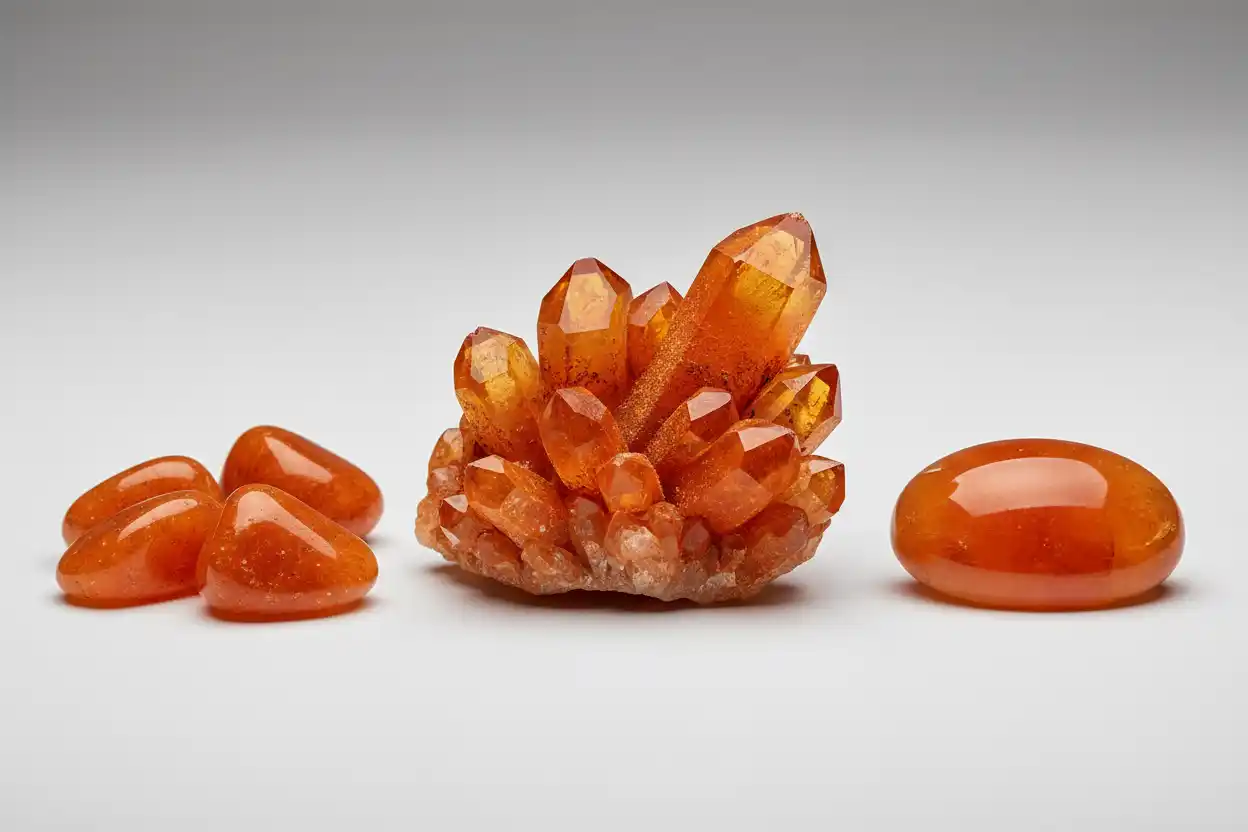
Tangerine Quartz: Meaning, Properties & Symbolism
Tangerine Quartz is a commercial name for quartz whose crystal surfaces or near-surface zones carry natural orange, reddish-orange, rust, peach, or brown iron minerals. Hematite is the most frequently identified coloring phase, although goethite, manganese-bearing oxides, and mixed iron-rich coatings can contribute to the appearance.
It is not a distinct quartz species, and it should not automatically be classified as citrine. The quartz itself may remain colorless beneath a thin ferruginous coating, while other specimens contain microscopic hematite particles enclosed just inside the crystal.
Tangerine Quartz at a Glance
| Property | Tangerine Quartz |
|---|---|
| Composition | Quartz, SiO₂, with hematite, goethite, iron oxide, or manganese-rich surface coatings and inclusions |
| Group or type | Ferruginous quartz; orange-colored trade variety of macrocrystalline quartz |
| Color | Peach, pale orange, tangerine, rust, red-orange, orange-brown, brown-red |
| Crystal system or texture | Trigonal quartz with external or near-surface ferruginous coloration |
| Habit | Six-sided prisms, terminated points, clusters, drusy plates, massive or polished material |
| Luster | Vitreous beneath the coating; dull, earthy, satin, or metallic where iron minerals cover the surface |
| Transparency | Transparent to opaque, commonly translucent |
| Mohs hardness | 7 for quartz; softer surface coatings may abrade more easily |
| Cleavage | None |
| Tenacity | Brittle |
| Common uses | Mineral specimens, clusters, polished stones, cabochons, pendants, decorative pieces |
| Primary care concern | Fragile iron coating, fractures, acid damage, artificial staining, and silica dust during cutting |
What Is Tangerine Quartz?
Tangerine Quartz belongs to the broader quartz family. Its host crystal has the same silicon dioxide composition, trigonal structure, hardness, and basic optical properties as colorless quartz.
The commercial name describes the orange appearance rather than a unique mineral formula. Consequently, two pieces sold as Tangerine Quartz can differ in several important ways.
One specimen may consist of clear quartz beneath an external hematite coating. Another may contain microscopic red-orange hematite inclusions immediately below the surface. A third may combine internal particles, surface staining, manganese oxides, clay, and iron-rich material along fractures.
This variability makes precise description more useful than the trade name alone. A well-labeled specimen might read “hematite-coated quartz from Brazil, sold as Tangerine Quartz.”
The variety is listed in the crystals that start with T and gemstones that start with T directories. However, its principal value lies in natural crystal form and ferruginous color rather than conventional gemstone rarity.
What Causes the Orange Color?
Hematite is the most common source of Tangerine Quartz’s orange-to-red coloration. Extremely fine hematite particles can coat the surface, gather in growth depressions, or remain enclosed just beneath a later layer of quartz.
The particle size influences color. Thick or crystalline hematite may appear dark red, brown, grey, or metallic, while very fine particles can create bright orange, peach, or rust-colored surfaces.
Goethite can contribute yellow, orange-brown, and dark brown tones. Natural mixtures of goethite and hematite often produce more complex coloration than either mineral alone.
Manganese oxides may deepen brown or black areas. Clay and other iron-rich weathering products can also become trapped between crystals or inside surface textures.
The orange material is therefore not necessarily distributed through the entire quartz crystal. A chipped edge may expose colorless quartz beneath a thin tangerine-colored layer.
In other specimens, later quartz growth covers the ferruginous particles. The color then appears internal even though it originally formed on an earlier crystal surface.
Surface Coating Versus Internal Inclusions
Understanding where the color sits is important for identification, cleaning, and value.
A true surface coating lies directly on the quartz. Under magnification, it may look granular, patchy, earthy, or concentrated inside horizontal striations and growth depressions.
Near-surface inclusions sit beneath a clear outer layer. The quartz surface remains smooth and glassy, while orange particles appear suspended immediately below it.
Some crystals show both conditions. An early hematite coating became enclosed by additional quartz, followed by later iron staining after the crystal stopped growing.
A superficial coating can be scratched, chemically removed, or worn away more readily than the quartz beneath it. Internal particles remain protected unless the crystal is cut or fractured.
This distinction also affects authenticity. Artificial dye usually follows open fractures, pores, or damaged areas, whereas natural hematite growth commonly follows crystal faces and geological growth zones.
How Tangerine Quartz Forms
Quartz grows when silica-rich hydrothermal fluids move through fractures and cavities, then deposit silicon dioxide as temperature, pressure, and chemistry change.
After an initial quartz crystal forms, iron-rich water may circulate through the cavity. Oxygen converts dissolved iron into hematite, goethite, and related minerals that settle on the existing crystal surfaces.
Quartz growth can then resume. When new silica covers the ferruginous layer, the orange particles become enclosed as phantoms or near-surface inclusions.
Alternatively, the iron coating can develop after quartz growth has ended. Weathering fluids pass over the exposed crystals and deposit iron minerals on their surfaces.
Repeated fluid episodes create layered effects. A specimen may contain colorless quartz, an internal orange phantom, a clear outer growth layer, and a later brown surface stain.
Tangerine Quartz therefore records the changing chemistry of the mineral cavity. The orange layer is not merely decoration; it can mark a distinct stage in the deposit’s history.
Crystal Habits and Patterns
Most Tangerine Quartz appears as prismatic points or clusters. Well-developed crystals retain six-sided prisms with pyramidal terminations beneath or through the orange coating.
Fine drusy coatings may sparkle across a larger crystal or matrix. Other pieces form dense clusters of short points whose color is strongest near their bases.
Common visual patterns include:
- Uniform peach-orange coating
- Dark red material along crystal striations
- Pale tips above orange bases
- Internal hematite phantoms
- Red-orange specks inside transparent quartz
- Black manganese-rich patches
- Clear contact faces where neighboring crystals blocked the coating
- Colour concentrated along healed fractures
A contact mark is not necessarily damage. It may show where another crystal or matrix mineral touched the quartz during growth.
Fresh chips, however, interrupt the natural surface and expose colorless or paler material beneath the ferruginous layer.
Important Sources
Brazil is one of the main commercial sources. Tangerine-colored quartz has been reported from several areas of Minas Gerais, including the wider Diamantina, Buenópolis, Corinto, and Curvelo regions.
Locality descriptions vary significantly in the retail market. “Minas Gerais” may be accurate at state level without identifying the exact mine or collecting site.
Madagascar has produced large quartz clusters whose orange color comes from iron, hematite, manganese-rich material, or combinations of surface coatings and inclusions. Some specimens reach cabinet size and contain long, well-terminated crystals.
Morocco supplies iron-coated and hematoid quartz with orange, red, brown, and metallic surfaces. Material from Morocco may be sold under Tangerine Quartz, Fire Quartz, Hematoid Quartz, or ferruginous quartz.
Similar orange-coated quartz occurs in Namibia, South Africa, the United States, and other iron-rich quartz deposits.
Origin should not be inferred from appearance. Brazilian, Madagascan, and Moroccan specimens can overlap in color and habit, especially after trimming and commercial cleaning.
Tangerine Quartz Versus Citrine
Citrine is yellow-to-orange quartz whose body color arises primarily from color centers and iron-related structural effects within the quartz.
Tangerine Quartz generally owes its appearance to visible iron minerals on or near the surface. Beneath the coating, the quartz may be colorless.
A transparent faceted orange quartz gem is more likely to be classified as citrine or treated quartz than Tangerine Quartz. In contrast, an orange-coated natural cluster with earthy hematite belongs more naturally under the Tangerine Quartz trade name.
The boundary becomes less obvious when ferruginous particles are enclosed throughout transparent quartz. Microscopy and spectroscopy may then be required to determine whether the color is particulate or structural.
A seller should not use the citrine name merely because the crystal looks orange. The yellow quartz page also owns broader yellow-quartz naming and treatment boundaries.
Tangerine Quartz Versus Fire Quartz
Fire Quartz usually refers to quartz containing red, orange, or brown hematite and other iron-rich inclusions.
The Tangerine Quartz name tends to emphasize a lighter orange surface coating or near-surface coloration. Fire Quartz more often describes internal clouds, phantoms, flakes, and visually dramatic red patterns.
However, no internationally enforced definition separates the two labels. A single crystal may fit both descriptions.
When the orange coating defines the appearance, Tangerine Quartz is the clearer name. When internal iron inclusions dominate, Fire Quartz or Hematoid Quartz may provide a more accurate description.
Hematite remains the underlying inclusion mineral in many examples, so identifying the actual phase is more important than selecting the most marketable quartz label.
Tangerine Quartz Versus Golden Healer Quartz
Golden Healer Quartz is another iron-coated quartz trade variety.
Golden Healer material usually has yellow, gold, honey, or pale brown ferruginous coloration. Tangerine Quartz occupies the warmer peach, orange, rust, and red-orange range.
Natural specimens can grade continuously from yellow to orange. Therefore, the commercial boundary depends partly on dominant color and seller usage.
Neither name represents a separate mineral species. Both should remain linked to quartz and described according to their iron coating, locality, condition, and treatment.
How to Identify Tangerine Quartz
The first step is confirming the host is quartz. Quartz has hardness 7, no cleavage, conchoidal fracture, specific gravity near 2.65, and refractive indices around 1.544–1.553.
Natural crystal points commonly show horizontal striations on prism faces and irregular growth textures. Perfectly smooth molded surfaces or seams suggest glass or resin.
Magnification should reveal whether the orange material lies on the surface, just beneath it, inside fractures, or throughout the crystal.
Natural hematite coatings may appear granular or crystalline. They often follow crystal faces and collect around growth features without penetrating every open crack.
Artificial dye commonly concentrates in fractures, pits, drill holes, and porous matrix. An unnaturally uniform neon-orange color also deserves scrutiny.
A cotton swab or solvent test should not be used casually because it can damage coatings and treatments. Likewise, acid testing may remove genuine iron minerals and permanently alter the specimen.
Raman spectroscopy and X-ray diffraction can identify hematite, goethite, quartz, and other coating minerals. The broader how to identify crystals guide explains why appearance alone does not establish mineral identity or natural color.
Treatments and Artificial Color
Tangerine Quartz is vulnerable to several forms of enhancement.
Pale quartz can be stained with iron solutions to imitate a natural ferruginous coating. Artificial staining may still use genuine iron oxide, making simple chemical identification insufficient to prove geological origin.
Dye may be added to fractures and porous surfaces. Bright orange, red, or pink color concentrated inside cracks is a common warning sign.
Heat treatment can alter iron compounds and deepen or change their color. Heating may also damage fluid inclusions and increase fractures.
Aura coatings create metallic orange, gold, rainbow, or copper-colored surfaces. These thin films produce iridescence that differs from ordinary earthy hematite.
Wax or resin can deepen color, create a wet-looking surface, and strengthen damaged clusters. Glue repairs may reconnect broken points or attach crystals to matrix.
The treatment terminology in gemstone treatments explained helps distinguish coating, dyeing, impregnation, filling, and repair.
Synthetic Quartz and Imitations
Quartz can be grown hydrothermally, but intentionally manufacturing synthetic Tangerine Quartz is generally unnecessary because natural ferruginous quartz is abundant.
Colorless synthetic quartz could be coated or stained orange. Such a product would combine a laboratory-grown host with an artificial surface treatment.
Glass provides a simpler imitation. It may show rounded bubbles, curved flow lines, mold seams, and uniform orange pigment.
Resin replicas can reproduce crystal clusters, including detailed points and surface color. They may feel unusually light, scratch easily, or show flexible projections and trapped bubbles.
Reconstructed pieces can combine quartz fragments with resin and iron pigment. They should be disclosed as composites.
The lab-grown vs natural gemstones guide explains why laboratory growth, glass imitation, artificial coating, and reconstruction are separate issues.
Cutting and Polishing Behavior
Natural clusters are usually more desirable uncut because the ferruginous surface records their geological growth.
Sawing through a crystal may reveal that the orange color is only a thin outer layer. A polished cross-section can still be attractive, but it no longer displays the original coating in the same way.
Massive iron-included quartz can be fashioned into cabochons, freeforms, spheres, beads, or carvings. These pieces overlap commercially with Fire Quartz and Hematoid Quartz.
The quartz host accepts a bright polish, while exposed hematite-rich areas may undercut, pit, or polish differently.
Fractures can open during sawing. Dense iron material along a crack may make it look visually appealing while simultaneously marking a structural weakness.
Drilling and grinding create crystalline silica dust. Wet methods and professional dust controls remain necessary even when the piece is small.
Durability and Jewelry Suitability
Quartz has good scratch resistance at Mohs 7 and no cleavage. A structurally sound polished piece can tolerate moderate jewelry wear.
Surface-coated crystals require more caution. The hematite layer may scratch, rub away, flake, or become polished smooth through repeated contact.
Natural clusters are unsuitable for rings and bracelets because projecting points chip and catch on fabric.
Cabochons can work in pendants, earrings, brooches, and protected occasional-wear rings. A bezel setting helps guard the edge.
Internal fractures remain the main durability concern. A stone with orange material concentrated along open cracks may break more easily than clean quartz.
The gemstone hardness chart provides scratch-resistance context, but surface condition and fracture density must also be considered.
Tangerine Quartz Value and July 2026 Asking Prices
Tangerine Quartz is generally affordable because ferruginous quartz occurs in several countries and is sold primarily as a specimen material.
As of July 2026, small clusters and individual points commonly carry asking prices around $10–$30. Current dealer examples include Brazilian clusters around $15–$20.
Attractive hand-sized specimens with stronger orange color, intact points, and good display balance often appear around $30–$100.
Large clusters, unusually long crystals, internal hematite phantoms, attractive secondary growth, and documented locality can raise asking prices to approximately $100–$500.
Major cabinet specimens from Madagascar or older collections can exceed $500, particularly when crystal size, condition, and aesthetics align.
Small cabochons, tumbled pieces, and pendants commonly range from $5–$40. The price should reflect natural color and craftsmanship rather than unsupported rarity claims.
Buying Tangerine Quartz
Ask whether the orange color is an external coating, internal inclusion, fracture stain, or artificial treatment.
Request dry photographs under neutral light. Wetting can deepen the orange color and make a dull coating look more saturated.
Photographs should show the base, back, crystal tips, and any contact points. Fresh chips often expose pale or colorless quartz beneath the coating.
Ask for the exact locality and whether the specimen has been acid-cleaned, stained, dyed, heated, waxed, resin-treated, repaired, or glued.
A mineral dealer should distinguish Tangerine Quartz from citrine and explain whether hematite, goethite, or another mineral was identified.
The how to buy gemstones online guide provides wider checks for measurements, photography, provenance, return policies, and unsupported grade language.
Cleaning and Storage
Remove loose dust with a rubber air blower or a very soft dry brush. Brush gently so the ferruginous coating remains intact.
A stable specimen can receive a brief rinse in room-temperature water, but soaking provides little advantage.
Avoid acids, vinegar, rust remover, bleach, and aggressive mineral-cleaning chemicals. These products can dissolve or alter the iron minerals responsible for the orange color.
Ultrasonic cleaning may loosen repaired crystals, extend fractures, or detach fragile coatings. The risks are covered in gemstones in ultrasonic cleaners.
Brief water contact is different from repeated immersion, especially when resin, glue, clay, or porous matrix is present. The crystals you can put in water guide explains that distinction.
Store clusters in fitted boxes with clearance around each point. Polished stones should remain separate from harder gems and metal edges.
Tangerine Quartz Meaning and Symbolism
Tangerine Quartz has no distinct ancient symbolic tradition under its modern commercial name.
Contemporary crystal practices commonly associate its orange color with creativity, motivation, sociability, enthusiasm, and beginning practical work after a period of planning.
The contrast between clear quartz and earthy iron minerals may symbolize combining imagination with grounded action.
Its layered formation can also serve as a metaphor for experience accumulating over time. Earlier quartz growth remains visible beneath later mineral coatings rather than being completely replaced.
Some people use the stone as a reminder to approach change with curiosity, warmth, and realistic momentum.
These interpretations belong to personal and spiritual belief systems. Scientific evidence does not show that Tangerine Quartz treats disease, increases fertility, changes metabolism, or produces guaranteed emotional effects.
Frequently Asked Questions
1. Is Tangerine Quartz a separate mineral?
No. It is quartz colored by orange iron-rich coatings or inclusions.
2. What creates Tangerine Quartz’s orange color?
Hematite is the most common cause, although goethite, manganese oxides, clay, and mixed iron minerals may contribute.
3. Is Tangerine Quartz the same as citrine?
No. Citrine has yellow-to-orange body color within the quartz, while Tangerine Quartz usually has particulate iron coloration on or near its surface.
4. Is Tangerine Quartz the same as Fire Quartz?
The names overlap, but Tangerine Quartz generally emphasizes an orange surface or near-surface coating, while Fire Quartz often contains broader internal hematite patterns.
5. Can Tangerine Quartz be naturally coated?
Yes. Iron-rich groundwater can deposit hematite and goethite on quartz crystal faces.
6. Can the orange coating come off?
A superficial coating can abrade or dissolve in strong chemicals, while enclosed particles remain protected by quartz.
7. Is all Tangerine Quartz from Brazil?
No. Commercial material also comes from Madagascar, Morocco, and other quartz-producing regions.
8. Can Tangerine Quartz be artificially stained?
Yes. Quartz can be dyed or treated with iron-bearing solutions to imitate natural ferruginous coloration.
9. Should Tangerine Quartz be cleaned with acid?
No. Acid can remove the genuine iron minerals responsible for its color.
10. Is Tangerine Quartz suitable for jewelry?
Polished stable material can be used carefully, but natural clusters and fragile coatings are better suited to display.
11. Can Tangerine Quartz go in water?
Brief rinsing may be suitable for a stable untreated piece, but prolonged soaking can affect matrix, repairs, clay, and surface coatings.
12. What most affects Tangerine Quartz value?
Natural color, intact crystal form, coating quality, internal phantoms, size, locality, condition, preparation, and treatment disclosure determine value.
The best Tangerine Quartz specimens retain enough transparency and natural surface structure to show how iron-rich fluids interacted with an earlier quartz crystal. Their appeal comes from that geological relationship, not from presenting the trade name as a rare new mineral.
Tangerine Quartz has a crystalline silica host. Cutting, drilling, grinding, or dry-polishing can release respirable silica dust capable of causing serious lung disease. Preserve natural coatings when possible and use wet methods, effective local exhaust ventilation, sealed eye protection, suitable respiratory protection, and controlled cleanup during lapidary work.