Types of Aquamarine: Colors and Varieties Explained
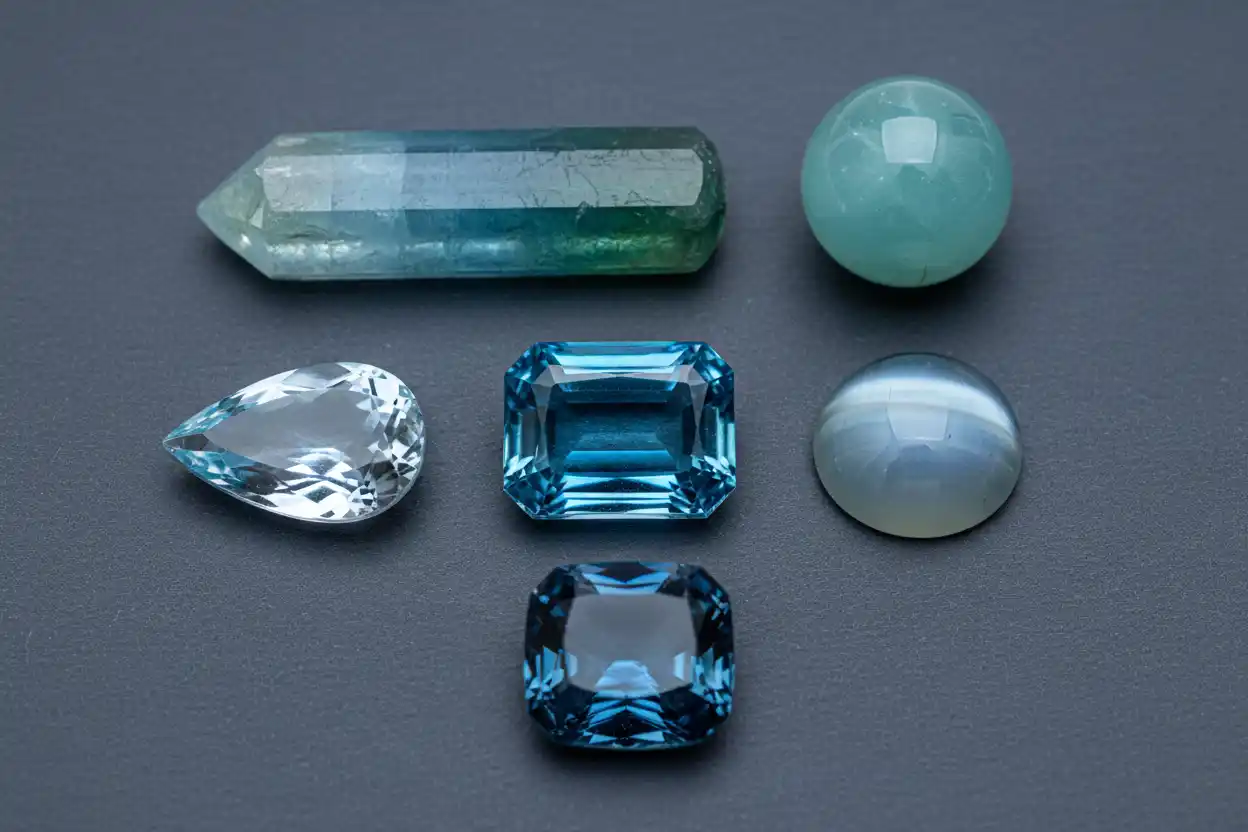
Aquamarine is the greenish-blue to blue variety of Beryl. Its recognized types are based mainly on color depth, green or blue balance, transparency, inclusions, optical effects, geographic origin, and treatment.
Trade terms such as Santa Maria, Santa Maria Africana, Espírito Santo, and Marta Rocha describe historical sources or preferred color styles rather than separate mineral species. Cat’s-eye, star, milky, and moss Aquamarine remain Beryl but occupy different jewelry and collector markets from eye-clean faceted stones.
Aquamarine at a Glance
| Property | Aquamarine |
|---|---|
| Composition | Beryllium aluminum silicate, Be₃Al₂Si₆O₁₈ |
| Group or type | Greenish-blue to blue variety of Beryl |
| Main colors | Pale blue, green-blue, blue-green, medium blue, deep blue, grey-blue |
| Crystal system | Hexagonal |
| Habit | Long hexagonal prisms, etched crystals, broken fragments, alluvial pebbles |
| Luster | Vitreous |
| Transparency | Transparent to opaque |
| Mohs hardness | 7.5–8 |
| Cleavage | Indistinct; basal parting and fractures may occur |
| Tenacity | Brittle |
| Common cuts | Emerald, oval, cushion, pear, round, trillion, cabochon, bead |
| Main care concern | Impact, internal fractures, heat, filling, coatings, and colour misrepresentation |
What Is Aquamarine?
Aquamarine belongs to the Beryl family, which also includes Emerald, Morganite, Heliodor, Goshenite, Red Beryl, and related color varieties.
The Aquamarine parent guide owns its general properties, history, symbolism, and formation. This article focuses on the different colors, clarity styles, optical phenomena, source names, and treatments found in the market.
Iron causes Aquamarine’s blue and green-blue color. Different oxidation states and structural sites influence whether a stone appears greener, purer blue, greyish, or more deeply saturated.
Aquamarine is dichroic. One crystal direction commonly appears stronger blue, while another may look pale, greenish, or nearly colorless.
Its accessible large crystal sizes distinguish it from many colored gems. However, saturated blue rough becomes progressively scarcer, especially when the stone is also eye-clean.
Aquamarine belongs naturally within blue gemstones and, in greener material, green gemstones.
How Aquamarine Types Are Classified
Aquamarine types fall into five useful systems.
Color names describe pale green-blue, pure blue, Santa Maria-style saturation, or grey-blue appearance.
Clarity names distinguish eye-clean faceted gems from milky, moss-included, or cabochon-grade material.
Optical-effect names identify cat’s-eye, star, and other rare included varieties.
Geographic names refer to sources such as Brazil, Pakistan, Nigeria, Mozambique, Madagascar, Ethiopia, Zambia, Namibia, and the United States.
Treatment categories separate natural-color or unheated stones from conventionally heated Aquamarine, filled gems, coated material, and unstable Maxixe-type blue Beryl.
Main Types of Aquamarine
| Type | Typical appearance | Main distinction |
|---|---|---|
| Pale Aquamarine | Light blue or greenish blue | Common commercial color |
| Unheated green-blue Aquamarine | Noticeable green component | Natural preheating appearance |
| Pure blue Aquamarine | Reduced green modifier | Commonly heated and highly marketable |
| Santa Maria Aquamarine | Medium-to-deep saturated blue | Premium historical color term |
| Santa Maria Africana | Saturated African blue material | Trade term referencing Santa Maria-style color |
| Espírito Santo Aquamarine | Lighter or moderately saturated blue | Brazilian source or color-style name |
| Marta Rocha Aquamarine | Fine deep blue historical trade type | Named for a famous Brazilian crystal and color association |
| Milky Aquamarine | Cloudy blue or green-blue | Dense inclusions reduce transparency |
| Moss Aquamarine | Visible dark, green, or scenic inclusions | Modern inclusion-focused trade style |
| Cat’s-eye Aquamarine | Moving light band across cabochon | Produced by aligned tubes or needles |
| Star Aquamarine | Four- or six-ray asterism | Extremely rare optical-effect material |
| Maxixe Beryl | Deep irradiated blue that may fade | Gemologically distinct from stable iron-colored Aquamarine |
| Aquamarine crystal specimens | Natural prismatic crystals on matrix | Valued for form, locality, and associations |
Pale Blue Aquamarine
Most commercial Aquamarine has a light pastel blue or slightly greenish-blue color.
Small stones often appear especially pale because the light path through the gem is short. Larger stones can show greater saturation even when cut from the same rough.
Pale material is abundant enough to supply calibrated stones, matching pairs, bead strands, and large center gems.
Fine cutting matters because a windowed pavilion makes an already pale gem look nearly colorless.
A pale stone should still have attractive brightness and even color. Grey, brown, obvious zoning, or a large dead center reduces value.
Natural Green-Blue Aquamarine
Unheated Aquamarine frequently contains a visible green component.
Colors can range from pale seafoam and blue-green to medium greenish blue.
The greener appearance does not mean the stone is inferior mineralogically. Some collectors prefer the natural ocean-like balance, especially when laboratory evidence supports an unheated origin.
Commercial heating reduces yellow or green components and leaves a purer blue.
Because the treatment does not usually make a pale stone much darker, natural saturation remains important.
Sellers should not use “unheated” as a substitute for quality. An attractive heated blue gem can be more valuable than an unattractive unheated grey-green stone.
Pure Blue Aquamarine
Pure or nearly pure blue Aquamarine is the dominant modern jewelry preference.
Heat treatment is common because it removes much of the green modifier while retaining the iron-related blue.
The resulting color is stable under normal wear and lighting.
Fine pure-blue Aquamarine should remain lively rather than dark or grey. The best stones have even saturation, eye-clean clarity, and proportions that return light across the face.
Blue color appears stronger in gems above several carats, explaining why large stones can command higher per-carat prices than small pale material.
Santa Maria Aquamarine
Santa Maria is the most prestigious Aquamarine trade name.
The term originated from deeply saturated blue material mined at Santa Maria de Itabira in Minas Gerais, Brazil.
Historic gems from the original source are rare. In modern commerce, Santa Maria is often used as a color-quality term for intense, relatively pure blue Aquamarine regardless of exact source.
A true origin claim should therefore be separated from a color comparison. “Santa Maria color” does not prove that a gem came from the historic Brazilian mine.
Fine examples have medium-to-dark tone, strong saturation, limited grey, high transparency, and good brilliance.
Excessively dark navy material should not receive the premium automatically. If a stone turns black in ordinary lighting, its color is too deep for most buyers.
Santa Maria Africana
Santa Maria Africana, Santa Maria d’Afrique, or African Santa Maria describes highly saturated African Aquamarine resembling the classic Brazilian color.
Mozambique is strongly associated with the term, while similarly colored material may also come from Nigeria, Zambia, Madagascar, or other African sources.
The label should identify a color style and broad origin, not imply connection with the original Santa Maria mine.
Fine African material can equal or exceed average Brazilian Aquamarine in saturation.
A laboratory may identify the gem as natural Aquamarine but not necessarily use Santa Maria Africana as an official variety name.
Espírito Santo Aquamarine
Espírito Santo is a Brazilian state and a long-standing Aquamarine source.
In trade usage, the name often describes lighter or moderately saturated blue material compared with Santa Maria color.
The term can therefore refer to either provenance or an informal color category.
A pale stone should not be assumed to come from Espírito Santo without documentation.
Likewise, authenticated Espírito Santo origin does not guarantee one exact shade because the region has produced a range of blue and green-blue material.
Marta Rocha Aquamarine
Marta Rocha is a historical Brazilian trade name associated with particularly fine blue Aquamarine.
The name honors Brazilian beauty queen Martha Rocha and has also been linked with a famous large Aquamarine crystal found in Brazil.
Modern usage is inconsistent. Some dealers apply it to deep blue stones comparable with Santa Maria, while others use it for a particular medium-blue shade.
Because no universal grading standard controls the term, buyers should judge the actual gem and request provenance where historical origin affects the price.
Brazilian Aquamarine
Brazil is the world’s best-known Aquamarine source and has produced enormous gem crystals.
Minas Gerais is especially important, with pegmatite districts around Teófilo Otoni, Governador Valadares, Araçuaí, and other regions.
Brazilian material ranges from pale green-blue through medium blue and rare deep Santa Maria color.
Large eye-clean rough allows impressive faceted gems, carvings, crystal specimens, and matched jewelry sets.
Country origin alone does not establish premium quality. Many pale commercial stones are Brazilian, while fine saturated material also comes from Africa and Asia.
Pakistani and Afghan Aquamarine
Pakistan and Afghanistan produce highly aesthetic prismatic Aquamarine crystals from high-altitude pegmatites.
The crystals may occur on white Albite, Muscovite, Quartz, Tourmaline, or other matrix minerals.
Colors are commonly pale-to-medium blue or green-blue, though more saturated material occurs.
Fine specimens are valued for sharp terminations, transparency, size, matrix balance, and precise locality.
A crystal can be more valuable intact than as faceting rough because cutting destroys its natural form and provenance.
African Aquamarine
Mozambique, Nigeria, Zambia, Madagascar, Tanzania, Namibia, and Ethiopia have all produced important Aquamarine.
Mozambique and Nigeria are known for saturated faceting rough, including Santa Maria Africana-type colors.
Madagascar produces pale-to-deep blue gems, crystals, included material, and occasional cat’s-eye stones.
Ethiopian Aquamarine can show strong blue-to-green colors and distinctive inclusion scenes.
Zambian and Namibian deposits supply both faceting rough and mineral specimens.
“African Aquamarine” is therefore too broad to function as a grade. Mine or district documentation is more useful.
Milky Aquamarine
Milky Aquamarine contains dense microscopic inclusions, tubes, particles, or internal scattering that create a cloudy blue appearance.
The material may be translucent rather than transparent.
Commercial faceted Aquamarine is normally expected to be eye-clean, so milky stones occupy a separate decorative and designer market.
Cabochons, beads, carvings, and high-domed freeforms can showcase the soft color.
Milky appearance should not be confused with surface frost, poor polish, resin filling, or photographic diffusion.
Strong color and an even cloud can make the stone attractive, but it usually costs less than clean transparent material.
Moss Aquamarine
Moss Aquamarine is a modern trade description for Aquamarine containing visible mineral inclusions, tubes, needles, dark particles, veils, or scenic internal structures.
The inclusions may resemble moss, plants, sea grass, or miniature landscapes, but they are mineral or fluid features rather than organic matter.
The term has no strict laboratory definition. Some material is simply heavily included Aquamarine sold under a more appealing name.
Fine examples should have deliberate visual character, useful blue color, stable fractures, and good cutting.
A seller should disclose whether the inclusions reach the surface and whether resin or oil has been used.
Moss Aquamarine is often cut as rose cuts, cabochons, tablets, and freeforms rather than deep brilliant designs.
Cat’s-Eye Aquamarine
Cat’s-eye Aquamarine displays one narrow moving band of light across a cabochon.
Aligned hollow tubes, needles, or fibrous inclusions produce the effect.
The cabochon must be oriented with the inclusion direction across the stone. Incorrect cutting produces a weak, off-center, or invisible eye.
Fine material has a straight bright eye over a blue or green-blue body, along with enough translucency to avoid a chalky appearance.
Cat’s-eye Aquamarine is rare and usually more included than conventional faceted material.
It should not be confused with Chrysoberyl Cat’s Eye, which has a different composition, higher density, and usually stronger commercial recognition.
Star Aquamarine
Rare Aquamarine can show asterism.
Two or three aligned inclusion systems may produce four- or six-rayed stars after cabochon cutting.
Fine rays should be straight, complete, centered, and mobile beneath one point light.
Star material is substantially rarer than cat’s-eye Aquamarine and may require expert laboratory documentation.
A cross-shaped scratch, surface reflection, or backing effect should not be mistaken for true asterism.
Aquamarine Crystals with Etching and Inclusions
Some Aquamarine crystals are valued more for natural form than faceting potential.
Etch pits, skeletal growth, dissolution channels, complex terminations, internal tubes, fluid inclusions, and mineral associations can record the history of the pegmatite.
Pakistan, Afghanistan, Brazil, Namibia, and several African localities are important specimen sources.
Damage must be distinguished from natural etching. A fresh chip exposes a bright irregular break, while natural dissolution follows consistent crystallographic patterns.
Repairs, reattached crystals, and reconstructed matrix should be disclosed.
Maxixe and Maxixe-Type Beryl
Maxixe is a deep blue Beryl whose color is associated with radiation-induced centers rather than ordinary stable Aquamarine coloring.
Natural Maxixe material was historically found in Brazil. Maxixe-type blue can also be produced through artificial irradiation.
The color can fade substantially under light or heat.
Gemological references generally separate Maxixe and Maxixe-type Beryl from true Aquamarine because their color mechanism, pleochroism, and stability differ.
A deeply saturated blue stone offered as Aquamarine should receive laboratory testing when its color appears unusually intense or unstable.
The dedicated treated Aquamarine page owns detailed identification of heat, irradiation, filling, coating, synthetic Beryl, and Maxixe-type material.
Heat-Treated Aquamarine
Heat treatment is accepted and common.
Heating typically removes green or yellow components, shifting greenish-blue rough toward a purer blue.
It does not usually transform pale material into a deeply saturated Santa Maria stone. Original iron concentration and crystal orientation still control the maximum color.
The treatment is generally stable and difficult to detect conclusively in every stone.
Because heating is routine, buyers should select the color they prefer rather than assuming untreated material is always superior.
Synthetic Aquamarine and Imitations
Hydrothermal synthetic blue Beryl exists and can reproduce Aquamarine-like color and physical properties.
Synthetic material may show growth structures, seed plates, unusual inclusions, chemical differences, and spectroscopic features.
Blue Topaz is one of the most common visual alternatives. The dedicated Aquamarine vs Blue Topaz guide addresses their color, density, brilliance, and pricing.
The broader Aquamarine vs Topaz comparison covers colorless and pale variants.
Glass, synthetic Spinel, Cubic Zirconia, blue Sapphire, and coated stones can also imitate Aquamarine.
The real vs fake Aquamarine guide owns the full authenticity process.
Aquamarine Versus Apatite
Neon blue Apatite can resemble strongly saturated Aquamarine in photographs.
Apatite is much softer at Mohs 5, while Aquamarine ranks 7.5–8.
Aquamarine has a lower specific gravity and different refractive properties.
Apatite may display more intense turquoise saturation, but color alone cannot identify either stone.
The dedicated Apatite vs Aquamarine page owns detailed testing.
Cutting Aquamarine Types
Transparent Aquamarine is commonly faceted as emerald, oval, cushion, pear, round, trillion, and fantasy cuts.
Emerald cuts work particularly well because Beryl crystals often grow as long hexagonal prisms.
The cutter orients the table to emphasize the stronger blue pleochroic direction.
Deep cutting may increase saturation but retain excessive hidden weight. Shallow cutting produces a colorless window.
Milky and moss varieties suit cabochons, rose cuts, beads, and tablets.
Cat’s-eye and star rough must be oriented around the inclusion direction rather than conventional brilliance.
Durability and Jewelry Types
Aquamarine has good scratch resistance, although it remains brittle and can contain fractures or parting.
Rings are practical when the gem is eye-clean and protected. The Aquamarine ring guide covers routine styles, while Aquamarine engagement rings addresses daily-wear setting choices.
Lower-impact designs include an Aquamarine necklace or Aquamarine earrings.
An Aquamarine bracelet experiences more repeated contact and therefore needs secure links and protected settings.
Inclusion-rich, filled, cat’s-eye, and moss material requires more caution than clean faceted Aquamarine.
Aquamarine Value and July 2026 Asking Prices
Detailed valuation belongs on the dedicated Aquamarine price page.
As of July 2026, pale commercial faceted Aquamarine commonly carries asking prices around $20–$80 per carat.
Better eye-clean medium-blue stones often appear around $80–$250 per carat.
Fine saturated material above several carats commonly asks approximately $250–$700 per carat.
Santa Maria-style deep blue gems can exceed $700–$1,500 per carat, particularly when large, clean, evenly colored, and well cut.
Milky and moss cabochons commonly sell by the piece, often around $10–$100, while unusually artistic included gems can reach higher designer prices.
Rare cat’s-eye or star material has a thin market and may range from hundreds to several thousand dollars per stone depending on phenomenon quality.
The broader reasons for size and color premiums are explained in how gemstone prices work.
Buying the Right Aquamarine Type
The dedicated Aquamarine buying guide owns detailed transactional intent.
Ask whether names such as Santa Maria, Santa Maria Africana, Marta Rocha, and Espírito Santo refer to documented origin or merely color style.
View the gem under neutral daylight-equivalent and warm indoor light. It should remain blue or green-blue rather than grey.
Request weight, dimensions, depth, clarity, heat disclosure, filling disclosure, origin claim, and a rotating video.
Compare carat weight with face-up size. Deep stones can hide substantial weight in the pavilion.
For valuable saturated stones, cat’s-eye material, stars, or unusual unheated claims, obtain an independent laboratory report.
March buyers may also consult the March birthstone guide, but birthstone status should not replace gemological verification.
Cleaning and Storage
Detailed instructions belong on how to clean Aquamarine jewelry.
Use lukewarm water, mild soap, and a soft brush or cloth. Rinse briefly and dry carefully.
Avoid sudden temperature changes, harsh acids, bleach, and hard impact.
Steam and ultrasonic cleaning may be acceptable for some sound untreated stones, but hand cleaning is safer when the gem contains fractures, filling, coatings, inclusions, or an antique setting.
Store Aquamarine separately from Diamond, Sapphire, Ruby, and Topaz, which can scratch it.
Frequently Asked Questions
1. How many types of Aquamarine are there?
There is no fixed number because names describe color, origin, clarity, optical effects, or treatment rather than separate mineral species.
2. What is Santa Maria Aquamarine?
It is a premium deep-blue trade type originally named for material from the Santa Maria de Itabira mine in Brazil.
3. Does Santa Maria Aquamarine always come from Brazil?
No. The name is frequently used as a color description, so origin requires documentation.
4. What is Santa Maria Africana?
It is a trade term for saturated African Aquamarine resembling the classic Santa Maria color.
5. What is Espírito Santo Aquamarine?
It can mean Aquamarine from Brazil’s Espírito Santo state or an informal lighter-blue color category.
6. What is Marta Rocha Aquamarine?
It is a historical Brazilian trade name associated with fine deep-blue Aquamarine, though modern usage is inconsistent.
7. Is green Aquamarine natural?
Yes. Unheated Aquamarine commonly shows a green component, which heat treatment can reduce.
8. What is moss Aquamarine?
It is included Aquamarine marketed for scenic, dark, fibrous, or plant-like internal patterns.
9. Can Aquamarine show a cat’s-eye or star?
Yes. Aligned inclusions can produce cat’s-eye and very rare four- or six-rayed star effects.
10. Is Maxixe the same as Aquamarine?
No. Maxixe is unstable radiation-colored blue Beryl and is generally classified separately from true iron-colored Aquamarine.
11. Is most Aquamarine heat treated?
A substantial share is heated to remove green or yellow modifiers and produce a purer blue.
12. What most affects Aquamarine value?
Color saturation, blue-green balance, clarity, size, cut, treatment, origin documentation, phenomenon quality, and condition determine value.
Aquamarine types are best judged by what the eye can verify and the laboratory can support. A pale natural green-blue gem, deep Santa Maria-style stone, included moss cabochon, and cat’s-eye all share Beryl chemistry, yet their quality standards and appropriate uses differ significantly.