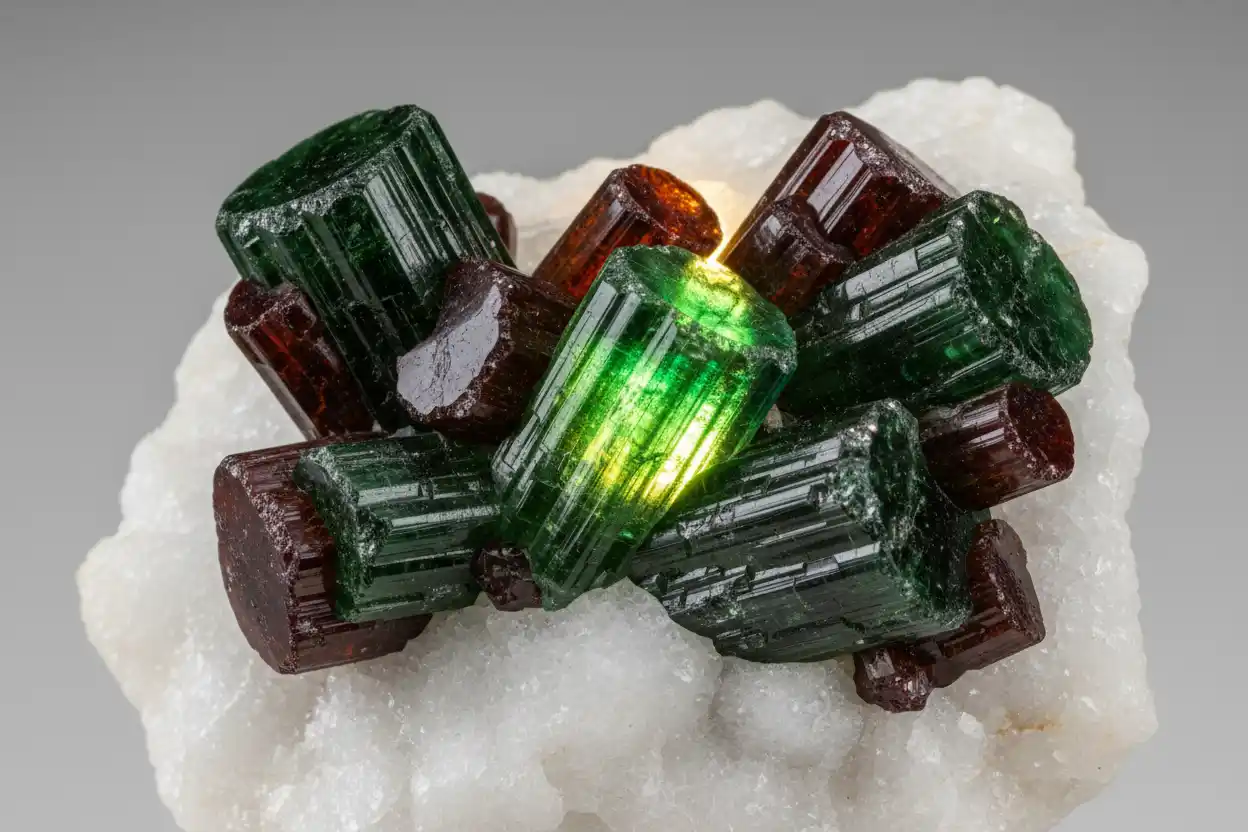
Uvite Meaning, Properties, Colors and Identification
Uvite is a calcium- and magnesium-rich member of the tourmaline supergroup, commonly found in metamorphosed limestone, marble and other calcium-rich rocks. It occurs most often as dark brown, green, reddish-brown or nearly black crystals, although transparent gem-quality material is occasionally cut.
Modern tourmaline nomenclature has refined the historical uvite name into species such as fluor-uvite and hydroxyl-dominant compositions. Consequently, many older specimens labeled simply “uvite” require chemical testing before their exact modern species can be established.
Uvite at a Glance
| Property | Uvite |
|---|---|
| Mineral group | Tourmaline supergroup |
| General chemical character | Calcium-magnesium-aluminum borosilicate |
| Modern related species | Fluor-uvite and hydroxyl-dominant uvite compositions |
| Common colors | Brown, reddish brown, green, dark green, black and occasionally colorless |
| Crystal system | Trigonal |
| Common habit | Short to stout prismatic crystals, rounded triangular cross-sections and crystal aggregates |
| Luster | Vitreous to resinous |
| Transparency | Transparent to opaque |
| Refractive index | Commonly around 1.62–1.66 |
| Birefringence | Commonly around 0.018–0.030 |
| Specific gravity | Approximately 3.0–3.2 |
| Optical character | Uniaxial negative |
| Mohs hardness | About 7–7.5 |
| Cleavage | Poor or indistinct |
| Tenacity | Brittle |
| Common use | Mineral specimens, occasional faceted stones, cabochons and collector jewelry |
| Main care concern | Dark orientation, inclusions and brittle fractures can affect cutting and wear |
What Is Uvite?
Uvite belongs to the chemically complex tourmaline supergroup. Unlike lithium-rich elbaite, uvite is characterized by calcium at one structural site and magnesium-rich chemistry at others.
The historical ideal formula for uvite was commonly written as a calcium-magnesium-aluminum borosilicate containing hydroxyl. Modern classification places greater emphasis on which anion—fluorine, hydroxyl or oxygen—dominates at a specific structural position.
As a result, many crystals formerly called uvite are now classified as fluor-uvite when fluorine is dominant. Collectors and dealers still use uvite as a practical group-level name for related calcium-magnesium tourmalines.
The wider tourmaline meaning guide owns family-level history and symbolism, while the types of tourmaline guide explains the boundaries among uvite, dravite, elbaite, schorl and trade color names.
Where Did Uvite Get Its Name?
Uvite was named after Sri Lanka’s Uva Province, where the mineral was first described. The name reflects locality rather than color or chemistry.
Historical mineral labels may use “uvite,” “uvite tourmaline” or “brown uvite.” Modern specimens may instead carry the name fluor-uvite when analytical data support that species.
A seller should not assume that every brown tourmaline is uvite. Brown color also occurs in dravite, schorl, elbaite and mixed-composition tourmalines.
Uvite Colors
Brown Uvite
Brown is the classic color and ranges from honey brown to reddish brown, mahogany and nearly black. Iron and titanium can influence the depth and secondary hue.
Transparent brown crystals may produce attractive collector gems, especially when their color remains warm rather than becoming opaque or muddy.
Reddish-Brown Uvite
Reddish-brown material is particularly associated with some Brazilian deposits. Backlighting can reveal red, orange or burgundy tones that are hidden in ordinary reflected light.
Large crystals may look black until a thin edge or transparent internal zone is illuminated.
Green Uvite
Green uvite ranges from yellowish green and olive to dark forest green. Chromium and vanadium may contribute to vivid green colors in some calcium-magnesium tourmalines.
Fine green material can resemble chrome tourmaline, dravite or green elbaite. Exact species and color cause require laboratory analysis.
Black Uvite
Very dark green or brown uvite can appear black. Such crystals are primarily mineral specimens rather than transparent gems.
Black appearance does not make the mineral schorl. Schorl is iron-rich sodium tourmaline, while uvite is calcium- and magnesium-rich.
Colorless Uvite
Colorless or nearly colorless uvite is rare. Trace-element chemistry normally adds brown, green or dark coloration.
Small pale zones may occur within otherwise colored crystals, reflecting changes in fluid chemistry during growth.
Uvite and Fluor-Uvite
Tourmaline-supergroup nomenclature classifies minerals according to dominant elements and anions at several structural sites.
Fluor-uvite contains fluorine as the dominant anion at the relevant site. Hydroxyl-dominant material retains the uvite name under modern usage.
Without laboratory chemical analysis, visual examination cannot determine fluorine-versus-hydroxyl dominance. Therefore, older labels reading uvite may be reasonable historically but incomplete under current classification.
This is not evidence that the specimen is fake. It reflects the increased precision of mineral nomenclature.
Uvite Versus Dravite
Dravite is another magnesium-rich tourmaline and commonly appears brown, yellow-brown, dark green or black.
The principal distinction involves calcium and sodium occupancy. Uvite is calcium-dominant at the large structural site, while dravite is sodium-dominant.
Both minerals can occur in metamorphic environments and form compositional relationships. Consequently, many crystals contain mixed uvite-dravite chemistry.
Color, crystal shape and locality may suggest one species, but electron-microprobe analysis is required for certainty.
Uvite Versus Chrome Tourmaline
Chrome tourmaline is a gem-trade term for intensely green tourmaline colored by chromium and vanadium. Much fine East African chrome tourmaline belongs chemically to dravite-uvite series material.
Therefore, chrome tourmaline and uvite are not mutually exclusive names. One describes color and coloring elements, while the other describes mineral species chemistry.
However, not every green uvite qualifies commercially as chrome tourmaline. The color must be strong, and laboratory testing may be needed to confirm chromium and vanadium.
Uvite Versus Elbaite
Elbaite is a lithium-bearing tourmaline species responsible for many transparent pink, red, blue, green and multicolored gems.
Uvite generally forms in calcium-rich metamorphic rocks, while elbaite is strongly associated with lithium-rich granitic pegmatites.
Elbaite crystals are often elongated and strongly color-zoned. Uvite frequently forms shorter, stouter crystals, although habit alone is not conclusive.
Commercial pink tourmaline, rubellite, indicolite and watermelon tourmaline are normally elbaite rather than uvite.
Geology and Formation
Uvite most commonly forms in metamorphosed limestone, dolomitic marble, skarns and other calcium- and magnesium-rich environments that received boron-bearing fluids.
During contact or regional metamorphism, heat and chemically active fluids react with carbonate rocks and associated silicate minerals. Calcium and magnesium from the host rock combine with boron, aluminum and silica to grow tourmaline.
The mineral may occur with calcite, dolomite, diopside, tremolite, phlogopite, scapolite, quartz and other metamorphic minerals.
Some uvite also forms in pegmatites or hydrothermal settings where local chemistry supplies sufficient calcium and magnesium.
Changes in fluid composition during growth can produce color zoning and chemical zoning. A single crystal may therefore contain uvite-rich, dravite-rich or fluor-uvite-rich zones.
Important Localities
Sri Lanka’s Uva Province is historically significant because it gave the mineral its name. Sri Lankan uvite may occur in metamorphic rocks and gem-bearing gravels.
Brumado in Bahia, Brazil, is famous for large reddish-brown, dark brown and greenish uvite or fluor-uvite crystals, often associated with white magnesite or carbonate-rich matrix.
Afghanistan and Pakistan have produced calcium-rich tourmalines from marble and metamorphic environments. Some specimens show strong green, brown or dark coloration.
Canada, Italy, Russia, Tanzania, Kenya, Madagascar and the United States also contain documented uvite-group occurrences.
Locality can guide identification, but it cannot replace analytical testing. Multiple tourmaline species may occur within the same district.
Crystal Habit and Surface Features
Uvite commonly forms stout prismatic crystals with three-sided or six-sided outlines. Cross-sections may appear triangular with rounded edges.
Vertical striations can occur along prism faces, although they may be less pronounced than in some elongated elbaite crystals.
Terminations vary from flat and simple to complex combinations of rhombohedral faces. Intergrowths and partially embedded crystals are common in matrix specimens.
Crystal surfaces may be glossy, etched or coated with carbonate minerals. Natural etching can produce pits and stepped textures that should not automatically be mistaken for damage.
Inclusions and Internal Features
Uvite grows in fluid-rich metamorphic environments, so liquid inclusions, healed fractures and mineral crystals are common.
Included minerals can reflect the host rock and may include calcite, dolomite, diopside, phlogopite, apatite or other tourmaline.
Growth tubes and elongated cavities may run parallel to the crystal axis. These features resemble inclusions found in other tourmaline species.
Color zoning can appear as darker rims, lighter cores or irregular sectors. Chemical zones may not always be visible without specialized imaging or analysis.
Surface-reaching fractures require attention in faceted gems because they can reduce durability. In mineral specimens, however, internal fractures may be acceptable when the crystal remains stable and visually attractive.
Identifying Uvite
A gemologist can confirm tourmaline through refractive index, birefringence, pleochroism, spectroscopy, specific gravity and microscopic features.
Tourmaline is doubly refractive and commonly shows directional color differences. Strong pleochroism can make one direction significantly darker than another.
Rough crystals frequently show trigonal symmetry and a rounded triangular cross-section. These features support tourmaline identification but do not determine the species.
Exact uvite classification requires chemical testing to establish calcium dominance and the magnesium-aluminum balance. Fluorine analysis may also be needed to distinguish uvite from fluor-uvite.
The crystal identification guide explains why species-level identification cannot rely on color or hardness alone.
Common Lookalikes
Dravite
Brown or green dravite can be nearly indistinguishable by appearance. Chemistry provides the definitive separation.
Schorl
Dark uvite may resemble black tourmaline, which is usually schorl. Schorl is generally more iron-rich and sodium-dominant.
Green Elbaite
Transparent green elbaite may overlap uvite in color. Pegmatite origin, chemical composition and trace elements separate them.
Chrome Diopside
Chrome diopside can show a similar vivid green but has different cleavage, refractive properties and crystal habit.
Vesuvianite
Green or brown vesuvianite can occur in comparable metamorphic settings. Its tetragonal structure and optical properties differ from tourmaline.
Glass and Synthetic Spinel
Manufactured imitations may copy transparent green or brown tourmaline. Rounded bubbles, mold features and laboratory properties reveal the difference.
Treatments, Synthetic Material and Imitations
Routine treatment is uncommon for uvite because most material enters mineral collections rather than the mass jewelry market.
Heat can theoretically lighten or modify some tourmaline colors, but dark uvite does not have a well-established commercial treatment pipeline comparable with blue zircon or tanzanite.
Fracture filling with resin or oil may improve the appearance of transparent material. Such enhancement should be disclosed because it changes care requirements.
Surface coatings can imitate vivid green tourmaline. Color concentrated around facet junctions or worn areas may indicate a coating rather than natural body color.
No significant commercial supply of synthetic gem tourmaline exists. Glass, synthetic spinel and other simulants are much more likely than laboratory-grown uvite.
The broader gemstone treatments guide and lab-grown versus natural gemstones guide retain the full treatment and terminology intent.
Cutting and Polishing Behavior
Transparent uvite is rare enough that cutters must balance color, clarity and weight retention carefully.
Pleochroism strongly affects orientation. A dark optical direction can make a poorly oriented stone appear almost black, even when the rough contains attractive green or reddish color.
Shallow cutting may create a window, while excessive depth preserves weight at the cost of brightness. Ovals and cushions often provide a practical compromise.
Open fractures and mineral inclusions can cause pitting during polishing. Sudden heat from a dry wheel may also extend liquid-filled fractures.
Opaque crystals are generally left intact as mineral specimens. Cutting a fine terminated crystal can destroy more value than faceting would create.
Durability and Jewelry Suitability
Uvite has a Mohs hardness of approximately 7–7.5, similar to other tourmalines. The gemstone hardness chart places it above many ornamental stones but below sapphire.
Its cleavage is poor or indistinct, yet it remains brittle. Included stones may chip or fracture under impact.
Transparent uvite works best in earrings and pendants. A structurally sound gem can be set in a ring, but corners and exposed girdle areas need protection.
The tourmaline ring guide covers setting considerations, while how to clean tourmaline jewelry retains the complete cleaning procedure.
Natural crystal specimens should be handled by the matrix or base rather than the termination.
Uvite Prices in 2026
Uvite is primarily a specimen market, so prices depend on crystal size, color, transparency, matrix, locality and condition.
Small common crystals or matrix pieces may retail for approximately $15–$75. Attractive Brazilian or Sri Lankan specimens with good form often range from $75–$300.
Large, lustrous Brumado crystals on contrasting white matrix can sell for $300–$1,000 or more, especially when they show strong transparency, uncommon color or exceptional aesthetics.
Faceted uvite is scarce and inconsistently marketed. Small brown or green gems may range from roughly $75–$300 per carat, while unusually clean, well-documented stones can exceed that level.
A seller should not apply mainstream tourmaline price ranges without considering species rarity and the fact that uvite lacks a standardized jewelry market.
Buying Guidance
Determine whether the seller uses uvite historically or according to current mineral nomenclature. A laboratory report may identify the stone more specifically as fluor-uvite.
For specimens, inspect crystal terminations, repaired areas, matrix stability and glue. Large crystals are sometimes reattached after mining or transport, and restoration should be disclosed.
Backlighting can reveal transparency and hidden red, brown or green zones. However, photographs taken with intense backlighting may exaggerate color compared with normal display conditions.
For faceted material, check extinction, surface-reaching fractures and species documentation. An attractive green tourmaline is not necessarily uvite.
The general tourmaline buying guide covers seller and laboratory-report checks, but collector specimens also require careful evaluation of restoration and locality.
Cleaning, Water, Heat and Storage
Clean sound uvite briefly with lukewarm water, mild soap and a soft brush. Avoid abrupt temperature changes.
Ultrasonic and steam cleaning are not recommended because fluid inclusions and fractures can react to vibration or heat.
Matrix specimens require additional caution. Calcite, dolomite, magnesite and other associated minerals can react to acids and harsh cleaners even when the tourmaline itself remains stable.
Do not use bleach, ammonia, jewelry dips or acidic solutions. These products can damage both the crystal and its matrix.
Most natural uvite colors remain stable in ordinary light. Nevertheless, prolonged heat can alter appearance or extend fractures.
Store faceted stones separately from harder gems. Support large matrix specimens from below so the crystal’s weight does not stress its attachment point.
Meaning and Symbolism
Uvite has less extensive historical gemstone lore than familiar elbaite varieties. Modern crystal traditions often associate brown uvite with stability and grounded attention, while green material is linked symbolically with growth, resilience and connection with nature.
Its occurrence within marble and metamorphic rock has also encouraged interpretations involving adaptation under pressure and gradual transformation.
These meanings are cultural, spiritual or personal rather than scientifically established properties. Uvite should not be presented as a universal treatment for physical or emotional conditions.
The broader tourmaline color meaning guide explores color symbolism without replacing uvite’s mineral-specific identity.
Frequently Asked Questions
1. Is uvite a type of tourmaline?
Yes. Uvite is a calcium- and magnesium-rich member of the tourmaline supergroup.
2. What is fluor-uvite?
Fluor-uvite is the related species in which fluorine dominates a specific anion site. Many older specimens labeled uvite may classify as fluor-uvite under modern nomenclature.
3. Why is uvite commonly brown?
Iron, titanium and other trace-element interactions can create brown, reddish-brown and very dark colors.
4. Can uvite be green?
Yes. Green uvite ranges from olive to vivid chromium- or vanadium-influenced green.
5. Is green uvite the same as chrome tourmaline?
Sometimes green uvite-group material may qualify as chrome tourmaline, but the terms describe different things. Uvite is a species classification, while chrome tourmaline is a color-and-trace-element trade name.
6. How is uvite different from dravite?
Uvite is calcium-dominant at a key structural site, while dravite is sodium-dominant. Their colors and geological settings can overlap.
7. Where does uvite form?
It commonly forms in metamorphosed limestone, dolomitic marble, skarns and other calcium-magnesium-rich rocks affected by boron-bearing fluids.
8. Can uvite be faceted?
Yes, but transparent clean rough is uncommon. Most uvite is preserved as a mineral specimen.
9. Is uvite treated?
Routine treatment is not common. Rare transparent stones could be filled or otherwise enhanced, so disclosure remains important.
10. Is uvite suitable for rings?
A clean, well-cut stone can work in a protective setting, but dark orientation, brittleness and inclusions may limit everyday durability.
11. How much does uvite cost?
Small specimens may cost $15–$75, while fine large crystals can sell for several hundred dollars or more. Faceted stones are scarce and have no standardized price structure.
12. Does uvite have scientifically proven healing properties?
No. Its symbolic meanings may be personally significant, but scientific evidence does not establish healing effects.
Uvite records a very different geological setting from the lithium-rich tourmalines familiar in fine jewelry. Its stout crystals, calcium-magnesium chemistry and close association with marble make it particularly valuable for understanding how broad and chemically adaptable the tourmaline supergroup can be.
Uvite is included in Crystals That Start With U.