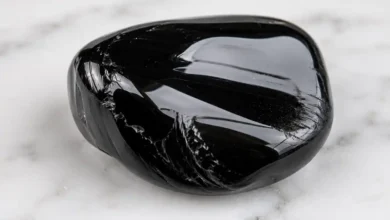

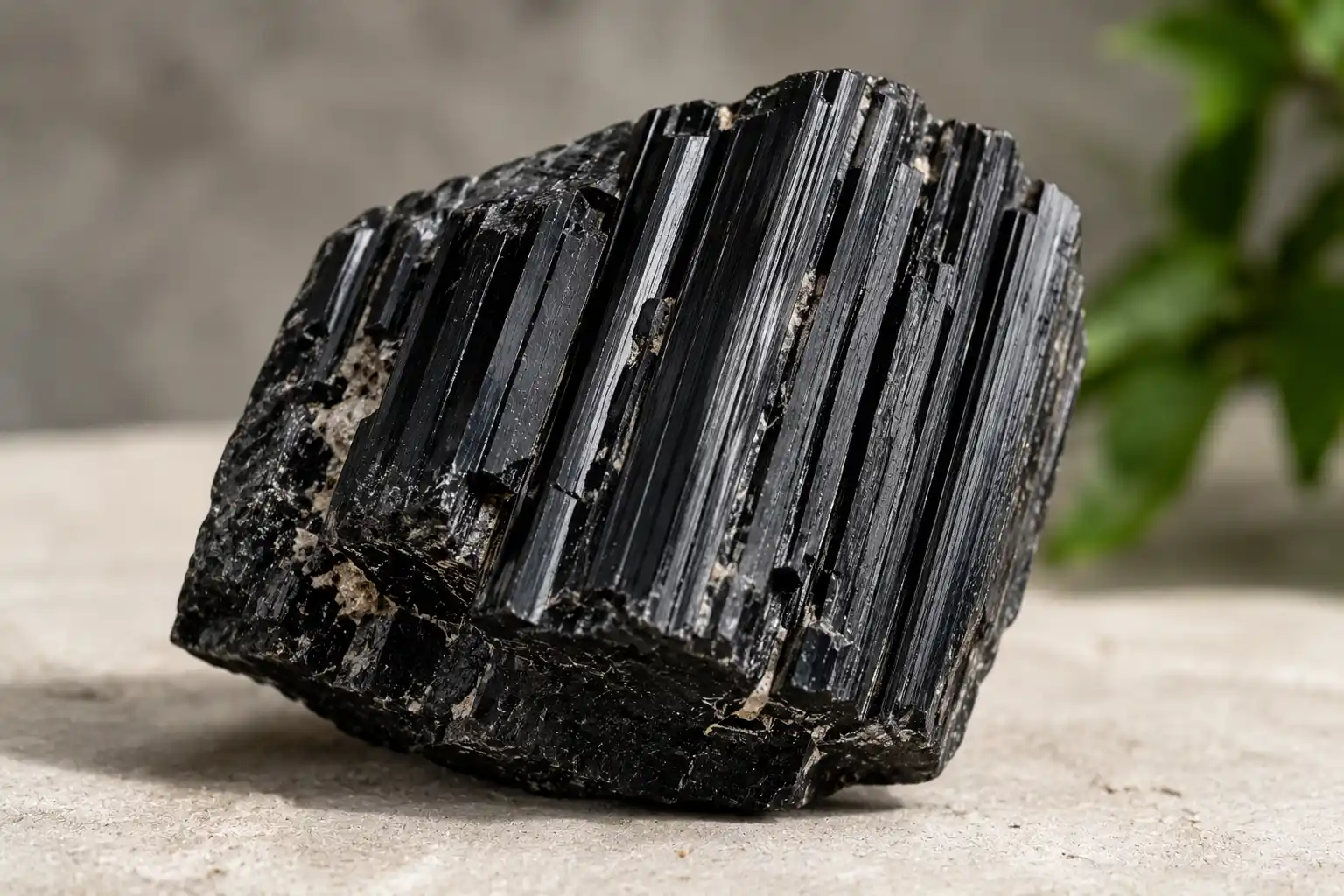

Black tourmaline is traditionally associated with grounding, firm boundaries, protection and the ability to remain steady in demanding environments. Its opaque color, substantial crystal form and strongly striated surfaces have made it one of the most recognizable stones in modern spiritual practice.
Mineralogically, most black tourmaline is schorl, an iron-rich member of the tourmaline group. Its measurable electrical properties, mineral structure and durability are real physical characteristics, but they do not establish claims that the stone blocks harmful energy, treats illness or shields the body from electromagnetic radiation.
Black Tourmaline at a Glance
| Property | Black tourmaline |
|---|---|
| Common mineral species | Schorl |
| Mineral group | Tourmaline |
| General composition | Complex iron-rich borosilicate |
| Typical color | Opaque black to extremely dark brown-black |
| Crystal system | Trigonal |
| Common habit | Long prismatic crystals with strong vertical striations |
| Luster | Vitreous to resinous |
| Transparency | Usually opaque |
| Mohs hardness | 7–7.5 |
| Toughness | Fair |
| Cleavage | Indistinct or poor |
| Common uses | Specimens, beads, cabochons, carvings and pendants |
| Traditional themes | Grounding, protection, boundaries and resilience |
| Main care concern | Fractures, thermal shock and sharp crystal terminations |
What Is Black Tourmaline?
Tourmaline is a group of closely related borosilicate minerals with complex and variable chemistry.
Most colorful gem tourmalines belong to species such as elbaite, liddicoatite, dravite or uvite. By contrast, the opaque black material commonly sold as black tourmaline is usually schorl.
Schorl contains substantial iron, which contributes to its dark appearance. The name should not be treated as a separate spiritual stone or a duplicate mineral page. In the tracker, schorl is an alias that canonicalizes to black tourmaline.
The broader tourmaline meaning guide explains the entire mineral group, while the types of tourmaline guide covers schorl alongside colored varieties such as rubellite, indicolite and watermelon tourmaline.
How Black Tourmaline Forms
Black tourmaline forms in several geological environments.
It commonly crystallizes in granitic pegmatites, where volatile-rich melts allow large crystals to grow beside quartz, feldspar and mica. Schorl also occurs in granites, schists and other metamorphic rocks.
Crystals often develop as elongated prisms marked by parallel grooves along their length. Their cross-sections may appear triangular or rounded triangular, reflecting tourmaline’s trigonal crystal structure.
Some crystals grow as radiating clusters, embedded sprays or thick columns. Others occur as inclusions within quartz, producing material commonly called tourmalinated quartz.
The dedicated tourmalinated quartz guide owns that included-quartz material rather than treating it as solid black tourmaline.
Where Black Tourmaline Is Found
Black tourmaline occurs widely because schorl forms in more geological environments than many rare gem tourmalines.
Commercial and collector material comes from Brazil, Pakistan, Afghanistan, Madagascar, Namibia, Mozambique and the United States, among other regions.
A locality does not automatically establish quality. A complete undamaged crystal from a less famous deposit may offer more collector value than a larger specimen with repaired terminations or glued fragments.
Transparent colored tourmaline receives most fine-jewelry attention. Black schorl is more often valued for crystal form, polish, symbolic use and contrast with lighter minerals.
Why Is Black Tourmaline Black?
Iron-rich chemistry strongly influences schorl’s color.
The crystal absorbs most visible light, causing thick specimens to appear opaque black. Very thin edges may occasionally reveal a dark brown tone under intense transmitted light.
Surface texture changes the appearance as well. Fresh crystal faces may show a glassy luster, whereas weathered or rough pieces can look dull and uneven.
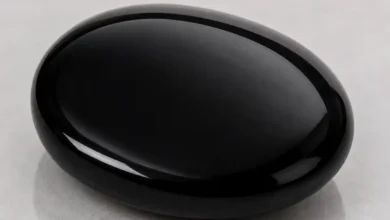
A polished black tourmaline cabochon may resemble onyx, black spinel, glass or another dark material. Therefore, color alone does not establish identity.
Natural striations support identification in intact crystals, but polished stones may require refractive index, density, microscopy or other professional testing.
Black Tourmaline Meaning
Black tourmaline’s central traditional meaning is grounded protection through clear boundaries.
The stone is often described as protective, but a responsible interpretation should focus on practical actions rather than an invisible guarantee. It can symbolize recognizing a harmful pattern, stating a limit or leaving an environment that repeatedly causes distress.
Its heavy visual character also supports grounding symbolism. A black stone may remind someone to return attention to immediate facts, physical sensations and choices within their control.
Black tourmaline does not stop accidents, prevent abuse or make a risky situation safe. Its meaning is strongest when it accompanies real boundaries and safety measures.
The broader black crystals guide compares it with other dark materials used in grounding traditions.
Traditional Emotional Healing Properties
Establishing Boundaries
Black tourmaline is frequently used as a symbol of personal boundaries.
A practical exercise involves writing three statements:
- What behavior you will accept.
- What behavior you will decline.
- What action you can take if the boundary is ignored.
The stone can remain beside the written statement as a reminder. However, it cannot enforce the boundary or control another person.
Reducing Emotional Overload
Some people use black tourmaline when they feel overstimulated by work, social demands or repeated interruptions.
Holding a smooth stone can provide a sensory point of attention. The user may notice its weight, temperature and texture while slowing their breathing.
This routine can create a pause before responding. The effect comes from attention and deliberate regulation rather than a proven mineral emission.
Resilience During Stress
Black tourmaline is traditionally linked with endurance and resilience.
In a responsible practice, resilience does not mean tolerating every harmful condition. Instead, it can mean identifying which challenge deserves persistence and which situation requires withdrawal or support.
A stone placed beside a planner might mark the next realistic action rather than symbolize limitless strength.
Releasing Other People’s Expectations
Protection traditions often describe black tourmaline as preventing the wearer from absorbing other people’s energy.
A more grounded interpretation uses the stone to separate another person’s opinion from one’s own responsibility.
For example, someone can ask:
- Is this criticism accurate?
- Is it relevant?
- Is action required?
- Does the speaker have authority or useful knowledge?
The exercise prevents every outside reaction from being treated as an instruction.
Traditional Mental and Spiritual Associations
Black tourmaline is commonly associated with focus, clear judgment and reduced mental clutter.
A person may use it while dividing concerns into three categories: actionable now, actionable later and outside personal control.
The gemstone can also symbolize privacy. Not every plan, emotion or personal decision must be shared immediately.
In spiritual settings, black tourmaline is frequently placed near entrances, workspaces or meditation areas. The placement may mark an intention to keep the space calm and purposeful.
No reliable evidence shows that a crystal changes the emotional atmosphere of a room independently of human behavior.
Black Tourmaline and the Root Chakra
Black tourmaline is strongly connected with root-chakra traditions.
The root chakra guide describes this spiritual framework in terms of security, stability, physical presence and basic needs.
Within that system, black tourmaline may symbolize returning attention to shelter, finances, rest, food, safety and practical responsibilities.
The root chakra crystals guide compares it with smoky quartz, hematite, red jasper and other commonly used stones.
Chakras are spiritual concepts rather than scientifically verified anatomical structures. A root-chakra practice should not replace financial planning, medical care, housing support or personal safety measures.
Does Black Tourmaline Block Negative Energy?
Protection is black tourmaline’s best-known metaphysical association.
Some users describe the stone as absorbing, repelling or transforming negative energy. These claims have not been demonstrated through controlled scientific testing.
The phrase “negative energy” can also mean several different things, including conflict, stress, fear, electromagnetic radiation or another person’s mood. These are not one measurable substance.
Black tourmaline can still serve as a meaningful reminder to limit exposure to harmful behavior, leave an unhealthy interaction or create a calmer routine.
Its usefulness lies in the behavior connected with the symbol rather than a proven invisible shield.
Black Tourmaline and Electromagnetic Fields
Tourmaline has real pyroelectric and piezoelectric properties.
A crystal can develop a small surface charge when heated, cooled or placed under mechanical pressure. This property can make tourmaline attract dust.
However, these effects do not prove that a black tourmaline specimen protects the body from Wi-Fi, mobile phones, electrical wiring or other electromagnetic fields.
A crystal placed beside a router does not replace exposure standards, equipment maintenance or advice from qualified health and engineering professionals.
Marketing that uses scientific terms such as frequency, ion or piezoelectricity without measurable evidence often creates a misleading impression of proven protection.
Ways to Use Black Tourmaline
As a Pocket Stone
A polished stone can serve as a tactile cue during stressful situations.
Before reacting, hold it briefly and identify the next action that is both useful and within your control.
Avoid carrying sharp raw crystals loose in a pocket because broken terminations can cut skin or damage other objects.
At a Workspace
Place the stone beside a notebook, timer or task list.
It can represent the start of focused work and the decision to postpone unrelated interruptions.
The object does not improve concentration automatically. Its value depends on the routine connected with it.
Near an Entrance
Some people place black tourmaline near a doorway as a symbolic boundary.
A practical version combines the stone with real household habits, such as removing shoes, placing keys in one location or creating a transition between work and home.
During Meditation
Sit comfortably and hold the stone without gripping it tightly.
Observe its grooves, weight and temperature. When attention drifts, return to one physical feature.
This sensory meditation requires no belief that the crystal transmits energy.
As Jewelry
A pendant or bead bracelet keeps the symbolism visible throughout the day.
Tourmaline’s hardness supports jewelry, but its fair toughness and common fractures require protection from hard knocks.
The complete physical care procedure belongs to the guide on cleaning tourmaline jewelry.
Black Tourmaline Jewelry
Black tourmaline appears in beads, cabochons, carvings and raw-crystal pendants.
Beads should have smooth drill holes because fractures radiating from an opening can weaken the strand.
Cabochons suit rings and pendants, although protected bezels work better than exposed corners.
Raw-crystal pendants need secure caps or wraps. Adhesive attachments should not be soaked, heated or assumed permanent.
Black tourmaline can also appear beside clear quartz, white metal or colored gems for contrast.
Its Mohs hardness supports regular wear, but the guide to gemstone toughness versus hardness explains why impact remains a concern.
The gemstone cleavage guide provides further context for mineral breakage.
Black Tourmaline Versus Other Black Stones
Black tourmaline differs from black obsidian, which is natural volcanic glass rather than a crystalline mineral.
Onyx is chalcedony, and uniform commercial black material is often dyed.
Smoky quartz is transparent to opaque quartz colored by irradiation-related defects and trace chemistry.
Shungite is a carbon-rich rock rather than tourmaline.
These distinctions matter for identification, care and price. The unresolved tracker page covering black tourmaline, obsidian and onyx retains the dedicated comparison intent and should not be duplicated here.
How to Identify Black Tourmaline
Raw crystals often show strong parallel striations running along the prism.
Their cross-sections may look roughly triangular, although broken and embedded specimens do not always preserve a clear outline.
Polished black tourmaline usually has a vitreous luster and may show fractures or irregular internal texture.
Glass can contain round bubbles, molded surfaces or unusually uniform appearance. Dyed stones may show color concentrated in cracks.
Home scratch testing is not recommended because it can damage the specimen and may not distinguish several similarly hard materials.
For an important piece, professional gemological testing provides stronger evidence.
Buying Black Tourmaline
Choose the format first.
A collector specimen should have intact terminations, clear natural form and disclosed repairs. A polished stone should have an even surface without deep pits or unstable fractures.
For jewelry, inspect the drill holes, setting, bail, clasp and cord rather than evaluating only the black material.
Ask whether a cluster has been repaired, glued to a base or reconstructed from several pieces.
The dedicated guide to buying real black tourmaline owns the full authenticity and seller-checking workflow.
Directories for crystals beginning with B and gemstones beginning with B provide access to the wider alphabetical cluster.
Cleaning and Care
Warm, mildly soapy water and a soft brush provide the safest routine cleaning method for solid black tourmaline.
Rinse briefly and dry thoroughly. Avoid soaking pieces containing glue, elastic, porous matrix or uncertain repairs.
Ultrasonic and steam cleaning are not recommended. Vibration can worsen fractures, while sudden heat may create thermal shock.
High temperatures can damage tourmaline or alter treated color in other varieties. Black schorl is usually stable to ordinary light, but it should still be kept away from extreme heat.
Store polished pieces separately from harder gems. Protect raw crystals from falls because their terminations and fractured areas can break.
Frequently Asked Questions
1. What is black tourmaline?
Black tourmaline is usually schorl, an iron-rich member of the tourmaline mineral group.
2. Is schorl the same as black tourmaline?
Schorl is the mineral species most commonly sold as black tourmaline. The names should not be treated as separate gemstone pages.
3. What does black tourmaline symbolize?
It traditionally symbolizes grounding, protection, boundaries, resilience and practical stability.
4. Does black tourmaline really protect against negative energy?
No reliable scientific evidence shows that it creates an invisible protective field. It can serve as a personal reminder to establish real boundaries.
5. Does black tourmaline block electromagnetic radiation?
No established evidence shows that wearing or displaying the stone protects the body from Wi-Fi, mobile phones or electrical equipment.
6. Which chakra is associated with black tourmaline?
It is most commonly connected with root-chakra traditions involving stability, security and physical presence.
7. Can black tourmaline go in water?
Brief cleaning with mild soapy water is generally suitable for solid pieces. Avoid prolonged soaking, glued jewelry and fractured specimens.
8. Can black tourmaline go in sunlight?
Ordinary light is generally acceptable. Avoid excessive heat and prolonged hot display conditions.
9. Is black tourmaline suitable for daily jewelry?
It can be worn regularly, but fractures and fair toughness make protective settings advisable.
10. How can I tell black tourmaline from glass?
Natural crystal striations, irregular fractures and gemological properties provide clues. Professional testing is more reliable than appearance alone.
11. How should black tourmaline be cleaned?
Use warm water, mild soap and a soft brush. Avoid steam and ultrasonic cleaners.
12. Are black tourmaline’s healing properties scientifically proven?
No. Grounding, protection and chakra properties belong to spiritual traditions rather than established medical science.
Protection Through Deliberate Boundaries
Black tourmaline’s symbolism becomes most useful when protection means action rather than avoidance. The stone can represent naming a limit, reviewing a risk or returning attention to the facts directly in front of you.
Its physical identity is equally specific. Black tourmaline is usually iron-rich schorl with real mineral structure, hardness and electrical behavior. Those characteristics make it an important crystal, but they should not be stretched into claims that it cures illness or blocks every invisible threat.
Disclaimer: Black tourmaline’s healing, chakra, protection and energy properties reflect spiritual traditions and personal beliefs rather than established medical or physical effects. It should not replace healthcare, mental health treatment, personal safety planning or professionally recommended electromagnetic-safety measures.