Opal Meaning: Properties, Healing Traditions, Uses & Care
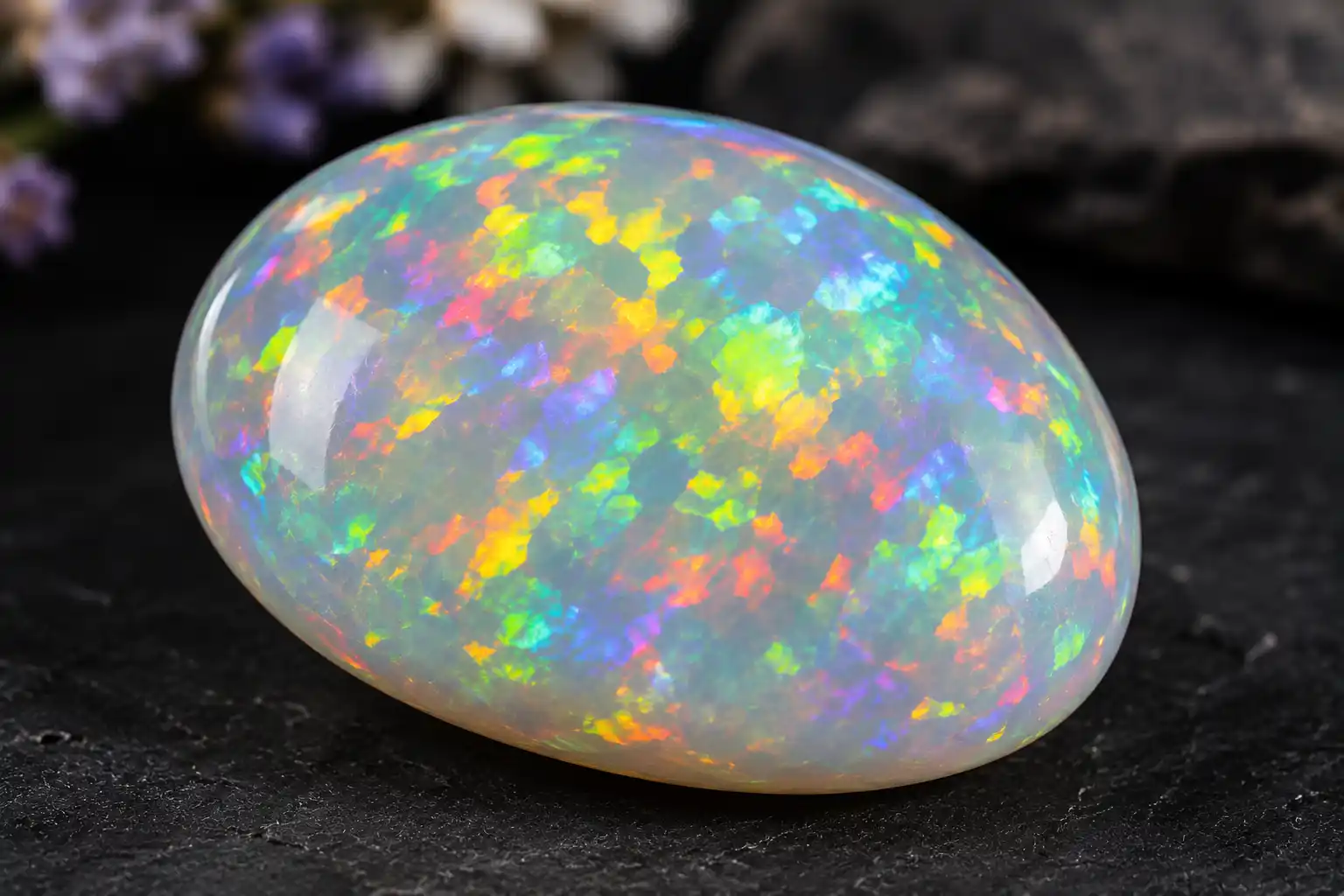
Opal is hydrated silica celebrated for one of gemology’s most distinctive optical phenomena: play-of-color. In precious opal, flashes of red, orange, yellow, green, blue and violet can appear to move across or within the stone as its viewing angle changes. Common opal lacks this spectral display but may still be valued for vivid body color, translucency, inclusions and pattern. Opal meaning developed around that constantly changing appearance, leading to symbolic associations with imagination, hope, creativity, individuality, love and transformation.
The physical gemstone and opal meaning answer different questions. Gemology explains the stone’s silica structure, variable water content, play-of-color, porosity, treatments and susceptibility to crazing. Cultural traditions and contemporary spiritual practices explain why people use opal as a symbol of emotional expression, inspiration or change.
Keeping those layers separate makes opal meaning more useful. A stone can become a meaningful reminder to express an idea, reconsider a perspective or approach change creatively without being presented as a medical treatment, supernatural predictor or guaranteed source of good fortune.
Opal at a Glance
| Property | Opal |
|---|---|
| Material identity | Hydrated silica mineraloid |
| General formula | SiO₂·nH₂O |
| Structure | Primarily amorphous to poorly crystalline |
| Main classes | Precious opal and common opal |
| Defining optical effect | Play-of-color in precious opal |
| Body colors | Colorless, white, gray, black, brown, blue, green, pink, yellow, orange and red |
| Transparency | Transparent to opaque |
| Luster | Vitreous, waxy, resinous or pearly |
| Mohs hardness | Approximately 5–6.5 |
| Cleavage | None |
| Tenacity | Brittle |
| Typical cuts | Cabochons, freeforms, beads, carvings and some faceted fire opal |
| Common constructions | Solid opal, boulder opal, doublets and triplets |
| Main care concerns | Scratching, impact, crazing, heat, rapid environmental change, porosity and treatments |
| Common symbolic themes | Creativity, hope, imagination, change, individuality and emotional expression |
What Is Opal?
Opal is a silica-rich natural material containing variable amounts of water. It is commonly described as a mineraloid because it generally lacks the long-range repeating atomic lattice that defines conventional crystalline minerals such as quartz, sapphire or topaz.
That distinction is central to understanding the stone itself but does not determine opal meaning. A person may encounter opal in crystal traditions, yet gemologically it is not a typical crystal.
Opal forms in several geological settings. Silica-bearing water can move through cracks, cavities and porous rock before silica is deposited as water conditions change. Over time, those deposits may develop seams, nodules, cavity fillings, fossil replacements or irregular masses.
Different formation environments help explain the remarkable diversity organized in the types of opal family. Some stones are pale and nearly opaque. Others are transparent orange. Some retain dark host rock, while others produce spectacular moving spectral colors.
This variety also explains why opal meaning has never been limited to one visual theme.
Precious Opal vs Common Opal
The most important initial distinction is between precious and common opal.
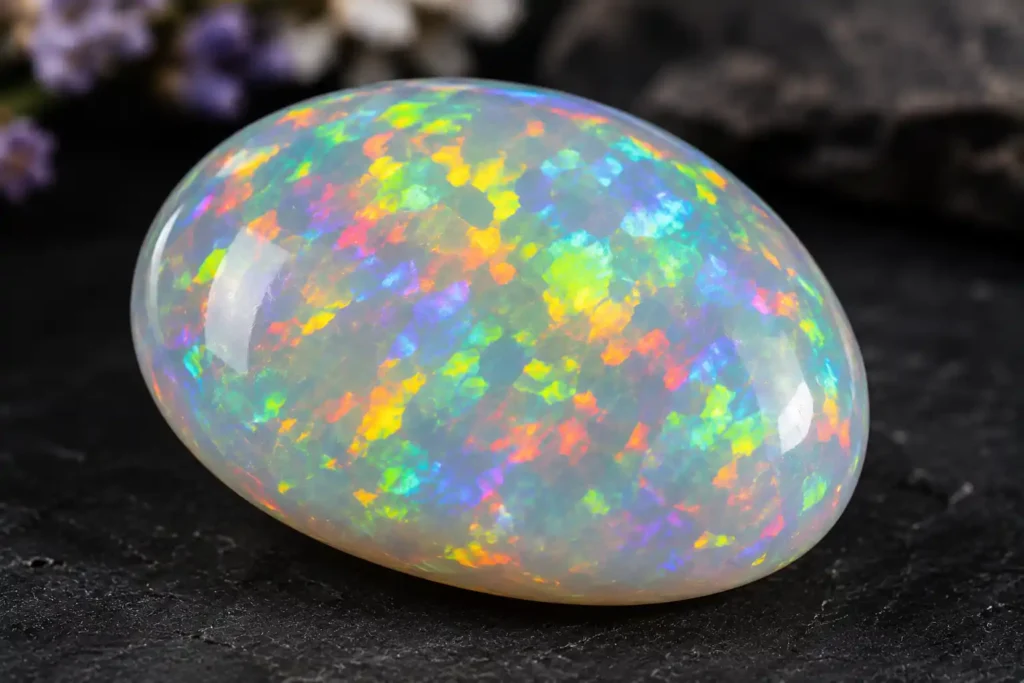
Precious opal displays play-of-color. As the stone, light source or observer moves, spectral colors change position or intensity.
Common opal lacks this effect.
That does not make common opal fake or necessarily unattractive. Pink, blue, green, yellow and white common opals can be prized for body color, pattern, translucency and inclusions.
This distinction matters because opal meaning often emphasizes rainbow color even though many genuine opals do not show any spectral flashes.
Color name alone does not determine the classification either. A white opal may be precious or common. Fire opal may display play-of-color or be valued almost entirely for its orange-to-red body color.
Understanding those differences prevents opal meaning from obscuring the material’s actual identity.
How Opal Play-of-Color Forms
Precious opal contains microscopic silica structures arranged with enough regularity to interact with visible light.
When light passes through those ordered regions, different wavelengths are diffracted in different directions. Changing the viewing angle therefore changes which wavelengths reach the eye.
The result is play-of-color.
Red and orange flashes require structural spacing capable of interacting with longer wavelengths, while smaller spacing can favor blue and violet. Brightness depends on how extensive and orderly the color-producing structures are.
Pattern also matters. Opal may show broad flashes, tiny pinfire points, rolling areas of color, ribbons, blocks or complex combinations.
This changing light is the physical feature that most strongly shaped opal meaning. Its appearance can transform without the gemstone itself changing, making it an intuitive metaphor for perspective, creativity and the ability to see more than one possibility.
The optical phenomenon is nevertheless physical. It does not prove that opal changes a person’s emotions, fortune or future.
Opal Meaning and Symbolism
Modern opal meaning most commonly centers on imagination, hope, creativity, individuality, emotional expression and transformation.
These associations make visual sense. Precious opal can reveal entirely different colors from one moment to the next, while common opal appears in an unusually broad range of body colors. Few gem materials offer such variety under one name.
A grounded way to approach opal meaning is to use the stone as a prompt for flexibility.
When a problem appears fixed, ask whether another interpretation is possible. When a creative project stalls, explore a deliberately different approach. During a transition, separate what has genuinely changed from what remains stable.
The gemstone does not supply the answer.
Instead, opal meaning can become a reminder that perspective can change as new information becomes visible.
Opal Meaning for Creativity
Creativity is one of the strongest themes associated with opal meaning.
The connection is easy to understand when looking at precious material. One small cabochon can contain multiple colors, patterns and viewing experiences, with new details appearing every time the stone moves.
For writers, artists, designers and other creative people, opal meaning can symbolize experimentation rather than guaranteed inspiration.
A practical exercise is to use the stone as a cue to generate alternatives. If the first idea feels predictable, produce three different approaches before deciding which one deserves further work.
This interpretation keeps opal meaning connected with a real creative process. Inspiration becomes something supported by observation, practice and experimentation rather than something the stone is expected to transmit.
Opal cannot guarantee artistic success or make someone more talented simply through possession.
Opal Meaning for Imagination
Imagination and opal meaning are closely linked in contemporary gemstone traditions.
The stone’s shifting colors naturally encourage associations with possibilities that are not immediately visible.
A useful reflective practice is to distinguish imagination from prediction.
Imagination asks, “What could happen?” Prediction claims, “This will happen.”
Opal meaning works safely in the first category. Someone can use the gemstone to explore scenarios, develop stories or consider alternative solutions without treating those ideas as supernatural information about the future.
That difference becomes particularly important when decisions involve relationships, finances or health.
Creative possibility can broaden thinking. Evidence should still determine what is treated as fact.
Opal Meaning for Hope
Hope appears repeatedly in historical and modern opal meaning.
A gemstone cannot guarantee that circumstances will improve. However, hope can have practical value when it supports persistence without denying reality.
Someone moving through uncertainty may use opal meaning as a reminder to separate what is unknown from what is impossible.
Those are not the same thing.
A difficult situation can contain uncertainty without promising a positive ending. The useful next question becomes: What action still makes sense under the circumstances?
This interpretation gives hope structure. It avoids both fatalism and unrealistic promises.
Opal meaning can represent openness to a better possibility while leaving actual outcomes dependent on events, choices and factors outside personal control.
Opal Meaning for Transformation and Change
Transformation is another natural component of opal meaning because the gemstone can look dramatically different with a small movement.
That visual change provides a useful metaphor for transitions in which the underlying situation remains complicated even though perspective evolves.
Someone changing careers, ending a project, moving home or entering another stage of life might use opal meaning as a reminder that adaptation does not require abandoning identity.
The stone can look blue from one angle and red from another while remaining the same piece of opal.
Applied symbolically, the idea is that a person can change strategies, opinions or routines without losing every part of what came before.
Opal does not create transformation automatically. Practical change still requires decisions, resources, support and repeated action.
Opal Meaning for Emotional Expression
Emotional expression frequently appears within opal meaning, especially because the stone may display several contrasting colors in a small area.
Contemporary traditions sometimes describe opal as intensifying feelings. There is no established evidence that hydrated silica chemically or energetically amplifies human emotions.
A safer interpretation is that a symbolic object can encourage someone to notice feelings they might otherwise ignore.
A useful exercise separates emotion from action. Name the emotion first. Then ask what information it may contain and what response would be proportionate.
Anger may signal a crossed boundary without justifying harmful behavior. Fear may identify a risk without proving the worst outcome. Sadness may require space without meaning that nothing can improve.
Opal meaning can represent allowing emotional complexity rather than reducing every experience to one simple label.
Opal Meaning in Love and Relationships
Love has been associated with opal meaning across multiple periods and traditions.
Today, opal is often connected symbolically with affection, emotional openness, passion and individuality within relationships.
The gemstone cannot determine compatibility, prove fidelity, make someone fall in love or cause an estranged partner to return.
A grounded relationship interpretation of opal meaning instead emphasizes the difference between feeling and evidence.
Someone may feel hopeful about a relationship while still asking whether communication is respectful, commitments are consistent and boundaries are honored.
Opal’s changing appearance can also symbolize allowing another person to be complex rather than forcing them into a fixed ideal.
That does not mean tolerating manipulation, coercion, intimidation or repeated mistreatment. Healthy flexibility still requires boundaries.
Opal Meaning and the Idea of Luck
Opal has acquired dramatically different reputations for luck.
In some traditions it represented hope, favorable fortune or exceptional beauty. Later European superstition sometimes portrayed opal as unlucky, particularly for people who were not born in October.
Neither interpretation represents a measurable property of the stone.
Much of the modern “unlucky opal” reputation was reinforced by literature, storytelling and repetition rather than one universal ancient belief.
For an owner, opal meaning does not have to depend on either superstition.
An inherited opal may symbolize family history. An October birthstone ring may mark identity. A newly purchased cabochon may simply represent appreciation of an extraordinary optical phenomenon.
A gemstone does not need to predict fortune to hold personal significance.
Opal as an October Birthstone
Opal is one of the recognized October birthstones, alongside tourmaline in modern birthstone traditions.
This gives opal meaning an additional personal dimension for people born in October.
Birthstone significance is cultural rather than biological. Wearing opal does not give an October-born person a unique physical response, and someone born in another month is not at greater risk from the gem.
The birthstone association can still make opal jewelry meaningful as a birthday gift or family keepsake.
For many owners, that personal connection matters more than any metaphysical interpretation of opal meaning.
Opal Meaning and Chakra Traditions
Because opal occurs in many colors, contemporary chakra systems assign different opals to different symbolic centers.
White and transparent opal may be associated with crown-chakra themes such as reflection or spiritual awareness. Blue material may be linked with communication. Pink opal may be connected with heart-centered symbolism, while orange fire opal may appear in sacral-chakra practices involving creativity and motivation.
These assignments vary considerably.
Chakras are spiritual concepts rather than scientifically demonstrated anatomical structures. Opal does not physically open a chakra, diagnose an energy blockage or treat diseases associated with a body area.
Within a symbolic practice, opal meaning can instead help define the subject of reflection: communication, creativity, boundaries, relationships or another personally relevant theme.
Different Opal Varieties and Their Symbolism
Different colors and structures have developed their own modern interpretations of opal meaning.
Black opal has a dark body tone that creates dramatic contrast with play-of-color. Contemporary symbolism often associates it with confidence, individuality, mystery and personal boundaries.
Fire opal is defined mainly by yellow, orange or red body color and may occur with or without play-of-color. Its warm appearance encourages associations with motivation, creativity, enthusiasm and action.
Pink opal is generally common opal valued for soft pink, rose, peach or mauve body color rather than spectral flashes. Modern traditions commonly associate it with compassion, emotional gentleness and reflection.
Ethiopian opal is especially important in the modern precious-opal market. Much Wollo material is hydrophane, which affects physical care but does not create a separate scientifically measurable spiritual property.
Hyalite opal is transparent to translucent common opal, and some specimens fluoresce vivid green under ultraviolet light. Its unusual appearance has encouraged modern themes involving clarity and observation.
These differences can personalize opal meaning, but color symbolism should not be confused with gemological classification.
Common Opal Is Still Genuine Opal
One of the most persistent misconceptions is that genuine opal must flash rainbow colors.
It does not.
Common opal lacks play-of-color but remains real opal. It may be white, pink, blue, green, yellow, brown or another color.
The distinction is important because attractive common opal is sometimes dismissed as fake simply because it lacks fire.
Conversely, a manufactured product can display bright iridescence without being natural opal.
Opal meaning should therefore never be used as an authenticity shortcut. Whether someone feels an emotional connection to a stone does not establish what material it is.
Opal vs Opalite
Opalite is a particularly important source of confusion.
In modern crystal and jewelry retail, opalite usually refers to manufactured opalescent glass with a milky blue-white appearance and orange or golden transmitted glow.
It is not usually natural opal.
Opalite can still be attractive and may hold whatever personal symbolism an owner assigns to it, but it should not be represented as natural opal or as a laboratory-grown version of natural opal unless testing supports that description.
This distinction is also a useful example of why opal meaning and material identity must remain separate.
A symbolic interpretation does not change manufactured glass into natural hydrated silica.
How to Recognize Real Opal
Authenticating opal requires more than looking for rainbow colors.
The real vs fake opal process begins by determining construction. Is the object solid natural opal, a natural boulder opal, an assembled doublet or triplet, synthetic opal, treated material or an imitation?
Solid natural opal consists of one continuous natural opal body, although natural matrix or potch may remain attached.
A doublet normally uses a thin opal layer glued to a darker backing. A triplet adds a transparent cap above an even thinner opal layer.
Both can contain genuine natural opal. They are assembled gemstones rather than solid stones.
Inspecting the side and back can reveal straight bonding planes, a transparent dome, dark artificial backing or glue.
Synthetic and imitation materials are more difficult because some produce convincing play-of-color.
Avoid destructive scratch, flame, hot-needle or chemical tests. Important stones may require independent gemological examination.
Opal meaning, perceived energy or temperature in the hand cannot establish authenticity.
Treatments and Synthetic Opal
Opal can undergo numerous treatments, including dyeing, smoke darkening, sugar-acid treatment, impregnation, fracture filling and coating.
The treated opal guide separates those processes from synthetic production and assembled construction.
Porous hydrophane material can accept dye or smoke particularly effectively. A pale stone may therefore be made darker so its play-of-color appears more intense against the new background.
Resin and other fillers may alter transparency or reduce the visibility of fractures.
Treatment does not necessarily make opal undesirable. It does affect value, identification and cleaning requirements, so disclosure matters.
Synthetic opal is different. It is manufactured material designed to reproduce opal-like structure and optical behavior. Glass, resin and foil imitations may look similar without having the same structure.
Claims about opal meaning provide no reliable way to distinguish these categories.
Hydrophane Opal Needs Special Attention
Some opal, particularly much Ethiopian material, is hydrophane.
Connected pore spaces allow it to absorb liquids readily. When wet, a hydrophane opal may become more transparent, gain weight or temporarily lose apparent play-of-color.
After drying, the original appearance may return.
The greater problem is exposure to substances that do not evaporate cleanly. Oils, perfume, dye and contaminated water can enter porous material and produce persistent changes.
Do not soak a finished opal simply to test whether it is hydrophane.
That experiment can alter the stone and may also affect glue, coatings or settings.
Physical porosity has no connection with opal meaning. A hydrophane stone is not spiritually more absorbent because it can physically absorb liquid.
Crazing and Opal Stability
Crazing is a network of cracks that develops within opal.
It may result from internal stress, rapid environmental change, excessive heat, dehydration, cutting stress or inherent instability.
Crazing is more serious than an ordinary inclusion because the cracks can expand and compromise the gemstone.
A crazed opal should be handled conservatively. Oil or resin may temporarily make fractures less visible but does not restore the original silica structure.
This physical vulnerability creates an interesting contrast with opal meaning. The stone may symbolize hope and transformation, yet some specimens require extremely stable environmental conditions.
Symbolic resilience and physical durability are separate ideas.
Opal Hardness and Durability
Opal generally ranks around 5–6.5 on the Mohs scale.
That makes it softer than quartz, topaz, sapphire and diamond. Contact with harder jewelry can scratch the surface.
Opal has no cleavage, but it is brittle. Existing cracks, thin edges, inclusions, porosity and assembled construction can further reduce durability.
The greatest everyday risks are impact, abrasion, high heat and abrupt temperature change.
Opal meaning does not change those properties. A gemstone worn for protection still needs a protective setting and sensible handling.
Opal Jewelry
Opal’s play-of-color is especially effective in jewelry because normal movement constantly changes the viewing angle.
An opal necklace can display a relatively large cabochon or freeform stone while reducing the impact exposure common at hand level.
Opal earrings are another practical option because they generally experience less abrasion. Matching pairs should be compared for brightness, body tone, dominant colors and how their patterns respond to movement.
An opal ring requires significantly more care. A low bezel or protective halo is usually safer than a high exposed setting, particularly for valuable or thin stones.
An opal bracelet experiences frequent contact with desks and hard surfaces, so construction, fit and protection become especially important.
Someone may choose any of these pieces because of opal meaning, but lifestyle should determine how the stone is set and worn.
Solid Opal, Doublets and Triplets
Construction strongly influences durability and value.
Solid opal is one continuous piece of natural opal. Boulder opal may retain naturally attached host rock and is still considered natural rather than assembled.
A doublet joins a thin opal layer to a backing, often dark material that improves contrast.
A triplet adds a transparent protective cap above a very thin opal layer.
Well-made doublets and triplets can offer attractive play-of-color at lower prices. They are legitimate products when clearly disclosed.
They should not be priced or represented as solid opal, and their adhesives make prolonged soaking especially unsuitable.
These construction differences matter much more to care and market value than any interpretation of opal meaning.
How to Judge Opal Quality
Opal does not have one simple grading formula.
For precious opal, brightness is usually one of the most important factors. Strong flashes visible through normal movement are generally more desirable than faint color seen only under one intense light.
Color range matters, but brightness can outweigh simply having more hues. A vivid green-and-blue stone may be more attractive than a weak opal containing small amounts of red.
Pattern, coverage and directionality also matter. Broad, balanced flashes can be visually impressive, while excessive dead areas may reduce appeal.
Body tone affects contrast. Fine natural black opal can produce exceptional visual intensity because spectral colors stand against a dark background.
Transparency, size, stability, treatment, construction, locality evidence and workmanship complete the picture.
Opal meaning is not a gemological value factor. A seller cannot establish higher quality by describing one stone as more powerful, lucky or spiritually active.
Opal Value and Buying Decisions
Opal prices vary enormously because no two stones have identical patterns.
Common opal can be relatively affordable. Commercial white precious opal, doublets and many Ethiopian stones also make colorful material accessible at moderate price points.
At the other end of the market, exceptional black, crystal and boulder opals can command substantial prices.
Size adds value only when quality remains strong. A large stone with weak play-of-color, instability or significant treatment may be less desirable than a smaller bright specimen.
Before buying, request realistic video rather than relying only on one heavily lit photograph. Play-of-color should remain attractive while the stone moves through ordinary viewing angles.
Ask whether the stone is solid, boulder, doublet, triplet, treated or synthetic.
Those questions determine what is actually being purchased. Opal meaning is a personal consideration after the material facts are understood.
Practical Uses for Opal Meaning
Opal meaning works particularly well as a prompt for reflection because the gemstone itself changes visually with perspective.
During creative work, it can represent trying another approach rather than insisting on the first solution.
During emotional reflection, it can symbolize allowing several feelings to coexist.
During transition, it can represent adapting without pretending uncertainty has disappeared.
In relationships, opal meaning can become a reminder to remain open to complexity while still evaluating behavior clearly.
In personal goal-setting, it can represent imagination followed by practical action.
These uses do not depend on believing the stone transmits energy. Meaning develops through the relationship between an object, an intention and repeated behavior.
Meditation With Opal
An intact polished opal can be used as a visual focus during meditation.
Place it somewhere stable under comfortable light. Move it slowly enough to observe changes in body color and, where present, play-of-color.
Then choose one question rather than attempting to interpret every flash as a message.
For example: What assumption would I reconsider if I looked at this situation from another angle?
Another useful question is: Which part of this problem needs imagination, and which part needs evidence?
That distinction captures opal meaning particularly well.
The gemstone can support observation. It cannot provide supernatural confirmation of a decision.
If meditation increases distress, panic or dissociation, stop the exercise rather than interpreting discomfort as necessary spiritual healing.
Spiritual Cleansing vs Physical Cleaning
Spiritual cleansing is an optional symbolic practice. Physical cleaning removes dirt, skin oil and residues.
They should not be confused.
Because some opals are hydrophane, treated or assembled, rituals involving prolonged soaking are unnecessarily risky.
Dry or non-contact symbolic methods are easier to adapt to uncertain opal material.
There is also no need to expose opal to extreme heat, salt, chemicals or repeated wet-and-dry cycles to preserve opal meaning.
A symbolic practice cannot be improved by damaging the gemstone.
How to Clean and Store Opal
For routine cleaning, use lukewarm water, a small amount of mild soap and a soft cloth. Keep cleaning brief.
Never use steam or ultrasonic equipment.
Avoid bleach, strong solvents, abrasive cleaners, extreme heat and rapid temperature changes.
Hydrophane opal deserves additional caution around oils, perfumes and colored liquids. Doublets and triplets should not soak because moisture may affect adhesive layers.
Store opal separately from harder gemstones. A padded compartment protects the surface from scratches and reduces impact.
Avoid keeping valuable opal directly beside strong heat sources, very dry vents or environments that experience repeated abrupt temperature shifts.
Normal careful storage is more useful than elaborate remedies based on opal meaning.
How Opal Meaning Fits With the Real Gem
Opal meaning becomes strongest when the symbolism reflects the gemstone without replacing its real properties.
Play-of-color can symbolize changing perspective. Multiple colors can represent creative possibility. The stone’s diversity can represent individuality. Its delicate structure can remind an owner that valuable things sometimes require thoughtful care.
These are metaphors.
Opal does not need to cure illness, predict luck or control another person for those metaphors to be worthwhile.
At Gems Lore, opal meaning is most useful when it encourages imagination without confusing imagination with evidence. The gemstone can accompany reflection, creativity, jewelry traditions and personal rituals while mineral science continues to determine what the material actually is.
That separation is especially important with opal because the market includes common and precious material, natural and synthetic stones, treated gems, hydrophane varieties, doublets, triplets and convincing imitations.
Understanding those differences adds substance to opal meaning rather than taking anything away from it.
Readers comparing related names can also place natural opal beside other O materials in the crystals that start with O directory.
Frequently Asked Questions
What is the main opal meaning?
The main opal meaning is associated with creativity, hope, imagination, emotional expression, individuality and transformation. These interpretations come from cultural and contemporary spiritual traditions rather than scientifically demonstrated effects.
What does opal symbolize spiritually?
Spiritual opal meaning commonly emphasizes changing perspectives, inspiration, openness and personal expression. Different colors may receive additional symbolic associations, but these vary between traditions.
Does opal have healing properties?
Claims about opal healing properties belong to crystal-healing traditions. Scientific evidence has not established that opal treats disease, balances hormones, heals trauma or produces other medical effects.
Can opal help with emotions?
A person may use opal meaning as a reminder to pause, journal or reflect on complicated feelings. The gemstone itself has not been shown to regulate emotional states or treat mental-health conditions.
Is opal considered lucky?
Opal has been described as both lucky and unlucky in different cultural periods. Neither reputation represents a measurable property. Modern owners can choose personal symbolism without treating the stone as a predictor of fortune.
Is opal an October birthstone?
Yes. Opal is a recognized October birthstone. This is a cultural jewelry tradition rather than evidence that people born in October respond physically or spiritually to the gemstone differently.
Does every real opal have rainbow colors?
No. Precious opal displays play-of-color, while common opal does not. Common opal can still be completely natural and genuine.
What causes opal’s rainbow flashes?
Regular microscopic silica structures in precious opal diffract visible light. Different wavelengths become visible at different viewing angles, creating play-of-color.
Is opal a crystal?
Opal is generally considered a mineraloid rather than a conventional crystalline mineral because its silica structure lacks the long-range order found in materials such as quartz.
Is opalite real opal?
Modern commercial opalite is usually manufactured opalescent glass rather than natural opal. The trade name should not be treated as proof of natural origin.
What is the difference between precious and common opal?
Precious opal displays play-of-color. Common opal lacks that spectral phenomenon but may still be valued for body color, pattern, translucency or inclusions.
Is black opal naturally black?
Some black opal has a naturally dark body tone, but dark appearance can also be produced through smoke treatment, dye, backing or assembled construction. High-value claims deserve careful verification.
Is Ethiopian opal real opal?
Yes. Ethiopia produces large quantities of natural opal, including vivid precious material. Much Wollo opal is hydrophane, meaning it can absorb liquids through connected pore spaces.
Is an opal doublet fake?
No. A doublet commonly contains a real natural opal layer attached to a backing. It is an assembled gemstone rather than solid opal and should be disclosed as such.
Is an opal triplet real?
A triplet usually contains a very thin opal layer beneath a transparent cap and above a backing. It contains opal but is an assembled product rather than one solid natural opal.
Can opal go in water?
Brief contact during careful cleaning may be appropriate for many solid opals, but prolonged soaking is unnecessary. Hydrophane material can absorb water, and doublets, triplets, treated stones and jewelry adhesives require additional caution.
Can opal be worn every day?
Opal can be worn regularly with care, but it is softer and more brittle than many common jewelry gems. Earrings and pendants generally experience less impact than rings and bracelets.
How should opal be cleaned?
Use lukewarm water, mild soap and a soft cloth for brief cleaning. Avoid steam, ultrasonic equipment, harsh chemicals, abrasive products, high heat and sudden temperature changes.
Opal is one of the clearest examples of a gemstone whose scientific and symbolic identities can complement each other without becoming confused. Its hydrated silica structure creates genuine physical complexity, while play-of-color provides a visual experience that naturally encourages ideas about imagination, change and perspective.
The most grounded interpretation of opal meaning follows that distinction. Opal can represent creativity without creating talent, symbolize hope without guaranteeing an outcome and accompany emotional reflection without becoming a treatment. Its shifting colors can remind an owner that a different angle sometimes reveals information that was present all along.
Opal meaning therefore becomes less about what the stone promises and more about what it can represent: curiosity, expression, adaptability and the willingness to look again.
Opal meaning, chakra associations, emotional-healing traditions, creativity practices, protection beliefs and ideas about luck are cultural, spiritual or personal interpretations rather than scientifically established effects. Opal should not replace medical or mental-health care or be used to make health, fertility, relationship or financial predictions. Avoid direct crystal elixirs, unnecessary soaking, extreme heat and harsh cleaning methods, particularly with hydrophane, treated, filled, doublet or triplet opal.