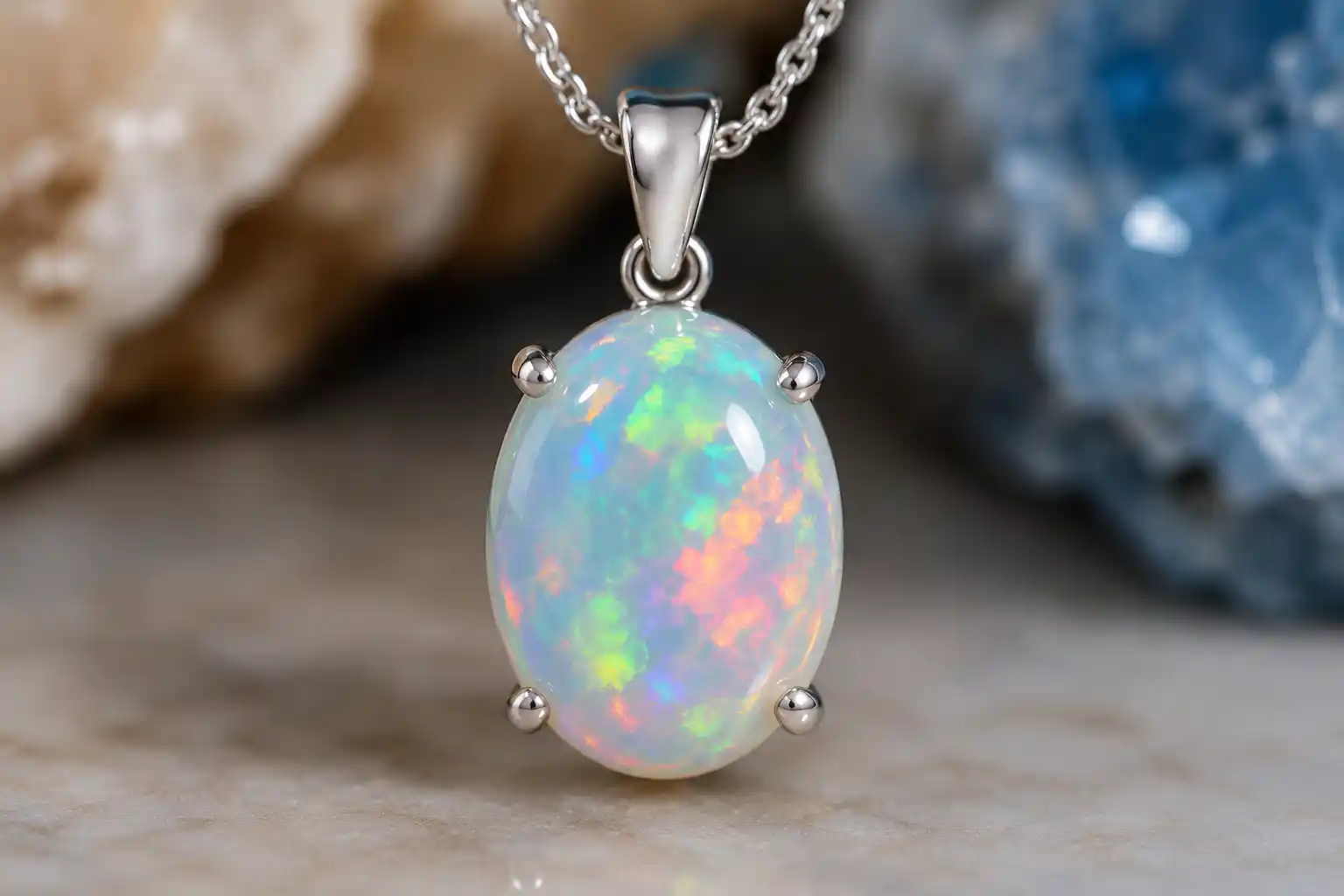
Opal Necklaces and Pendants: A Style Guide
Opal necklaces place the gem’s shifting play-of-color in one of its safest and most expressive jewelry positions. A pendant can hold a broad cabochon, an irregular Boulder Opal or a transparent Fire Opal without exposing it to the repeated impacts that rings and bracelets receive.
The format also gives designers room to control the background behind the stone. White, yellow or rose metal can change the contrast around an Opal, while an intentionally dark backing may strengthen the appearance of a translucent stone. Because backing can also conceal a doublet, triplet or thin Opal layer, the construction must be described accurately.
A successful necklace balances the stone, setting, bail and chain. The pendant should hang face-forward, reveal its best color under normal movement and remain supported by metal strong enough for its weight.
The broader Opal gemstone guide owns Opal’s structure, formation, varieties, history and symbolism. This page focuses specifically on necklace styles, pendant construction, chains, buying and care.
Opal Necklaces at a Glance
| Feature | What to evaluate |
|---|---|
| Gem material | Hydrated silica |
| Defining optical effect | Play-of-color in precious Opal |
| Mohs hardness | Approximately 5–6.5 |
| Toughness | Very poor to fair |
| Most protective pendant setting | Low full or substantial partial bezel |
| Main visual factor | Bright play-of-color visible in the hanging position |
| Main construction disclosure | Solid Opal, doublet, triplet, synthetic or imitation |
| Main source-related concern | Hydrophane liquid absorption |
| Main pendant concern | Flipping, swinging and exposed edges |
| Main bail concern | Opening size, connection strength and balance |
| Main chain concern | Gauge, clasp and compatibility with the pendant |
| Safest cleaning | Brief hand cleaning with lukewarm soapy water |
Why Necklaces Suit Opal
Necklaces generally protect Opal better than hand-level jewelry.
An Opal bracelet repeatedly contacts desks and surrounding objects, while an Opal ring faces impact, abrasion and pressure throughout the day. Opal earrings provide similarly protected wear but usually use smaller stones.
A pendant can accommodate greater size and more irregular outlines. It can also be oriented carefully so a directional play-of-color pattern remains visible from the front.
The main risk comes from movement. A long or poorly balanced pendant may swing into furniture, seat belts, bags or buttons. Necklace length and stone size should therefore be considered together.
Main Opal Necklace Styles
| Necklace style | Main advantage | Main concern |
|---|---|---|
| Solitaire cabochon | Gives one Opal complete focus | Balance and directional color |
| Full-bezel pendant | Strong edge protection | More visible metal |
| Partial-bezel pendant | Balances visibility and support | Exposed sides |
| Prong-set pendant | Shows the complete stone outline | Girdle vulnerability |
| Halo pendant | Adds contrast and apparent size | Hard accents and many prongs |
| Boulder Opal pendant | Preserves natural matrix and freeform shape | Irregular thickness |
| Opal doublet pendant | Strong color at a lower price | Adhesive and backing |
| Opal triplet pendant | Protected surface and vivid display | Layered construction |
| Station necklace | Light, contemporary appearance | Stations turning backward |
| Graduated necklace | Builds color and size toward the center | Matching and total weight |
| Opal bead necklace | Continuous color and movement | Drill holes and liquid exposure |
| Lariat necklace | Adjustable vertical design | Swinging and slider security |
Solitaire Opal Pendants
A solitaire places one Opal at the center of the necklace.
Oval and round cabochons are the most adaptable because their smooth outlines distribute impact more evenly than pointed shapes. Pears, shields, triangles and freeforms can create stronger visual character but need greater protection around tips and thin edges.
The stone should display attractive color while hanging vertically. A video of the Opal lying flat may exaggerate a flash that disappears when the pendant is upright.
The complete loose-stone evaluation belongs to the Opal Buying Guide. For a necklace, the same quality factors must be judged in the final setting rather than in isolation.
A solitaire should remain face-forward. If the pendant turns toward the chest, the bail position, chain thickness or center of gravity may be unsuitable.
Full-Bezel Opal Pendants
A full bezel surrounds the stone with metal.
This construction protects the perimeter and reduces snagging. It is particularly useful for valuable Black Opal, thin Crystal Opal and freeform material with uneven edges.
The bezel should meet the Opal evenly without gaps, folded metal or visible adhesive. Excessive pressure can damage a fractured or thin stone during setting.
An open or partly open reverse allows inspection and careful cleaning. A fully closed cup may support the stone, but it can also hide backing, glue or a very thin Opal layer.
Closed construction is not automatically a problem. The seller should simply explain what lies beneath the visible face.
Partial Bezels
A partial bezel holds selected areas of the perimeter while leaving other sides visible.
The style reduces the amount of metal around the Opal and can suit elongated ovals, rectangles or asymmetrical stones.
Exposed sections remain vulnerable. A partial bezel should protect the thinnest or most pointed areas rather than leaving them open for visual symmetry alone.
The pendant needs enough support beneath the Opal to prevent flexing.
A side view often reveals whether the setting is genuinely protective or merely looks substantial from the front.
Prong-Set Opal Pendants
Prongs reveal more of the Opal’s outline but concentrate pressure at a few points.
The stone should rest in a supporting basket rather than hang only between the prong tips. Each prong must avoid surface-reaching cracks and pits.
Rounded cabochons are safer than thin pointed stones in open prongs.
A prong that catches clothing may already be lifted or damaged. Continued wear can loosen the Opal before movement becomes obvious.
Prong-set pendants suit sound stones and careful wearers who are willing to inspect the setting periodically.
Halo Opal Pendants
A halo surrounds Opal with Diamond, laboratory-grown Diamond, Moissanite, Sapphire, Zircon or Cubic Zirconia.
The border increases apparent size and creates strong contrast. White accents can make red, orange and green play-of-color appear brighter, while the surrounding metal influences the overall temperature of the design.
Every accent material should be identified.
Hard accent stones must remain separated from the Opal by metal. Diamond, Sapphire and Moissanite can scratch the softer silica material if their girdles touch.
A halo also introduces numerous small prongs, increasing maintenance compared with a simple bezel.
Choosing Play-of-Color
Play-of-color is the main visual factor in precious Opal.
Brightness should remain visible under ordinary movement rather than only under one concentrated lamp. A smaller stone with lively color may appear more impressive than a larger cabochon containing broad inactive areas.
Red and orange receive strong demand, although vivid green and blue can also create an exceptional pendant. Pattern and coverage matter alongside hue.
The Types of Opal guide explains the major body types and varieties. The necklace should be judged for the actual display it provides, not merely the variety name on the label.
Directional stones can work effectively in pendants when the setting holds the best viewing orientation toward the observer.
Body Tone and Transparency
Opal has a background or body tone in addition to play-of-color.
White and cream backgrounds produce a softer appearance. Dark body tones increase contrast, while transparent Crystal Opal allows color to appear within a clearer host.
The setting can influence the visible background. A dark closed cup may strengthen a translucent stone, while a white metal opening can create a cooler impression.
The listing should distinguish natural body tone from backing, smoke treatment or dye.
Transparency can also reveal glue lines, foil or assembled layers more readily than opaque material.
Black Opal Pendants
Black Opal has a naturally dark body tone that can make play-of-color appear especially vivid.
Fine natural stones can justify substantial prices and strong documentation. The Black Opal Buying Guide owns the detailed assessment of body tone, brightness, source and treatment.
A dark appearance can also result from smoke treatment, dye, backing or doublet construction. Side and reverse examination are therefore essential.
A Black Opal pendant should use a secure bail and setting proportionate to its value. The chain should not become the weakest part of the necklace.
Boulder Opal Pendants
Boulder Opal retains natural host rock, commonly ironstone, behind or around the precious Opal.
The matrix creates freeform patterns and can provide natural backing. It also makes each outline and thickness different.
The Boulder Opal Buying Guide explains how seam thickness, matrix, color and cutting affect quality.
A custom bezel usually works better than generic prongs because it can follow the irregular perimeter.
Natural attached matrix should be distinguished from a separately glued backing. The side profile provides the clearest evidence.
Ethiopian Opal Pendants
Ethiopian Opal is known for vivid play-of-color and often hydrophane behavior.
Hydrophane Opal can absorb water, oil, perfume and other liquids through connected pores. Absorption may change transparency, weight and the visible color pattern.
The Ethiopian Opal Buying Guide owns the source-specific quality and care questions.
A pendant protects the stone from hand washing, but perfume, body oil and cosmetics still matter. Apply personal-care products before putting on the necklace.
The Opal should not rest continuously against freshly applied lotion or perfume.
Fire Opal Pendants
Fire Opal is defined mainly by yellow, orange or red bodycolor and may or may not show play-of-color.
Transparent material can be faceted, while translucent examples are commonly cabochon cut.
Warm bodycolor works naturally with yellow or rose gold. White metal creates stronger contrast.
Faceted pears and pointed cuts require protective prongs or bezels at the tips.
Fire Opal can be sensitive to heat and thermal shock, so repair work should keep the stone away from a jeweler’s torch.
White Opal Pendants
White Opal has a pale body tone ranging from translucent white to opaque cream.
A pendant provides enough surface area for pinfire, broad flash or mixed patterns to become visible.
Brightness should take priority over a perfectly white background. A cream stone with lively red and green color may be more attractive than a stark-white Opal with weak flashes.
White Opal is widely available in solid, doublet, triplet, synthetic and imitation forms. Construction should be confirmed rather than inferred from appearance.
Solid Opal, Doublets and Triplets
A solid Opal consists of Opal through its visible depth.
A doublet normally combines a thin precious-Opal layer with a dark backing. A triplet adds a transparent cap above the Opal layer.
The Real vs Fake Opal guide owns the full diagnostic workflow.
Doublets and triplets can create vivid, affordable pendants. Their assembled construction should be stated clearly because glue affects cleaning and repair.
Side examination may reveal straight bonding planes, changes in luster and layers with different colors or thicknesses.
A large face-up display does not indicate a large amount of natural Opal when the visible layer is thin.
Treatments and Synthetic Opal
Opal can be smoked, dyed, coated, filled, impregnated or assembled.
The Treated and Synthetic Opal guide owns those processes and their disclosure boundaries.
Synthetic Opal can contain an ordered silica structure capable of producing play-of-color, but it forms through manufacturing. Glass, resin and foil products can imitate the visual effect through different structures.
Treatment does not automatically make a pendant unsuitable. It must be reflected in the price, description and care instructions.
A phrase such as created Opal should be clarified because it may refer to synthetic Opal, imitation material or an assembled product.
Opal Bead Necklaces
Opal beads may be round, oval, barrel-shaped, faceted or irregular.
A strand creates continuous movement, but every drill hole becomes a potential stress point. Chips or radiating cracks around an opening can damage the cord and weaken the bead.
Knots between valuable beads reduce direct contact and limit loss if the strand breaks.
Hydrophane Opal beads are particularly vulnerable to skin oil, perfume and absorbed liquids. They should not be worn during exercise or in humid, cosmetic-heavy conditions.
Heavy bead necklaces should be stored flat rather than hanging permanently from the clasp.
Station and Graduated Necklaces
A station necklace spaces several Opals along a chain.
Two-point connections help each setting remain face-up. A one-point attachment allows more movement but may display the reverse frequently.
A graduated necklace increases stone size toward the center. Color, body tone and pattern should progress smoothly rather than changing abruptly.
The chain must support the combined weight of all settings. Extremely fine chains can stretch or break even when the Opals remain intact.
Each station needs enough separation to prevent stone-to-stone collision.
Choosing the Bail
The bail controls how the pendant hangs and carries its complete weight.
Its internal opening must accommodate both the chain and the chain’s end fitting. A chain may fit through the bail while the clasp or end cap does not.
An articulated bail allows the pendant to settle naturally. A fixed bail can keep a geometric or directional stone aligned.
The connection between the bail and setting must contain enough metal to resist bending.
Large Boulder Opal and halo pendants should not hang from a thin decorative loop merely because the design looks delicate.
Choosing the Chain
Chain strength should match the pendant’s weight.
Cable, box, wheat, curb and rope chains can all work when appropriately sized. A very fine chain may suit a small white Opal solitaire but becomes a security risk with a large Black Opal or Boulder Opal.
The clasp and adjacent jump rings should be proportionate to the chain.
Yellow gold emphasizes warm color, while white metal creates cooler contrast. Rose gold can complement Fire Opal and pink common Opal.
Metal composition also affects skin sensitivity independently from the gemstone.
Necklace Length and Balance
Princess length suits many Opal pendants because it places the stone on the upper chest and limits excessive swinging.
Long matinee and opera lengths create more movement and increase the chance of contact with furniture.
A heavy pendant may feel more comfortable on a shorter or slightly wider chain.
The clasp should remain near the back of the neck rather than being pulled forward by an unbalanced setting.
Actual measurements are more useful than general necklace-length names because body proportions and pendant scale alter placement.
Price and Value
Current valuation belongs to the Opal Price Guide.
Necklace price depends on the Opal’s brightness, pattern, body tone, transparency, stability, treatment and construction, together with metal weight, chain quality and craftsmanship.
Solid Black Opal and exceptional Boulder Opal can command far more than commercial white Opal, doublets or synthetic material.
A large pendant is not automatically valuable. Broad inactive areas, instability or weak setting construction can outweigh size.
An expensive Opal should not be purchased through guaranteed investment claims.
Buying an Opal Necklace Online
Follow How to Buy Gemstones Online Without Getting Scammed.
Request continuous video of the exact pendant hanging under neutral light. Images of the stone lying flat cannot confirm balance or normal color display.
The listing should state the Opal type, source claim, treatment, solid or assembled construction, dimensions, total weight, metal alloy, chain length, bail opening and return terms.
A good return period is essential because play-of-color and transparency can look different away from the seller’s lighting.
Opal is also recognized in the October Birthstone guide, making necklaces a practical gift when ring size is unknown.
Cleaning and Storage
Follow How to Clean Opal Jewelry Safely.
Use lukewarm water, mild soap and a soft cloth. Keep cleaning brief and avoid prolonged soaking.
Never use steam or ultrasonic equipment.
Hydrophane, doublet, triplet, filled, coated and glued pendants require especially conservative handling.
Store the necklace flat or in a broad curve. Keep the chain, clasp and harder accent stones from rubbing against the Opal.
Stop wearing the piece if the stone moves, the bail opens, a crack appears or the chain begins stretching.
Frequently Asked Questions
1. Is a necklace a safe way to wear Opal?
Yes. Necklaces generally expose Opal to less impact than rings and bracelets, although swinging and hard contact remain possible.
2. What is the safest Opal pendant setting?
A low full bezel normally provides the strongest perimeter protection.
3. Why does my Opal pendant flip backward?
The bail position, chain thickness or pendant’s center of gravity may be unbalanced.
4. Is a closed-back Opal pendant suspicious?
Not automatically. It may provide support, but it can also conceal backing, glue or assembled construction that should be disclosed.
5. Are Opal doublet pendants genuine?
They contain a genuine Opal layer attached to a backing and are legitimate when the construction is identified.
6. Are triplet pendants more durable?
The cap protects the surface, but adhesive and layered construction remain sensitive to heat and soaking.
7. Can Ethiopian Opal touch the skin?
Yes, but hydrophane material should be protected from perfume, lotion, oil and perspiration.
8. Which chain is best for a large Opal pendant?
Choose a chain whose gauge, clasp and jump rings are proportionate to the pendant’s total weight.
9. Is Black Opal suitable for necklaces?
Yes. A necklace is one of the safer ways to wear valuable Black Opal when the bail and setting are secure.
10. Does an Opal necklace need certification?
Documentation may be useful for high-value Black Opal, significant treatment claims or disputed natural origin.
11. Can an Opal necklace be cleaned ultrasonically?
No. Vibration can damage the Opal, glue, filling and assembled layers.
12. How should the necklace be stored?
Lay it flat or in a broad curve in a padded compartment, keeping metal and harder gemstones away from the Opal.
An Opal necklace works best when the pendant is treated as a complete mechanical system. The color must face forward, the setting must protect the stone, and the chain must carry its weight without strain. A spectacular Opal on an inadequate bail is not a successful piece of jewelry.